Key Takeaways:
- In 2026, mental health apps provide a completely integrated experience featuring AI guidance, assessments, therapy, help with navigating care, and the ability to track progress.
-
Headspace, Spring Health, Lyra Health, Talkspace, and Calm are launching new features such as AI support, provider matching, integration with wearables, clinical handoffs, and employer reporting.
-
Now, healthcare teams need more effective safeguards with regard to AI, and the main requirements of the product should be crisis detection, human escalation, tracking of the PHQ-9 and GAD-7 scores, control over consent, and clearly defined limitations as to what the AI is allowed to do.
-
The cost involved in either building or upgrading an enterprise mental health app usually lies between $70,000 and $300,000, and this amount depends on the AI features, the requirement for EHR or FHIR integrations, the use of wearable data, teletherapy, analytics, and compliance needs.
-
Intellivon creates its mental health apps by working on the AI, the integration, the safety features, the analytics, and the various workflow elements associated with the care model, always having human oversight over clinical decisions and any cases that are high risk.
Employers are continually introducing mental health benefits, yet engagement remains almost unchanged. A conventional EAP is included in the benefits package, is referred to once during open enrollment, and is then left alone for the rest of the year. This gap between having the benefit and actually using it is precisely what the 2026 updates to mental health apps are aiming to address, not by adding yet another app to the collection but by getting the ones that employees already have access to actually put into use.
Nevertheless, the majority of the platform updates this year are not aimed at attracting new users but are instead directed at those who have already downloaded the app and then stopped using it. Although traditional EAPs still have engagement rates of only 3 to 5%, platforms that combine AI personalization, wearable data, and crisis escalation within a single system achieve engagement levels above 40%, a difference large enough to account for the fact that the roadmap decisions in 2026 are so different from those in 2023.
This blog looks at the features and the latest trends that are actually making a difference in 2026, namely AI-powered risk detection, wearable integration, digital therapeutics, the design of workplace mental health services, and the regulatory changes that determine what platforms can claim.
What Changed in Mental Health Apps During 2026?
Mental health apps changed the most in 2026 because five separate capabilities finally connected into one system: AI guidance, human clinical oversight, continuous assessment, wearable data, and enterprise benefits reporting.
Instead of treating AI chat as an isolated feature, the strongest 2026 products routed it directly into escalation, provider matching, and outcome measurement.
As a result, the year became less about adding features and more about wiring existing ones together.
1. January 2026 — Regulatory boundaries got sharper
The FDA released two updated final guidance documents on January 6, 2026: one covering general wellness products and one covering clinical decision support software.
Together, they clarified which AI-driven wellness features stay outside FDA device classification and which cross into regulated territory.
Because these guidances now separate wellness scoring from clinical decision-making, product teams have a clearer line to design against.
2. February 2026 — Mental health data rules tightened
Compliance with the updated 42 CFR Part 2 rule became mandatory on February 16, 2026, affecting how substance-use-disorder data gets consented, stored, and shared.
That same month, Spring Health published early results from VERA-MH, an open benchmark for testing how AI responds to high-risk mental health conversations.
Consequently, safety testing shifted from a feature to a documented standard.
3. April 2026 — AI moved from chat feature to care layer
Spring Health launched Guide, an AI experience built to hold clinical context across sessions instead of resetting with every new provider.
According to Spring Health, members who needed care most saw up to 25% greater symptom improvement when supported by Guide. Every AI capability inside it is scored against the VERA-MH safety framework before deployment.
4. May 2026 — AI and wearables both hit general availability
Lyra made its AI guide broadly available across members, providers, and employers on May 5, 2026, adding natural-language triage and 24/7 continuity support between coaching sessions.
Around the same week, Headspace rebuilt its Apple Watch app to use Apple Health data to detect moments when a member is receptive to a mindfulness break. Both moves signal that passive signal detection is no longer experimental.
5. July 2026 — Enterprise measurement became the differentiator
Lyra relaunched Connect, its employer-facing platform, with redesigned utilization insights, peer benchmarking, and a content library built for HR and benefits leaders.
Meanwhile, Youper announced it would shut down entirely on September 30, 2026, after running out of runway despite a 3-million-plus user base.
That contrast- one company scaling enterprise reporting and one closing outright- defines where 2026 drew the line between infrastructure and a standalone feature.
2026 marks a shift from feature accumulation toward connected care infrastructure, where AI, wearables, compliance, and enterprise reporting now depend on each other instead of shipping separately.
Therefore, a platform judged on chat quality alone is already behind. But whether that infrastructure shift reflects a market still expanding, or one starting to consolidate around fewer, better-capitalized players, is the harder question enterprise buyers need answered before committing budget.
The 2026 Market Is Growing but Generic Apps Face Pressure
The mental health app market keeps growing in 2026, but that growth is concentrating around products offering more than meditation, journaling, or basic chatbot functionality.
Consequently, capital and users are moving toward platforms that connect AI to clinical outcomes and enterprise reporting. A rising market no longer protects a generic feature set.
According to Fortune Business Insights, the numbers behind that shift look like this:
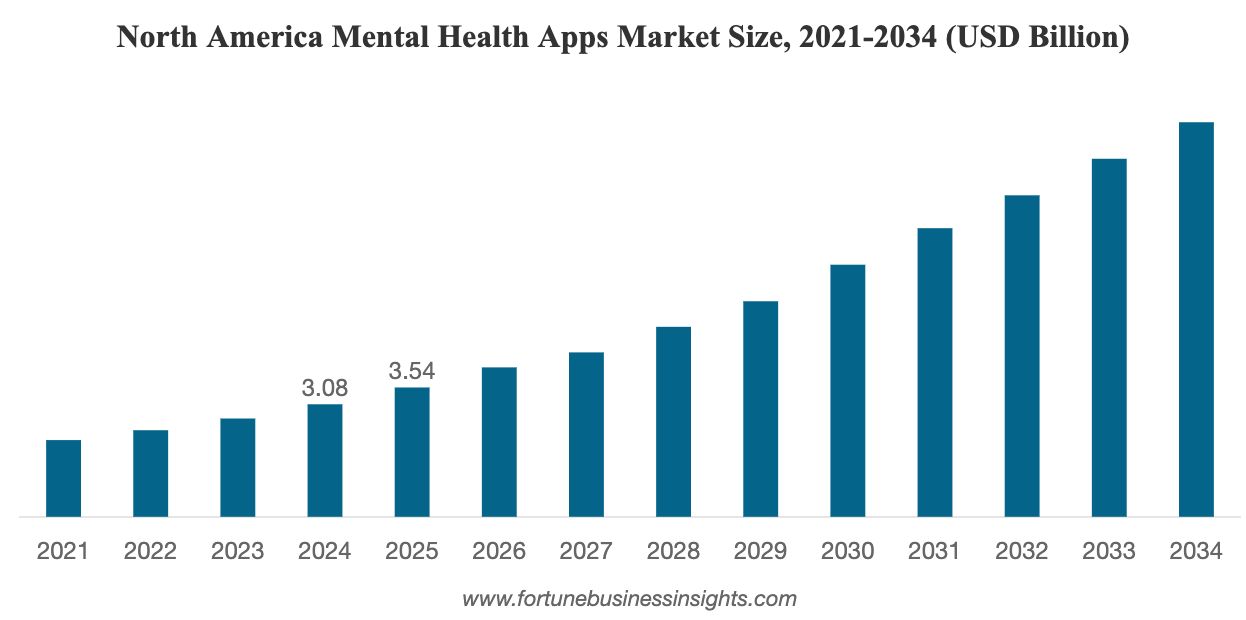
- Global market valued at $8.64 billion in 2026, projected to reach $35.29 billion by 2034
- Growing at a 19.23% CAGR across that forecast window
- North America held 47.26% of the market in 2025, the largest single region
That pace of growth explains why enterprise buyers keep getting pitched new AI mental health vendors every quarter.
Because most of that expansion is flowing toward hybrid, employer-integrated, and clinically validated platforms, a standalone chatbot competing on conversation quality alone is fighting for a shrinking share of a growing pie.
Why Growth Does Not Guarantee Product-Market Fit
Category growth and individual product survival are two different things, and 2026 made that gap visible between apps that stayed single-feature and apps that built into a broader care pathway:
- Woebot retired its consumer app in June 2025 and moved entirely to enterprise and payer contracts
- Youper is shutting down completely on September 30, 2026, after roughly 3 million users
- Spring Health, Lyra, and Headspace, by contrast, expanded into broader care ecosystems instead of staying single-feature tools
Woebot’s own pivot confirms the pattern: the AI technology was not the problem. Instead, the standalone consumer business model was.
For a B2B buyer, the lesson is not “build another chatbot because the category is growing.” It is “build a capability that owns a clinically or economically valuable part of the care pathway,” whether that is risk triage, provider matching, or outcome reporting an employer can act on.
For a deeper breakdown of the broader market direction, see our guide on [Mental Health App Trends to Watch in 2026](LINK: internal Intellivon post on mental health app trends).
Which Mental Health Apps Made the Biggest 2026 Updates?
Five platforms defined the 2026 mental health app category, and each one connected AI to a specific part of the care pathway instead of shipping it as a standalone feature.
In fact, Headspace, Spring Health, Lyra, Talkspace, and Calm all made a different architectural bet, and comparing them side by side shows exactly where the category is heading.
2026 Product Benchmark: AI Role vs. Human Care by Platform
| Platform | Important 2026 Change | AI Role | Human Care | What We Can Learn |
| Headspace | Ebb voice mode, memory, and Apple Watch expansion | Conversational AI + real-time risk classifier | Coaching and insurance-covered therapy inside the same app | AI as a connective layer, not the product itself |
| Spring Health | Guide launched as a continuity layer across sessions | Multi-agent AI scored against the VERA-MH safety framework | Care Navigators and licensed clinicians remain in the loop | Independent outcome data beats vendor-reported claims |
| Lyra | AI guide reached general availability, Connect relaunched | Risk-flagging AI, natural-language triage, employer analytics | Coaches, therapists, and psychiatrists, matched by AI | AI must work across three separate interfaces at once |
| Talkspace | Tee AI guide launched, Smart Notes rolled out | Standalone AI companion plus clinician-facing documentation tools | Licensed therapists remain the only treatment layer | AI augments the therapist workflow, but does not replace it. |
| Calm | Split into Calm, Calm Health, and Calm Sleep | Emotions Check-In personalization engine | Calm Health carries clinical programs distributed through employers and health plans | One app is not always the right architecture |
1. Headspace Is Connecting AI, Therapy and Wearable Access
Headspace’s 2026 update is not really about the chatbot. Instead, it is about how one AI layer, Ebb, now connects content, wearable data, coaching, and licensed therapy inside a single member journey.
Because Ebb supports both voice and text, and retains memory across sessions, a member does not have to re-explain context every time they open the app. As a result, the AI functions more like a thread running through the entire product than a bolted-on feature.
Meanwhile, safety runs underneath all of it. Headspace states that Ebb monitors 100% of messages through a proprietary Safety Risk Identification system, using a small fine-tuned language model alongside foundation models to classify seven categories of risk in real time.
When Ebb detects one of these risks, it accordingly directs the member to crisis resources and ends the conversation.
That safety architecture, in turn, sits inside a broader ecosystem expansion:
- Personalized content recommendations — since Ebb reads the member’s current emotional state, it routes them from reflection into a specific meditation, sleepcast, or exercise
- Apple Watch expansion — a rebuilt watch app uses Apple Health data to surface mindfulness moments when a member is more receptive to a break
- Insurance-covered therapy — rather than sitting as a separate product, licensed care lives inside the same ecosystem as the AI companion
What We Can Learn From Headspace: ultimately, the differentiator is not conversational quality. Instead, it is whether an AI guide can route a member across content, self-reflection, wearable signals, coaching, and therapy without the member noticing the handoffs.
That routing layer is exactly what most competing platforms still bolt on, rather than design for from the start.
2. Spring Health Guide Turns AI Into a Care Continuity Layer
Spring Health built Guide to solve a specific problem: mental healthcare traditionally resets every time a member changes providers, jobs, or insurance. Because Guide holds context across that entire arc, care therefore does not start over each time something changes.
Since Guide operates entirely within Spring Health’s unified clinical platform, every AI interaction stays coordinated with a provider and subject to clinical oversight. Consequently, the AI never acts as an unsupervised layer sitting outside clinical review.
Spring Health reported that members with higher needs saw up to 25% greater symptom improvement in its own launch data. However, that figure should be treated as company-reported rather than independent proof.
A stronger, independent data point instead comes from peer-reviewed research on Spring Health’s provider-matching system:
- 24,303 participants were studied in a retrospective cohort published in npj Mental Health Research
- Patients matched to a therapist by historical performance data therefore improved 8.5% faster on depression symptoms than patients who self-selected a provider
- Because matching also reduced wasted sessions, matched patients cost 11 to 13% less per improved member
- Guide then layers longitudinal context, between-session support, and provider escalation on top of that matching foundation
What We Can Learn From Spring Health: the credible data point here is not the vendor’s own outcomes claim. Instead, it is the peer-reviewed matching study, since it isolates one variable and measures it against a control group, which is exactly the standard a CMO should apply to any AI health claim.
3. Lyra Is Expanding AI Across Members, Providers and Employers
Lyra’s 2026 update matters because it pushed AI into three separate interfaces at once, rather than improving just one. As a result, that triple deployment- member, provider, and employer- is a harder architecture problem than a single chat feature.
On the member side, Lyra’s AI guide reached general availability in May 2026, adding natural-language search, enhanced triage, and voice mode.
Because the AI also includes a risk-flagging system, a conversation that needs immediate human attention gets handed off to a live member of Lyra’s care team rather than resolved inside the chat.
Meanwhile, on the provider and employer side, the rollout went even further:
- AI-enabled intake — since members describe symptoms in their own words, they get matched to the right provider type faster
- Streamlined documentation — AI generates session and episode summaries so providers spend less time on paperwork
- Lyra Connect — relaunched in July 2026 with smarter utilization insights, peer benchmarking, and a content library built for HR and benefits leaders
- Proactive recommendations — AI flags workforce mental health trends for HR before they escalate into larger claims
What We Can Learn From Lyra: this is where the multi-portal architecture point becomes concrete. Because a single AI model has to serve a member, a clinician, and a benefits administrator at once, it therefore needs three different permission structures and three different escalation paths, not one chatbot wearing three skins.
4. Talkspace Is Using AI Around the Therapist Workflow
Talkspace’s 2026 positioning is explicit: AI augments the therapist, but it does not replace one. As a result, every AI feature the company shipped in 2026 sits either in front of the therapist as a documentation aid, or beside the member as a bounded, non-clinical companion.
Tee, Talkspace’s AI mental health guide, launched in June 2026 with built-in guardrails. Specifically, users under 18 are excluded, and anyone reporting a history of self-harm or suicidal ideation during intake is routed away from the tool entirely.
On the clinician side, meanwhile, the AI stack looks different by design:
- Smart Notes — since AI only drafts session notes and summaries, therapists still review and finalize everything before it ships
- Automated self-harm alerts — real-time message scanning flags risk language and accordingly sends an urgent alert to the assigned therapist
- Talkcast — AI-generated personalized audio recaps members can use for support between sessions
- Provider-side accuracy tracking — Talkspace’s original risk-detection model has flagged roughly 32,000 members since 2019, with 83% of providers reporting the alerts are clinically useful
What We Can Learn From Talkspace: This is the clearest 2026 example of AI therapist augmentation instead of therapist replacement. Ultimately, the AI’s job is to shorten the distance between a risk signal and a licensed human response, not to generate the therapeutic response itself.
5. Calm Is Splitting Wellness Into More Specialized Experiences
Calm made a structural bet in 2026 that most competitors have not: one app cannot serve every use case well. Accordingly, by January 2026, Calm operated three distinct products instead of one general wellness app.
- Calm — the original meditation and mindfulness product for general users
- Calm Health — an invitation-only product distributed through employers, health plans, and care teams, built around clinician-designed programs
- Calm Sleep — a standalone sleep-specific app with its own content library and Apple HealthKit integration for acting on sleep data
Inside Calm Health specifically, Emotions Check-In uses a framework built on Dr. Paul Ekman’s research tying emotions to physical expression.
Because members select from 7 to 11 sub-emotion options per primary emotion, the app can therefore route personalized content instead of offering a generic recommendation.
Mood tracking and sleep readiness scoring both feed from that same check-in data, and since Apple Health integration reads signals passively, the product can act without asking the member for anything extra.
What We Can Learn From Calm: a single “mental health app” is not always the correct product architecture. Therefore, for an enterprise buyer with distinct populations, a common platform supporting several targeted experiences may outperform one app trying to serve everyone.
Across all five platforms, the pattern holds steady: AI wins trust only when it sits inside a clinical record, a therapist’s workflow, or a wearable’s data stream, never when it stands alone as the entire product.
Consequently, the platforms gaining ground in 2026 are the ones that treat AI as connective tissue, not as a headline feature.
Mental Health App Features That Are Unavoidable in 2026
By 2026, certain mental health app features have stopped being differentiators and have become table stakes, while a smaller set of capabilities now decides whether a platform actually wins an enterprise contract.
Therefore, the real question for a CDO or VP of Digital Health is no longer “which features should we build,” but “which features are commodity and which ones justify a custom build.”
2026 Feature Landscape: What’s Baseline vs. What’s a Differentiator
| Feature | 2026 Status | Build or Buy? | Enterprise Value |
| Mood tracking | Baseline | Buy or build simple | Low differentiation |
| Journaling | Baseline | Commodity | Engagement |
| PHQ-9 / GAD-7 assessment | Baseline clinical | Build the workflow | Measurement |
| Video therapy | Baseline hybrid care | Buy infrastructure | Care delivery |
| Provider matching | Differentiator | Build or customize | Outcomes |
| AI guide | Emerging baseline | Custom governance | Engagement and navigation |
| Crisis detection | Mandatory for high-risk AI | Custom | Safety |
| Wearable signals | Differentiator | Integrate | Longitudinal context |
| FHIR / EHR integration | Enterprise differentiator | Custom | Clinical adoption |
| Employer analytics | B2B differentiator | Custom | Contract renewal |
| Clinical outcome reporting | B2B differentiator | Custom | ROI |
Features No Longer Sufficient by Themselves
6 features used to define a mental health app. Now, they only get a product into the conversation, since every competitor already has them.
- Mood tracking — a mood tracking feature is expected by default, not evaluated as a differentiator
- Journals — a mental health journal feature design pattern is fully commoditized across the category
- Mindfulness content — meditation libraries are now a baseline expectation, not a reason to choose one app over another
- Basic chat — an unsupervised conversational layer with no clinical governance behind it reads as dated rather than innovative
- Gamification — a mental health gamification feature can support adherence, but it cannot carry a platform’s value proposition alone
- Reminders — push-based nudges are utility, not strategy
Because these 6 features ship in nearly every consumer and enterprise app already, they compress margins instead of expanding them. Consequently, a buyer paying for custom development to rebuild any of these from scratch is very likely overpaying.
Features Still Capable of Creating Defensibility
By contrast, 9 capabilities still separate a serious platform from a commodity one, and each requires real engineering rather than a template.
- Longitudinal personalization — an AI mental health personalization layer that holds context across months, not just within a single session
- Provider matching — algorithmic matching based on historical outcomes, not a static directory search
- Closed-loop referrals — a referral that confirms the member actually reached care, instead of ending the moment a recommendation is made
- High-acuity escalation — AI crisis detection mental health design that hands a conversation to a licensed human the moment risk language appears
- Condition-specific pathways — adaptive mental health content design built around a specific population, such as maternal mental health or adolescent mental health, rather than one generic flow for everyone
- Clinician copilots — AI therapist augmentation features that draft notes and summaries without ever generating the therapeutic response itself
- Outcome measurement — PHQ-9 and GAD-7 digital assessment data tied directly to a reportable outcome, not just a self-reported check-in
- Population health analytics — mental health population health features that surface trends across a workforce or member base before costs escalate
- Enterprise integrations — mental health FHIR integration and mental health Epic integration work that lets clinical data move instead of sitting in a silo
Because each of these nine capabilities depends on custom logic, clinical validation, or a compliance-aware data architecture, they cannot be copied from an off-the-shelf template. As a result, they are exactly where a build partner’s engineering work pays for itself.
The line for 2026 is simple: baseline features get an app noticed, but differentiator features get an app renewed.
That distinction is exactly why wearable and passive sensing data, one of the differentiators above, deserves its own closer look next.
AI Mental Health Features Now Need a Clinical Safety Stack
A safe AI mental health feature is not one model doing everything. Instead, it is five separate layers working together: conversation, risk detection, memory control, testing, and human escalation.
Each layer needs its own architecture, so treating “safe AI” as one prompt is where most builds fail.
1. Use the LLM for Conversation
The LLM’s job is dialogue, not diagnosis. Consequently, it should run on a general foundation model constrained by RAG pulling from reviewed clinical content, not open training data.
- Prompt policies and output constraints define scope boundaries before generation happens
- CBT, DBT, ACT, and motivational interviewing frameworks guide tone, not clinical judgment
- The model never issues a diagnosis or treatment plan; it reflects and redirects
2. Add a Separate Risk Detection Layer
Because conversation and safety are different jobs, they need different systems. A dedicated classifier scans for suicide and self-harm language independently of the chat model.
- Crisis classification runs against confidence thresholds, not a single keyword match
- Deterministic escalation triggers automatically once a threshold is crossed
- Localized emergency resources and 988 integration fire for U.S. workflows specifically
- A human reviews flagged conversations after escalation, not instead of it
Headspace’s Ebb is a useful live example: its Safety Risk Identification system runs separately from the conversational layer, classifying every message before Ebb ever responds.
3. Control What the AI Is Allowed to Remember
Memory needs boundaries as much as conversation does. Longitudinal memory should require explicit consent, with sensitive-data categories flagged differently from general chat history.
- Session retention and deletion policies must be member-controlled, not permanent by default
- Model training exclusions keep clinical conversations out of future training runs
- Therapist visibility into AI conversations should be opt-in, mirroring Headspace’s user-controlled sharing model
4. Test Mental Health AI Before Release
Testing has to happen before launch, not after an incident. That means hallucination tests, self-harm scenarios, dependency testing, bias and algorithmic fairness checks, boundary adherence, refusal behavior, and escalation success rate, run as a full suite.
VERA-MH is the named 2026 benchmark for this: Spring Health scored its own system 82 out of 100 against the framework, an example other product teams can now measure against directly.
5. Keep Human Care in the Escalation Path
Intellivon separates conversational generation, safety classification, escalation logic, audit logging, and clinician review, instead of asking one LLM to perform all five jobs.
That separation is what makes the stack auditable when a regulator or health system asks how a specific decision was made.
A safe AI mental health product is therefore never one model wearing five hats. Instead, it is five accountable systems: conversation, risk detection, memory governance, pre-release testing, and human escalation, each auditable on its own.
That separation is exactly what a health system’s compliance team will ask to see first, which is what the next section on crisis intervention architecture builds on directly.
Wearables Are Becoming Inputs to Mental Health Workflows
Wearable integration in mental health products is moving well past step counts and daily activity summaries. Instead, the more useful architecture combines sleep, activity, heart-rate patterns, self-reported mood, clinical assessments, and care events into one longitudinal picture.
As a result, a wearable stops being a novelty add-on and becomes another data source feeding the same care record.
1. Apple Watch and Apple Health Integrations
Two 2026 launches show what this looks like in production. Because Headspace rebuilt its Apple Watch app to read Apple Health data directly, it can surface a mindfulness nudge at the exact moment a member is likely to be receptive, rather than on a fixed schedule.
Similarly, Calm Sleep syncs with Apple HealthKit so members can act on their own sleep data instead of just reading about sleep hygiene in the abstract. In both cases, the wearable data drives a specific in-app action, not just a dashboard nobody checks.
2. HRV, Sleep and Biometric Mental Health Monitoring
Underneath both examples sits a familiar signal set. Consequently, most credible platforms are converging on the same four inputs:
- Heart rate variability, since it correlates with stress and recovery patterns
- Sleep duration and consistency, tracked over weeks rather than a single night
- Activity levels, as a proxy for behavioral withdrawal or engagement
- Resting heart-rate trends, paired with optional mood check-ins for context
Because none of these signals means much in isolation, they only become useful once paired with a self-reported data point.
3. Passive Sensing and Digital Phenotyping
Phone and wearable usage patterns, typing speed, screen time, and movement can also become additional signals.
However, a pattern is not a diagnosis, and treating it as one creates both a clinical and liability problem. Instead, passive sensing works best as a trigger for a check-in, not as an automated conclusion about a member’s mental state.
4. Voice Biomarkers Need Stricter Validation
Voice tone, pace, and linguistic changes may genuinely help surface risk signals worth a closer look.
That said, none of that should be framed as a depression diagnosis unless a validated medical function specifically supports the claim, since voice-based inference is still an emerging science rather than an established one.
Wearable data therefore earns its place only when it feeds context into an existing care workflow, and not when it becomes a headline feature on its own.
Mental Health Apps Are Moving Into Existing Care Systems
Mental health apps stopped being standalone destinations in 2026. Instead, the biggest 2026 updates connected assessments, care plans, benefits platforms, and referrals into systems clinicians, HR teams, and employers already use daily.
As a result, integration work has become the actual product, not an afterthought bolted on after launch.
Connect Assessments and Care Plans With EHRs
Because clinical adoption depends on data reaching the record, not sitting in a separate app, EHR integration is now foundational rather than optional. Epic and Oracle Health/Cerner remain the two systems most enterprise buyers need to plan around.
- FHIR and HL7 standards move data between the app and the EHR
- Patient, Observation, and Questionnaire/QuestionnaireResponse resources carry assessment data like PHQ-9 and GAD-7 scores
- Appointments, care plans, medications, and referrals sync bidirectionally, so a clinician sees the same picture the app does
Connect Teletherapy, Asynchronous Care and Scheduling
Once assessments flow into the record, scheduling and care delivery need to follow the same logic. Therapist matching, therefore, has to connect directly to real-time availability, not a static calendar link.
- Appointment booking spans video, secure text, and asynchronous follow-ups in one workflow
- Medication management ties back to the same care plan an EHR integration already surfaces
- Because follow-ups trigger automatically after a session, care does not depend on a member remembering to book again
Integrate Employer Benefits Without Exposing Employee PHI
This is where the architecture gets sensitive, since HR platforms need utilization data without ever seeing individual clinical detail. Spring Health’s August 2026 partnership with Alight and Lyra’s designation as Workday Wellness’s Preferred Mental Health Partner both show this pattern in production.
- Eligibility feeds connect HR systems to EAP and benefits access automatically
- Aggregated employer reporting replaces individual-level visibility entirely
- Minimum-cohort thresholds suppress any data set small enough to identify a person
- No manager ever gets access to individual clinical information, only workforce-level trends
Connect SDOH and Community Referrals
Finally, care extends past the clinical record into the conditions shaping a person’s health. Consequently, population health and health equity goals depend on referral systems that actually close the loop.
- SDOH data routes members toward housing, food, or transportation support alongside clinical care
- Multilingual care navigation ensures referrals work across a workforce’s actual language needs
- Referral completion tracking confirms a member reached the resource, not just that one was suggested
Because none of these four layers work in isolation, from EHR data to benefits privacy to community referrals, the real engineering challenge is keeping them synchronized without violating HIPAA, 42 CFR Part 2, or an employer’s PHI boundaries.
2026 Compliance Changes Now Affect Mental Health App Development
Compliance requirements for mental health apps did not just get stricter in 2026. As a result, product teams now have more precise boundaries to design against, instead of guessing where regulators will draw the line.
FDA Clarified the Wellness-to-Medical-Device Boundary
The FDA’s January 2026 General Wellness guidance drew a sharper line than the category had before. Consequently, a feature focused on stress management or healthy lifestyle habits generally stays in general wellness territory.
However, once a feature diagnoses, prevents, treats, or mitigates a specific condition, such as depression or PTSD, it moves into device territory instead. That distinction alone should shape how a product team scopes its next feature.
Clinical Decision Support Guidance Also Changed in 2026
FDA also finalized updated CDS guidance in January 2026, which directly affects any AI feature offering a recommendation to a clinician.
Therefore, therapist copilots, provider recommendations, risk scoring, and AI-generated clinical guidance all need to be evaluated against this framework specifically, not treated as generic software.
Part 2 Compliance Became Mandatory February 16, 2026
Because substance use disorder data carries heightened protection, 42 CFR Part 2 compliance became mandatory on February 16, 2026.
At the same time, SUD records now require explicit consent before disclosure, and unauthorized use can trigger a formal OCR complaint and enforcement action.
- Consent must be documented before SUD data moves anywhere outside direct treatment
- Segmented access controls keep SUD records visible only to roles that need them
- This applies to addiction recovery features specifically, not general mental health data
HIPAA Does Not Cover Every Mental Health App
Coverage depends entirely on who is handling the data. A provider, payer, or business-associate workflow falls under HIPAA, but many consumer-facing mental health apps sit outside it entirely.
Instead, the FTC’s Health Breach Notification Rule fills that gap, and its amended scope now explicitly covers health apps and connected devices capable of drawing data from multiple sources, even when HIPAA never applies.
AI Governance Must Cover Models as Well as Databases
Governance can no longer stop at the database. Since AI models introduce their own risk surface, they need the same rigor as any PHI-handling system:
- Training-data provenance and PHI use both require documentation
- BAAs, access control, and encryption apply to the model layer, not just storage
- Audit logs and prompt/output logs record what the AI actually generated
- Model changes, safety evaluations, and bias monitoring run on an ongoing basis, not once at launch
Together, these five changes mean 2026 compliance work starts earlier in the build process, not after a feature ships. Because FDA, Part 2, HIPAA, FTC, and AI governance now overlap on the same product, the next section turns to what building around all five actually costs.
What Does Mental Health App Development Cost in 2026?
Building or substantially modernizing an enterprise mental health app typically costs $70,000 to $300,000 in 2026.
Because scope, AI complexity, and integration depth all move the number differently, the breakdown below shows exactly where that range comes from.
Mental Health App Development Cost Table
| Development Area | Typical Range |
| Product and clinical discovery | $8K–$20K |
| UX and care workflow design | $10K–$25K |
| Core mobile/web platform | $25K–$65K |
| AI/LLM and safety layer | $15K–$55K |
| EHR/wearable/benefits integrations | $15K–$45K |
| Security and compliance | $15K–$40K |
| Pilot, QA and deployment | $8K–$20K |
These phase ranges overlap rather than stack, so a total engagement should not simply add every maximum together. Instead, the full build stays within the $70K–$300K range depending on scope.
That range breaks down further by product type:
- Wellness-focused MVP — $70K–$100K
- AI mental health application — $100K–$160K
- Hybrid AI + therapy platform — $150K–$220K
- Integrated enterprise behavioral health application — $220K–$300K
Once a platform launches, ongoing maintenance typically runs 15% to 25% of initial development cost annually.
That figure covers cloud infrastructure, API costs, model evaluation, security patching, compliance updates, content maintenance, and integration upkeep, since none of those costs disappear after launch.
Planning a 2026 mental health product update? Intellivon can map your current feature set against AI safety, integration, compliance, and enterprise-readiness requirements before development begins.
When Building Another Mental Health App Is the Wrong Move
A build is not always the right answer, and saying so directly is exactly what makes the rest of this guide credible.
Because founder communities keep raising the same three concerns, they are worth naming upfront: the AI mental health market already feels crowded, proving willingness to pay and retention remains genuinely hard, and safety and regulation get far more complicated once software crosses into clinical territory.
1. Do Not Build if Your Differentiation Is Only an AI Chatbot
Open-ended conversation is no longer a moat. Instead, ChatGPT, Claude, Gemini, and numerous specialized mental health products already cover general conversational support, so a new chatbot competing on dialogue quality alone starts from behind before it even launches.
2. Do Not Build Clinical AI Without Clinical Ownership
Similarly, a general development team paired with a base LLM is not sufficient once software enters clinical territory.
Instead, risk classification, escalation logic, and safety evaluation all need a clinician’s judgment built into the process from the start, not applied as a review step after the fact.
3. Do Not Build Every Commodity Feature
That said, not every layer deserves custom engineering. Consequently, some pieces should always be bought rather than built:
- Video infrastructure
- Payments processing
- SMS and notifications
- Commodity identity and authentication tooling
Build instead where differentiation actually lives: clinical workflows, proprietary care navigation, risk models, analytics, integrations, and specialized user experience.
Because these are the parts a template cannot replicate, they are exactly where engineering investment pays off.
4. Sometimes Upgrading an Existing Product Is Better
Even so, a full rebuild is not always the answer either. Often, an existing platform just needs a modernized AI safety layer, a new integration, or an updated compliance posture, rather than a ground-up replacement.
Launch a 2026-Ready Mental Health App With Intellivon
If your existing mental health product still treats AI, assessments, care delivery, analytics, and integrations as separate modules, the next release is likely to require architectural work rather than another feature patch.
Consequently, that work tends to fall into four specific capability areas.
1. Mental Health AI and Safety Engineering
Because conversation and clinical safety need separate systems, this covers LLMs and RAG for grounded dialogue, clinical guardrails for scope control, dedicated risk classifiers, crisis escalation logic, and ongoing model evaluation.
2. Clinical and Enterprise Integration
Since data has to move between systems your clinical and HR teams already use, this spans FHIR and HL7 standards, Epic connectivity, benefits platform integration, and teletherapy and wearable data pipelines.
3. Outcome and Population Analytics
Instead of engagement metrics alone, this covers PHQ-9 and GAD-7 tracking tied to real outcomes, cohort analysis, health equity reporting, and the employer-facing analytics benefits leaders need for renewal decisions.
4. Compliance-Ready Product Engineering
Because compliance now touches the model layer as much as the database, this covers HIPAA, 42 CFR Part 2, FTC Health Breach Notification Rule requirements, consent architecture, audit logging, and FDA-aware product boundaries built in from the start.
Talk to Intellivon about upgrading or building a mental health application around your clinical model, distribution channel, integration requirements, and $70K–$300K development budget.
Conclusion
Ultimately, 2026 changed mental health apps by connecting AI, wearables, compliance, and enterprise reporting into one system instead of shipping them separately. Consequently, the platforms winning renewals are the ones treating AI as connective infrastructure, not a standalone chatbot feature.
Therefore, before building or upgrading, enterprise leaders need clarity on distribution, clinical ownership, and integration scope.
As covered throughout this guide, that clarity typically comes from a focused scoping conversation, which is exactly where a technical partner like Intellivon adds the most value.
FAQs
Q1. Does every mental health app need HIPAA compliance?
A1. Not automatically. HIPAA applies to providers, payers, and business associates handling PHI. However, many consumer apps sit outside HIPAA entirely, so the FTC’s Health Breach Notification Rule applies instead, requiring breach notification for apps that draw health data from multiple sources.
Q2. Can ChatGPT or another general LLM power a therapy app?
A2. Only as one layer, never as the complete system. Instead, use a foundation model for conversation, then add RAG for clinical grounding, a separate safety classifier, deterministic escalation, and ongoing monitoring. Human oversight remains mandatory throughout, since no general LLM alone meets clinical safety standards.
Q3. Does a mental health app need FDA approval?
A3. It depends entirely on intended use. Under 2026 wellness guidance, stress management and healthy-lifestyle features typically stay general wellness. However, once a feature diagnoses, prevents, or treats a specific condition like depression, it moves into device territory requiring FDA review.
Q4. Do mental health apps need FHIR or Epic integration?
A4. Usually not for consumer self-help tools, since standalone wellness apps rarely touch clinical records. Conversely, hospital, payer, and provider-facing platforms almost always need FHIR and Epic connectivity, because clinical adoption depends on data reaching the record clinicians already use.
Q5. Should enterprises build or buy mental health technology?
A5. Apply a hybrid rule. Buy commodity infrastructure like video, payments, and SMS, since building these adds no differentiation. Instead, build the workflows, AI intelligence, integrations, and data assets that create competitive advantage, because those are the parts a template cannot replicate.
Q6. Why are some AI mental health apps shutting down despite market growth?
A6. Woebot retired its consumer app, and Youper is closing entirely, despite both having strong clinical evidence. Ultimately, the failures trace to retention, monetization, and distribution, not technology, since enterprise adoption requires a business model consumer subscriptions alone rarely support.