Key Takeaways:
-
Enterprise AI regulatory compliance starts with AI discovery, inventory, and jurisdiction-level risk classification.
-
One unified control framework covering documentation, lineage, logs, testing, and human oversight replaces separate compliance programs.
-
LLM, RAG, foundation model, and agentic AI risks require specific controls beyond standard model governance frameworks.
-
Healthcare and financial services overlays add HIPAA, ONC, SR 26-2, and EU AI Act timeline requirements.
-
How Intellivon builds enterprise AI regulatory readiness programs within $70,000 to $300,000 depending on scope and complexity.
Every enterprise preparing for AI regulation in 2026 eventually hits the same problem. Specifically, governance structures and policy frameworks get built before anyone completes an AI system inventory. In practice, that ordering means the governance structures end up covering the wrong systems entirely. The right preparation sequence for AI regulation enterprises starts with a complete system inventory.
The inventory step is where preparation programs most commonly stall or get skipped. Moreover, without knowing what AI systems the organization runs, regulatory framework mapping is guesswork at best. A 2026 readiness assessment found 83% of enterprises have no formal AI system inventory. Consequently, those organizations cannot determine which regulations apply, so everything built afterward sits on assumptions.
Intellivon helps enterprises build AI regulation readiness programs for healthcare and financial services environments. The approach therefore always starts with a structured AI system inventory before any governance framework is designed. Accordingly, this blog covers each preparation step with specific timelines, documentation requirements, and governance design decisions.
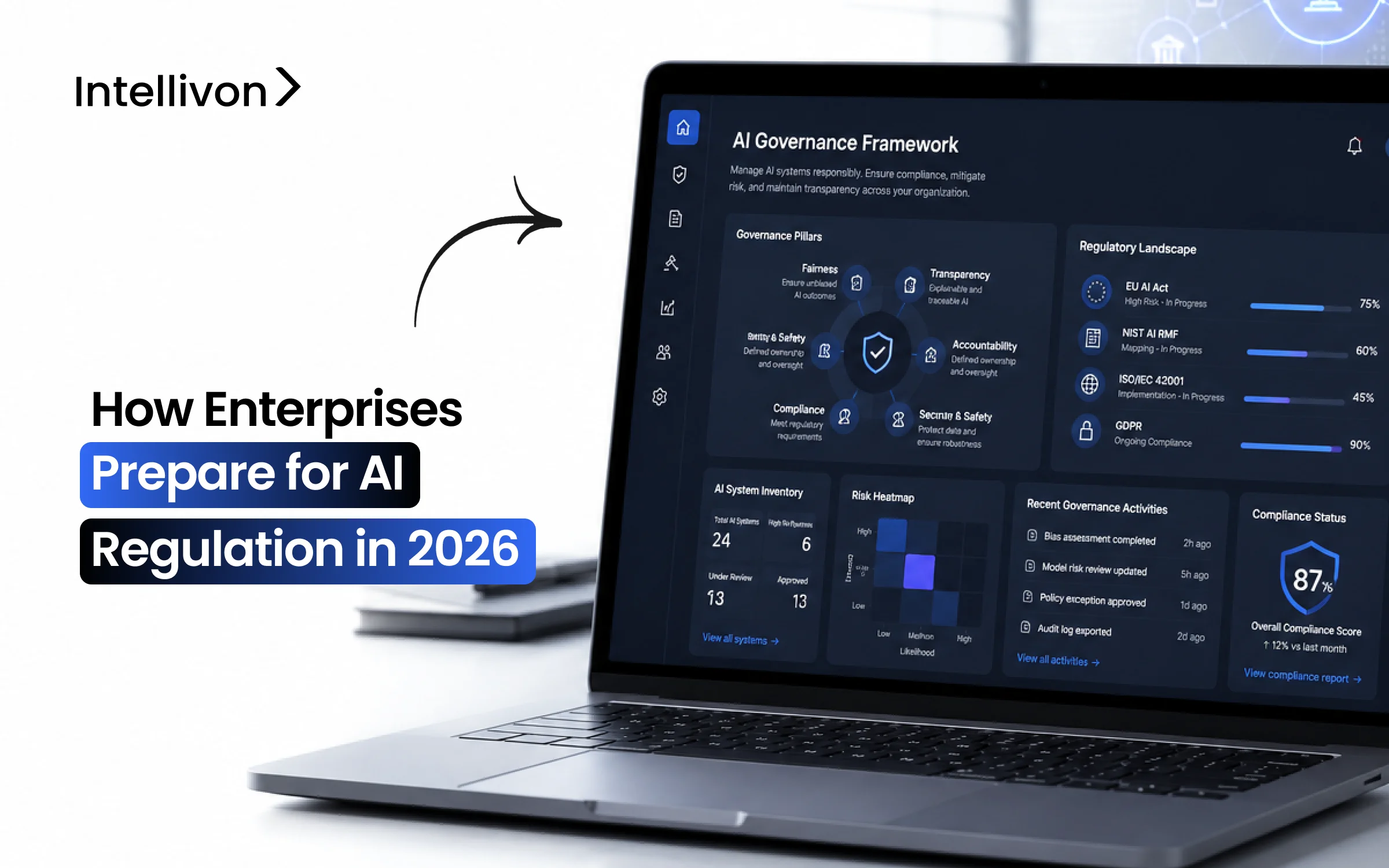
What AI Regulation Enterprises Need to Track in 2026
In 2026, enterprise leaders navigate a structured web of AI governance determined by geography, industry, AI use case, model type, and organizational role. Specifically, compliance pathways depend on whether an enterprise develops, provides, deploys, or procures an AI system.
Consequently, tracking these evolving frameworks gives organizations a clear roadmap to innovate safely while meeting global standards for AI regulation.
1. EU AI Act — What Changed After the 2026 AI Omnibus
The European Union clarified its compliance milestones following the July 27, 2026 AI Omnibus entry into force.
- First, Article 50 transparency requirements take effect on August 2, 2026.
- Next, stand-alone high-risk systems reach full enforcement on December 2, 2027, while high-risk AI embedded in regulated products moves to August 2, 2028
Additionally, general-purpose AI (GPAI) frameworks clearly define duties for both providers and deployers. Providers focus on technical documentation and conformity assessments.
Meanwhile, deployers establish post-market monitoring, incident reporting, and fundamental-rights impact assessments (FRIA).
2. The US Has a Patchwork AI Compliance Regime
In the United States, compliance readiness involves coordinating federal sectoral guidelines with active state statutes. For instance, Texas TRAIGA, California ADMT regulations, and Colorado SB 26-189 offer specific parameters for automated decision-making.
Because of these region-specific rules, geographic tracking operates as an essential function within enterprise IT teams.
Furthermore, mapping model deployments across state lines ensures smooth operational alignment across every market you serve.
3. Voluntary Frameworks
Alongside statutory requirements, voluntary standards provide excellent blueprints for technical architecture.
The NIST AI RMF structures governance around four key functions: Govern, Map, Measure, and Manage, which pairs cleanly with the NIST GenAI Profile.
In addition, ISO/IEC 42001 delivers a recognized global standard for managing AI infrastructure.
Importantly, while these voluntary frameworks support regulatory compliance, they do not replace formal laws. Therefore, forward-looking engineering teams use these standards to build auditable controls that satisfy binding statutory mandates.
Which AI Regulations Actually Apply to Your Enterprise?
Determining compliance scope requires evaluating your operational footprint rather than relying on standard legal lists.
To establish true applicability, organizations must analyze where models run, who uses them, and how decisions affect individuals.
This structured mapping process helps engineering teams build targeted controls directly into their tech stack.
1. Map Jurisdiction
Your regulatory scope depends directly on geographic reach and data processing boundaries:
- Operating locations and corporate headquarters
- Residence of customers, patients, or affected users
- Physical hosting locations for data and model inference nodes
- Cross-border data transfers and international decision processing
Understanding these jurisdictional boundaries ensures your infrastructure satisfies localized statutory requirements.
Consequently, mapping global footprint prevents unexpected enforcement actions across cross-border deployments. Furthermore, verifying server locations protects against regional compliance violations.
2. Map Your Regulatory Role
Legal duties shift significantly based on how your enterprise interacts with the system:
- Provider or developer building proprietary models
- Deployer running third-party AI systems internally
- Importer or distributor bringing external models into new markets
- Employer, healthcare provider, or financial institution facing domain-specific rules
Defining your exact role clarifies whether you handle technical documentation or operational monitoring. As a result, engineering leads can assign precise compliance responsibilities to internal teams.
3. Map the AI Use Case
Specific software applications trigger distinct risk classifications and legal oversight rules:
- High-impact decisions like credit scoring, hiring, or insurance underwriting
- Clinical decision support, patient documentation, or healthcare triage
- Operational oversight including fraud detection, AML, or employee monitoring
- Interactive tools like public-facing chatbots or autonomous AI agents
Classifying your use cases allows technical teams to embed appropriate algorithmic safeguards.
Thus, high-risk systems receive maximum testing while low-risk tools move rapidly through production.
4. Build an Applicability Matrix
Consequently, consolidating operational inputs creates a single source of truth for teams:
- System → Owner → Jurisdiction → Model → Data → Business Decision → Risk Tier → Laws → Required Controls → Evidence → Review Date
This matrix establishes an immutable record for internal audit teams and external regulators. Additionally, maintaining centralized visibility streamlines continuous model monitoring across all business units.
Enterprise teams can systematically evaluate risk profiles while ensuring complete alignment with emerging global mandates.
How Enterprises Prepare for AI Regulation
To achieve audit readiness, organizations must move from legal policies to technical execution. Large enterprises establish five operational steps to protect production AI systems while maintaining speed.
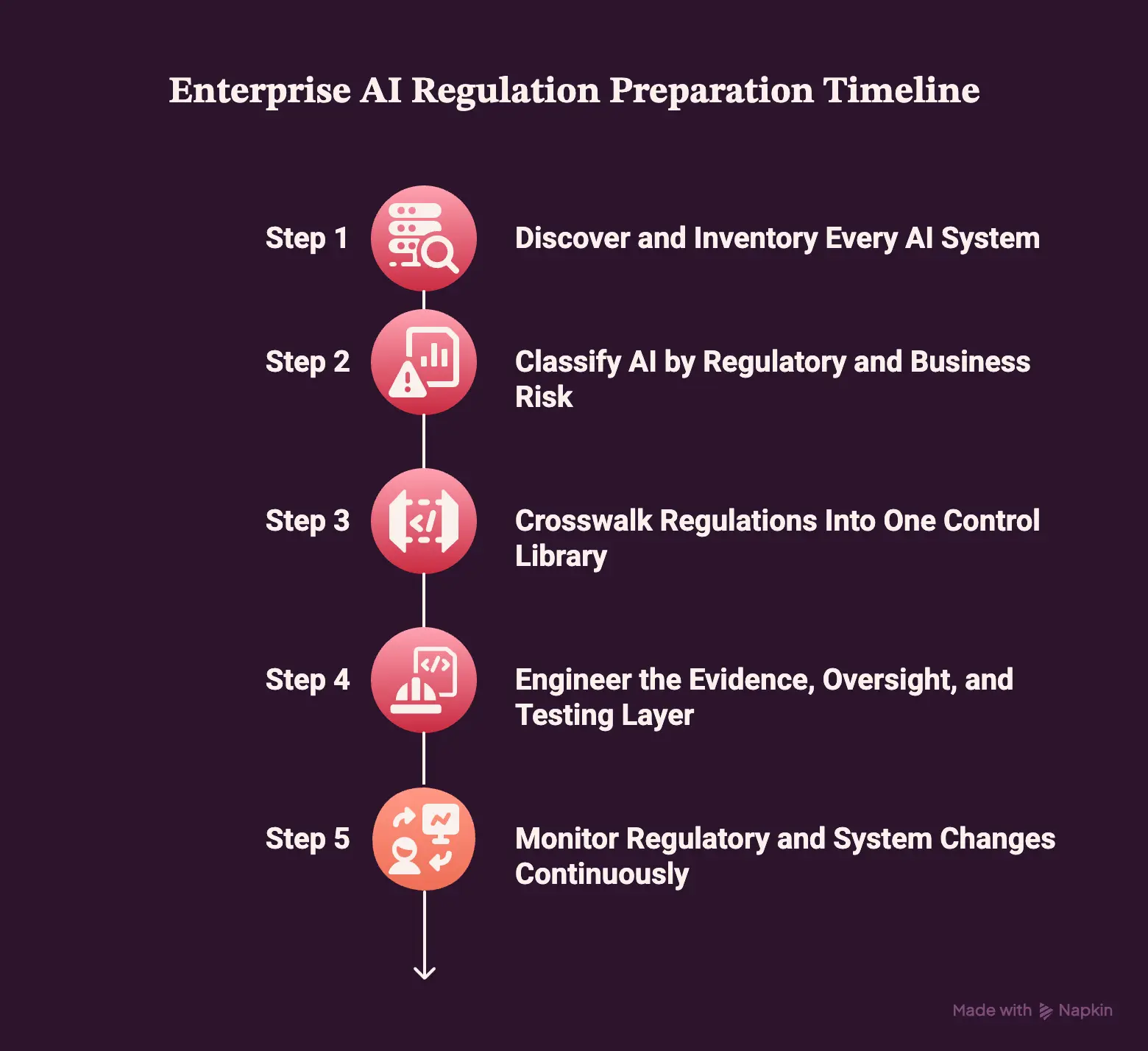
Step 1 — Discover and Inventory Every AI System
You cannot classify regulatory risk for unknown AI systems. Therefore, technical discovery must find every active software dependency across the company.
Your catalog must track these technical assets:
- Sanctioned tools and shadow AI apps
- Embedded SaaS features and external APIs
- Internal models, fine-tuned layers, and open-source models
- Copilots, RAG pipelines, and autonomous AI agents
For every system, your repository must log these key fields:
- Owners: Business owner, technical lead, and model developer
- Scope: Purpose, target users, deployment environment, and influenced decisions
- Lineage: Training data sources, API endpoints, vendors, and processing regions
Intellivon’s Approach: We combine code repository scanning and API logging with procurement record audits. This hybrid approach uncovers hidden shadow AI dependencies before formal regulatory audits begin.
Establishing complete technical visibility enables systematic risk classification.
Step 2 — Classify AI by Regulatory and Business Risk
After inventorying systems, teams evaluate each model against a unified risk taxonomy. Enterprise risk often exceeds baseline legal rules.
At the same time, classify systems across four tiers (Tier 1: Critical Risk to Tier 4: Minimal Risk) using these factors:
- Legal risk tier (prohibited, high, limited, or minimal)
- Physical safety and direct financial impact
- Fundamental rights and protected class exposure
- PHI/PII data handling and third-party dependencies
- Autonomous action levels, decision reversibility, and human review options
Assigning unified tiers ensures high-risk models get strong technical controls. Meanwhile, low-risk utilities move fast through production pipelines.
Intellivon’s Approach: We engineer custom risk engines into enterprise MLOps platforms. These engines assign risk tiers automatically based on data inputs and decision impact.
Clear risk profiles help teams map controls across global legal jurisdictions.
Step 3 — Crosswalk Regulations Into One Control Library
Instead of managing separate compliance lists, enterprises build one master AI control library. This operationalizes the “build once, evidence many” principle across all frameworks.
For example, a Human Oversight control satisfies several rules simultaneously:
Intellivon’s Approach: We build central governance software layers that connect software workflows to global standards.
For deeper technical architecture details, see our guide on EU AI Act Compliance Software Development Guide.
Unifying technical controls simplifies generating immutable evidence for auditors.
Step 4 — Engineer the Evidence, Oversight, and Testing Layer
Auditors require real technical evidence rather than static policy documents. Therefore, production MLOps pipelines must generate continuous, tamper-proof compliance artifacts:
- Audit Logs: Immutable logs tracking inputs, outputs, model versions, and data lineage
- Model Cards: Dynamic docs listing system limits, architecture, and intended scope
- Testing Artifacts: Bias evaluations, SHAP explainability reports, and red-teaming logs
- Human Records: System logs tracking review approvals and manual decision overrides
Intellivon’s Approach: We build logging and explainability tools directly into production inference nodes. This setup logs telemetry without adding system latency.
Real-time telemetry keeps compliance frameworks aligned as software changes.
Step 5 — Monitor Regulatory and System Changes Continuously
Enterprise compliance requires continuous engineering oversight rather than annual reviews. At the same time, automated triggers must track both code updates and legal changes.
Trigger automatic reassessments whenever these system events occur:
- Model retraining, weight updates, or prompt edits
- RAG source changes or new tool integrations
- Regional expansions or new business use cases
- Vendor model upgrades or legal rule changes
Intellivon’s Approach: We integrate automated circuit breakers into continuous deployment pipelines. If a model update introduces bias or drift, pipelines stop deployment instantly. At the same time, continuous monitoring ensures software changes remain fully compliant over time.
Preparing for AI regulation requires a unified control library that connects global statutory rules into a “build once, evidence many” architecture. In addition, continuous compliance relies on automated discovery, real-time telemetry, and MLOps circuit breakers that halt deployments whenever model updates introduce drift or bias.
Build an AI Compliance Evidence Stack
While competitors discuss generic policy documentation, enterprise readiness requires a technical evidence architecture. Static PDFs, stale documentation, and disconnected approval records quickly create governance failures during audits.
Consequently, organizations must build an integrated evidence stack that automatically captures live telemetry and creates a reconstructable, end-to-end compliance trail.
To solve this, a modern AI compliance stack must continuously capture and connect eight essential core layers:
- AI Registry and Model Catalog: Maintains a central record of every AI asset, vendor dependency, and operational relationship across the organization.
- Full-Chain Data Lineage: Automatically maps training data to features, inputs, model versions, configurations, outputs, and downstream actions.
- Model Performance Metrics: Continuously tracks core statistical metrics, including real-time accuracy, feature drift, and output fairness.
- Safety and Security Evaluation: Stores system evaluation results for explainability, hallucination rates, toxicity levels, and adversarial vulnerability tests.
- Red-Team Incident Artifacts: Preserves documented vulnerability scans, simulated attack logs, and historical stress-testing outcomes for audit inspection.
- Automated Decision Logs: Records high-stakes automated outputs, which are vital for regulated lending, insurance, healthcare, and employment workflows.
- Human-Override Trails: Captures manual intervention records, reviewer approvals, and human-in-the-loop overrides across autonomous agentic systems.
We engineer automated governance architectures that link live system telemetry directly to global regulatory requirements. For complete architecture patterns, explore our guide on AI Governance Software Development Strategies.
A production evidence stack replaces scattered manual PDFs with a unified, automated telemetry pipeline across your entire software ecosystem. Ultimately, linking live system logs directly to regulatory rules gives enterprises an instantly reconstructable audit trail.
How to Prepare LLMs and Agentic AI for Regulation
Regulating probabilistic Large Language Models (LLMs) and autonomous agentic workflows introduces unique compliance challenges. Because generative outputs dynamically change, static testing is insufficient.
Consequently, organizations must embed continuous, runtime governance directly into their generative AI and agent infrastructure.
To govern non-deterministic systems, enterprise tech stacks must systematically enforce four specialized control points:
- Foundation Model and GPAI Dependencies: First, log vendor hosting, exact model versions, and contractual assurances. Furthermore, track training data transparency disclosures, downstream modifications, and automated fallback models.
- Knowledge Lineage in RAG Systems: Next, trace every generated response directly to its retrieval source. Specifically, track document versioning, user access permissions, vector index revisions, retrieved evidence chunks, and final outputs.
- Action Governance for Agentic Systems: Additionally, control autonomous agents far beyond simple prompt engineering. Systematically record available tools, API endpoints, system permissions, working memory, financial execution limits, human escalation triggers, failed actions, and emergency kill switches.
- Employee GenAI Inventory: Finally, bring shadow AI into official enterprise governance. Enforce prompt filtering, Data Loss Prevention (DLP) for confidential data, audit logging, and approved-use policies across public LLM tools and enterprise copilots.
We engineer custom orchestration layers that wrap enterprise LLMs and autonomous agents in real-time policy boundaries.
For practical implementation patterns, review our technical blueprint on Enterprise Agentic AI Governance and Guardrails Architecture.
Preparing LLMs and autonomous agents for regulation requires controlling both information retrieval pathways and real-world system execution boundaries.
Ultimately, locking down foundational dependencies alongside employee GenAI usage prevents catastrophic data leaks and regulatory non-compliance.
Preparing Financial Services for AI Regulation in 2026
Financial institutions face shifting supervisory standards as regulators update legacy frameworks. Consequently, financial compliance requires separating quantitative risk models from generative and agentic systems.
To maintain regulatory readiness across financial infrastructure, institutions must address three critical regulatory boundaries:
- Model Risk Management After SR 26-2: On April 17, 2026, regulators issued SR 26-2 (OCC Bulletin 2026-13), officially replacing legacy SR 11-7. This revised guidance focuses strictly on quantitative model exposure, inventorying, and validation. Notably, generative and agentic AI sit explicitly outside this specific guidance, meaning firms cannot assume conventional MRM covers GenAI dependencies.
- GenAI and Agent Supervision Under FINRA: Because GenAI falls outside traditional MRM guidance, firms must apply targeted FINRA supervision. Specifically, FINRA’s 2026 oversight materials enforce strict rules for recordkeeping, customer communications, prompt/output monitoring, human-in-the-loop review, and agent permission limits.
- Consumer-Impact Controls for Decision AI: Systems driving credit, underwriting, fraud, AML, insurance, and investment recommendations require separate fairness controls. Consequently, firms must log adverse-action reasoning, maintain explainability artifacts, and store audit-ready records to satisfy consumer protection mandates.
Replacing legacy SR 11-7 with SR 26-2 narrows quantitative model risk while leaving generative and agentic AI under distinct FINRA supervisory rules.
Ultimately, separating quantitative decision models from generative workflows ensures total compliance across financial enterprise systems.
Preparing Healthcare Enterprises for AI Regulation in 2026
Deploying AI across healthcare infrastructure requires navigating a layered web of federal and international frameworks.
Consequently, enterprise healthcare AI presents three overlapping regulatory challenges spanning data privacy, health IT certification, and medical device classification.
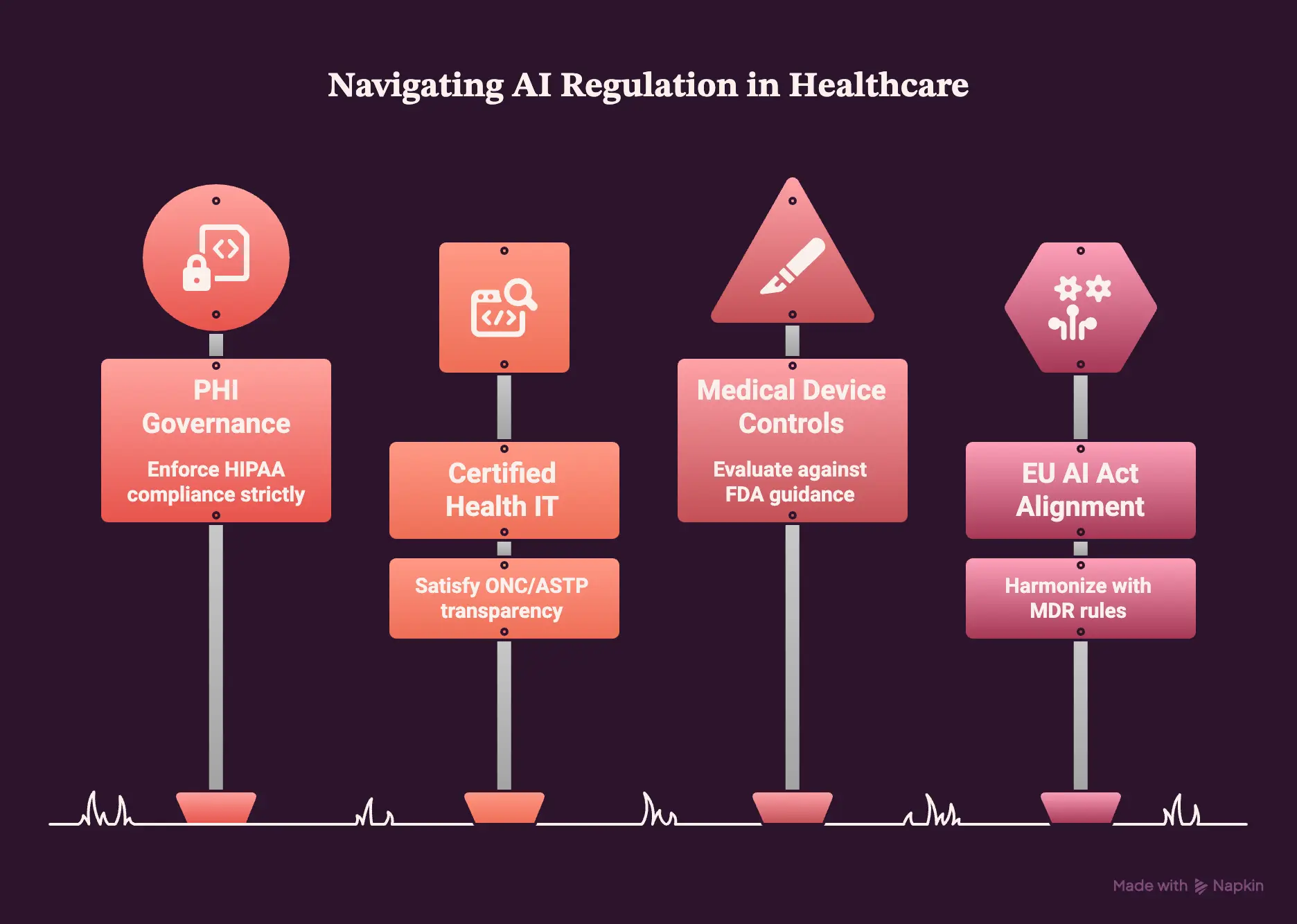
To maintain full compliance, health systems and digital health vendors must execute four targeted control strategies:
- Protected Health Information (PHI) Governance: First, enforce strict HIPAA compliance across all training and inference pipelines. Restrict models to minimum necessary data usage, maintain signed Business Associate Agreements (BAAs) with cloud providers, enforce retention limits, and log audit trails.
- Predictive AI in Certified Health IT: Next, satisfy the ONC/ASTP algorithm-transparency requirements established under the HTI-1 rule. Rather than viewing HTI-2 as a new baseline law, developers must disclose source attributes, training data characteristics, and fairness metrics for predictive decision-support interventions built into certified systems.
- Medical Device Software Controls: Additionally, evaluate software against the FDA’s final Clinical Decision Support (CDS) guidance issued in January 2026. For AI-enabled devices, implement Predetermined Change Control Plans (PCCPs) to manage lifecycle updates and monitor post-deployment drift without triggering repeated premarket reviews.
- EU AI Act and MDR Alignment: Finally, for models sold or operated in Europe, harmonize EU AI Act requirements with Medical Device Regulation (MDR) rules. Because clinical AI generally falls into high-risk tiers, teams must prepare comprehensive technical documentation, continuous quality management systems, and formal conformity assessments.
We construct HIPAA-compliant, FDA-ready MLOps pipelines designed for enterprise healthcare systems.
For a deeper breakdown of healthcare governance architecture, see our guide on How to Build a Healthcare AI Governance Platform Today.
Managing regulatory risk in healthcare AI requires addressing PHI privacy, ASTP algorithm transparency, and FDA medical device classifications simultaneously. Ultimately, unifying these frameworks into a single architecture ensures full compliance without sacrificing clinical innovation.
How to Manage AI Regulation Across Multiple Jurisdictions
Operating AI infrastructure across global markets requires navigating fragmented, overlapping compliance regimes. Rather than building isolated silos for the EU AI Act, US state laws, and regional frameworks, multinational enterprises must deploy a centralized, automated governance architecture.
To harmonize cross-border execution, enterprise compliance teams should implement three continuous control pillars:
- Build a Regulatory Obligations Register: First, centralize every applicable requirement into a structured database. Record the regulation, jurisdiction, effective date, affected systems, exact requirements, business owners, control owners, audit evidence, and live compliance status.
- Deploy Regulatory Horizon Scanning: Next, establish continuous tracking for emerging global changes. Systematically monitor proposed bills, adopted rules, agency implementation guidance, regulator enforcement actions, updated technical standards (such as NIST or ISO), and relevant judicial precedents.
- Connect Regulatory Changes Directly to Impact Assessment: Finally, replace manual email alerts with automated risk workflows. Whenever a rule updates, the change should programmatically trigger impact assessments that map directly down to system parameters.
Managing cross-border AI regulation requires replacing static spreadsheets with dynamic obligations registers and continuous horizon scanning. Ultimately, connecting legislative updates directly to technical control mappings ensures multi-jurisdictional compliance without slowing down enterprise deployment cycles.
What Technology Does an AI Regulation Readiness Program Need?
An effective AI regulation readiness program requires an integrated technical stack rather than isolated compliance tools.
To turn static policies into enforceable guardrails, enterprises must deploy unified technology architectures that link daily developer workflows directly to executive risk monitoring.
AI Regulation Readiness Program
| Core Capability | Primary Function | Standard Integrations | Build vs. Buy Strategy |
| AI Inventory & Registry | Centralizes model cards, ownership, and metadata | Data catalogues, IAM | Buy (Standard GRC) |
| Regulatory Intelligence | Maps emerging global laws into system rules | Horizon scanners, API feeds | Buy (SaaS intelligence) |
| Risk Classification Engine | Categorizes models by impact and risk tier | Procurement systems | Buy (Rule-based engines) |
| Policy & Control Library | Enforces organizational guardrails and frameworks | Jira, ServiceNow | Buy (GRC platforms) |
| Model & Data Lineage | Traces dataset versions, pipelines, and outputs | MLflow, cloud platforms | Build (Deep MLOps) |
| Evaluation & Bias Monitoring | Tracks real-time drift, fairness, and accuracy | MLOps, CI/CD pipelines | Build (Custom telemetry) |
| Audit Trail & Evidence Store | Maintains immutable logs for regulatory review | SIEM, object storage | Build (Regulated data) |
| Approval Workflows | Automates sign-offs across three lines of defense | ITSM, Slack, Teams | Buy (Standard workflows) |
As a general rule, enterprises should buy off-the-shelf GRC platforms when standard regulatory tracking dominates. Conversely, organizations should build custom extensions when they require model-level telemetry, deep MLOps integrations, or complex controls for healthcare and financial AI.
Intellivon’s Approach: We engineer custom compliance integration layers that bridge your existing MLOps tools directly into regulatory reporting platforms.
For a deeper breakdown of governance architecture, see our guide on How to Build a Robust AI Governance Framework for Enterprises.
Modern AI regulation readiness requires marrying GRC policy tracking with deep, model-level MLOps telemetry.
Ultimately, building custom telemetry for high-risk systems while configuring standard GRC software for policy management delivers total auditability without slowing engineering velocity.
What Does Enterprise AI Regulation Readiness Cost in 2026?
A scoped enterprise AI regulation readiness programme typically requires a $70,000–$300,000 implementation budget, depending on system count, jurisdictions, integrations, industry controls and automation depth.
1. AI Regulation Readiness Cost Table
| Phase | Budget Range |
| Regulatory Discovery + AI Inventory | $10,000–$25,000 |
| Risk Taxonomy + Control Mapping | $15,000–$40,000 |
| Evidence Architecture + Technical Integrations | $25,000–$100,000 |
| Testing, Oversight + Vendor/GenAI Controls | $10,000–$55,000 |
| Audit Readiness, Training + Production Rollout | $10,000–$80,000 |
| Total Programme Range | $70,000–$300,000 |
2. Ongoing Maintenance Costs
After initial deployment, budget an annual operating range of 15–25% of initial costs to manage ongoing regulatory updates, control adjustments, MLOps integrations, continuous monitoring, and evidence retention.
(Note: This $70K–$300K scope covers regulatory readiness and compliance engineering; full enterprise-wide governance platform builds remain a larger, separate capital investment.)
Scoping an AI readiness programme requires balancing initial setup against continuous maintenance. Ultimately, treating compliance engineering as a focused, modular build prevents cost overruns while guaranteeing audit readiness.
Conclusion
Preparing enterprise AI for 2026 regulation requires shifting from static policy manuals to continuous, technical execution. By embedding automated evidence logging, knowledge lineage, and real-time guardrails directly into your MLOps pipeline, compliance becomes an operational advantage rather than a bottleneck.
Ultimately, building a unified, audit-ready architecture ensures your organization can navigate shifting global mandates, mitigate catastrophic operational risks, and deploy high-impact artificial intelligence with complete confidence.
Build AI Regulation Readiness Infrastructure With Intellivon
Moving from passive regulatory policies to active, audit-ready AI infrastructure requires robust technical execution. Intellivon engineers enterprise-grade governance architectures that embed continuous, real-time compliance directly into your production MLOps pipelines.
Instead of relying on fragmented spreadsheets and manual oversight, deploy an integrated technical stack tailored to your regulatory environment:
- Centralized AI Registries: Maintain automated model cards, versioning, and complete data lineage.
- Dynamic Regulatory Mapping: Programmatically align shifting jurisdictional obligations with system-level controls.
- LLM, RAG & Agentic Guardrails: Enforce real-time prompt filtering, knowledge lineage, and action execution boundaries.
- Sector-Specific Systems: Deploy specialized compliance architectures designed for FDA/HTI-1 healthcare frameworks and FINRA/SR 26-2 financial standards.
Do not let regulatory uncertainty stall your deployment velocity. Partner with Intellivon’s compliance engineering team to build scalable, high-performing AI systems that satisfy global regulators and protect your enterprise.
FAQs
Q1. Did the EU AI Act High-Risk Deadline Change in 2026?
A1. Yes, deadlines shifted slightly. High-risk systems under Annex III now face enforcement by December 2, 2027, while Annex I embedded systems move to August 2, 2028. Consequently, Article 50 transparency obligations still apply on August 2, 2026. Therefore, enterprises must prioritize immediate compliance for customer-facing systems.
Q2. Is SR 11-7 Still the Current Model Risk Standard for Banks?
A2. While SR 11-7 established legacy foundations, financial institutions are actively transitioning toward SR 26-2 and OCC Bulletin 2026-13. Furthermore, traditional governance struggles with non-deterministic outputs. As a result, regulators now mandate continuous runtime telemetry, real-time prompt logging, and specialized evaluation frameworks for generative and agentic systems.
Q3. Can NIST AI RMF or ISO 42001 Replace Legal Compliance?
A3. No, voluntary frameworks cannot replace statutory law. While NIST AI RMF and ISO 42001 structure internal controls, assign responsibilities, and organize technical evidence effectively, they do not erase local legal liabilities. Thus, enterprises must explicitly map framework controls directly to specific jurisdictional legal mandates.
Q4. How Should Enterprises Govern Employee Use of ChatGPT and Other LLMs?
A4. To govern LLM usage effectively, organizations must implement formal use-case approvals alongside robust data loss prevention (DLP) tools. Additionally, security teams should enforce strict prompt handling rules, enterprise vendor agreements, explicit access limits, comprehensive logging, and mandatory employee training to prevent sensitive data exposure.
Q5. Do AI Agents Need Different Regulatory Controls From Chatbots?
A5. Yes, autonomous agents require vastly stricter oversight than passive chatbots. Because agents execute actions independently, engineers must deploy scoped tool permissions, hard API limits, and mandatory human-in-the-loop approval thresholds. Ultimately, every autonomous workflow needs immutable action logging and a real-time emergency kill switch.
Q6. Should Enterprises Build or Buy AI Regulation Software?
A6. Enterprises should generally buy the baseline commodity layer while custom-building the differentiated control layer. Therefore, buying standard regulatory feeds and core GRC features saves time. Conversely, custom engineering becomes essential when integrating proprietary model telemetry, agentic workflows, MLOps pipelines, and sector-specific evidence architecture.
To Sum It Up
- The EU’s 2026 timeline changes created more implementation runway for high-risk AI, not permission to postpone inventory and evidence engineering.
- The most scalable compliance architecture maps many regulations to one control library instead of building one compliance programme per jurisdiction.
- An AI policy proves intent; versioned models, lineage, evaluations, approvals and decision logs prove execution.
- Agentic AI expands governance from “what did the model say?” to “what was the system allowed to do, what did it do, and who approved it?”