Key Takeaways:
-
EU AI compliance software connects AI inventory, risk classification, evidence workflows, and runtime monitoring together.
-
Provider-versus-deployer logic, GPAI controls, and article-level obligation mapping are core architectural requirements.
-
Runtime monitoring, human oversight, incident management, and MLOps integrations complete the 5 connected capability layers.
-
Builds cost $70,000 to $300,000 with 12- to 16-week MVPs and 20- to 40-week production timelines.
-
How Intellivon builds EU AI compliance platforms with multi-regulation mapping, GRC integrations, and audit-ready evidence workflows.
Building EU AI compliance software means covering four distinct obligation tracks defined by the EU AI Act. First, the risk classification engine determines which track applies to each AI system in the portfolio. Then the platform separates into a pre-market provider workflow and a post-market deployer workflow. Together, both tracks handle conformity assessment, technical documentation, human oversight, logging, and incident reporting.
The biggest build mistake is using one workflow engine for both provider and deployer obligations. In practice, that approach creates compliance gaps at the exact points regulators check. EU AI Act penalties under Article 99 reach up to 3% of global annual turnover. Consequently, a platform built around one role inevitably leaves gaps that examiners will find.
Intellivon builds EU AI compliance software for enterprises managing both provider and deployer obligations. The approach therefore always starts with risk classification before any other compliance module is scoped. Accordingly, this blog covers classification architecture, conformity assessment, FRIA workflow, GPAI obligations, and post-market monitoring.

What Is EU-Compliant AI Software For Enterprises?
EU-compliant AI software refers to enterprise platforms engineered to meet the regulatory, governance, and transparency mandates of the EU AI Act. Consequently, these platforms systematically classify risk, automate audit trails, track model drift, and enforce human oversight across all AI workflows.
Moreover, building custom EU AI compliance software allows enterprises to continuously validate models against strict European standards without disrupting daily production.
By embedding these automated compliance controls directly into existing MLOps pipelines, risk teams can eliminate continuous manual reviews. This technical foundation ensures your systems remain auditable and secure as regulatory requirements evolve.
The global EU AI Act compliance solutions market is accelerating rapidly. Consequently, analysts project the sector will expand from $609.4 million to $10.5 billion by 2035.
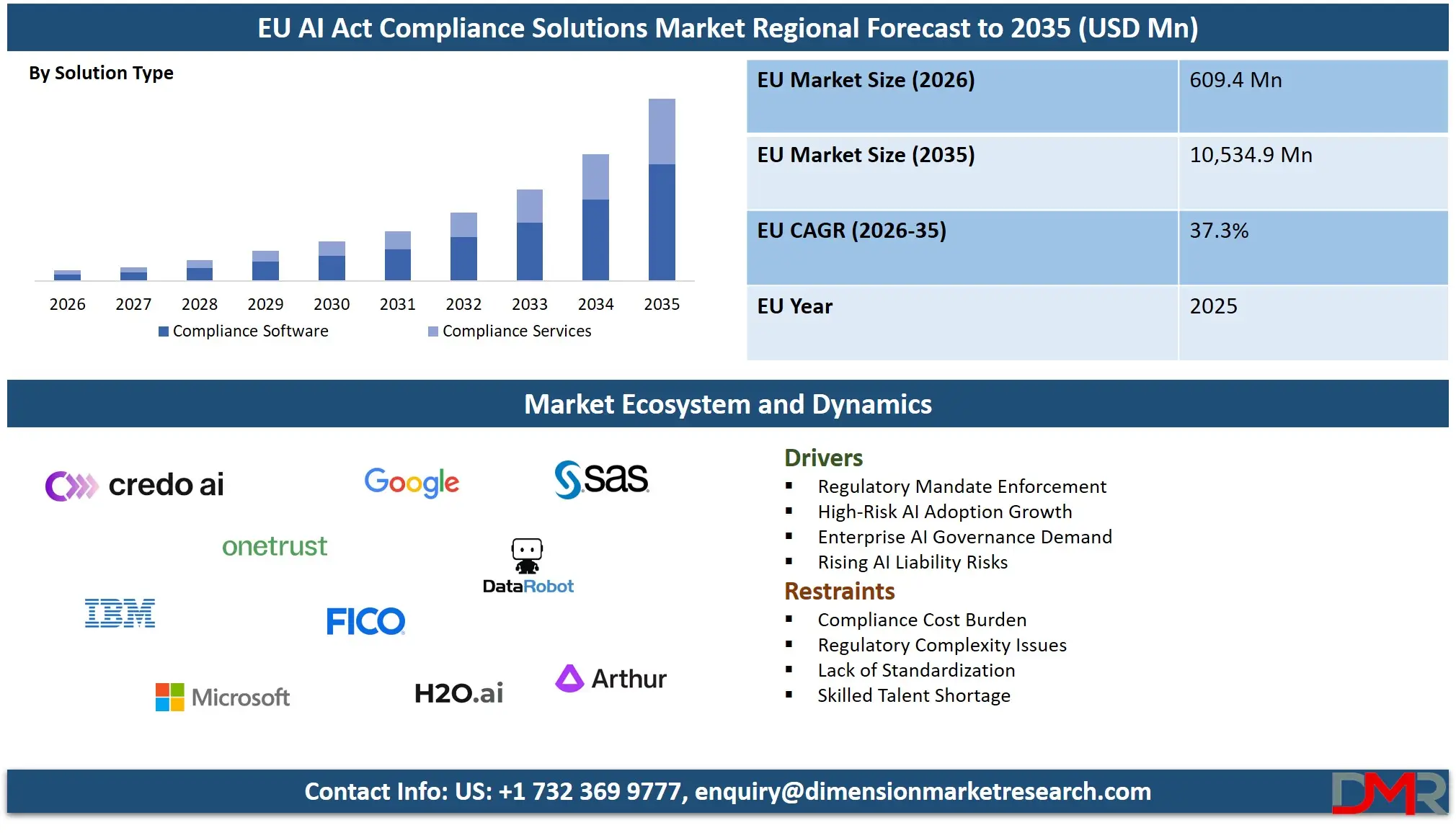
This expansion represents a 37.3% CAGR, driven by mandatory regulatory enforcement. Therefore, enterprise leaders are actively building automated compliance platforms today.
Who Needs EU AI Compliance Software and Which Deadlines Apply?
EU AI compliance software targets any enterprise developing, deploying, importing, or distributing AI within the European market. Consequently, the software must dynamically map legal duties by role, risk tier, and geographic footprint.
It tracks enforcement dates to keep architectures legally sound across evolving EU mandates.
1. Provider, Deployer and Representative Roles
Enterprise duties depend entirely on system position, use case, and deployment context.
- Providers face direct obligations for conformity assessments, technical docs, and risk management systems.
- Deployers must maintain human oversight, monitor operation, and run fundamental rights impact assessments.
- Importers and Distributors verify compliance documentation, CE markings, and regulatory database entries.
- Authorized Representatives act as local EU points of contact for non-EU providers.
- White-label rebranding or substantial retraining shifts deployer or distributor status directly to provider status.
Role assignments dictate system controls. Misclassifying an operational role creates immediate non-compliance exposure.
2. The 2025–2028 EU AI Act Application Timeline
Enforcement milestones apply progressively based on model scope and system risk classification.
| Obligation Group | Application Date |
| Prohibited practices and AI literacy | February 2, 2025 |
| GPAI provider obligations | August 2, 2025 |
| Article 50 transparency obligations | August 2, 2026 |
| Transition for existing GPAI models | August 2, 2027 |
| Stand-alone high-risk systems | December 2, 2027 |
| High-risk AI in regulated products | August 2, 2028 |
High-risk deadlines offer runway, but core transparency and literacy rules are already active. Compliance engines must handle phased dates now.
3. Why the Platform Needs a Regulatory Change Engine
Static compliance checklists fail under frequent legislative amendments and delegated acts.
- Monitors continuous updates from the European Commission, AI Office, and national authorities.
- Tracks harmonized standards, common specifications, and sector-specific guidance automatically.
- Maps control fields for effective dates, jurisdiction, versions, and superseded controls.
- Alerts compliance officers when new implementing acts change existing system workflows.
Automated regulatory tracking prevents system obsolescence. At the same time, real-time updates ensure runtime controls mirror current statutory definitions.
Compliance scope cannot be hardcoded as one static checklist. At the same time, the system must determine who is responsible, which law version applies, and when each obligation becomes enforceable.
How the EU AI Act Risk Classification Engine Should Work
An enterprise classification engine must function as an automated, continuous evaluation pipeline rather than a static onboarding checklist. Consequently, the engine continuously re-evaluates system risks as code, data, and deployments shift.
This process maps every model against the EU AI Act regulatory framework overview software to establish an auditable legal trail.
Gate 1 — Identify Prohibited AI Practices
The platform must immediately flag and block prohibited AI system monitoring platform use cases before deployment.
- Detects manipulative or exploitative practices that distort human behavior or target vulnerable demographics.
- Blocks social scoring mechanisms and restricted biometric categorization tools in production code.
- Halts workplace and education emotion recognition along with untargeted facial recognition database scraping.
- Triggers a system release block and mandatory legal escalation when prohibited features appear.
Gate 1 acts as an absolute circuit breaker. Detecting unacceptable risk, AI identification software triggers halt commands that prevent regulatory non-compliance.
Gate 2 — Determine Annex I or Annex III High-Risk Status
Systems bypassing Gate 1 undergo automated EU AI Act high-risk AI system compliance platform analysis.
- Evaluates intended purpose, sector, and decision authority against Annex I and Annex III use cases.
- Checks if the system acts as a safety component for regulated products like medical devices.
- Monitors high-risk domains like healthcare triage, credit scoring, and employment recruitment tools.
- Applies statutory exception rules when an AI system merely performs narrow procedural tasks.
Gate 2 separates high-risk platforms from low-risk utilities. Correctly identifying EU AI Act high-risk AI system identification software dictates whether a full conformity assessment applies.
Gate 3 — Detect Article 50 Transparency Obligations
Limited-risk applications must enforce EU AI Act limited risk AI transparency compliance rules automatically.
- Injects mandatory disclosures for conversational AI, chatbots, and human-facing interfaces.
- Notifies users during active emotion recognition or biometric categorization events.
- Applies machine-readable metadata tags to synthetic content, deepfakes, and generated text.
- Enforces watermarking standards to remain compliant without slowing down model generation latency.
Article 50 compliance requires runtime user notifications. The engine ensures generated outputs contain traceable digital watermarks.
Gate 4 — Identify GPAI and Systemic-Risk Duties
General-purpose models face specialized EU AI Act general-purpose AI model compliance rules.
- Evaluates General Purpose AI (GPAI) status and verifies open-source licensing exemptions.
- Tracks training-compute metrics to detect models exceeding $10^{25}$ FLOPs systemic risk boundaries.
- Automates downstream provider documentation and technical integration specs.
- Executes model evaluation and adversarial testing protocols to document model capabilities.
GPAI rules target foundational models. The system tracks training capacity to enforce systemic risk GPAI model software controls instantly.
Reclassification After Model or Use-Case Changes
Continuous MLOps monitoring ensures systems get re-evaluated after any operational drift or substantial modification.
- Triggers re-evaluation during fine-tuning, model swaps, or dataset architecture updates.
- Detects geographic expansions into new EU member state jurisdictions or affected populations.
- Flags shifts in decision authority, such as moving from human-in-the-loop recommendations to autonomous actions.
- Logs full change history for versioned model updates and modified instructions for use.
System changes alter legal obligations. For a deeper breakdown of building compliant agentic architectures, see our guide on How to Make Compliant Agentic Agents for Collections.
Stored classification reasoning, signed reviewer logs, and legal mapping form a defensible compliance history. A risk label without its decision trail will not support an enterprise audit.
EU AI Compliance Software Architecture for Enterprise Scale
A production-grade EU AI compliance software architecture requires a modular, multi-layered design. Consequently, it decouples regulatory logic from underlying MLOps execution.
This structural separation ensures seamless integration with enterprise data pipelines while maintaining real-time compliance enforcement.
7-Layered Architecture Table
| Architectural Layer | Core Capabilities & Functional Scope | Technical Components & Data Objects | Enterprise Value & Regulatory Impact |
| Layer 1: AI System & Model Registry | Centralizes system metadata across the enterprise lifecycle. | System ID, model versions, datasets, intended purpose, vendor ID, geography, and current risk tier. | Ensures absolute visibility over all active AI assets. |
| Layer 2: Regulatory Knowledge & Control Graph | Replaces static PDFs with an active, queryable compliance graph. | Graph mapping: Regulation $\rightarrow$ Article $\rightarrow$ Obligation $\rightarrow$ Risk Tier $\rightarrow$ Control $\rightarrow$ Evidence $\rightarrow$ Test. | Enables automated impact analysis when regulations change. |
| Layer 3: Risk Classification & Rules Engine | Runs deterministic legal gates and configurable decision tables. | Decision trees, versioned rules, exception handlers, legal queues, and explainability logs. | Eliminates manual assessment errors via automated gating. |
| Layer 4: Evidence & Documentation Repository | Stores required compliance records in an immutable system. | Annex IV docs, model cards, AI Bill of Materials (AIBOM), FRIA/DPIA records, and CE certificates. | Provides an instant, audit-ready compliance evidence vault. |
| Layer 5: Workflow & Human Oversight Engine | Orchestrates reviews, approvals, and intervention rules. | Role-based reviews, segregation of duties, escalation paths, override logs, and e-signatures. | Enforces meaningful human oversight required under Article 14. |
| Layer 6: Runtime Monitoring & Incident Layer | Captures real-time telemetry and flags operational anomalies. | Model drift detectors, fairness monitors, security event logs, complaint trackers, and incident alerts. | Prevents silent model decay and automates serious incident reporting. |
| Layer 7: Integration, Security & Tenant Controls | Secures system access and manages cross-platform events. | REST/gRPC APIs, Kafka streams, SSO/IAM, zero-trust encryption, RBAC/ABAC, and immutable audit trails. | Guarantees enterprise-grade data isolation and security. |
Building a seven-layer architecture ensures enterprise AI stays auditable, secure, and fully compliant across its entire operational life cycle.
Compliance Workflows the Platform Must Automate
Automating compliance requires converting abstract legal mandates into operational software workflows.
Consequently, the platform orchestrates risk management, data governance, record-keeping, transparency, human oversight, and conformity testing across all active enterprise pipelines.
1. Risk Management and Residual-Risk Tracking
Under Article 9, high-risk systems require continuous risk identification and tracking.
- Maintains a foreseeable-risk library mapping safety, operational, and fundamental-rights hazards.
- Calculates severity and likelihood scores automatically before and after applying technical controls.
- Tracks residual-risk acceptance sign-offs with assigned risk owners and targeted review dates.
- Validates control effectiveness through continuous testing and real-time operational telemetry.
2. Data Governance, Data Quality, Bias, and Fairness
Article 10 enforces rigorous data quality checks across training, validation, and test sets.
- Evaluates dataset representativeness, missing fields, and data provenance across model iterations.
- Verifies lawful basis and consent tags for all ingested data pipelines.
- Executes bias checks measuring demographic parity and equalized odds for protected groups.
- Generates discriminatory-output alerts while linking fairness metrics directly to dataset versions.
3. Technical Documentation and Record-Keeping
Article 11 and Annex IV require structured, auto-populating technical documentation files.
- Builds Annex IV technical dossiers automatically from CI/CD metadata and MLOps build logs.
- Logs model architecture details, hardware dependencies, performance limitations, and intended uses.
- Captures automatic audit logs tracking all model inputs, outputs, and system version changes.
- Triggers evidence expiry alerts when documentation components require annual or modification reviews.
4. Transparency, Instructions for Use, and Human Oversight
Article 13 and Article 14 mandate clear deployer instructions and meaningful human oversight mechanisms.
- Generates deployer instructions detailing known system limitations and expected human competence.
- Enforces human override controls and emergency stop-use procedures within production interfaces.
- Delivers user notification prompts informing individuals when interacting with AI systems.
- Tracks staff AI literacy completion to verify required user operational competence.
5. FRIA and Affected-Person Rights Workflows
Article 27 mandates Fundamental Rights Impact Assessments (FRIA) for high-risk deployers.
- Guides FRIA evaluations identifying affected user categories, potential harm scenarios, and mitigations.
- Connects FRIA findings directly to GDPR Data Protection Impact Assessment (DPIA) records.
- Automates complaint intake and explanation request tracking for affected individuals.
- Logs case resolutions and formal review approvals in a centralized compliance ledger.
6. Conformity Assessment, CE Marking, and Registration
High-risk AI systems must complete formal conformity procedures before market placement.
- Evaluates internal self-assessment versus notified-body third-party assessment requirements.
- Tracks quality management system (QMS) evidence to complete the EU declaration of conformity.
- Generates CE-marking records and maintains certificate renewal timelines.
- Automates registration data prep for mandatory entry into the official EU AI system database.
Automating these core compliance workflows converts manual, spreadsheet-based governance into a continuous, real-time MLOps pipeline.
By centralizing evidence collection, human oversight, and conformity tracking, enterprises achieve seamless audit readiness while maintaining full operational agility.
How to Manage GPAI and Foundation Model Compliance
Building cross-regulation interoperability requires a unified governance schema that maps shared data, risk, and audit controls across multiple regulatory frameworks simultaneously.
Instead of managing siloed compliance checks, the software aligns the EU AI Act regulatory framework directly with existing enterprise directives.
Consequently, this multi-framework integration eliminates redundant testing and prevents conflicting operational requirements.
1. GDPR and EU AI Act Dual Compliance
The platform synchronizes personal data protection requirements with AI risk management controls.
- Maps Data Protection Impact Assessments (DPIAs) directly to Fundamental Rights Impact Assessments (FRIAs).
- Automates user consent tracking and lawful basis verification across training data pipelines.
- Enforces data minimization principles during active feature engineering and model training.
- Synchronizes right-to-explanation requests under GDPR Article 22 with AI Act transparency rules.
2. Financial Sector Integration (DORA, MiFID II, SR 11-7)
Financial institutions must harmonize AI governance with strict banking and operational resilience standards.
- Aligns ICT risk management workflows under DORA with high-risk AI system risk management plans.
- Integrates Model Risk Management (MRM) principles from Federal Reserve SR 11-7 into MLOps testing.
- Captures algorithmic trading audit trails to fulfill MiFID II record-keeping mandates.
- Monitors automated credit scoring models to ensure fairness and prevent discriminatory lending practices.
3. Healthcare Sector Integration (MDR, IVDR, HIPAA)
Medical device software demands absolute alignment between clinical evaluation protocols and AI regulations.
- Links Annex IV technical documentation with Medical Device Regulation (MDR) technical files.
- Synchronizes Quality Management Systems (QMS) under ISO 13485 with AI Act QMS rules.
- Automates post-market surveillance workflows to fulfill both MDR and AI Act incident reporting.
- Harmonizes international health privacy standards for global deployments. For a deeper breakdown of cross-border medical data architectures, see our guide on How to Build HIPAA-Compliant Healthcare AI Systems.
4. Cyber Security and Infrastructure Integration (NIS2)
Enterprise AI deployments require robust infrastructure resilience and continuous threat monitoring.
- Maps NIS2 incident response protocols directly to AI Act serious-incident reporting pipelines.
- Monitors supply chain security risks across open-source libraries, foundation models, and third-party APIs.
- Enforces zero-trust access controls and continuous vulnerability patching across inference endpoints.
- Logs security events and adversarial attacks within an immutable, audit-ready security database.
True regulatory interoperability prevents compliance duplication by consolidating shared data governance, security, and risk controls into a single operational architecture.
Mapping the EU AI Act directly to GDPR, DORA, MDR, and NIS2 allows enterprise systems to remain fully compliant across all operating jurisdictions without compromising performance.
Integration Architecture for MLOps and GRC Security
A compliance platform cannot survive as an isolated manual repository. Consequently, the architecture integrates directly into developer pipelines, enterprise security tools, and core business software through an automated evidence collection ecosystem.
1. MLOps and Model Engineering Integrations
The system automatically extracts compliance artifacts directly from the model development lifecycle.
- Monitors ML pipelines, feature stores, and registries to capture model lineages and training runs.
- Integrates with CI/CD systems and code repositories to validate code commits against safety policies.
- Captures LLM observability traces, prompt systems, and agent workflows during real-time evaluations.
2. Governance and Security Integrations
Connecting with enterprise security ensures seamless identity control and audit readiness.
- Synchronizes IAM, SSO, and GRC software to maintain unified role-based access controls.
- Feeds SIEM platforms and CMDB registers with continuous AI asset telemetry and security logs.
- Links data catalogues, privacy tools, and ticketing platforms to streamline vendor risk workflows.
3. Business-System Integrations
Embedded compliance checks protect high-stakes operational workflows across key business applications.
- Monitors core banking, fraud, and loan systems for automated risk and bias tracking.
- Integrates with EHR clinical platforms, ERP, HRIS, and CRM to enforce user transparency mandates.
- Connects cloud data warehouses to track data minimization and usage consent across departments.
Integrating compliance directly into existing MLOps engines, GRC tools, and enterprise APIs turns passive regulatory mandates into an automated, continuous background process.
Build Sector-Specific Compliance Packs for Banking and Healthcare
Sector-specific compliance cannot be treated as a secondary appendix, because domain-specific rules fundamentally change classification pathways, evidence requirements, and continuous monitoring protocols.
Consequently, the compliance platform provides dedicated, pre-configured software packs that translate banking and healthcare regulations into operational controls.
1. EU AI Act Compliance Platform Development for Banks
Crucially, the platform avoids labeling every AML or fraud tool as high-risk automatically. Instead, while automated credit scoring falls under Annex III high-risk rules, narrow procedural fraud tools may qualify for lower-risk classifications under Article 6 exemptions.
The banking pack harmonizes the EU AI Act directly alongside parallel regulatory frameworks:
- GDPR: Automates lawful basis tracking, credit decision explainability, and Article 22 human review workflows.
- DORA: Connects AI incident alerts with Digital Operational Resilience Act ICT risk management frameworks.
- MiFID II & Consumer Credit: Enforces record-keeping for algorithmic trading and algorithmic fairness checks for retail lending.
- Model Risk Governance: Maps internal model validation rules to global standards, including Federal Reserve SR 11-7, NIST AI RMF, and ISO 42001.
2. Healthcare EU AI Act Compliance Software Development
The healthcare pack provides tailored governance for clinical decision support, diagnostic AI, medical imaging, ambient clinical documentation, and EHR-integrated tools.
The platform connects EU AI Act mandates with medical device requirements, leveraging lex specialis principles to streamline dual-compliance workflows:
- MDR & IVDR: Integrates AI Act Annex IV technical documentation directly into Medical Device Regulation and In Vitro Diagnostic Regulation technical files.
- Quality & Risk Standards: Synchronizes Quality Management Systems (ISO 13485) and risk management standards (ISO 14971) with AI lifecycle controls.
- Software Lifecycle: Aligns continuous MLOps deployments with IEC 62304 medical software life-cycle processes.
- Clinical Safety & Privacy: Tracks clinical evaluation data, post-market surveillance alerts, and HIPAA compliance for cross-border global deployments.
3. Shared Sector-Pack Architecture
To maintain systematic governance across industries, every sector pack operates on a standardized, modular software architecture containing:
- Use-Case Taxonomies & Risk Triggers: Pre-mapped intent trees that automatically evaluate systems against Annex III high-risk criteria.
- Required Evidence & Approvals: Automated data collection pipelines paired with role-based sign-off gates for qualified domain experts.
- Performance & Incident Tracking: Real-time dashboards monitoring drift, bias, and serious-incident thresholds linked to regulatory notification endpoints.
- Integration Templates: Ready-to-use API connectors for major core banking systems, EHR databases, and enterprise data warehouses.
Sector-specific compliance packs replace generalized governance templates with tailored taxonomies, regulatory mappings, and integration bridges.
By embedding banking and healthcare rules directly into the MLOps pipeline, enterprises ensure full multi-framework compliance without sacrificing operational efficiency.
How to Build EU AI Act Compliance Software in Five Phases
Building an enterprise-grade EU AI Act compliance engine requires an execution roadmap that balances legal rigor with technical MLOps integration. Rather than attempting to govern every algorithm simultaneously, software engineering teams should adopt a modular, phase-gated approach.
Consequently, this five-phase framework translates complex statutory rules into an operational, continuous compliance platform.
Step 1 — Establish Scope, Operator Roles, and the Regulatory Baseline
Initially, the software must systematically discover all enterprise AI assets to map out the baseline regulatory scope.
- Discovers enterprise AI assets across shadow IT, third-party APIs, and internal repositories.
- Maps business processes to determine precise user workflows, data flows, and decision impacts.
- Classifies operator roles as Provider, Deployer, Importer, or Distributor under Article 3.
- Evaluates jurisdictional scope for systems impacting individuals within the European Union.
- Inventories applicable regulations across GDPR, DORA, NIS2, MDR, and sector-specific rules.
- Audits existing technical controls to identify critical gaps in risk and evidence tracking.
- Shortlists high-risk use cases matching Annex III criteria for immediate platform ingestion.
- Defines MVP development boundaries to ensure rapid deployment and focused compliance validation.
Intellivon approach: Begin with one regulated business line, a defined set of AI systems, and one evidence model. Avoid trying to govern every automation, model, agent, and vendor in the first release.
Step 2 — Design the AI Registry and Compliance Data Model
Next, building the platform core requires an underlying relational schema that captures end-to-end model governance metadata.
- Defines core entity relationships connecting systems, models, datasets, risks, and audit logs.
- Enforces semantic system versioning to track architectural modifications and code commits over time.
- Tracks dataset lineage metadata including provenance, quality checks, and consent tags.
- Assigns granular operator roles and permissions aligned with legal accountability structures.
- Structures evidence metadata to support automated Annex IV technical dossier generation.
- Maps explicit control ownership to engineering, legal, data, and compliance leads.
- Schedules mandatory review dates for periodic risk assessments and conformity reassessments.
- Links incident management records directly to affected model versions and system instances.
- Applies strict data retention rules matching EU record-keeping obligations under Article 12.
Intellivon approach: Design the registry before dashboards. Every assessment, document, alert, approval, and incident must reference a specific AI system and version.
Step 3 — Build the Classification, Obligation, and Workflow Engines
Subsequently, executing regulatory logic demands deterministic rule evaluation rather than unpredictable model generation.
- Engineers a deterministic rule engine to process risk classification logic systematically.
- Maps statutory EU AI Act articles directly to actionable platform software requirements.
- Executes decision tables to evaluate Annex III high-risk exceptions and exemptions.
- Maintains versioned legal logic to adapt automatically as regulatory standards evolve.
- Automates exception handling queues when classification outputs trigger ambiguous regulatory boundaries.
- Orchestrates human review queues for compliance officer sign-offs and legal verification.
- Drives FRIA workflows guiding fundamental-rights impact assessments and mitigation plans.
- Generates technical documentation assembling Annex IV dossiers directly from MLOps metadata.
- Enforces human oversight interfaces providing override capabilities and emergency stop controls.
- Automates conformity assessment workflows tracking CE marking and EU database registration steps.
Intellivon approach: Use deterministic rules for legal gates. LLMs may retrieve, summarize, or draft evidence, but they should not make the final legal classification.
Step 4 — Connect Runtime Systems and Validate Compliance Controls
Furthermore, continuous verification requires deep integration into production infrastructure and live telemetry feeds.
- Integrates model registries to capture weights, hyperparameters, and build environments automatically.
- Connects CI/CD deployment pipelines to block non-compliant code from entering production.
- Binds IAM and SSO platforms to enforce role-based access control and oversight protocols.
- Streams telemetry to SIEM systems for continuous security logging and threat monitoring.
- Synchronizes enterprise GRC platforms to unify risk management reporting across departments.
- Hooks into enterprise data platforms to audit data minimization and lineage during training.
- Deploys runtime monitoring agents tracking performance degradation, drift, and bias metrics.
- Automates serious-incident feeds for real-time alerting and regulatory reporting triggers.
- Maintains cryptographically verified immutable logs supporting independent third-party audits.
- Executes security penetration testing verifying model robustness against adversarial attacks.
Intellivon approach: Validate each control using a traceable scenario. A test should demonstrate the trigger, platform action, human decision, stored evidence, and final audit output.
Step 5 — Pilot, Deploy, and Establish Continuous Regulatory Operations
Finally, transitioning from development to operations requires controlled pilot validation and continuous post-market surveillance.
- Launches a controlled pilot in a single high-risk operational business unit.
- Executes user acceptance testing with legal, engineering, and compliance stakeholders.
- Conducts formal legal reviews validating generated audit packs against EU mandates.
- Delivers targeted role-based training for operators, deployers, and oversight managers.
- Verifies organization-wide AI literacy to satisfy mandatory Article 4 compliance rules.
- Enforces formal rollout gates before activating automated governance across production systems.
- Establishes a change-management board to oversee model updates and reclassifications.
- Ingests regulatory-content updates as EU guidelines, standards, and case law evolve.
- Operationalizes post-market monitoring to track real-world system performance continuously.
- Maintains executive KPI dashboards displaying real-time risk exposure and audit readiness.
Intellivon approach: Pilot with a real system that has measurable regulatory exposure. A theoretical sandbox will not reveal evidence gaps, ownership problems, or integration delays.
Building an EU AI Act compliance engine requires an iterative, 5-phase engineering roadmap that moves systematically from discovery to continuous operation.
By grounding legal logic in deterministic rules and integrating deeply with production MLOps pipelines, enterprises transform regulatory compliance into an automated, scalable competitive advantage.
EU AI Compliance Software Development Cost: $70,000–$300,000
Custom EU AI compliance software typically costs between $70,000 and $300,000, depending on the number of AI systems, operator roles, integrations, regulatory frameworks, sector packs, and runtime-monitoring requirements.
Intellivon’s existing enterprise AI governance guidance places custom governance platforms in this $70,000–$300,000 range, with 12–16-week MVPs and longer production programmes.
Phase-Wise Development Cost
| Development Phase | Scope | Estimated Cost |
| Discovery & Regulatory Mapping | Roles, use cases, gap analysis, MVP controls | $8,000–$15,000 |
| Architecture & Security Design | Registry schema, control graph, workflows, RBAC | $10,000–$25,000 |
| Registry & Classification Engine | Inventory, risk gates, obligation mapping, rule versioning | $18,000–$50,000 |
| Documentation & FRIA Workflows | Annex IV, impact assessments, approvals, evidence packs | $15,000–$45,000 |
| Integrations & Runtime Monitoring | MLOps, GRC, IAM, SIEM, enterprise systems, incident feeds | $12,000–$70,000 |
| Testing, Security & Deployment | QA, penetration testing, performance, cloud deployment | $7,000–$25,000 |
| Advanced Sector/GPAI Modules | Banking, healthcare, GPAI, white-label SaaS | $0–$70,000 |
| Total | MVP through advanced enterprise platform | $70,000–$300,000 |
Cost and Timeline Tiers
- Readiness and Inventory MVP: $70,000–$110,000; 12–16 weeks.
- Enterprise Compliance Control Plane: $120,000–$210,000; 5–7 months.
- Multi-Entity / White-Label SaaS Platform: $210,000–$300,000; 7–10 months.
Ongoing Maintenance
Budget 15%–22% of the original build annually for regulatory updates, integration maintenance, security patches, new sector packs, rules-engine updates, model-monitoring changes, and evidence-template revisions.
Building an enterprise EU AI compliance platform requires a clear capital investment starting at $70,000 for an initial MVP. Factoring in phase-wise builds, tier-based scoping, and annual maintenance ensures predictable software delivery without unexpected budget overruns.
Build EU AI Act Compliance Infrastructure With Intellivon
Navigating the EU AI Act demands shifting from manual regulatory checklists to active, continuous engineering controls.
Consequently, Intellivon builds custom compliance infrastructure that directly connects statutory requirements to live AI systems, MLOps workflows, auditable evidence repositories, and production monitoring pipelines.
Engagements typically begin with a focused AI inventory and classification MVP, subsequently expanding into full-scale FRIA, conformity assessment, GPAI governance, sector-specific packs, and multi-regulation modules.
Key Engineering Proof Points
- Article-Level Control and Evidence Architecture: Software logic maps statutory mandates directly to automated data collection routines, generating Annex IV dossiers and real-time risk registers.
- Deep Infrastructure & Domain Integrations: Native API connectors bridge MLOps tools, GRC platforms, IAM/SIEM security layers, core banking applications, and EHR healthcare platforms.
- Human Oversight and Complete Auditability: Embedded review gates, manual override triggers, and cryptographically verified decision logs ensure full compliance with Article 14 human-in-the-loop requirements.
- Multi-Tenant and White-Label RegTech Architecture: Engineered for software founders, our modular multi-tenant framework enables rapid deployment of branded SaaS compliance products.
- Production-First Enterprise Delivery: Backed by 200+ specialized engineers, Intellivon delivers production-grade governance across complex LLMs, predictive models, agentic workflows, fintech platforms, and clinical systems.
Ready to Automate Your EU AI Act Compliance?
Partner with Intellivon to replace manual spreadsheets with an automated, auditable compliance engine.
Schedule an Enterprise Architecture Strategy Session with Intellivon to map your AI inventory and define your 12-week compliance MVP roadmap.
Conclusion
Building compliance directly into your MLOps ecosystem transforms statutory risk into a sustainable engineering advantage. By integrating continuous oversight, automated evidence tracking, and deterministic rule engines across every pipeline, enterprise architectures maintain perpetual audit readiness.
Ultimately, proactive governance eliminates expensive compliance retrofits, allowing your organization to scale high-risk AI applications with speed, security, and complete legal confidence.
FAQs
Q1. Does Every Enterprise Using AI Need a Dedicated Compliance Platform?
A1. Organizations rarely require a dedicated platform for a single low-risk application. However, as AI deployments scale across high-risk Annex III use cases or multiple jurisdictions, managing compliance manually becomes unviable. Consequently, enterprises acting as providers or deployers with heavy evidence requirements need a centralized control plane to automate ongoing governance.
Q2. Can One Platform Handle GDPR and the EU AI Act?
A2. A unified platform can manage both frameworks efficiently by sharing underlying technical assets like lineage maps and security logs. However, the software must distinguish between data privacy and AI safety requirements. Therefore, it should interconnect DPIA, FRIA, data processing records, and model registries without conflating fundamental rights with system risk.
Q3. Can AI Automatically Classify a System as High-Risk?
A3. Generative AI should never assign final legal classifications independently due to hallucination risks and legal accountability. Instead, AI tools can summarize technical specs, retrieve relevant regulatory articles, and recommend initial risk tiers. Subsequently, deterministic rule engines must evaluate the underlying statutory logic, requiring mandatory approval from compliance officers.
Q4. How Should the Platform Handle Third-Party GPAI Models?
A4. Managing external general-purpose AI models requires a comprehensive vendor governance workflow. The platform must continuously track model versions, ingest technical documentation, and monitor API changes. Furthermore, it should evaluate open-source licenses, issue automated incident alerts, enforce downstream-provider obligations, and maintain fallback routing to ensure continuous operational resilience.
Q5. Did the EU Delay the High-Risk AI Requirements?
A5. Yes, under the approved Digital Omnibus package, compliance deadlines for standalone Annex III high-risk AI systems have been extended to December 2, 2027. Nevertheless, this delay does not pause active obligations. Prohibited practices, AI literacy mandates, general-purpose AI rules, and synthetic content transparency requirements remain fully enforceable on schedule.
To Sum It Up:
- EU AI Act compliance cannot remain static because an AI system’s legal status can change when its purpose, model, market, or level of autonomy changes.
- A classification label without its legal basis, evidence, reviewer, and regulation version will not support a defensible regulatory examination.
- The most valuable compliance integrations connect production events to governance actions, rather than moving screenshots into an evidence folder.
- Enterprises should use deterministic logic for regulatory gates and reserve LLMs for retrieval, drafting, summarisation, and evidence assistance.