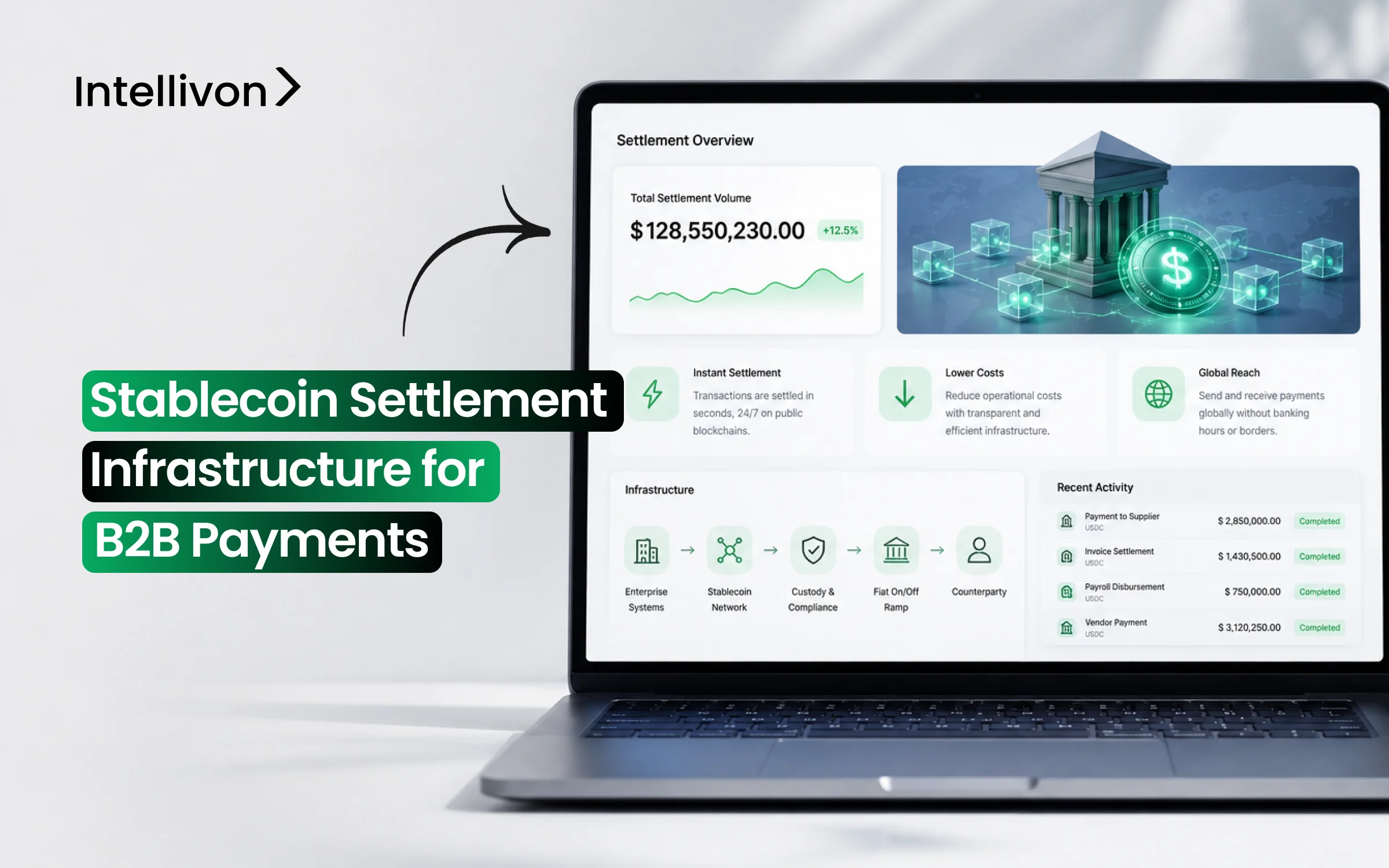
Key Takeaways:
-
Stablecoin rails replace the slowest settlement legs of ACH, SWIFT, wire, and card flows, and not entire networks.
-
Regulated on-ramps, MPC wallets, USDC or EURC, FX orchestration, and compliant off-ramps enable 24/7 value movement.
-
GENIUS Act, MiCA, FATF Travel Rule, KYC/KYB, sanctions screening, and licensing shape platform design requirements.
-
Corridor MVPs cost $70,000 to $120,000 while multi-corridor multi-chain platforms reach $180,000 to $300,000.
-
How Intellivon builds stablecoin payment rails corridor-first, keeping regulated services separate from proprietary orchestration layers.
Stablecoin settlement infrastructure is the layer that clears and finalizes B2B payments without routing them through a chain of correspondent banks. For a treasury team managing hundreds of supplier invoices, that layer decides whether a $2 million payment settles today or sits in transit for days.
However, settlement alone doesn’t solve netting. Businesses paying dozens of counterparties still need to consolidate what they owe against what they’re owed, instead of settling each invoice one by one. In fact, each correspondent bank in a payment chain adds $15 to $50 per transaction, plus an FX spread of up to 2%, according to World Bank data cited in a 2026 analysis. As a result, businesses that build netting directly into settlement typically recover that cost within six months.
Meanwhile, settlement infrastructure built without a netting engine tends to hit its limits fast, usually right around the time transaction volume climbs. This blog covers settlement finality, multilateral netting, custody, and compliance in order. By the end, you’ll know exactly what a production-grade B2B settlement build requires.

What Is Stablecoin Settlement Infrastructure for B2B Payments?
Stablecoin settlement infrastructure for B2B payments is the complete software stack for enterprise transfers. Specifically, it coordinates funds movement, compliance, clearing, liquidity, and ERP accounting integration across blockchains and banks.
As a result, enterprise platforms automate multi-party workflows, ensure instant finality, enforce regulatory checks, and sync with accounting systems.
1. The Difference Between Payment, Clearing, and Settlement
Traditional finance treats these steps as separate, multi-day functions. In contrast, on-chain architecture unifies them into one continuous pipeline.
| Financial Operation | Operational Definition | Core System Function | Timeframe |
| Payment | Transfer instruction from buyer to seller. | Captures intent and subsequently validates digital signatures. | Real-time |
| Clearing | Matching, verifying, and calculating final obligations. | Netting calculations and consequent compliance pre-screening. | Seconds |
| Settlement | Transfer of value that discharges financial obligation. | On-chain asset movement and therefore instant finality. | Instant ($T+0$) |
| Reconciliation | Matching ledger records with settlement data. | ERP synchronization and subsequent discrepancy resolution. | Continuous |
2. Why a Stablecoin Wallet Is Not a Settlement Platform
A crypto wallet merely holds private keys. However, an enterprise platform orchestrates the full operational stack.
- Payment Processing Engine: First, it manages transaction routing, batching, and gas fee optimization across multiple blockchains.
- Enterprise Ledger: Additionally, it tracks double-entry accounting records and maps transactions to internal business units.
- Compliance System: Furthermore, it executes real-time sanction screening, automated KYC checks, and AML risk monitoring.
- Liquidity Layer: Meanwhile, it coordinates real-time fiat-to-stablecoin conversions and foreign exchange rate locks globally.
- Reconciliation Platform: Finally, it automatically maps cryptographic transaction hashes to corporate invoice numbers inside ERPs.
For a deeper breakdown of enterprise financial software, see our guide on Building Cross-Border Payment Platforms Using Stablecoins.
3. Who Participates in a Stablecoin Settlement Transaction?
Executing high-value enterprise payments requires coordinated interaction between regulated entities, technical infrastructure, and software systems.
- Buyer & Supplier: Commercial counterparties initiating invoice payments and subsequently receiving final settlement funds.
- Stablecoin Issuer: Regulated entities that mint, redeem, and therefore back digital dollar tokens.
- Blockchain Network: Underlying protocols providing decentralized consensus and consequently ledger state updates.
- Institutional Custodian: MPC or HSM security providers, thus safeguarding enterprise private wallet keys.
- Liquidity Provider & Banking Partner: Financial institutions facilitating deep market liquidity and also holding fiat deposits.
- On-Ramp & Off-Ramp Service: Meanwhile, these providers execute instant conversions between bank channels and digital assets.
- Compliance & Analytics Partner: In addition, automated platforms screen wallet addresses and enforce FATF Travel Rule requirements.
- Settlement Platform: Ultimately, custom orchestration software built by Intellivon integrates all components seamlessly.
In summary, stablecoin settlement infrastructure coordinates every system involved in moving, recording, and verifying enterprise funds. Therefore, building a production platform requires evaluating the core technical components of the underlying architecture.
Why Enterprises Are Exploring B2B Stablecoin Payments
Enterprises are adopting stablecoin settlement infrastructure to eliminate structural inefficiencies in global cross-border treasury operations.
Replacing legacy correspondent banking channels with programmable blockchain rails allows corporate treasuries to accelerate capital velocity, eliminate intermediary fees, automate auditing, and optimize liquidity management.
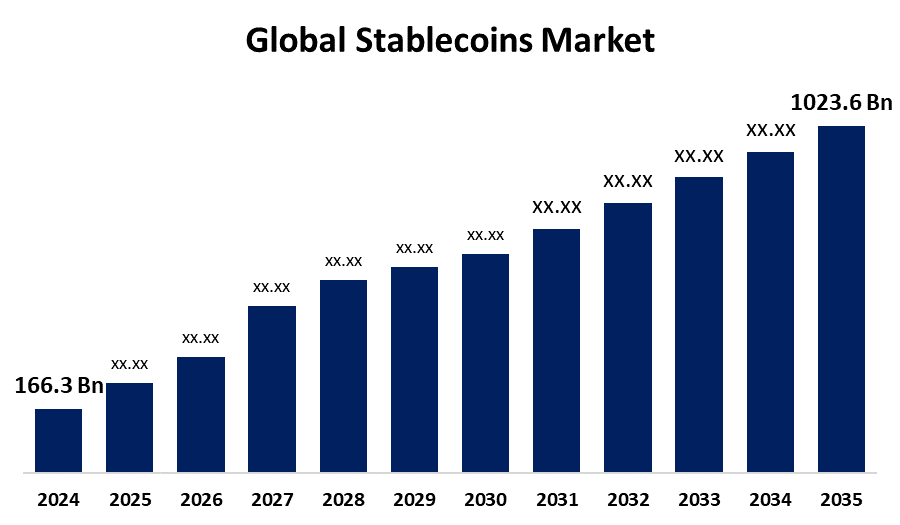
The global cross-border payments market is rapidly modernizing. According to recent industry benchmarks, the global stablecoin payment market is projected to expand at a compound annual growth rate (CAGR) exceeding 30% through 2030, driven largely by enterprise B2B adoption and corporate treasury optimization.
1. Faster Cross-Border Supplier Settlement
Legacy wire systems rely on commercial bank operating hours and batch processing cycles. In contrast, stablecoin settlement infrastructure operates continuously across public and private blockchains.
- Near-Real-Time Transfers: Blockchain networks process and finalize settlement transactions within seconds or minutes.
- 24/7/365 Availability: Furthermore, payment processing continues seamlessly across weekends and national bank holidays.
- Elimination of Cut-Off Times: Corporate treasuries can execute high-value supplier payments without adhering to strict banking cut-off windows.
- Instant Supplier Confirmation: Consequently, global vendors receive cryptographic proof of settlement immediately upon block inclusion.
Note on Fiat Delivery: While the on-chain transfer of stablecoins occurs instantly ($T+0$), final fiat delivery into a supplier’s local bank account still depends on local banking settlement rails (such as ACH, SEPA, or local real-time payment networks) and off-ramp processing speeds.
2. Lower Intermediary and Correspondent Banking Costs
Cross-border SWIFT transfers frequently pass through multiple correspondent banks, with each entity extracting processing fees and currency conversion margins along the payment route.
- Correspondent Fee Elimination: As a result, direct peer-to-peer on-chain transfers remove intermediary processing fees completely.
- Zero Lifting Fees: Additionally, suppliers avoid unexpected deductions from incoming wire transfers by intermediate banks.
- Reduced Investigation Expenses: Clear on-chain status reduces internal labor spent tracking stuck or missing international wires.
- Minimized FX Slippage: Finally, direct stablecoin rails eliminate repeated, multi-tiered currency conversions across intermediate banking corridors.
For a deeper breakdown of cost optimization strategies, see our guide on AI Engineering Solutions for Enterprise Finance.
3. Reduced Prefunding and Working Capital Pressure
Traditional cross-border payment providers require corporate treasuries to maintain capital reserves in multiple foreign accounts to guarantee rapid local payouts.
- Elimination of Nostro Balances: Specifically, companies no longer need capital trapped in foreign correspondent bank accounts.
- Reduced Corridor Reserves: Treasuries can hold centralized dollar-backed liquidity instead of prefunding individual geographic payout accounts.
- Lower Processor Float: Therefore, capital previously locked up as collateral with payment processors is freed for operational use.
- Optimized Liquidity Management: Consequently, finance teams improve cash forecasting and capital allocation across global subsidiaries.
4. Better Payment Tracking and Auditability
Legacy corporate payments suffer from fragmented tracking numbers and disconnected banking statements. In contrast, stablecoins provide cryptographic verification.
- Immutable Transaction Hashes: First, every settlement generates a unique, unalterable transaction identifier on-chain.
- Precise Timestamps: Second, block timestamps record the exact second payment finality was achieved.
- Verified Wallet Addresses: Third, clear address tracking ensures complete visibility into sender and receiver identities.
- ERP-Linked Audit Trails: Finally, custom integration engine software links on-chain hashes directly to internal corporate invoice records.
Enterprise stablecoin settlement delivers maximum value for high-volume, cross-border B2B transactions by eliminating correspondent banking friction, while traditional payment rails remain optimal for simple domestic transfers.
Core Components of a B2B Stablecoin Settlement Platform
Designing a B2B stablecoin settlement platform requires a unified architecture connecting internal corporate systems with distributed blockchain networks. Rather than serving as a simple wallet, the platform functions as an orchestration layer.
Specifically, it automates financial workflows, maintains immutable accounting records, and enforces strict compliance.
1. Enterprise Payment Dashboard
The front-end interface provides corporate treasurers with complete operational control over international payment workflows.
- Payment Creation & Approvals: Teams initiate transactions with configurable multi-level corporate sign-off policies.
- Supplier Management: Meanwhile, the system tracks verified vendor profiles, payment preferences, and linked wallet addresses.
- Tracking & Analytics: Real-time dashboards provide live status updates, search functionality, and treasury reporting.
- Role-Based Access Control: Additionally, strict permissioning ensures granular visibility based on enterprise user roles.
2. Settlement and Transaction Processing Engine
The core execution engine manages transaction lifecycle mechanics from validation to finality.
- Validation & Reservation: First, the system validates incoming requests and reserves ledger balances before execution.
- Routing & Status Management: Next, automated logic routes transactions across target networks and updates transaction state.
- Resilience Mechanisms: Furthermore, built-in safeguards prevent duplicate payments, handle network retries, and execute scheduled batches.
3. Enterprise Ledger
A double-entry accounting ledger tracks internal balances independent of underlying blockchain state changes.
- Balance Segregation: The engine maintains segregated records for available, reserved, pending, and settled funds.
- Accounting Adjustments: As a result, automatic entries capture network gas fees, foreign exchange adjustments, and payment reversals.
- Client Fund Protection: Consequently, multi-tenant ledger structures enforce strict segregation of enterprise funds.
4. Stablecoin and Blockchain Integration Layer
This abstraction layer manages low-level technical interactions across heterogeneous public and private blockchains.
- Smart Contract Adapters: Standardized smart contract interfaces interact with ERC-20, SPL, and native asset standards.
- Node & RPC Infrastructure: In addition, dedicated RPC connections ensure high availability and continuous confirmation tracking.
- Gas & Route Optimization: Ultimately, intelligent routing models estimate network fees and select optimal blockchain rails.
5. Custody and Wallet Infrastructure
Enterprise key management protects digital asset reserves without introducing operational bottlenecks.
- MPC & HSM Security: Multi-party computation and hardware security modules secure cryptographic private keys.
- Multi-Signature Vaults: Meanwhile, tiered wallet structures distribute risk across hot, warm, and cold storage layers.
- Governance Policies: Therefore, automated key recovery and programmatic approval rules prevent unauthorized transfers.
6. Compliance and Risk Infrastructure
Automated compliance modules enforce global regulatory requirements prior to on-chain execution.
- Identity Verification: Integrated KYB and KYC workflows screen corporate counterparties during onboarding.
- Transaction Monitoring: Real-time wallet screening detects illicit activity and enforces FATF Travel Rule compliance.
- Sanctions & Fraud Prevention: Similarly, automated rules check OFAC lists and route suspicious transactions to case management.
7. Integration and Reporting Layer
The platform bridges decentralized networks with legacy corporate IT infrastructure.
- ERP & Banking Connectors: Pre-built REST APIs and webhooks integrate directly with SAP, Oracle, and NetSuite.
- Financial Messaging: Furthermore, support for ISO 20022 formats aligns on-chain metadata with standard banking rails.
- Automated Audit Reports: Finally, reporting engines generate exportable logs for tax, accounting, and regulatory audits.
In summary, enterprise stablecoin settlement platforms integrate core payment processing, double-entry ledgers, MPC custody, and automated compliance into a single architecture.
Consequently, evaluating these components helps organizations determine whether to build custom infrastructure or integrate existing market solutions.
Choosing Stablecoins and Blockchain Networks
Choosing stablecoins and execution networks requires evaluating corridor needs rather than asset popularity. Enterprise platforms must analyze reserve transparency, liquidity depth, and finality speeds to ensure reliable corporate payment execution.
1. How to Select a Stablecoin for B2B Settlement
- Reserve Transparency: First, treasuries evaluate third-party audit reports and short-term Treasury holdings.
- Redemption Access: Furthermore, direct minting mechanisms dictate how fast fiat payouts settle into bank accounts.
- Regulatory Status: However, compliance with local frameworks like MiCA dictates long-term asset viability.
- Jurisdiction Risks: Additionally, local banking relationships dictate overall counterparty exposure.
- Market Liquidity: Therefore, high daily volume minimizes order book slippage during large transfers.
- Recovery Tools: Finally, programmatically enforceable freeze functions allow issuers to isolate illicit transactions.
Supported enterprise assets include Circle’s USDC, Tether’s USDT, Circle’s EURC, Paxos’s PYUSD, and Ripple’s RLUSD.
2. How to Select a Blockchain Network
- Settlement Speed: First, deterministic finality prevents payment reversal risks for high-value supplier transfers.
- Execution Cost: Furthermore, predictable low gas fees keep high-volume batch payments economically viable.
- Custody Support: However, deep liquidity must pair with Fireblocks or Anchorage support for security.
- Smart Contracts: Therefore, advanced programmability enables custom escrow logic and automated fee splits.
Supported execution networks include Ethereum, Solana, Stellar, XRP Ledger, Polygon, Base, Arbitrum, and Avalanche. For multi-chain deployment, review our guide on Stablecoin vs SWIFT: Which Payment Rail Should Businesses Choose?
3. Should the Platform Support Multiple Stablecoins?
- Corridor Preferences: Specifically, Asian vendors often request USDT, whereas European firms require native EURC.
- Risk Management: Furthermore, multi-asset routing prevents single-issuer concentration risk.
- Regulatory Compliance: Additionally, regional laws mandate specific licensed digital assets within local borders.
- Liquidity Redundancy: Consequently, multi-stablecoin support prevents payment halts during localized de-pegging events.
4. When Multi-Chain Support Is Necessary
- Congestion Rerouting: Specifically, high fees on mainnet routes automatically trigger fallback layer-2 routes.
- Outage Protection: Furthermore, backup settlement options maintain uptime during primary network downtime.
- Counterparty Needs: Additionally, suppliers often request specific low-cost networks based on local infrastructure.
- Native Assets: Consequently, accessing specific stablecoin variants requires native multi-chain integration.
5. Risks of Cross-Chain Bridges
- Smart Contract Exploits: Specifically, complex bridge contracts represent primary targets for malicious attacks.
- Liquidity Fragmentation: Furthermore, locked asset pools often lack depth for large corporate payments.
- Wrapped Token De-pegs: However, holding synthetic assets exposes corporate treasuries to insolvency risks.
- Bridge Shutdowns: Consequently, unexpected validator halts lock enterprise capital in transit indefinitely.
In conclusion, enterprise platforms avoid unvetted bridges and prioritize native multi-chain liquidity pools. Consequently, evaluating these options leads directly into enterprise integration workflows.
Choosing the Right Settlement Model
Choosing a settlement model depends on balancing instant finality against liquidity efficiency. Platforms can execute individual payments immediately or aggregate recurring obligations through netting.
Furthermore, hybrid structures automate settlement selection based on transaction urgency and risk.
Consequently, treasuries eliminate capital drag while protecting global B2B transactions against default. Therefore, selecting the optimal architecture ensures efficient cash flow across all corridors.
1. Real-Time Gross Settlement
Real-Time Gross Settlement processes each payment individually on-chain without offsetting prior balances.
- High-Value Transfers: First, it is best suited for high-value supplier transfers requiring speed.
- Immediate Finality: Furthermore, it provides immediate block finality for urgent corporate treasury movements.
- Low-Frequency Payments: However, it is ideal for low-frequency payments rather than bulk batches.
- Zero Credit Risk: Consequently, settlement occurs instantly without exposing trading partners to credit risk.
2. Bilateral Netting
Bilateral netting offsets mutual balances between two partners before settling the net difference.
- Regular Partners: First, it is best suited for long-term trading relationships.
- Intercompany Settlements: Additionally, enterprise subsidiaries use it to consolidate internal intercompany liabilities.
- Reduced Gas Fees: As a result, netting reduces total transaction volume and on-chain fees.
3. Multilateral Netting
Multilateral netting aggregates obligations across multiple participants through one central platform.
- B2B Marketplaces: Specifically, it benefits B2B marketplaces, supply chains, and payment processors.
- Trade Platforms: Furthermore, trade finance platforms use it to optimize liquidity management.
- Reduced Float: Consequently, participants settle net positions while reducing total required cash reserves.
4. Hybrid Settlement
Hybrid settlement combines real-time execution with scheduled intraday batch netting algorithms.
- Urgent Real-Time Transfers: Specifically, urgent high-value payments settle instantly through real-time gross channels.
- Intraday Netting Batches: In contrast, recurring payments accumulate for scheduled intraday netting batches.
- Exposure Limit Triggers: Therefore, automated triggers execute immediate settlement when exposure limits are reached.
5. Managing Counterparty and Default Risk
Netting structures introduce temporal risk, requiring strict programmatic liquidity controls.
- Credit Limits: First, platforms enforce participant credit limits and prefunding smart contract requirements.
- Collateral Protection: Furthermore, posted collateral guarantees settlement during sudden market volatility events.
- Automated Suspensions: Consequently, automated default procedures suspend non-compliant accounts to protect network capital.
Real-time settlement eliminates credit risk, while netting maximizes overall capital efficiency. Therefore, selecting a settlement model dictates the required platform liquidity architecture.
Compliance Requirements for B2B Stablecoin Settlement
Deploying B2B stablecoin settlement infrastructure requires continuous adherence to global regulatory frameworks, anti-money laundering mandates, and strict privacy laws. Enterprise architectures must automate compliance workflows directly within payment pipelines.
Consequently, compliance engines validate transactions programmatically prior to on-chain execution.
1. KYC and KYB Requirements
Corporate onboarding requires rigorous Know Your Business (KYB) and Know Your Customer (KYC) protocols to establish counterparty legitimacy.
- Business Verification: First, compliance teams verify legal corporate registration and operational status.
- Beneficial Ownership: Furthermore, automated systems identify ultimate beneficial owners holding significant equity stakes.
- Director Screening: Additionally, executive directors undergo direct identity verification and background checks.
- Source of Funds: Consequently, platforms validate business activities, fund sources, and expected volumes.
2. AML Transaction Monitoring
Continuous Anti-Money Laundering (AML) monitoring analyzes payment flows in real time to detect illicit financial patterns.
- Velocity Checks: First, automated rules track transaction sizes and sudden velocity spikes.
- Wallet History: Furthermore, risk models evaluate historical wallet interactions and counterparty behavior.
- Geographic Risk: Additionally, analytics engines flag transfers involving high-risk jurisdiction corridors.
- Unusual Patterns: Consequently, systems flag anomalous settlement activity for manual compliance review.
3. Sanctions and Wallet Screening
Sanctions screening engines inspect every corporate wallet and transaction hash against global regulatory watchlists.
- OFAC & PEP Checks: First, platforms screen counterparties against OFAC lists and PEP databases.
- Adverse Media: Furthermore, media monitoring tools scan global news for legal risks.
- Mixer Exposure: Additionally, wallet screening isolates direct or indirect exposure to obfuscation services.
- Risk Scoring: Consequently, automated scoring blocks sanctioned entities prior to smart contract execution.
4. FATF Travel Rule
The FATF Travel Rule mandates seamless identity data exchange between Virtual Asset Service Providers (VASPs).
- Identity Exchange: First, platforms securely transmit originator and beneficiary details alongside payments.
- VASP Data Sharing: Furthermore, encrypted VASP-to-VASP channels enable secure, compliant data transmission.
- IVMS 101 Standard: Additionally, systems format identity payloads using universal IVMS 101 data standards.
- Record Retention: Consequently, detailed transaction records are archived for statutory retention periods.
5. Regulatory Requirements by Market
Operating cross-border settlement rails requires maintaining local licenses and regulatory compliance across distinct jurisdictions.
- United States: First, platforms maintain FinCEN registration and state money transmission licenses.
- European Union: Furthermore, issuers and service providers must comply with strict MiCA requirements.
- United Kingdom: Additionally, UK operations require direct registration under FCA money laundering rules.
- Asia-Pacific & Middle East: Consequently, platforms adhere to MAS in Singapore, HKMA in Hong Kong, and VARA in Dubai.
6. Data Privacy and Residency
Enterprise payment architectures must balance regulatory transparency with rigorous global data privacy laws.
- GDPR & CCPA: First, privacy frameworks restrict unauthorized sharing of personally identifiable information.
- Data Encryption: Furthermore, zero-knowledge proofs and end-to-end encryption protect stored data.
- Data Localization: Additionally, local residency rules dictate where compliance database records reside.
- Access Control: Consequently, strict role-based permissions restrict sensitive corporate financial records.
In summary, integrating automated compliance mechanisms directly into payment pipelines protects enterprises against severe regulatory penalties and operational halts. Consequently, embedding compliance infrastructure provides a secure foundation for managing platform operational risks.
Using AI in B2B Stablecoin Settlement
Integrating AI into stablecoin settlement architectures enhances operational efficiency while maintaining strict treasury governance. AI models analyze streaming transaction metadata to optimize routing, forecast liquidity needs, and detect settlement anomalies in real time.
Consequently, predictive engines support human operators without taking direct custody or programmatic control of underlying treasury funds.
1. Fraud and Transaction Risk Scoring
Machine learning models continuously evaluate payment vectors to generate real-time risk scores prior to execution.
- Behavior Analysis: First, algorithms flag sudden spikes in payment values and transaction frequency.
- Counterparty Mapping: Furthermore, risk engines monitor wallet behavior and emerging counterparty relationship graphs.
- Geographic Patterns: Additionally, models detect abnormal geographic routing patterns and suspicious user activity.
- Risk Mitigation: Consequently, high-risk transactions trigger automated compliance holds for manual review.
2. Liquidity Forecasting
Predictive models analyze historical payment volume to optimize working capital across global settlement corridors.
- Corridor Demand: First, forecasting tools project daily stablecoin requirements across specific currency pairs.
- Fiat Payouts: Furthermore, algorithms calculate required local fiat reserves for off-ramp bank processing.
- Weekend Liquidity: Additionally, predictive models anticipate weekend payment volume when traditional banks close.
- Treasury Rebalancing: Consequently, treasuries rebalance cross-chain liquidity proactively before corridors face shortages.
3. Payment Route Optimization
AI routing engines generate real-time execution recommendations to minimize transaction costs and settlement friction.
- Fee Optimization: First, algorithms evaluate current network gas fees and dynamic FX spreads.
- Liquidity Assessment: Furthermore, routing engines evaluate provider availability and order book liquidity depth.
- Congestion Rerouting: Additionally, predictive systems monitor blockchain network congestion to prevent settlement delays.
- Cost Reduction: Consequently, automated recommendations select the fastest and cheapest execution pathway.
4. Reconciliation Anomaly Detection
Pattern recognition models streamline ledger reconciliation by pinpointing operational discrepancies across multi-chain systems.
- Record Matching: First, models detect missing ERP records and unmatched ledger transactions instantly.
- Amount Validation: Furthermore, algorithms flag incorrect payment amounts and duplicate settlement attempts.
- Off-Ramp Tracking: Additionally, automated monitors identify delayed fiat off-ramp confirmations across banking partners.
- Rapid Resolution: Consequently, finance teams resolve operational discrepancies before daily books close.
5. Where AI Should Not Control Settlement
Enterprise security mandates strict boundaries, preventing autonomous AI models from executing critical financial actions directly.
- Transaction Signing: First, AI models must never independently sign blockchain transactions or release funds.
- Beneficiary Changes: Furthermore, algorithms cannot modify beneficiary payment details or destination wallet addresses.
- Limit Overrides: Additionally, models must never override corporate transaction limits or release compliance holds.
- Final Approval: Consequently, human treasury managers retain absolute authority over final payment execution.
For further insights on implementing intelligent enterprise financial tools, explore our guide on How Fintechs Are Replacing Traditional Payment Rails With Stablecoins.
In summary, AI functions strictly as a predictive analysis layer while deterministic smart contracts and human operators retain complete execution authority.
Consequently, establishing rigid operational boundaries leads directly into overall platform risk management.
B2B Stablecoin Settlement Use Cases
Deploying programmatic stablecoin rails unlocks measurable liquidity efficiency across high-volume commercial settlement corridors. Enterprise treasury systems replace traditional correspondent banking chains with deterministic smart contract execution.
Consequently, global organizations eliminate cross-border settlement friction, lower transactional overhead, and maintain continuous operational working capital.
1. Cross-Border Supplier Payments
Global manufacturing and hardware supply chains require rapid, friction-free payment settlement across complex international borders.
- Automotive & Electronics: First, manufacturers settle multi-tiered component supplier invoices instantaneously on-chain.
- Pharmaceutical Imports: Furthermore, healthcare enterprises execute direct payments for international raw chemical orders.
- Medical Devices: Additionally, medical equipment distributors eliminate multi-day correspondent bank clearing delays.
- Capital Efficiency: Consequently, accelerated supplier payouts minimize production bottlenecks and supply chain halts.
2. Marketplace and Partner Settlement
Digital platforms require automated, high-velocity payout infrastructure to distribute funds across global seller networks.
- B2B Marketplaces: First, platforms execute immediate programmatic payouts to global multi-vendor networks.
- E-commerce & SaaS: Furthermore, digital platforms distribute recurring partner commissions without localized FX markups.
- Digital Media: Additionally, streaming networks stream micro-payouts directly to international content creators.
- Automated Splits: Consequently, smart contracts handle complex multi-party revenue splits during transaction settlement.
3. Intercompany Treasury Transfers
Multinational corporations manage complex cross-border cash flows across internal subsidiaries and operational entities.
- Subsidiary Funding: First, enterprise treasuries move working capital across global operating units instantly.
- Intra-Group Netting: Furthermore, centralized finance teams offset internal balance sheet obligations seamlessly.
- 24/7 Liquidity: Additionally, digital asset rails allow continuous weekend capital transfers without banking halts.
- Trapped Capital: Consequently, organizations eliminate trapped liquidity pools locked in correspondent banking networks.
4. Trade Finance and Commodity Settlement
International commodity trade relies on atomic, conditional settlement mechanisms to balance buyer and seller exposure.
- Energy & Commodities: First, trading desks settle large-scale physical energy shipments conditionally on-chain.
- Logistics Networks: Furthermore, freight operators execute automated payments upon verified Bill of Lading releases.
- International Trade: Additionally, digital escrow contracts replace slow, paper-based letters of credit.
- Default Mitigation: Consequently, atomic delivery-versus-payment execution eliminates counterparty settlement default risks.
5. Pharmaceutical and Clinical Research Payments
Global clinical trials demand precise, audit-ready financial disbursements across diverse international research facilities.
- CRO Disbursements: First, pharmaceutical sponsors distribute clinical research organization funding without administrative friction.
- Trial Site Funding: Furthermore, medical sites receive instant operational payments based on patient milestone completions.
- Contract Manufacturing: Additionally, laboratories and specialized chemical manufacturers settle production runs instantly.
- Regulatory Auditing: Consequently, immutable blockchain ledgers provide complete, transparent trial payment audit trails.
6. Financial Institution Settlement
Institutional market participants require ultra-low-latency settlement rails for wholesale interbank liquidity management.
- Interbank Clearing: First, commercial banks clear interbank obligations directly using institutional stablecoin assets.
- Payment Processors: Furthermore, merchant aggregators execute high-volume daily settlement rounds cost-effectively.
- Insurers & Funds: Additionally, asset managers and insurers settle institutional trading positions instantly.
- Trade Finance: Consequently, finance companies optimize collateral management across international liquidity pools.
In summary, replacing legacy correspondent networks with programmable stablecoin rails converts cross-border treasury operations into a real-time competitive advantage. Consequently, identifying relevant commercial use cases allows enterprise leaders to prioritize strategic deployment roadmaps.
How Much Does B2B Stablecoin Settlement Infrastructure Cost?
Building dedicated B2B stablecoin settlement infrastructure typically costs $70,000 to $300,000 depending on platform scope, multi-chain depth, and enterprise integration complexity.
Organizations must balance capital expenditure against long-term operational velocity across target settlement corridors. Consequently, evaluating cost structures by deployment tier ensures aligned treasury budgeting.
1. Focused Pilot — $70,000 to $110,000
A focused pilot validates core settlement mechanics within a single high-volume corridor prior to full enterprise rollout.
- Single Stablecoin: First, platforms integrate one asset such as USDC or USDT.
- Single Blockchain: Furthermore, execution relies on one high-speed network like Solana or Polygon.
- Single Corridor: Additionally, processing targets a specific bilateral payment route.
- Basic Ledger: Consequently, off-chain ledger tracking remains simple with third-party custody integrations.
- Compliance Setup: Specifically, basic KYB screening tools integrate alongside limited ERP connections.
2. Production Platform — $120,000 to $190,000
Production platforms support full operational volume across primary commercial payment corridors.
- Enterprise Ledger: First, architecture incorporates double-entry event-driven ledger engines.
- MPC Custody: Furthermore, security utilizes Multi-Party Computation (MPC) infrastructure via Fireblocks or Anchorage.
- Automated Reconciliation: Additionally, systems feature automated bank reconciliation, liquidity provider APIs, and dynamic FX management.
- ERP Workflows: Consequently, deep bi-directional ERP integration pairs with automated compliance monitoring pipelines.
3. Multi-Corridor Platform — $200,000 to $300,000
Multi-corridor platforms deliver global multi-asset liquidity orchestration for complex enterprise treasuries.
- Multi-Asset Routing: First, platforms support multiple stablecoins across diverse blockchain networks.
- Netting Engines: Furthermore, advanced engines support bilateral netting, multilateral netting, DvP, or PvP models.
- Smart Order Routing: Additionally, algorithmic liquidity routing optimizes execution across global market makers.
- Multi-Region Operations: Consequently, architecture supports multi-region enterprise deployments and multi-ERP systems.
4. Development Cost by Phase
Building enterprise settlement infrastructure requires capital allocation across distinct engineering phases:
- Discovery & Planning: First, discovery and compliance planning costs $7,000–$15,000.
- Architecture & Design: Furthermore, architecture and UX design costs $10,000–$25,000.
- Ledger & Settlement: Additionally, building the core ledger and settlement engine costs $20,000–$55,000.
- Custody Integrations: Subsequently, blockchain network and custody integrations cost $12,000–$35,000.
- Enterprise Workflows: Therefore, compliance, liquidity, and ERP integrations cost $15,000–$70,000.
- Testing & Support: Finally, testing, deployment, and pilot support cost $6,000–$30,000.
5. Ongoing Operating Costs
Annual system maintenance typically equals 15%–25% of original development costs. Furthermore, initial development estimates exclude specific operational overhead liabilities:
- Licensing & Legal: First, estimates exclude money transmission licensing fees and specialized legal advice.
- Capital & Reserves: Furthermore, working liquidity capital, stablecoin reserves, and custodian minimums are separate.
- Banking & Fees: Additionally, banking deposits, per-transaction provider costs, and independent certifications require separate budgeting.
Plan your enterprise settlement deployment accurately using our detailed cost modeling framework with Intellivon’s experts.
Therefore, understanding cost parameters enables executive teams to plan long-term technology roadmaps effectively.
B2B Stablecoin Settlement Implementation Roadmap
Executing an enterprise B2B stablecoin settlement architecture requires a disciplined, phase-gated implementation strategy. Organizations systematically mitigate operational, compliance, and counterparty risks by moving from corridor analysis to full production automation.
Consequently, structured execution roadmaps transform cross-border payment rails into scalable corporate infrastructure.
Phase 1 — Define the Payment Corridor
Initial execution begins by evaluating target commercial corridors to quantify financial friction and operational requirements.
- Market Selection: First, finance leaders identify primary origin and destination markets.
- Volume Mapping: Furthermore, treasury teams analyze historical payment volumes and settlement delays.
- Cost Analysis: Additionally, platforms calculate current correspondent banking fees and FX markups.
- Supplier Requirements: Consequently, teams document supplier needs while assigning explicit regional regulatory responsibilities.
Phase 2 — Design the Settlement Architecture
Architectural design establishes technical specifications across blockchain, custody, ledger, and banking integrations.
- Asset Selection: First, architects select optimal stablecoin assets and execution blockchain networks.
- Ledger Mechanics: Furthermore, engineers define core double-entry ledger structures and settlement models.
- Custody Framework: Additionally, platforms select institutional MPC custody providers and AML monitoring tools.
- System Connections: Consequently, design blueprints specify liquidity provider APIs and enterprise ERP connections.
Phase 3 — Build the Core Platform
Engineering teams construct the foundational software modules required for secure asset orchestration.
- API Infrastructure: First, developers build core payment APIs and double-entry enterprise ledgers.
- Approval Workflows: Furthermore, teams implement multi-signature governance workflows and wallet infrastructure.
- Transaction Engine: Additionally, engineers build scalable transaction processing microservices and administrative dashboards.
- Security Testing: Consequently, thorough smart contract security audits prepare the platform for live deployment.
Phase 4 — Add Compliance and Financial Integrations
Integrating specialized financial service providers ensures seamless fiat-to-crypto transitions and regulatory adherence.
- KYC & KYB Tools: First, engineers integrate automated KYB, AML, and sanctions screening engines.
- Travel Rule: Furthermore, compliance modules implement VASP-to-VASP FATF Travel Rule messaging rails.
- Fiat Off-Ramps: Additionally, systems connect banking partners for automated fiat on-ramp and off-ramp processing.
- ERP Synchronization: Consequently, real-time FX engines link directly with corporate ERP and treasury management tools.
Phase 5 — Launch a Controlled Pilot
Deploying a restricted pilot validates operational workflows while limiting initial financial exposure.
- Corridor Testing: First, operations launch within a single corridor using one stablecoin variant.
- Limited Scope: Furthermore, initial onboarding restricts participation to selected, high-volume suppliers.
- Risk Controls: Additionally, risk engines enforce strict transaction limits under manual compliance oversight.
- Daily Reconciliation: Consequently, finance teams perform daily manual balance reconciliations to verify ledger accuracy.
Phase 6 — Expand Into Production
Production scaling unlocks multi-asset liquidity routing and continuous operational settlement capabilities.
- Supplier Onboarding: First, platforms onboard broader supplier networks and increase transaction caps.
- Multi-Asset Support: Furthermore, operations integrate additional blockchain networks, stablecoins, and liquidity corridors.
- Automated Routing: Additionally, intelligent order routing engines automate cross-chain execution and FX conversions.
- Redundant Providers: Consequently, 24/7 automated routing relies on backup liquidity providers to maintain continuous uptime.
To learn more about engineering custom financial software platforms, consult our insights on Product and Platform Engineering.
In summary, a phased deployment framework allows enterprises to validate technical performance and compliance mechanisms before scaling transaction volumes globally. Consequently, executing a structured roadmap ensures long-term operational resilience and treasury security.
Build B2B Stablecoin Settlement Infrastructure With Intellivon
At Intellivon, we build treasury systems as real-time financial decision infrastructure rather than simple automation layers. The objective is to unify data, decision logic, and execution across your entire treasury function.
Consequently, our systems enable continuous, intelligent automation for global corporate operations.
Our engineering approach combines multi-agent AI systems with API-first, cloud-native architecture.
This ensures seamless integration with ERPs, core banking systems, SWIFT networks, and digital asset networks without operational disruption.
Why Build With Intellivon
- Infrastructure-First Approach: First, we design scalable treasury systems that handle complex enterprise operations effortlessly.
- Built for Real Workflows: Furthermore, every system aligns with real-world multi-entity liquidity management processes.
- Agent-Driven Decision Systems: Additionally, multi-agent architectures continuously monitor, decide, and execute workflows in real time.
- API-First Integration: Consequently, seamless connectivity with ERPs and banking APIs ensures rapid deployment flexibility.
- Compliance and Control Built In: Finally, audit trails and regulatory mechanisms meet global financial standards from day one.
From Strategy to Scalable Deployment
We work with your team from initial architecture design through full-scale deployment. This includes system design, enterprise integrations, multi-agent development, rigorous security testing, and ongoing optimization.
Consequently, your treasury evolves directly into a fully automated, intelligent financial execution system.
Get Your Treasury AI Roadmap
Looking to automate and scale your treasury operations with AI agents?
Connect with Intellivon’s AI consultants to build a custom, production-ready treasury system designed for real-time financial decision-making. Work with Intellivon to define your architecture, cost structure, and phased implementation roadmap on Intellivon Resources.
Conclusion
Modern stablecoin settlement infrastructure fundamentally transforms how global enterprise treasury operations function daily. Furthermore, programmable digital money replaces slow correspondent banking networks with deterministic smart contracts.
Consequently, corporate organizations achieve immediate transaction finality while minimizing costly cross-border friction.
Therefore, forward-thinking financial leaders must actively prioritize scalable multi-chain liquidity architecture today. Additionally, integrating automated compliance engines ensures strict regulatory adherence across all operational jurisdictions.
In conclusion, modernizing enterprise payment rails establishes a highly scalable and permanent competitive advantage.
FAQs
Q1. Which stablecoin is best for B2B payments?
A1. Fiat-backed stablecoins like USDC and USDT lead enterprise adoption due to high liquidity. Furthermore, fully reserved assets backed by short-term government treasuries minimize counterparty risk. Consequently, selecting a stablecoin depends heavily on target payment corridors, local regulatory approvals, and primary banking integration support.
Q2. Does a business need a licence to use stablecoins for settlement?
A2. Generally, end-user businesses paying vendors or receiving funds do not require dedicated crypto licences. However, using non-custodial infrastructure requires adherence to local AML and sanctions screening rules. Consequently, partnering with licensed virtual asset service providers ensures full regulatory compliance across every operational jurisdiction.
Q3. Can stablecoin settlement integrate with SAP or Oracle?
A3. Yes, enterprise stablecoin infrastructure integrates directly with major ERP systems using webhooks and RESTful APIs. Furthermore, automated middleware synchronizes double-entry subledgers with core financial software in real time. Consequently, finance teams execute, reconcile, and audit cross-border digital transactions without disrupting existing accounting workflows.
Q4. What happens if a payment goes to the wrong wallet?
A4. Blockchain transactions are completely irreversible once confirmed on-chain by network validators. Therefore, misdirected payments cannot be recalled through typical bank chargeback mechanisms. Consequently, enterprise platforms enforce automated address validation, smart-contract whitelisting, and strict multi-signature approval steps to eliminate manual routing errors entirely.
Q5. Is stablecoin settlement cheaper than SWIFT?
A5. Yes, stablecoin transactions eliminate correspondent banking chains, intermediary fee markups, and costly manual clearing delays. Furthermore, direct blockchain rails lower transaction fees to pennies regardless of total transfer value. Consequently, global enterprises consistently reduce cross-border settlement costs by 60% to 80% compared to traditional SWIFT networks.
To Sum It Up:
- A stablecoin wallet is only one component of B2B settlement infrastructure.
- Faster blockchain transfers do not guarantee faster supplier access to local currency.
- The enterprise ledger, reconciliation process, and liquidity model matter as much as the blockchain.
- Netting can reduce liquidity requirements but increases counterparty and default risk.
- A production platform typically costs $120,000–$300,000 when compliance, custody, integrations, and 24/7 operations are included.