Key Takeaways:
-
Stablecoin cross-border infrastructure converts fiat, routes value across blockchain networks, and pays recipients in local currency.
-
MPC/HSM custody, payment orchestration, on/off-ramps, FX, ISO 20022 messaging, and blockchain analytics are core components.
-
KYC/AML, Travel Rule controls, and regulated stablecoins like USDC and EURC are non-negotiable compliance requirements.
-
Single-corridor pilots cost $70,000 to $120,000 while multi-corridor production platforms reach $180,000 to $300,000.
-
How Intellivon builds stablecoin infrastructure corridor-first, separating regulated services from custom payment orchestration layers.
Stablecoin infrastructure is the underlying system that moves payments across borders. It includes custody, settlement, and compliance layers working together. Instead of routing through correspondent banks, payments move directly between parties. As a result, a treasury team can see a payment land in minutes. Meanwhile, the old system holds that same payment for days, passing it through several banks along the way.
However, picking a blockchain and a stablecoin isn’t infrastructure. It’s just one piece of it. What actually determines reliability is how settlement, custody, and compliance work as one system, rather than getting stitched together after launch. Otherwise, gaps start showing fast. For instance, cross-border B2B payments still take three to five days on average, and cost 6.3% of transaction value, largely due to correspondent banking, according to World Bank data cited in a 2026 analysis.
Typically, enterprises pick a blockchain first, then add compliance right before launch. However, this approach breaks down the entire platform, often when a partner bank asks for travel rule data the platform was never built to send. This blog covers our entire development process, including network and custody design, then compliance, then settlement, FX, and monitoring, so you know what a production-grade build actually takes.

What Is A Stablecoin Platform For Cross-Border Payments?
An enterprise stablecoin platform for cross-border payments is a software system that uses fiat-backed digital tokens to move money globally. Instead of relying on traditional correspondent banks, these platforms process international transfers directly on blockchain networks in real time.
As a result, your organization can settle cross-border transactions in seconds rather than days. The system automatically connects your existing bank accounts to blockchain networks, handles currency conversions, and ensures full regulatory compliance for every transfer.
Why Stablecoin Infrastructure Matters for Global Payments
Stablecoin infrastructure creates clear enterprise value when it reduces total landed payment cost, eliminates settlement uncertainty, minimizes prefunding requirements, and slashes reconciliation effort within a specific corridor.
Rather than serving as a blanket replacement for existing rails, these systems optimize capital efficiency across complex, multi-currency corporate payment flows.
Driven by strong enterprise demand, the stablecoin payment infrastructure market is projected to expand at a 34.5% CAGR between 2026 and 2035, according to Astute Analytica, growing from $3 billion to over $58 billion.
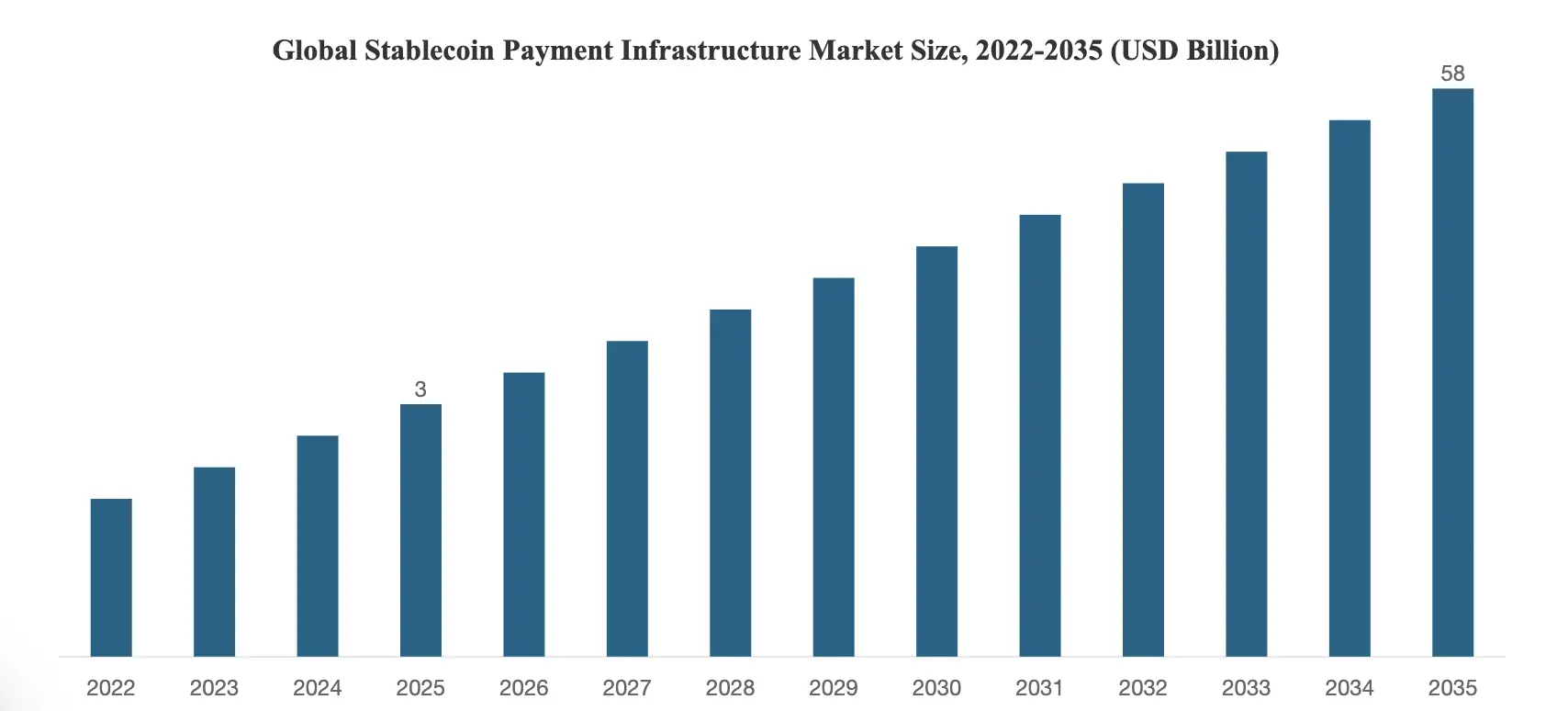
As cross-border payment volume scales globally, adopting modular digital asset rails allows forward-looking treasuries to optimize international liquidity.
1. Where Stablecoin Rails Create the Most Value
Stablecoin networks excel in high-value, time-sensitive, or cross-border payment flows where traditional correspondent banking layers add heavy fees, multi-day delays, and operational friction.
- High-value B2B supplier payments: Speeds up international vendor settlements and eliminates intermediary correspondent bank deduction fees.
- International payroll and contractor payments: Enables instant, 24/7 disbursements to global talent without paying local bank wire surcharges.
- Marketplace seller payouts: Allows cross-border platforms to settle funds instantly with global merchants at a fraction of standard card network fees.
- Intercompany treasury movements: Optimizes global cash management by moving liquidity across international subsidiaries instantly, 24 hours a day.
- Remittance and money-transfer corridors: Cuts consumer and business transfer costs on high-volume corridors with high retail bank margins.
- Freight, commodity, healthcare supply, and pharmaceutical payments: Delivers verifiable, real-time payment finality to unlock critical supply chain shipments without waiting for wire clearing.
2. Where Traditional Rails May Still Be Better
Legacy payment networks and domestic real-time rails remain the superior operational choice for localized, low-risk, or strictly regulated payment environments.
- Domestic real-time systems: Local rails like FedNow or Pix deliver instant settlement locally at near-zero cost without digital asset conversions.
- Low-value micro-transactions: On-chain gas fees and fiat conversion spreads can outweigh the benefits of small-value transfers.
- Weak stablecoin liquidity corridors: Emerging market corridors lacking deep local fiat-to-stablecoin liquidity pools incur heavy slippage.
- Markets with legal restrictions: Jurisdictions with strict capital controls or explicit crypto prohibitions present insurmountable legal compliance risks.
According to research from McKinsey, legacy payment networks retain distinct structural advantages, including widespread merchant acceptance, deeply established legal protections, and seamless local clearing integration.
At the same time, understanding these corridor economics is only the first step. At the same time, building a reliable network requires examining the core layers that make up a complete payment architecture.
The Seven-Layer Stablecoin Infrastructure Architecture
Enterprise stablecoin infrastructure is not merely a single payment rail, but rather an integrated modular stack.
Specifically, each layer handles a distinct technical function, ranging from base settlement and asset custody to automated compliance and enterprise ledger accounting.
7-Layer Stablecoin Architecture:
| Layer | Primary Technical Scope | Key Components & Infrastructure | Operational Function |
| 1. Asset & Issuer | Token selection and reserve verification | Reserves, attestations, mint/burn smart contracts, freeze controls | Ensures 1:1 fiat backing and asset liquidity per jurisdiction |
| 2. Settlement | Base network transaction execution | L1/L2 blockchains, full nodes, RPC nodes, transaction finality | Provides public or private ledger settlement and gas management |
| 3. Custody & Wallet | Key security and asset storage | MPC key management, HSMs, multi-sig, hot/warm/cold wallets | Secures private keys and enforces withdrawal policy limits |
| 4. Payment Orchestration | Workflow state and transaction execution | Routing engines, approval workflows, idempotency, retries, webhooks | Converts business logic into valid signed blockchain transactions |
| 5. Fiat, FX, & Liquidity | Multi-currency conversions and banking | On/off-ramps, market makers, liquidity pools, treasury accounts | Manages fiat conversions and slippage across currency corridors |
| 6. Compliance & Risk | Regulatory adherence and monitoring | KYC/KYB, FATF Travel Rule, sanctions screening, chain analytics | Filters illicit transactions and satisfies multi-jurisdictional laws |
| 7. Data & Operations | Enterprise integration and reporting | Audit logging, ERP/GL sync, alerting, automated reconciliation | Integrates on-chain transaction data with core financial books |
Consequently, designing an enterprise stablecoin platform requires configuring these seven layers as a unified stack rather than treating blockchain settlement as a standalone tool.
Furthermore, because specific corridor requirements directly impact system design, the destination bank rails ultimately determine how engineers must configure each individual layer.
How to Design a Stablecoin Payment Corridor
A stablecoin payment corridor is the complete, regulated route connecting a sender’s local bank account to a recipient’s usable currency. Specifically, it encompasses every intermediary, fiat bank rail, licensed entity, and liquidity pool along the transaction path.
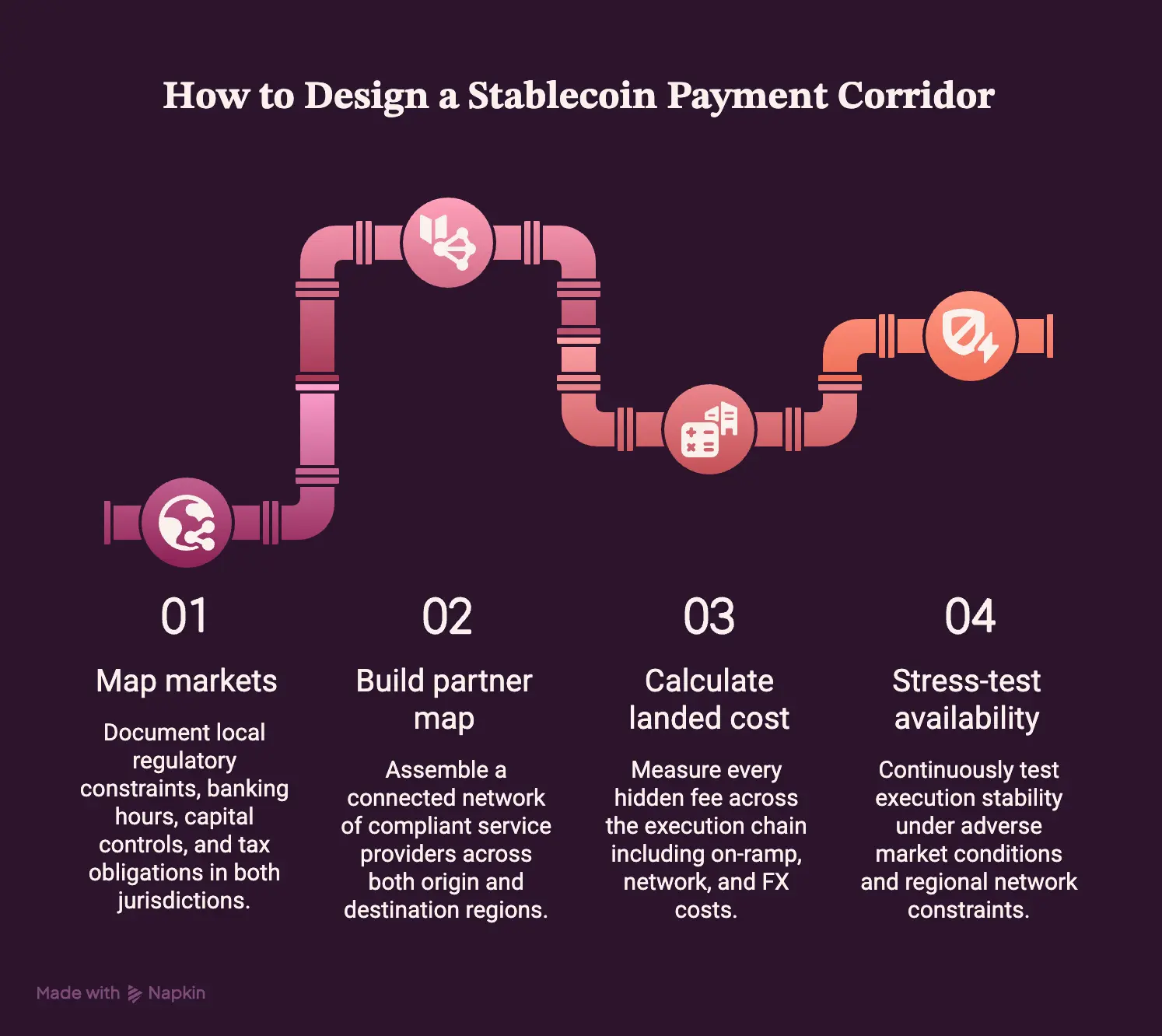
1. Map the Sender and Recipient Markets
First, engineers must document local regulatory constraints, banking hours, capital controls, and tax obligations in both jurisdictions. Furthermore, establishing local licensing requirements ensures long-term operational viability across borders.
2. Build the Corridor Partner Map
Next, you must assemble a connected network of compliant service providers across both origin and destination regions.
- Originating bank & on-ramp: Converts fiat currency to digital assets via local ACH, SEPA, or SWIFT integration.
- Issuer & custodian: Provides 1:1 fiat-backed stablecoins while securing asset reserve backing in regulated vaults.
- Blockchain network & FX provider: Executes base-layer settlement and manages real-time currency conversions.
- Destination off-ramp & local payout network: Converts stablecoins back into recipient local fiat and deposits funds into regional accounts.
3. Calculate the Total Landed Cost
Additionally, calculating true corridor efficiency requires measuring every hidden fee across the execution chain.
- On-ramp & off-ramp charges: Fiat deposit and withdrawal fees imposed by regional banking partners.
- Network gas & orchestration fees: On-chain execution costs combined with internal workflow processing fees.
- FX spreads & liquidity slippage: Market maker margins incurred during multi-currency token swaps.
4. Stress-Test Corridor Availability
Finally, teams must continuously test execution stability under adverse market conditions and regional network constraints.
- Banking cut-offs & liquidity drops: Simulates settlement delays during weekend bank closures and thin off-hours order books.
- Network spikes & compliance updates: Evaluates system fallback options during blockchain congestion or sudden sanctions list revisions.
For example, a high-volume US–Mexico or US–Philippines corridor prioritizes fast retail off-ramps like local mobile wallets. Conversely, an enterprise Middle East–Asia corridor requires deep institutional liquidity to process large B2B supply chain payouts without slippage.
For a deeper breakdown of enterprise asset rails, see our guide on How to Create a Real-World Asset Tokenization Platform.
Once corridor parameters are fully mapped, enterprises can evaluate asset selection criteria to balance peg stability, redemption speed, and regulatory acceptance.
How to Choose Stablecoins for Each Payment Corridor
Selecting stablecoins for cross-border payment corridors requires matching asset liquidity, regulatory compliance, and reserve stability to regional corridor requirements.
Consequently, treasury teams must evaluate token issuers, redemption guarantees, and off-ramp depth rather than relying on total market capitalization alone.
1. Compare Fiat-Backed Stablecoins
Specifically, global payment corridors rely on fiat-backed tokens such as USDC, USDT, PYUSD, RLUSD, EURC, XSGD, BRLA, and MXNB. Furthermore, enterprise architects evaluate these assets across critical operational criteria:
- Reserve backing & attestations: Evaluates monthly audit frequency and underlying high-quality liquid assets.
- Redemption & freeze controls: Assesses legal issuer obligations and programmatic contract freeze risks.
- Liquidity & off-ramp access: Measures local market order book depth and regional bank integration.
Under the U.S. GENIUS Act, permitted payment stablecoin issuers must maintain strict 1-to-1 high-quality reserves and publish monthly disclosures. Therefore, verified reserve architecture serves as an essential regulatory selection filter.
2. Existing Stablecoin Versus Custom Issuance
Integrating existing stablecoins requires thorough issuer due diligence and counterparty monitoring.
Conversely, custom stablecoin issuance demands managing reserve custody, mint-and-burn contracts, monthly attestations, and regional licenses.
3. Why Algorithmic Stablecoins Are Usually Unsuitable
Unbacked or algorithmic stablecoins introduce severe peg volatility and lack enforceable redemption rights.
Therefore, enterprise treasuries require clear reserve assets, legal claims, and regulatory acceptance.
4. Multi-Stablecoin Routing
An automated routing engine selects stablecoins dynamically based on real-time execution parameters.
Specifically, the system evaluates destination currency, trading fees, local regulatory eligibility, and off-ramp liquidity.
For a deeper breakdown of compliant financial asset systems, see our guide on AI Model Risk Management for Financial Institutions.
Therefore, stablecoin selection directly dictates which blockchain networks, custodians, and banking partners your platform can integrate. Once asset selection is finalized, technical teams must select the underlying blockchain networks and Layer 2 rails to process transactions.
How to Select Blockchain Networks and Layer 2 Rails
Select blockchain networks according to deep stablecoin liquidity, regional exchange depth, and enterprise custody support, rather than relying on advertised theoretical transactions per second.
Consequently, choosing a base network dictates execution reliability, settlement speed, and overall operational safety.
1. Layer 1 Network Scorecard
Specifically, primary Layer 1 networks offer distinct trade-offs across speed, costs, and institutional ecosystem support:
- Ethereum: Delivers high institutional custody support and deep liquidity, although base transaction gas fees remain variable.
- Solana & Stellar: Offer fast sub-second finality and low transaction costs, making them ideal for high-frequency payment corridors.
- Tron & XRPL: Provide high volume throughput and regional exchange off-ramp coverage across Asian and Latin American settlement hubs.
- Avalanche & Polygon: Supply enterprise subnet infrastructure, high RPC provider availability, and flexible smart contract customization.
2. Layer 2 Network Scorecard
Layer 2 networks like Base, Arbitrum, and Optimism lower settlement costs while maintaining Ethereum security guarantees.
However, engineers must carefully evaluate sequencer centralization risk, bridge withdrawal times, and gas abstraction support.
3. Native Issuance Versus Cross-Chain Bridges
Furthermore, integrating native stablecoin issuance directly from issuers like Circle or Tether eliminates bridge vulnerability risks.
Conversely, using generic wrapped tokens via third-party cross-chain bridges introduces severe smart contract and liquidity security exposures.
4. Node and RPC Infrastructure
Maintaining stable execution requires deploying load-balanced RPC endpoints, dedicated full nodes, and archive nodes. Therefore, building regional provider failover mechanisms prevents settlement downtime during network congestion events.
For a deeper breakdown of building enterprise infrastructure, see our guide on How to Develop an Enterprise AI Agent Orchestration Platform.
Therefore, while the underlying blockchain network safely transfers digital value across borders, robust custody policies ultimately determine who can authorize those transfers.
On-Ramps, Off-Ramps, FX, and Liquidity Infrastructure
A low blockchain network gas fee does not guarantee a cheap cross-border payment. Instead, total landed costs depend on local fiat on-ramps, destination off-ramps, FX conversion spreads, and local market maker liquidity.
1. Fiat On-Ramp Integration
First, funding on-chain accounts requires connecting corporate bank accounts directly to authorized fiat gateways.
- Domestic bank rails: Integrates local ACH, FedNow, SEPA, and SWIFT clearing networks.
- Direct minting APIs: Interconnects with primary issuers to mint stablecoins 1-to-1 upon wire arrival.
2. Local Off-Ramp Integration
Next, regional off-ramps must liquidate digital assets into local fiat and disburse funds into beneficiary accounts.
- Local payout networks: Route payments directly through local real-time bank rails, mobile money, or cash pickup agents.
- Beneficiary matching: Verifies recipient bank account names against compliance profiles before releasing local funds.
3. FX Conversion Engine
Furthermore, an automated FX engine calculates real-time conversion rates across digital assets and fiat pairs.
- Rate locks & spread rules: Locks guaranteed exchange rates for defined execution windows while managing price slippage.
- Automated hedging: Executes offsetting positions with institutional liquidity providers to eliminate intraday market exposure.
4. Liquidity Management
Additionally, maintaining continuous settlement capacity requires managing multi-currency treasury pools across global corridors.
- Market depth & slippage: Monitors order book depth to execute large B2B payments without moving market prices.
- Intraday rebalancing: Moves funds dynamically across corridors to replenish depleted local payout accounts.
5. Netting and Settlement Models
Finally, treasury teams select clear clearing frameworks to balance capital efficiency and real-time execution speeds.
- Real-time gross settlement: Clears individual transactions immediately on-chain for maximum speed and total finality.
- Deferred net settlement: Batches and offsets multi-currency obligations periodically to dramatically minimize gas fees.
For a deeper breakdown of corridor funding and liquidity controls, see our guide on How to Build Cross-Border Liquidity Management Software.
Therefore, optimizing on/off-ramp conversions and FX spreads yields far greater cost savings than optimizing blockchain gas fees alone. Once liquidity flows are secured, payment orchestration and messaging frameworks must harmonize each transaction into a single, traceable enterprise workflow.
Compliance Architecture for Stablecoin Payments
Compliance in cross-border stablecoin payments requires embedding real-time programmatic controls directly into the payment execution pipeline.
At the same time, rather than treating compliance as a post-transaction check, the platform architecture evaluates entity risks, wallet exposures, and regulatory data-sharing requirements before executing any on-chain transfer.
1. Customer and Business Verification
First, the system ingests Know Your Customer (KYC) and Know Your Business (KYB) data to evaluate counterparties prior to transaction authorization.
- Entity resolution & beneficial ownership: Identifies ultimate beneficial owners (UBOs) and maps complex corporate holding structures.
- Risk tiering & enhanced due diligence: Assigns real-time risk scores based on jurisdiction, source of funds, and expected volume thresholds.
2. Sanctions and Wallet Screening
Next, incoming and outgoing wallet addresses undergo real-time screening before interacting with smart contracts.
- Direct address screening: Checks wallets against global OFAC sanctions lists and high-risk jurisdiction databases.
- On-chain behavioral analytics: Integrates providers like Chainalysis, Elliptic, or TRM Labs to detect exposure to mixers, stolen assets, or darknet entities.
3. FATF Travel Rule Infrastructure
Additionally, payment engines must exchange transaction metadata synchronously with peer Virtual Asset Service Providers (VASPs).
- Data protocol integration: Uses standardized messaging protocols like IVMS 101 via Notabene, Sygna, or VerifyVASP to transmit originator and beneficiary details.
- Unhosted wallet controls: Verifies wallet ownership proof before executing transfers above jurisdictional reporting limits.
According to FATF reports, over 83% of surveyed jurisdictions have passed Travel Rule legislation. Consequently, automated data exchange must be deeply integrated into the base transaction flow.
4. Transaction Monitoring and Case Management
Furthermore, transaction monitoring engines score ongoing activity for behavioral anomalies like structuring or rapid velocity spikes.
When system rules flag an anomaly, the software routes the transaction to an investigator queue to manage potential Suspicious Activity Report (SAR) workflows.
For a deeper breakdown of AI-supported compliance workflows, see our guide on How Can Banks Develop an AI AML Compliance Copilot Platform?.
5. Audit and Regulatory Reporting
Finally, the platform maintains a tamper-proof audit log linking payment instructions, compliance scores, reviewer actions, and on-chain transaction hashes.
Therefore, robust compliance architecture programmatically enforces verification, wallet screening, and Travel Rule data exchange before value moves on-chain.
While these core control layers remain consistent globally, their specific licensing parameters and reporting rules adapt to local regulatory jurisdictions.
Stablecoin Regulations by Market in 2026
Regulatory mandates establish the mandatory legal parameters for issuing, holding, and transferring digital assets globally. Consequently, compliance officers must map local licensing requirements across every operating jurisdiction.
Market-Wise Stablecoin Regulation in 2026
| Market | Applicable Activity | Regulatory Status | Reserve Requirements | Licensing Body | Travel Rule Status | Operational Implication |
| United States | Issuance, Custody, Transfer | Enacted (GENIUS Act) | 1:1 HQLA / Monthly disclosures | OCC / Fed / State | Mandated (BSA/FinCEN) | Mandatory federal issuer registration and state money-transmitter compliance. |
| European Union | Public Offering, CASP | Enacted (MiCA) | Full liquid reserves / Segregation | EBA / ESMA / NCAs | Mandated (TFR) | Passporting enables single-license access across 27 EU member states. |
| United Kingdom | Issuance, Custody, Payment | Finalized (FCA 2026) | Ring-fenced UK safeguarding assets | FCA | Mandated | Mandates strict local safeguarding of reserve backing assets. |
| Asia-Pacific | Issuance, Trading | Enacted (HKMA / MAS) | 100% reserve backing / Audit | HKMA / MAS / JFSA | Mandated | Requires local capital deposits and verified redemption SLA guarantees. |
| LatAm / Canada | On/Off-ramp, FX | Enacted / Evolving | Local bank custody reserves | FINTRAC / BACEN / CNBV | Enacted | Demands strict local currency reporting and foreign exchange monitoring. |
1. United States
The GENIUS Act, signed on July 18, 2025, established the first U.S. federal payment-stablecoin framework.
Under this law, permitted issuers must maintain strict one-to-one high-quality liquid asset reserves and fulfill monthly disclosure rules. Furthermore, platforms must maintain FinCEN registrations and Bank Secrecy Act obligations.
2. European Union
The Markets in Crypto-Assets (MiCA) framework fully governs Asset-Referenced Tokens (ARTs) and E-Money Tokens (EMTs).
While stablecoin provisions took effect on June 30, 2024, the broader framework became fully applicable on December 30, 2024. Currently, the European Commission is conducting its 2026 review to refine cross-border passporting rules.
3. United Kingdom
Following extensive industry consultations, the Financial Conduct Authority (FCA) published its final stablecoin rules on June 30, 2026.
Therefore, issuers must maintain ring-fenced safeguarding accounts ahead of the broader cryptoasset regime commencing on October 25, 2027.
4. Asia-Pacific and the Middle East
In APAC, Hong Kong’s licensing regime came into force in 2025, leading the HKMA to grant its first two stablecoin issuer licenses in April 2026.
Simultaneously, Singapore’s MAS, Japan’s JFSA, and Dubai’s VARA enforce strict reserve auditing and Travel Rule compliance.
5. Canada and Latin America
Finally, Canadian operators align with FINTRAC standards.
Across Latin America, Brazil’s BACEN and Mexico’s CNBV enforce strict capital control compliance and local banking partner disclosures.
Therefore, jurisdictional regulatory frameworks dictate whether stablecoin infrastructure functions can be maintained in-house or outsourced to licensed regional partners. Once these regulatory structures are established, technical leaders must design resilient, high-availability system architecture to process cross-border volume continuously.
Where AI Adds Value to Stablecoin Payment Operations
AI should not manage core ledger execution. Instead, AI adds immense value by optimizing operational decisions surrounding the payment pipeline, including fraud monitoring, treasury management, and route optimization.
1. Fraud and Anomaly Detection
First, machine learning models analyze real-time transaction graphs to spot suspicious wallet behavior. Consequently, these systems detect sudden velocity spikes, device risk anomalies, and unexpected beneficiary address changes instantly.
2. Compliance Alert Prioritization
Next, intelligent agents score and prioritize high-volume compliance alerts. Specifically, models summarize complex transaction context, identify recurring false-positive patterns, and automatically assemble structured investigation dossiers for human analysts.
3. Liquidity and FX Forecasting
Additionally, predictive algorithms forecast corridor settlement demand across multi-currency treasury pools. Therefore, platforms can proactively rebalance off-ramp balances and hedge foreign exchange exposure before liquidity shortages occur.
4. Payment Route Optimization
Furthermore, dynamic routing engines evaluate every transaction path across multiple parameters:
- Cost & execution speed: Balances real-time gas fees against target settlement SLA windows.
- Liquidity & success rates: Scores routes based on available depth and historical provider failure probabilities.
5. AI Governance Requirements
Crucially, payment execution must remain strictly deterministic. Enterprise architects must maintain human-in-the-loop controls, explainability logs, false-positive metrics, and model version tracking to ensure total auditability.
Therefore, AI optimizes peripheral operational decisions, while the underlying payment rails handle asset movement deterministically. With intelligence layers defined, engineering leaders can map out a phased implementation roadmap to deploy stablecoin infrastructure safely.
Stablecoin Infrastructure Implementation Roadmap
Deploying stablecoin infrastructure requires a disciplined, multi-phase engineering approach to minimize operational risk and guarantee continuous regulatory compliance.
Consequently, enterprise technical leaders should follow a structured rollout framework that moves systematically from foundational design to full-scale automated operations.
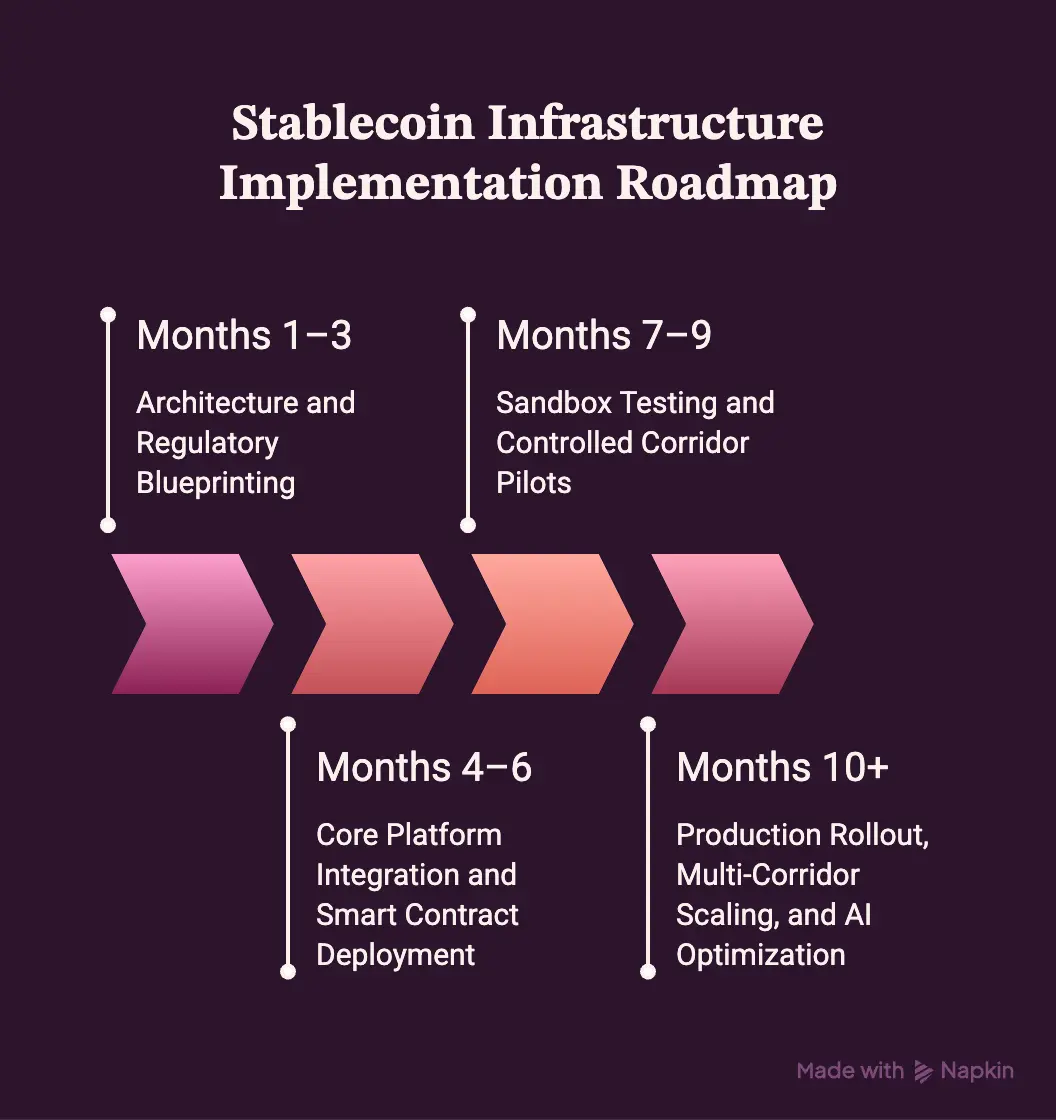
Phase 1: Architecture and Regulatory Blueprinting (Months 1–3)
First, cross-functional engineering, compliance, and treasury teams must define core operational boundaries and licensing strategies.
- Corridor mapping & licensing selection: Establishes exact target payout routes while evaluating whether to secure direct local money-transmitter licenses or partner with registered Virtual Asset Service Providers (VASPs).
- Custody & asset security architecture: Selects multi-party computation (MPC) HSM infrastructure and establishes formal key authorization policies.
- Liquidity partner onboarding: Negotiates credit facilities, FX spread structures, and API access agreements with institutional market makers and regional fiat gateways.
Phase 2: Core Platform Integration and Smart Contract Deployment (Months 4–6)
Next, technical teams build out base infrastructure layers and programmatically connect core service components.
- Smart contract & chain integration: Deploys verified, audited mint/burn or asset routing contracts on chosen Layer 1 or Layer 2 networks.
- Banking & compliance API connections: Integrates automated KYC/KYB screening, real-time wallet analytics, and Travel Rule data exchange protocols directly into the payment gateway middleware.
- Treasury management engines: Configures real-time ledger accounting databases to synchronize on-chain token balances with underlying fiat reserve accounts.
Phase 3: Sandbox Testing and Controlled Corridor Pilots (Months 7–9)
Additionally, platform reliability must be thoroughly verified within sandboxed environments before opening channels to external transaction volume.
- Closed-loop pilot corridor execution: Processes low-value corporate payments across a single, highly regulated corridor (such as US–Mexico or US–EU) to validate end-to-end settlement times.
- Stress testing & failure simulation: Simulates RPC node outages, sudden network gas fee spikes, thin order book slippage, and banking cut-off delays to verify automated system fallback logic.
- Regulatory review & audit verification: Submits smart contract code security audits, data privacy proofs, and AML compliance workflows to external legal and technical auditors.
Phase 4: Production Rollout, Multi-Corridor Scaling, and AI Optimization (Months 10+)
Finally, once pilot success criteria are met, organizations scale system capacity and layer on intelligent operational tools.
- Corridor expansion: Onboards secondary payout networks across emerging APAC, LatAm, and EMEA markets to enable global enterprise coverage.
- AI engine deployment: Integrates machine learning models for dynamic payment route selection, real-time liquidity demand forecasting, and automated compliance alert prioritization.
- Continuous governance & reserve reporting: Automates monthly reserve attestations, regulatory reporting submissions, and key management policy updates.
For a comprehensive guide on managing digital engineering roadmaps, explore our article on Top Use Cases of AI in Blockchain.
Therefore, a phased implementation strategy ensures that security, regulatory compliance, and banking rails are fully validated before scaling production transaction volumes across global payment corridors.
Stablecoin Infrastructure Development Cost: $70K–$300K
Stablecoin infrastructure development costs between $70,000 and $300,000 for most pilot-to-enterprise builds, excluding regulatory capital, license acquisition, prefunded liquidity pools, and third-party transaction processing fees.
Furthermore, the overall investment budget scales depending on corridor complexity, integration depth, and compliance requirements.
Cost Breakdown by Development Phase
| Development Phase | Estimated Cost |
| Corridor discovery and compliance blueprint | $5,000 – $15,000 |
| Architecture and proof of concept | $15,000 – $35,000 |
| Core payment and settlement engine | $20,000 – $60,000 |
| Custody, wallet, and security controls | $10,000 – $35,000 |
| On/off-ramp, FX, and liquidity integration | $10,000 – $50,000 |
| Compliance and blockchain analytics | $5,000 – $40,000 |
| Enterprise integration, testing, and deployment | $5,000 – $65,000 |
| Total Build Cost | $70,000 – $300,000 |
1. $70K–$120K Single-Corridor Pilot
Specifically, an entry-level build supports a single primary payment corridor utilizing one stablecoin on a single blockchain network.
Additionally, it features managed third-party custody, one fiat on-ramp, one local off-ramp, basic AML compliance hooks, and simple accounting export capabilities.
2. $120K–$220K Production Payment Platform
Conversely, a production-grade build introduces multi-provider redundancy across multiple payment rails.
Consequently, this tier delivers advanced compliance screening, deep ERP integration, production monitoring dashboards, high-availability architecture, and automated end-to-end ledger reconciliation.
3. $220K–$300K Multi-Corridor Infrastructure
Finally, a full enterprise build enables dynamic multi-chain and multi-stablecoin routing across several global payout markets.
Furthermore, it incorporates automated liquidity rebalancing, ISO 20022 messaging compatibility, advanced HSM security, AI-supported anomaly monitoring, and full disaster recovery infrastructure.
For a deeper breakdown of development investment, see our guide on Stablecoin Payment Infrastructure Platform Development Cost.
4. Ongoing Costs
Beyond the initial deployment, enterprises must budget 15% to 25% of the initial build cost annually for continuous system maintenance.
Specifically, ongoing expenditure covers protocol upgrades, vendor API updates, security patching, and regulatory reporting updates.
Build Cross-Border Stablecoin Infrastructure With Intellivon
Intellivon designs and engineers enterprise-grade stablecoin payment rails tailored specifically to your firm’s operating requirements.
At the same time, rather than forcing rigid, off-the-shelf software, we deliver custom infrastructure designed around your target corridors, regulatory boundaries, and existing core banking systems.
Our Core Infrastructure Engineering Capabilities
- Corridor & regulatory discovery: Mappings of local fiat clearing rails, licensing obligations, and capital controls.
- Stablecoin & blockchain selection: Objective asset selection and Layer 1/Layer 2 network integration.
- MPC/HSM custody integration: Multi-party computation key management and institutional vault security.
- Liquidity & FX orchestration: Automated on/off-ramp routing, price-lock engines, and treasury rebalancing.
- Built-in compliance architecture: Embedded KYC/KYB, wallet screening, Travel Rule protocols (IVMS 101), and AML monitoring.
- Enterprise integration: ISO 20022 messaging alignment, cloud-native observability, and AI-driven fraud detection.
A Risk-Mitigated Rollout Strategy
Intellivon builds stablecoin infrastructure around your actual payment corridors, treasury controls, regulatory responsibilities, and integration environment.
Consequently, engagements begin with a constrained, single-corridor pilot and expand only after settlement cost, liquidity depth, reconciliation speed, and compliance performance are fully validated.
Plan Your Stablecoin Infrastructure With Intellivon
Conclusion
Building enterprise stablecoin infrastructure for cross-border payments is far more than a simple blockchain integration. Instead, it is a fully regulated payment operating system connecting fiat rails, digital assets, custody vaults, liquidity pools, compliance frameworks, enterprise systems, and local payout networks.
To launch successfully, follow a strict execution sequence. First, validate your target corridor, then select your regulatory and custody model.
Next, build the orchestration layer and pilot under strict transaction limits. Finally, scale operations only after your cost, liquidity, and compliance targets are fully met.
FAQs
Q1. Which Stablecoin Is Best for Enterprise Cross-Border Payments?
A1. Consequently, selecting the right stablecoin requires evaluating specific operational criteria rather than choosing a universal winner. Enterprises must assess reserve backing transparency, 1:1 fiat redemption speed, regulatory licensing, multi-chain deployment options, secondary market liquidity depth, and local off-ramp availability across their primary payout corridors.
Q2. Do We Need Licenses in Every Country?
A2. Whether you need local licenses depends directly on your legal role within the payment flow. If your firm issues tokens, holds user funds, or converts fiat, direct licensing is mandatory. Conversely, pure software integrators can operate globally by routing transactions through locally regulated Virtual Asset Service Providers (VASPs).
Q3. Should We Build Custody or Use an MPC Provider?
A3. Initially, most enterprise platforms should leverage managed Multi-Party Computation (MPC) providers to ensure rapid deployment and robust protection. Building in-house key infrastructure is advisable only when an enterprise possesses mature key-security capabilities, specialized cryptographic expertise, strict internal compliance controls, continuous audit processes, and dedicated incident-response teams.
Q4. How Do Stablecoins Reduce Costs After FX and Off-Ramp Fees?
A4. Although FX conversion and local off-ramp fees apply, stablecoins significantly lower total settlement costs overall. Savings stem from eliminating correspondent banking intermediaries, reducing prefunded Nostro/Vostro balances, achieving near-instant settlement speed, and automating manual back-office reconciliation via smart contracts rather than relying on lower blockchain gas fees alone.
Q5. How Should the Platform Handle the FATF Travel Rule?
A5. To maintain compliance, the platform must collect mandatory originator and beneficiary details before executing transfers. Next, it verifies counterparty VASPs, securely transmits standardized IVMS 101 data payloads, applies strict verification policies to unhosted wallets, and automatically routes non-compliant transactions into quarantine queues for manual exception review.
To Sum It Up:
- The cheapest blockchain is not the cheapest payment route when local off-ramp liquidity is weak.
- Stablecoin rails reduce correspondent banking friction, but they do not remove banking, licensing, FX, or compliance dependencies.
- Multi-provider redundancy is an infrastructure requirement because no single provider offers equal coverage across every corridor.
- AI should improve fraud, compliance, liquidity, and routing decisions.
- A $70,000 pilot should prove one corridor before an enterprise commits to a $220,000–$300,000 multi-corridor build.