Key Takeaways:
- Stablecoin rails replace the slowest settlement legs of ACH, SWIFT, wire, and card flows.
- Regulated on-ramps, MPC wallets, USDC or EURC, FX orchestration, and compliant off-ramps enable 24/7 value movement.
- GENIUS Act, MiCA, FATF Travel Rule, KYC/KYB, sanctions screening, and licensing shape platform design requirements.
- Corridor MVPs cost $70,000 to $120,000 while multi-corridor multi-chain platforms reach $180,000 to $300,000.
- How Intellivon builds stablecoin payment rails corridor-first, keeping regulated services separate from proprietary orchestration layers.
Fintechs are replacing ACH, SWIFT, and card rails with stablecoin payment rails to cut the fees and delays baked into those systems. For years, they absorbed both costs as the price of doing business. Now a growing number are routing payments around that legacy chain entirely, and stablecoin payment rails are becoming the default path for cross-border transfers, payroll, and treasury settlement.
However, replacing a rail doesn’t fix the fee problem alone. The fintechs seeing real margin gains are the ones building compliance into the rail itself. In fact, 41% of businesses using stablecoins report cost savings of 10% or more, according to EY-Parthenon’s 2025 survey, with most recovering that investment within 8 months.
Compliance usually gets treated as a separate workstream, added once licensing questions come up late in a build. This blog walks through the architecture, the fintechs leading this shift, their licensing strategy, and adoption patterns across B2B, remittance, and payroll. By the end, you’ll know exactly how the replacement actually works.

What are Stablecoin Payment Rails?
Stablecoin payment rails are digital infrastructure networks that move fiat-backed tokens across blockchains to settle financial transactions instantly. Unlike traditional bank transfers that rely on slow intermediary networks, stablecoin rails transfer value directly between digital wallets.
Consequently, businesses can execute cross-border transfers, B2B supplier payouts, and merchant settlements 24/7 with near-zero transfer fees.
The stablecoin payment infrastructure market is expanding rapidly, projected to grow at a 34.5% CAGR from 2026 to 2035, reaching $58 billion according to Astute Analytica.
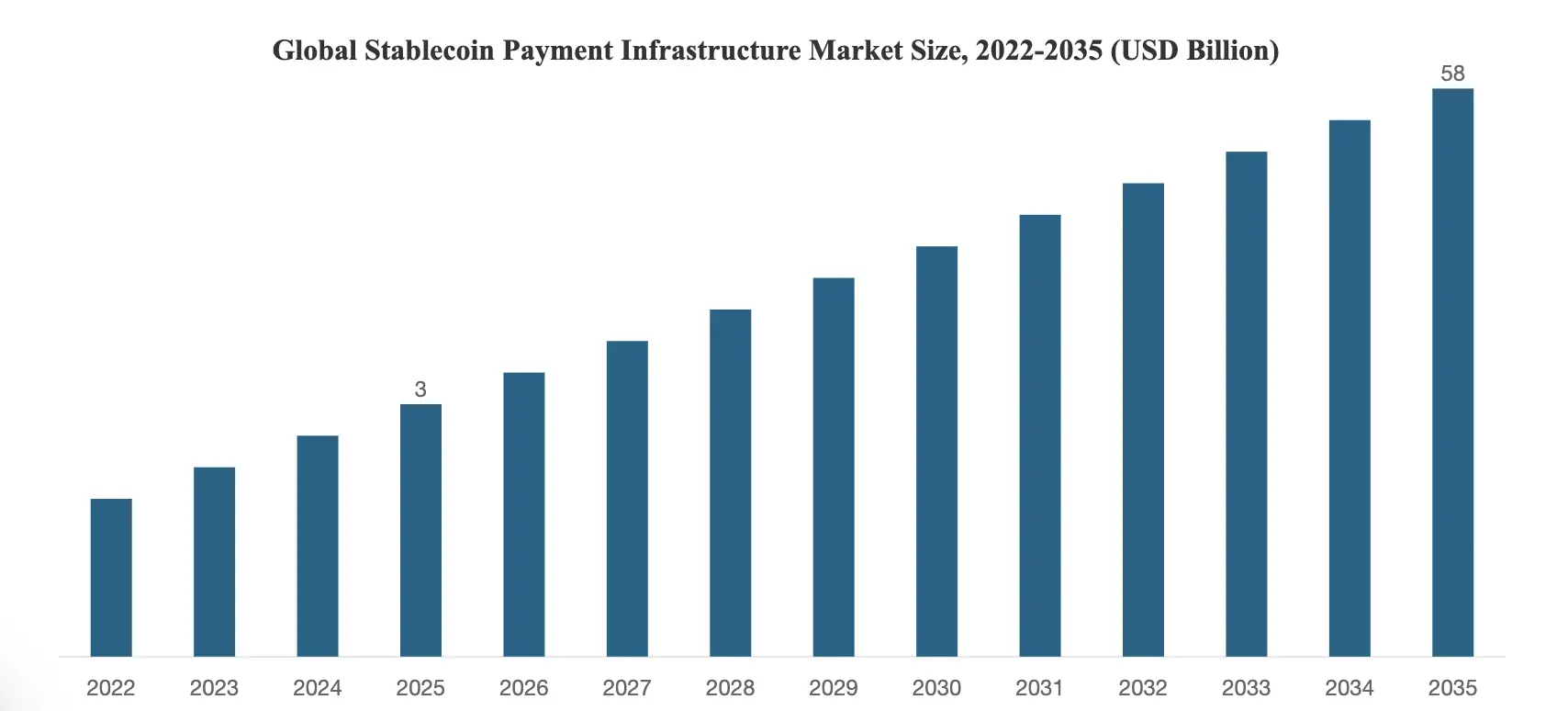
Additionally, annual economic settlement volumes surged past $33 trillion. This explosive growth occurs because enterprise platforms demand real-time settlement and lower FX costs over legacy bank rails.
What Stablecoin Payment Rails Actually Replace
Stablecoin rails primarily replace the cross-border settlement, correspondent banking, pre-funding, and manual reconciliation layers inside a payment flow. However, they rarely replace the entire customer-facing payment experience or every domestic payout rail.
Production systems still use bank accounts, local clearing networks, licensed financial institutions, and fiat off-ramps at the edges. Thus, fintechs remove the slow, expensive middle of the transaction lifecycle while maintaining normal user interfaces.
1. Payment Messaging Is Not the Same as Settlement
Understanding the distinction between communication and actual liquidity transfer is critical for evaluating payment architecture.
- Payment Initiation: The customer requests a transfer through a user interface or API.
- Authorization: Sanctions screening, fraud checks, and account balance verification occur automatically.
- Messaging: Legacy systems like SWIFT send instructions, but they do not transfer actual money.
- Clearing: Financial institutions calculate net obligations between sending and receiving entities.
- Settlement: Actual funds move across correspondent bank accounts, often taking several days.
- Reconciliation: Accounting systems match internal transaction logs against bank statements.
2. Stablecoins Replace the Settlement Bridge
By replacing legacy correspondent networks with blockchain ledgers, payment providers move value directly between liquidity pools.
- Local Fiat Collection: The fintech collects local fiat currency from the sender using traditional bank rails.
- On-Ramp Conversion: An API converts that fiat into a regulated stablecoin like USDC or PYUSD instantly.
- On-Chain Settlement: The tokens travel across high-throughput blockchains within seconds to complete final settlement.
- Off-Ramp Conversion: A local partner converts the stablecoins back into destination fiat currency.
- Domestic Payout: The local entity deposits funds directly into the recipient’s traditional bank account.
3. Local Fiat Rails Usually Remain at Both Ends
End users do not need to manage crypto wallets because existing bank networks handle domestic collection and payout.
- North America: ACH and FedNow manage initial deposits and final disbursements.
- Europe: SEPA and Faster Payments execute instant euro and pound settlements.
- Latin America: Systems like PIX in Brazil and SPEI in Mexico handle last-mile payouts.
- Asia-Pacific: Networks like UPI in India power immediate bank deposits.
For a deeper breakdown of modular financial integration, see our guide on building enterprise AI agents for real-time transaction processing.
The most credible replacement strategy removes the expensive, opaque middle of the cross-border payment chain.
Consequently, enterprise platforms deliver 24/7 instant settlement without forcing customers or recipients to interact with digital wallets directly. This approach preserves existing user habits while dramatically lowering backend operational costs.
Why Fintechs Are Moving Settlement On-Chain
Fintechs move settlement on-chain to bypass heavy financial friction, reducing operational overhead and freeing up working capital. Traditional payment networks force institutions to maintain locked liquidity across multiple intermediary accounts.
Consequently, shifting to blockchain settlement allows platforms to execute transfers instantly, eliminate manual reconciliation, and lower cross-border transaction fees significantly.
1. Correspondent Banking Creates Layered Costs
Traditional cross-border payments pass through multiple banks, accumulating heavy fees and operational friction along the way.
- Intermediary Deductions: Each foreign bank in the payment routing chain subtracts processing fees.
- Lifting Fees: Local payouts suffer from additional processing costs imposed by receiving financial institutions.
- FX Spreads: Opaque currency exchange markups reduce total delivered value across corridors.
- Repair Charges: Manual corrections for incorrect routing details add unexpected administrative expenses.
- Investigation Fees: Tracing lost transfers requires staff time and creates extended resolution delays.
- Nostro Account Costs: Maintaining multi-currency balances overseas locks up valuable corporate capital.
The International Monetary Fund highlights long processing chains and incompatible operating hours as major drivers of high cross-border payment costs.
2. Cutoff Times Create Liquidity Friction
Legacy bank clearing operates strictly during local business hours, creating severe delays over weekends and public holidays. Consequently, fintechs must pre-fund Nostro accounts to ensure continuous payouts.
This structure forces businesses to lock up capital, incurring high short-term borrowing costs during extended banking closures.
3. Stablecoins Improve Working-Capital Availability
On-chain settlement accelerates capital velocity by replacing slow batch processing with continuous, real-time clearing across global corridors.
- Reduced Funds in Transit: Real-time finality eliminates multi-day settlement delays for cross-border payouts.
- Minimized Foreign Balances: Companies maintain smaller offshore bank reserves, freeing liquidity for operations.
- Lower Borrowing Costs: Instant clearing removes the need for expensive short-term credit facilities.
- Automated Cash Positioning: Treasury teams monitor global liquidity instantly without checking multiple portals.
Data from the Visa Onchain Analytics Dashboard confirms organic stablecoin transactions remain high on weekends, proving demand for 24/7 settlement capabilities.
4. Programmability Changes Payment Operations
Smart contracts automate complex workflows directly on the settlement layer, removing manual operational steps completely.
- Conditional Supplier Payments: Funds release automatically once logistics APIs verify delivery.
- Automated Revenue Splits: Marketplaces distribute vendor earnings immediately at the point of sale.
- Escrow Release: Milestone verification triggers instant disbursement without escrow agent delays.
- Treasury Sweeping: Automated rules transfer excess balances into yield-bearing operational accounts.
For a deeper breakdown of smart contract risk management, see our guide on building AI model risk management platforms.
Shifting settlement on-chain resolves structural inefficiencies inherent to legacy correspondent banking. As a result, fintechs reduce operational costs, optimize treasury management, and deliver instant cross-border payments to enterprise clients worldwide.
How Stablecoin Payment Rails Work End to End
Modern stablecoin payment architectures execute end-to-end cross-border clearing through six distinct layers.
Therefore, by connecting traditional banking APIs to decentralized settlement networks, these platforms transfer value internationally within seconds.
1. Fiat Collection and On-Ramp
The transaction begins when the sending institution deposits local fiat currency through standard domestic bank networks.
- Account Provisioning: Dedicated virtual IBANs or virtual accounts receive sender funds automatically.
- Payment Deposit: The sender initiates transfers via domestic rails like ACH, SEPA, Faster Payments, or PIX.
- Token Conversion: Regulated on-ramp partners convert incoming fiat into stablecoins upon receiving deposit confirmations.
- KYC & AML Verification: Automated screening verifies customer identities and performs source-of-funds checks prior to conversion.
2. Wallet and Custody Orchestration
Fintechs route digital assets through specialized vault architectures to secure funds during transit.
- MPC Custody: Multi-Party Computation splits private key shards across distinct locations, eliminating single points of failure.
- HSM Protection: Hardware Security Modules sign high-value institutional transfers inside isolated secure environments.
- Account Models: Platforms choose between segregated user accounts or consolidated omnibus balances based on licensing rules.
- Smart Accounts: Account abstraction enables automated policy enforcement, gas abstraction, and batch transactions.
3. Blockchain Settlement
The platform broadcasts the transaction to high-throughput blockchains to achieve final settlement.
- Asset Selection: Regulated tokens like USDC, EURC, or PYUSD maintain strict 1:1 fiat reserve backing.
- Network Routing: Transactions execute across low-cost networks including Solana, Base, Polygon, Stellar, or Ethereum.
- Confirmation Verification: Smart contracts monitor block confirmations to guarantee transaction finality.
- Gas Sponsorship: Fee delegation contracts sponsor network gas, allowing users to settle without holding native gas tokens.
Data from Circle’s Q1 Financial Report highlights that quarterly USDC transaction volume surpassed $21 trillion, confirming broad adoption across enterprise networks.
4. Liquidity and FX Routing
Low blockchain network fees do not guarantee low overall transaction costs, making active liquidity management essential.
- FX Spread Minimization: Automated market makers and liquidity providers compete to offer tight exchange rates.
- Slippage Protection: Smart routers split large institutional orders across multiple pools to protect execution price.
- Quote Expiry Management: Short-duration pricing guarantees shield platforms from volatility during token conversion.
- Liquidity Strategies: Systems balance pre-funded local accounts with just-in-time liquidity to minimize tied-up capital.
5. Off-Ramp and Local Payout
Once on-chain transfers complete, the receiving entity converts tokens back into national currency.
- Token Sale: The off-ramp partner exchanges incoming stablecoins for destination fiat through local order books.
- Local Disbursement: The partner deposits fiat into the recipient’s traditional bank account via instant local rails.
- Receipt Generation: The payout system issues digital settlement receipts to both parties automatically.
6. Reconciliation and Accounting
The final layer syncs on-chain execution data with internal business systems and enterprise resource planning software.
- Double-Entry Ledgers: Internal accounting databases record matching debit and credit entries for every transaction.
- Address Mapping: Systems link public wallet addresses directly to verified customer IDs and invoice records.
- ERP Integration: Automated webhooks post completed payments into software like NetSuite, SAP, or QuickBooks.
- Failed Payment Handling: Automated routines re-route stalled transactions or initiate instant refund workflows.
For a deeper breakdown of the underlying layers, see our guide on Stablecoin Infrastructure for Cross-Border Payments: Complete Guide.
By structuring payments across these six operational layers, fintechs achieve continuous cross-border settlement. This end-to-end framework bypasses traditional banking delays while keeping complex blockchain mechanics completely hidden from end users.
Stablecoins vs ACH, SWIFT, Wires, Cards, and SEPA
Stablecoins excel at removing settlement friction, yet they function as complementary infrastructure rather than universal replacements for traditional rails.
At the same time, evaluating payment rails across speed, cost, and finality reveals clear technical trade-offs for enterprise architectures.
1. Stablecoins vs ACH, SWIFT, Wires, Cards, and SEPA
| Existing Rail | What Stablecoins Can Replace | What Usually Remains |
| ACH | Batch-based settlement and multi-day funding delays in selected workflows | Bank account funding, returns processing, and identity controls |
| SWIFT | Multi-bank correspondent settlement chains and payment-in-transit friction | Regulated financial institutions, messaging standards, and local payouts |
| Wire Transfers | Expensive cross-border value movement and high fixed transfer fees | Direct bank access, beneficiary account verification, and statutory reporting |
| Card Networks | Delayed merchant settlement windows and high cross-border interchange rates | Consumer checkout acceptance, dispute handling, and point-of-sale credentials |
| SEPA | Cross-border bridge transfers extending outside the European Economic Area | Euro collection, domestic clearing, and beneficiary account deposits |
| FedNow / RTP | Limited global availability and restrictive per-transaction transfer caps | Instant domestic bank-to-bank settlement within participating institutions |
| Correspondent Banking | Opaque multi-bank routing chains and pre-funded Nostro/Vostro accounts | Local fiat liquidity pools, banking relationships, and FX access |
2. Best Replacement Fit
Enterprise platforms achieve maximum ROI by deploying on-chain settlement across corridors burdened by high fees, complex intermediate handoffs, or severe time-zone mismatches.
- Cross-Border B2B Payments: Eliminates multi-bank correspondent deductions and speeds up global vendor disbursements.
- High-Frequency Marketplace Payouts: Enables automated, real-time payouts to international sellers without fixed wire fees.
- International Contractor Payments: Delivers 24/7 earned wage access to global freelancers without foreign bank charges.
- Treasury Transfers: Rebalances intercompany liquidity across global subsidiaries instantly outside standard banking hours.
- Remittance Settlement: Accelerates wholesale liquidity clearing between licensed money service businesses worldwide.
3. Weak Replacement Fit
Conversely, stablecoin rails add unnecessary operational overhead in domestic environments where existing clearing networks offer low fees, chargeback protection, or immediate clearing.
- Low-Value Domestic Retail Payments: Traditional domestic rails like FedNow or UPI already deliver immediate, low-cost clearing.
- Chargeback-Dependent Consumer Purchases: On-chain finality prevents the consumer disputes and chargeback protection buyers expect.
- Cash-Heavy Recipient Markets: Physical cash distribution requires local agent networks regardless of the underlying token.
- Corridors with Thin Off-Ramp Liquidity: Low local liquidity causes high slippage during fiat-to-stablecoin conversions.
- Payments Requiring Statutory Reversibility: Regulated commercial transfers needing built-in payment recall mechanisms.
Deploying stablecoins alongside traditional networks allows fintechs to modernize cross-border settlement without disrupting domestic banking touchpoints.
Consequently, platforms lower global operational costs while maintaining full regulatory compliance across local markets.
Leading Stablecoin Payment Models and Companies in 2026
Fintechs evaluate stablecoin infrastructure partners based on four structural operational models rather than surface-level brand metrics.
Consequently, each architecture balances asset custody, fiat connectivity, and regulatory licensing differently depending on target corridor dynamics.
1. Stablecoin Issuer and Network Model
Token issuers construct proprietary clearing networks that link commercial banking rails directly to multi-chain liquidity pools.
- Regulated Settlement Assets: Providers issue dollar-backed tokens like USDC or EURC backed by 1:1 cash reserves.
- Network Participants: Consequently, these rails connect global financial institutions, payment service providers, and virtual asset service providers.
- Cross-Chain Movement: Meanwhile, native transfer protocols move assets between blockchains without relying on risky third-party bridges.
- Developer Infrastructure: Standardized APIs enable direct treasury management and automated mint and burn redemption operations.
Specifically, Circle reported a $3.4 billion annualized transaction volume for its Circle Payments Network (CPN), which highlights rapid enterprise adoption across cross-border clearing corridors.
2. Full-Stack Orchestration Model
Full-stack providers bundle liquidity management, wallet infrastructure, and compliance controls into unified API platforms.
- Unified Infrastructure: For example, companies like BVNK, Bridge, and Zero Hash merge crypto custody with local fiat clearing.
- Embedded Wallets: As a result, developers launch enterprise MPC wallets without managing underlying cryptographic private key security.
- Automated FX Engines: In addition, algorithmic liquidity routing calculates optimal execution rates between local fiat and stablecoins.
- Reconciliation Dashboards: Automated ledgers map public transaction hashes directly to internal corporate account numbers.
3. Payment Processor Expansion Model
Established global processors integrate digital asset settlement directly into existing payment gateways and API workflows.
- Merchant Acceptance: Platforms like Stripe, Airwallex, and Checkout.com accept stablecoins alongside traditional credit cards.
- Payout Distribution: Furthermore, payout networks deliver local currency payouts into global merchant bank accounts automatically.
- API Familiarity: Ultimately, merchants enable stablecoin settlement without altering existing checkout user interfaces or accounting workflows.
For instance, Nium’s 2026 partnership with Circle links stablecoin settlement rails directly to local payout rails covering more than 190 countries.
4. Existing Network Integration Model
Traditional card networks embed digital asset settlement into their legacy clearing channels to accelerate cross-border B2B clearing.
- Card Network Settlement: Visa allows acquirers and issuers to settle daily clearing obligations using USDC on public blockchains.
- Multi-Token Protocols: Similarly, Mastercard’s Multi-Token Network connects commercial bank deposits with regulated stablecoins for corporate treasury use.
- Consumer Gateway Links: In addition, PayPal enables PYUSD transfers across external digital wallets and internal merchant checkout gateways.
Data from Visa’s Official Press Release confirmed that USDC settlement volume surpassed $3.5 billion annualized following its expanded roll-out to merchant acquirers.
5. Platform Comparison Table
| Platform Model | Primary Stablecoins | Blockchain Support | Fiat Payout Coverage | Best-Fit Enterprise Use Case |
| Issuer Network | USDC, EURC | Solana, Base, Ethereum, Stellar | Global Bank Partners | Institutional Liquidity & Treasury Clearing |
| Full-Stack Orchestrator | USDC, USDT, PYUSD | Polygon, Solana, Base, Ethereum | 100+ Local Banking Networks | B2B Cross-Border Marketplaces & Remittances |
| Payment Processor | USDC, PYUSD | Solana, Polygon, Ethereum | 190+ Countries | Global E-commerce Checkout & Merchant Payouts |
| Legacy Card Network | USDC | Solana, Ethereum | Global Visa/Mastercard Networks | Commercial Card Settlement & Interbank Treasury |
For a deeper breakdown of modular financial architecture, see our guide on building enterprise AI agents for real-time transaction processing.
In summary, selecting an enterprise payment provider depends on required fiat payout coverage, target blockchain performance, and existing licensing boundaries.
Therefore, choosing the right structural model allows fintechs to minimize technical integration effort while securing deep cross-border liquidity.
Compliance Rules for Stablecoin Payment Rails in 2026
Compliance obligations depend strictly on a fintech’s exact operational role within the transaction lifecycle, rather than simply whether its code touches digital assets.
Therefore, software vendors, custodial wallet providers, and regulated payment processors face vastly different legal standards across global markets.
1. Determine Your Regulatory Role First
First, defining an organization’s specific functional role prevents regulatory misclassification and dictates necessary legal licensing.
- Stablecoin Issuer: Entities that mint digital tokens and manage underlying fiat-backed reserve assets.
- Custodial Provider: Institutions that hold cryptographic private keys on behalf of corporate or retail clients.
- Money Transmitter: Platforms that receive fiat currency from senders to execute value transfers to third parties.
- Technology Vendor: Pure software providers that build non-custodial wallet infrastructure without controlling client funds.
- Virtual Asset Service Provider (VASP): Entities offering digital asset exchange, transfer, or wallet administration services.
2. United States Requirements
In the United States, federal and state laws enforce strict reserve management, customer verification, and money transmission compliance standards.
- The GENIUS Act: Signed into law on July 18, 2025, the Guiding and Establishing National Innovation for U.S. Stablecoins Act subjects permitted payment stablecoin issuers to 1:1 reserve, monthly public disclosure, and AML requirements.
- Bank Secrecy Act (BSA): Moreover, money service businesses must maintain formal anti-money laundering programs and submit Suspicious Activity Reports (SARs).
- FinCEN Registration: Consequently, non-bank payment providers operating in the US must register as Money Services Businesses (MSBs).
- State Licensing: In addition, entities executing money movement must obtain individual state Money Transmitter Licenses (MTLs).
- OFAC Sanctions: Real-time screening blocks wallet addresses associated with sanctioned individuals, sanctioned countries, or blocked entities.
3. European Union Requirements
Meanwhile, European regulations establish unified licensing rules across member states while enforcing strict data privacy standards on public ledgers.
- MiCA Framework: The Markets in Crypto-Assets regulation governs Electronic Money Tokens (EMTs) and mandates Crypto Asset Service Provider (CASP) authorization.
- Transfer of Funds Regulation (TFR): In addition, this regulation governs information accompanying digital asset transfers, making the FATF Travel Rule mandatory across all European transactions.
- Data Protection Standards: However, architectures must balance public blockchain immutability with strict GDPR consumer data privacy mandates.
- DORA Compliance: Furthermore, the Digital Operational Resilience Act mandates robust cybersecurity practices and ICT risk management protocols for financial entities.
4. FATF Travel Rule and Global Deployment
Globally, international standards require financial institutions to exchange originator and beneficiary information alongside cross-border digital transfers.
- Originator Data Collection: Systems must attach the sender’s full legal name, physical address, and account identifier to the transaction payload.
- Beneficiary Verification: Subsequently, the receiving VASP must verify beneficiary details before releasing funds into local bank accounts.
- Counterparty Due Diligence: Furthermore, institutions must conduct risk assessments on foreign VASP counterparties prior to executing transfers.
- Unhosted Wallet Rules: Finally, platforms apply risk-based monitoring controls when interacting with non-custodial software wallets.
An official report from the Financial Action Task Force indicates that 83% of surveyed global jurisdictions have enacted Travel Rule legislation, which emphasizes the need for automated compliance protocols.
5. Controls That Belong Inside the Architecture
To ensure efficiency, automated compliance controls must be embedded directly into software architectures rather than applied as manual post-transaction checks.
- Automated KYC/KYB: Identity verification modules validate corporate documents, ultimate beneficial owners (UBOs), and individual identities.
- Real-Time KYT Screening: Similarly, on-chain transaction monitoring tools like Chainalysis, Elliptic, or TRM Labs block high-risk wallet transfers automatically.
- PEP & Sanctions Filters: In addition, continuous database screening flags Politically Exposed Persons and sanctioned entities prior to payout.
- Destination Allowlists: Smart contract rules restrict token transfers strictly to verified, compliant wallet addresses.
- Immutable Audit Logging: Finally, double-entry ledger databases log complete transaction histories for internal compliance audits and regulatory reporting.
For a deeper breakdown of risk management frameworks, see our guide on building AI model risk management platforms.
In conclusion, designing compliance controls directly into payment orchestration software ensures seamless global operation without introducing manual settlement friction. As a result, fintechs meet global legal standards while delivering real-time cross-border stablecoin transfers.
Stablecoin Payment Rail Implementation Roadmap
Transitioning to stablecoin payment rails requires a structured, multi-phase engineering approach to protect transaction integrity and maintain strict regulatory compliance.
Phase 1 — Select One High-Value Corridor
First, evaluate specific corridors to isolate a high-impact starting point for stablecoin deployment.
- Cost Analysis: Measure existing cross-border fees against projected on-chain transaction costs.
- Settlement Latency: Identify corridors hindered by multi-day bank delays and restrictive cutoff times.
- Volume Metrics: Select corridors with sufficient payment volume to justify operational integration.
- Recipient Readiness: Confirm local partners accept stablecoin settlement and possess local banking connections.
- Off-Ramp Availability: Verify local off-ramps offer sufficient fiat liquidity and tight exchange spreads.
- Licensing Coverage: Ensure all operating entities hold necessary money transmission licenses across both ends.
- Savings Projections: Calculate total expected unit economic savings to establish baseline project ROI.
Phase 2 — Map Roles and Regulatory Obligations
Next, map functional responsibilities across all platform participants to clarify legal and compliance boundaries.
- Fiat Collection: Assign licensed banking partners to collect local fiat deposits from senders.
- Custody Management: Specify non-custodial or custodial wallet providers for digital asset orchestration.
- Token Conversion: Define regulated on-ramp entities handling initial fiat-to-stablecoin swaps.
- On-Chain Transfer: Build automated smart contract routers to execute cross-border token transfers.
- Off-Ramp Execution: Partner with verified local liquidity providers to exchange tokens back into target fiat.
- Local Payout: Integrate domestic instant payment networks to deliver final bank deposits.
- Customer Screening: Enforce real-time KYC, KYB, and sanctions checks across sending and receiving parties.
- Regulatory Reporting: Automate suspicious activity reporting and Travel Rule data compliance across jurisdictions.
Phase 3 — Design the Ledger and Payment Flow
Then, establish core accounting ledgers and transaction state logic to manage real-time fund flows.
- Account Architecture: Choose between segregated customer sub-accounts or consolidated omnibus vault structures.
- Wallet Model: Deploy MPC wallet infrastructure or account abstraction smart accounts for key management.
- Transaction State Machine: Define operational states spanning initiated, funded, on-chain, converted, and settled.
- Fee Engine: Program dynamic markup rules and network gas sponsorship logic into payout flows.
- FX Quotation: Lock short-duration exchange rates to protect users from currency volatility during transit.
- Reversal Logic: Build automated routines to manage failed processing, rejected deposits, and payment returns.
- Refund Protocols: Establish clear refund pathways to return funds safely to sending bank accounts.
- Exception Workflows: Create automated alerts and manual review queues for edge cases and unexpected delays.
Phase 4 — Integrate Regulated Providers
After ledger design, connect external regulated service providers through unified API integrations.
- Banking Infrastructure: Connect virtual account APIs for automated fiat collection and payout processing.
- On/Off-Ramp Partners: Integrate institutional liquidity providers to automate fiat-to-token swaps.
- Custody Solutions: Implement hardware-backed custody APIs to protect active operational balances.
- KYC/KYB Verification: Connect identity verification systems to automate customer onboarding checks.
- Blockchain Analytics: Embed real-time KYT transaction screening to flag suspicious wallet addresses.
- Liquidity Pools: Establish deep FX liquidity access to minimize slippage during peak volume hours.
- Local Clearing Networks: Integrate directly with domestic payout rails like FedNow, SEPA, or PIX.
Phase 5 — Build and Test a Corridor MVP
Subsequent to provider integration, test core execution mechanics against realistic failure scenarios.
- Normal Settlement: Verify end-to-end payment settlement times and automated ledger entries.
- Failed Funding Handling: Test system responses when incoming fiat transfers fail or time out.
- Delayed Confirmations: Simulate network congestion to ensure transaction retry routines operate correctly.
- Depeg Simulations: Program protective circuit breakers to halt transfers if token prices fluctuate wildly.
- Sanctions Matches: Verify real-time KYT tools block sanctioned wallets and halt payouts immediately.
- Off-Ramp Outages: Test dynamic routing to fallback off-ramps during sudden partner downtime.
- Duplicate Webhooks: Ensure idempotency protections prevent double payouts from repeated API notifications.
- Refund Testing: Validate automated refund workflows return exact fiat balances to originating senders.
Phase 6 — Run a Controlled Pilot
Following MVP validation, launch a restricted production pilot to verify live operational performance.
- Restricted Customers: Limit initial access to select trusted enterprise clients and partners.
- Transaction Caps: Enforce strict daily and per-transaction dollar limits during early testing.
- Token Limits: Restrict active assets strictly to highly liquid, regulated stablecoins like USDC.
- Network Isolation: Execute pilot transactions on a single high-throughput blockchain network.
- Corridor Focus: Process real-world flows across a single, highly monitored cross-border corridor.
- Destination Restrictions: Limit payout destinations strictly to pre-approved, verified bank accounts.
Phase 7 — Expand With Routing and Redundancy
Finally, scale platform operations by introducing multi-chain routing and systemic infrastructure redundancy.
- Multi-Chain Support: Integrate additional low-cost blockchains to prevent single-network reliance.
- Diverse Stablecoins: Support multiple regulated tokens to expand customer settlement choices.
- Liquidity Redundancy: Partner with multiple market makers to secure optimal FX execution rates.
- Backup Off-Ramps: Onboard secondary local off-ramp providers across every active corridor.
- Redundant Banking: Maintain multi-bank relationships to protect against individual partner disruptions.
- Compliance Diversity: Deploy secondary transaction monitoring vendors to ensure continuous compliance uptime.
In conclusion, executing this seven-phase roadmap allows fintechs to modernize cross-border settlement safely. Therefore, platforms achieve rapid real-time clearing while maintaining enterprise-grade security and full regulatory compliance.
Stablecoin Payment Platform Development Cost
Building stablecoin payment rails costs $70,000 to $300,000, depending on corridor count, custody, compliance scope, blockchain support, liquidity integrations, and enterprise-system requirements.
Consequently, understanding these cost variables allows technology teams to allocate budget accurately across development phases.
1. Stablecoin Payment Platform Development Cost Table
| Development Phase | Estimated Cost Range |
| Corridor Discovery & Regulatory Design | $7,000 – $15,000 |
| Architecture, UX & Technical Prototype | $8,000 – $20,000 |
| Core Ledger, Wallets & Payment Orchestration | $20,000 – $55,000 |
| On/Off-Ramp, FX & Liquidity Integrations | $10,000 – $45,000 |
| KYC, KYB, KYT, Travel Rule & Sanctions Controls | $12,000 – $45,000 |
| ERP, Reconciliation, Reporting & Webhooks | $8,000 – $35,000 |
| Security Testing, QA, Deployment & Pilot | $5,000 – $25,000 |
| Multi-Chain Routing & Advanced Automation | $0 – $60,000 |
| Total Build Investment | $70,000 – $300,000 |
2. Development Tiers and Timelines
Project complexity dictates required engineering timelines and resource allocation across three distinct platform tiers.
- Single-Corridor MVP: Costs $70,000 to $120,000 and requires 12 to 16 weeks to build a single functional payment pathway.
- Multi-Corridor Production Platform: Costs $120,000 to $220,000 over 5 to 8 months, adding multiple off-ramps and automated compliance.
- Multi-Chain Enterprise Platform: Costs $220,000 to $300,000 over 8 to 12 months, featuring multi-asset smart routing and full ERP sync.
3. Ongoing Maintenance Costs
In addition to initial development, budget 15% to 25% of the initial build cost annually for ongoing operational expenses.
Specifically, these funds cover cloud infrastructure, API provider minimums, evolving regulatory compliance updates, continuous KYT monitoring, penetration testing, new blockchain integrations, liquidity management, and 24/7 technical support.
For a complete phase-by-phase budget analysis, see our guide on the Cost to Build a Stablecoin Payment Infrastructure Platform.
In conclusion, scoping stablecoin development requires balancing immediate corridor needs against long-term multi-chain scalability. Therefore, starting with a focused single-corridor MVP minimizes initial capital risk while establishing a foundation for enterprise growth.
What Comes Next for Stablecoin Payment Rails
The future of payment infrastructure relies on combining decentralized settlement efficiency with familiar banking experiences.
Consequently, upcoming innovations will make blockchain mechanics invisible to end users while enabling autonomous machine commerce.
1. Invisible Stablecoin Settlement
Users will increasingly initiate and receive local fiat payments while stablecoins operate strictly as an underlying settlement layer.
Therefore, enterprise platforms will abstract away gas fees, wallet signatures, and network conversions, presenting standard bank balances to clients.
2. Dynamic Multi-Rail Routing
Intelligent routing engines will dynamically evaluate every outgoing transaction to choose the optimal path among ACH, FedNow, card networks, stablecoins, and SEPA.
- Cost Optimization: Automatically select low-fee rails for large wholesale liquidity transfers.
- Speed Requirements: Route urgent payouts over instant stablecoin rails or domestic real-time networks.
- Liquidity Availability: Check destination market depth before executing cross-border token swaps.
- Compliance Checks: Select alternative clearing paths if specific corridors face localized regulatory delays.
- Recipient Preferences: Respect individual user preferences for bank deposits or direct digital wallet deliveries.
3. Agentic and Machine-Initiated Payments
As autonomous AI agents execute tasks independently, programmatic protocols like x402 enable machine-to-machine micropayments over HTTP without human intervention.
- Spending Guardrails: Enforce hard dollar limits per transaction and daily cumulative budgets.
- Delegated Permissions: Issue scoped cryptographic keys for specific API services or compute purchases.
- Policy Engines: Run automated compliance verification rules directly at the wallet level during execution.
- Approval Thresholds: Require human authorization only when transactions exceed pre-configured cost parameters.
- Attestation Logging: Generate cryptographically verifiable audit trails for every machine-initiated payment.
Emerging research on agentic stablecoin payments focuses on signature-based authorization and real-time policy wrappers enforced at the execution layer.
4. Tokenized Deposits and CBDC Interoperability
Regulated stablecoins will coexist with commercial bank tokenized deposits, central bank digital currencies (CBDCs), and legacy clearing systems.
Consequently, interoperability protocols will bridge these distinct assets, allowing institutions to swap value across private and public ledgers smoothly.
5. AI as an Operational Layer
Artificial intelligence will act as an operational orchestration engine that optimizes efficiency without functioning as the payment rail itself.
- Fraud Detection: Identify suspicious transaction patterns and anomalous wallet behaviors instantly.
- Liquidity Forecasting: Predict daily corridor demand to optimize pre-funded fiat balances.
- Route Optimization: Select real-time payment paths based on network congestion and FX spreads.
- Alert Prioritization: Categorize compliance warnings to streamline manual analyst reviews.
- Reconciliation Matching: Match complex multi-currency invoices against public ledger records automatically.
In conclusion, payment rails are evolving toward an automated, multi-asset ecosystem where stablecoins move value seamlessly in the background. As a result, businesses will achieve instant, low-cost global clearing while enjoying complete operational simplicity.
Build Stablecoin Payment Rails With Intellivon
Building enterprise stablecoin rails requires a production-focused development partner rather than a generic crypto vendor.
Consequently, Intellivon engineers proprietary payment infrastructure that allows fintechs to retain total ownership over their differentiating technology while integrating regulated partners for custody, liquidity, issuance, and fiat movement.
- Proprietary Payment Orchestration: Dynamic payment routing engines and state machines customized for specific business models.
- Wallet & Ledger Systems: Enterprise double-entry ledgers integrated with non-custodial MPC wallet architectures.
- Multi-Chain Routing: Low-cost cross-chain settlement logic supporting Solana, Base, Polygon, and Ethereum.
- On/Off-Ramp Integrations: Direct API connectivity connecting local banking rails like FedNow, SEPA, and PIX.
- Compliance Workflows: Built-in automated KYC, KYB, KYT, Travel Rule, and real-time OFAC sanctions screening.
- Treasury Dashboards: Unified management interfaces providing real-time intraday visibility across digital assets.
- ERP & Accounting Sync: Seamless webhook architectures connecting directly into NetSuite, SAP, and QuickBooks.
- Fraud & Anomaly Detection: Specialized AI algorithms monitoring on-chain wallet behavior and detecting risks instantly.
- Agentic Payment Controls: Scoped policy engines and x402-style execution protocols for machine-initiated payments.
- Production Monitoring: Enterprise-grade observability, telemetry, and high-availability incident management.
Partnering with Intellivon ensures your stablecoin payment platform delivers instant, low-cost global clearing without compromising regulatory compliance or enterprise security. Therefore, your team retains core technical IP while scaling global settlement effortlessly.
Conclusion
In conclusion, modernizing cross-border settlement requires shifting away from legacy correspondent banking friction toward programmable digital assets.
Consequently, deploying custom stablecoin payment rails unlocks instant, 24/7 liquidity while significantly lowering total transaction overhead.
Furthermore, establishing modular orchestration allows fintechs to maintain complete ownership over proprietary workflows while meeting global compliance mandates.
Ultimately, building resilient digital asset infrastructure today positions forward-thinking financial platforms to lead the ongoing evolution of global enterprise payments.
FAQs
Q1. Are Stablecoins Actually Replacing SWIFT?
A1. Stablecoins replace the correspondent banking settlement leg rather than the entire SWIFT ecosystem. Consequently, SWIFT messaging, regulated banking institutions, fiat collection, and local payout networks remain active. Therefore, stablecoins function as a high-speed settlement layer that bypasses legacy interbank delays while leveraging existing local payment clearing rails.
Q2. Does a Fintech Need Money-Transmission or VASP Licenses?
A2. Licensing depends strictly on your exact operational role within the transaction lifecycle. For instance, pure software vendors offering non-custodial tools do not require financial licenses. However, entities holding user funds, executing fiat conversions, or managing token transfers must obtain Money Transmitter Licenses or register as Virtual Asset Service Providers.
Q3. How Do Stablecoin Platforms Handle Refunds?
A3. Public blockchain transactions are immutable and cannot be reversed like credit card charges. Consequently, platforms handle refunds by initiating an entirely new on-chain transaction back to the sender’s verified address. Furthermore, automated systems must log the original hash, re-verify compliance, and update internal accounting ledgers accurately.
Q4. What Systems Must Be Integrated Before Launch?
A4. Launching a production rail requires connecting core banking APIs, KYC/KYB identity verification, and secure wallet custody. In addition, platforms must integrate blockchain analytics, FX liquidity sources, ERP accounting systems, corporate treasury dashboards, customer support tools, and Travel Rule regulatory reporting software to ensure complete operational readiness.
To Sum It Up:
- Stablecoins usually replace the cross-border settlement bridge, not every bank account or domestic payout rail.
- A low blockchain fee does not guarantee a low-cost payment when FX, liquidity, compliance, and off-ramp costs remain high.
- Fintechs build stronger moats through corridor access, licences, reconciliation, and routing, and not through wallet creation alone.
- The best customer experience makes the stablecoin invisible while preserving 24/7 settlement underneath.
- Stablecoin infrastructure becomes commercially useful only when finance teams can reconcile, audit, refund, and report every payment.