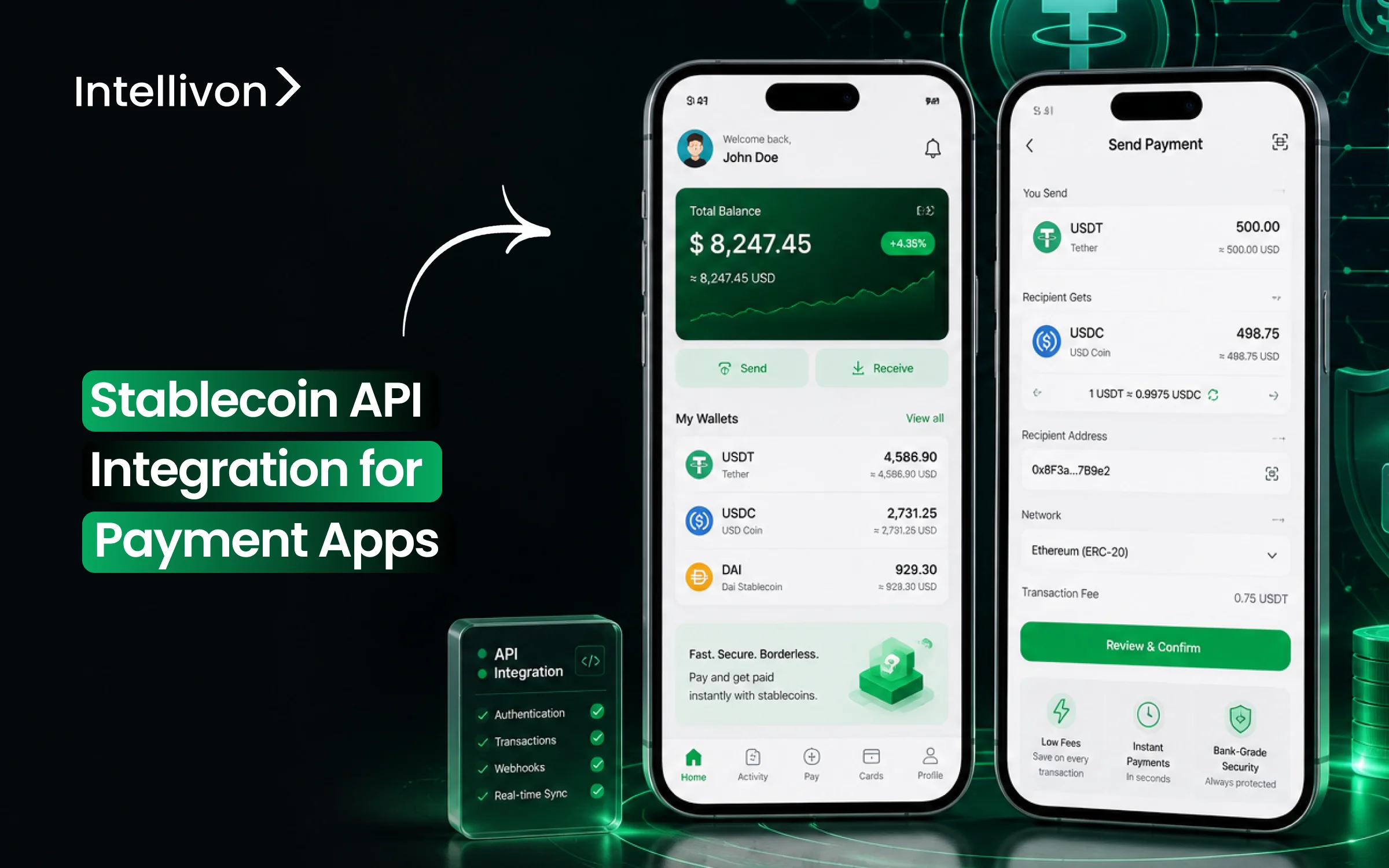
Key Takeaways:
- Production stablecoin API integration requires orchestration, double-entry ledger, custody, fiat ramps, and compliance checks.
-
REST APIs, webhooks, SDKs, wallets, ledgers, and on/off-ramps form the complete payment lifecycle architecture.
-
KYC, KYB, AML, OFAC, and Travel Rule responsibilities must be defined before choosing hosted versus direct API.
-
Builds cost $70,000 to $300,000 and take 3 – 9 months depending on integration depth and compliance scope.
-
How Intellivon builds stablecoin API integrations around full payment lifecycle ownership.
Stablecoin API integration lets a payment app accept and send stablecoins without a developer building wallet infrastructure from scratch. Skip that step, and a team spends months on blockchain monitoring, gas handling, and key management before shipping a single transaction. With the right API, that same integration takes days instead.
However, picking any API isn’t enough on its own. Payment apps still need KYC, AML, and travel rule checks wired into every transaction, and not layered on after launch. Stablecoin payment processors charge fees between 0.2% and 1%, compared to the 3% to 5% typical of card networks, according to a 2026 developer guide. As a result, apps that build compliance into the integration usually see that fee gap turn into recovered margin within six months.
Compliance usually gets bolted on right before a security review, once a bank partner starts asking questions. This blog covers API architecture, SDK integration, on-ramp and off-ramp design, and compliance in order. By the end, you’ll know exactly what a production-ready integration requires.

What Is a Stablecoin API Integration Platform?
A stablecoin API integration platform connects your payment application with stablecoin wallets, blockchain networks, fiat banking rails, custody providers, FX services, and compliance systems through one controlled application layer.
As a result, your team can add fast, cross-border stablecoin payments directly into your software. Consequently, you avoid the massive cost and complexity of building every blockchain connection and financial service from scratch.
Stablecoin API Integration vs a Stablecoin Payment Gateway
A stablecoin payment gateway simply handles basic payment acceptance, whereas an API integration platform orchestrates full-scale payment operations like payouts, FX conversions, compliance, and enterprise reconciliation.
Additionally, a full infrastructure platform goes even deeper by directly managing the underlying custody, blockchain nodes, and liquidity services.
Stablecoin API Integration vs Payment Gateway
| Capability / Feature | Stablecoin Payment Gateway | Stablecoin API Integration Platform | Stablecoin Infrastructure Platform |
| Primary Focus | Front-end checkout & simple payment collection | End-to-end payment workflow orchestration | Core node management, settlement & custody |
| Wallet Management | Limited to basic checkout wallets | Programmatic multi-wallet creation & management | Low-level address generation & key custody |
| On-Ramp / Off-Ramp & FX | Basic third-party checkout redirects | Automated REST/WebSocket conversion & payouts | Direct liquidity sourcing & market making |
| Compliance & Monitoring | Basic built-in screening | Granular KYC, AML, & Travel Rule API hooks | Protocol-level transaction monitoring & validation |
| System Integrations | Simple webhooks & web plugins | Deep ERP, treasury, & ledger system alignment | Low-level RPC endpoints & direct node access |
| Best Used For | Merchants needing quick crypto checkout | Fintechs & enterprises building custom payment apps | Financial institutions building raw crypto services |
Which Systems Connect to the Platform?
An enterprise integration layer acts as the central router for your entire financial workflow. Consequently, it binds customer-facing interfaces directly with internal core ledgers and third-party compliance vendors.
- Mobile and web applications: Native iOS, Android, and web interfaces deliver user account balances, checkout flows, and payment links.
- Banking and payment APIs: Traditional rails like ACH, SEPA, and FedNow handle fiat clearing for on-ramp and off-ramp operations.
- ERP systems: Systems like SAP and Oracle automatically sync invoice statuses and cross-border vendor disbursements.
- Treasury management platforms: Central dashboards monitor real-time multi-currency liquidity and internal capital movements.
- Accounting software: Platforms like QuickBooks and Xero capture transaction data for automated journal entries and reconciliation.
- CRM systems: Software such as Salesforce maps wallet addresses to corporate accounts for unified client tracking.
- Identity verification providers: Services like Jumio and Onfido automate user onboarding through integrated KYC and KYB checks.
- Blockchain analytics tools: Vendors like Chainalysis and Elliptic screen transaction destinations for AML compliance.
- Custody providers: Institutional services like Fireblocks and BitGo secure private keys using HSMs and MPC architecture.
- Liquidity and FX providers: Exchanges and market makers lock in real-time conversion rates to eliminate currency risk.
A stablecoin API integration platform does not replace every financial provider. Instead, it connects those providers through one governed payment layer that the enterprise can monitor and control.
Why Enterprises Are Adopting Stablecoin API Integration
Enterprises adopt stablecoin APIs to drastically improve cross-border payment availability, settlement speed, corridor coverage, and payment programmability. Consequently, enterprise payment leaders look for modular digital rails that bypass traditional operational bottlenecks.
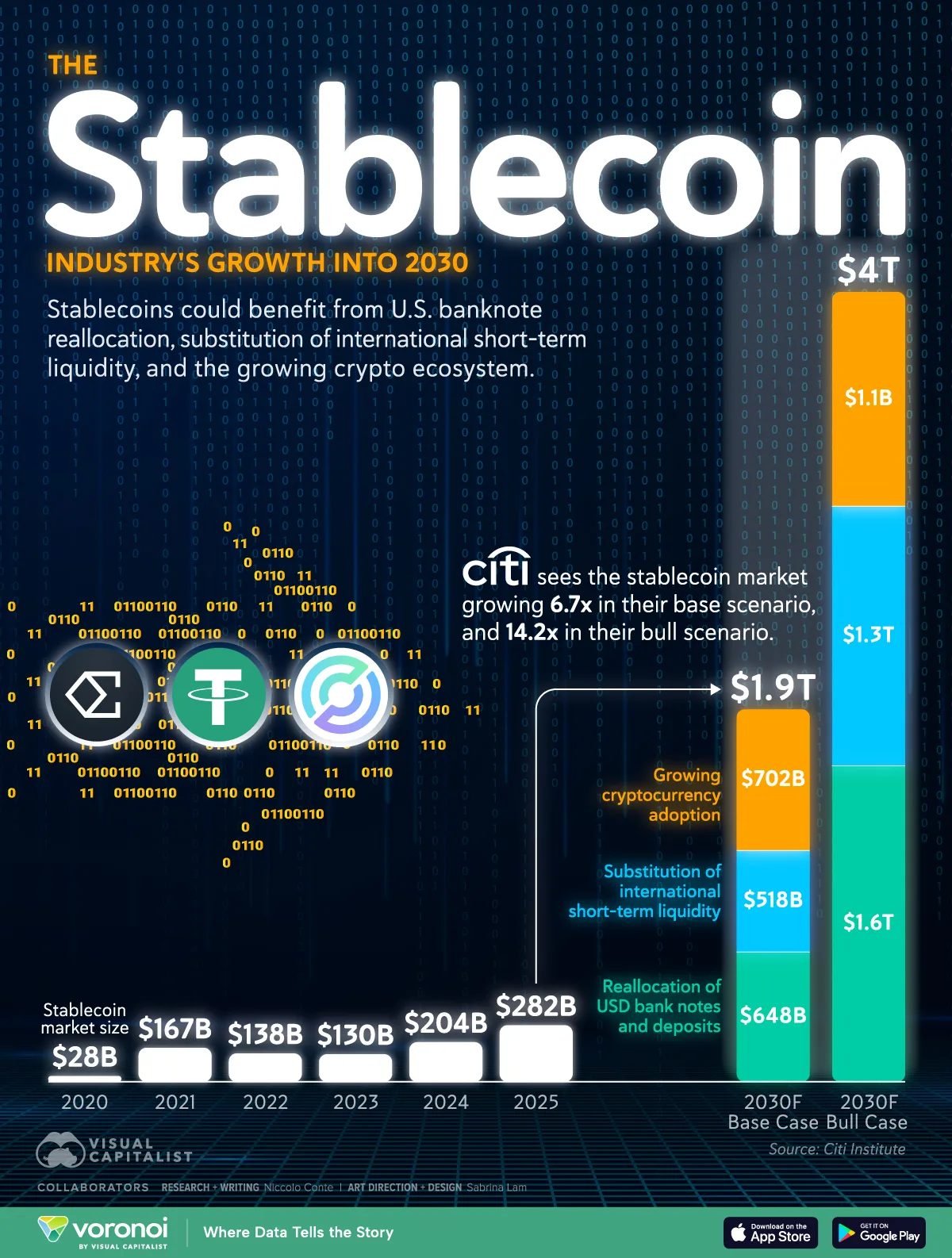
According to institutional research by Citi GPS published via Visual Capitalist, the stablecoin market is projected to reach between $1.9 trillion (base case) and $4.0 trillion (bull case) by 2030, driven heavily by international liquidity substitution and corporate treasury allocation. Furthermore, analysis by Oliver Wyman shows B2B transactions driving the fastest growth in real payment use cases.
1. Faster Cross-Border Settlement
On-chain stablecoin transactions clear in seconds or minutes. However, complete fiat-to-fiat settlement times still depend on local banking hours and compliance reviews.
- Correspondent banking settlement: Traditional SWIFT routes pass through multiple intermediary banks, taking 2 to 5 business days to finalize.
- Weekend and holiday restrictions: Standard fiat clearing systems halt operations outside regular banking hours, causing severe weekend operational delays.
- Stablecoin network availability: Public blockchain networks process and validate token transfers 24/7/365 without schedule interruptions.
- Off-ramp processing time: Local banking systems like ACH or SEPA determine final cash payouts once tokens leave the chain.
- Final recipient bank credit: Integrated APIs trigger automated payouts to recipient accounts immediately after local banking rails open.
Detailed research in BIS Paper No 167 highlights how multi-layered correspondent banking adds friction and latency. Consequently, engineering teams build fallback queues to handle delayed fiat payouts while keeping the core blockchain transfer real-time.
2. Lower Dependence on Pre-Funded Accounts
Using programmatic stablecoin settlement minimizes the capital tied up in foreign currency accounts worldwide.
- Nostro and vostro account requirements: Enterprise treasury teams traditionally lock up working capital across regional banks to guarantee fast local payouts.
- Idle liquidity: Trapped account balances reduce overall capital efficiency and expose companies to local currency devaluation risks.
- Corridor-level prefunding: Real-time liquidity access allows firms to convert and transfer funds on-demand per transaction instead of holding bulk reserves.
- Working capital optimization: Freeing up locked balances allows corporations to reallocate capital into revenue-generating operational activities.
- Treasury visibility: Automated dashboard feeds provide instant tracking across both blockchain wallets and partner bank balances.
An industry overview from McKinsey & Company notes that tokenized cash rails eliminate the heavy balance-sheet drag of idle reserves. Therefore, businesses drastically lower global cash holding requirements without sacrificing their ability to pay local vendors quickly.
3. Better Payment Tracking and Reconciliation
Blockchain ledgers provide cryptographically verifiable audit trails that streamline internal financial reporting and reconciliation processes.
- Transaction timestamps: Every transfer records an unalterable, precise block timestamp directly on the public ledger.
- Wallet addresses: Sender and recipient public keys are permanently linked to the specific payment payload.
- Network confirmation status: Automated webhooks report transaction stages from pending pool inclusion to full block confirmation.
- Fee information: On-chain records explicitly capture exact network gas charges incurred during transfer execution.
- Conversion records: API logs capture foreign exchange rates and conversion slippage at the exact moment of execution.
- Provider references: Internal transaction IDs map directly to on-chain hashes and banking off-ramp transaction codes.
- Settlement evidence: Immutable block records serve as indisputable proof of payment during vendor contract disputes.
Data published by the World Bank confirms that lack of transparency drives up transaction costs across global payment corridors. Although blockchain ledgers provide immutable transfer proof, enterprises must still maintain internal double-entry ledgers for accurate corporate accounting.
4. Faster Entry Into New Payment Corridors
API-driven payment architectures enable rapid expansion into emerging global markets without requiring underlying structural redesigns.
- Local regulations: Every new jurisdiction requires strict adherence to local licensing, capital controls, and consumer protection laws.
- Banking access: Establishing dependable local fiat off-ramp connections demands vetted banking or payment institution partnerships.
- Stablecoin liquidity: Regional markets require deep local fiat order books to prevent extreme price slippage during conversion.
- Off-ramp coverage: Physical cash-out networks or instant bank transfer coverage vary significantly across emerging market corridors.
- Sanctions exposure: High-risk payment destinations mandate continuous real-time geopolitical monitoring and automated screening checks.
- Customer support requirement: Operating across multi-currency corridors requires localized support workflows to resolve stuck payouts.
As highlighted in J.P. Morgan’s 2026 Payments Trends Report, over 93% of financial institutions are modernizing infrastructure to capture new corridor growth. As a result, a well-designed integration layer abstracts protocol complexity, letting teams launch new payout corridors through simple config changes.
5. Greater Control Than a Hosted Payment Widget
Direct API integrations give enterprise teams full ownership over branding, workflow design, risk management, and system architecture.
- Branded customer experience: Native API calls eliminate third-party checkout redirects, keeping users within your custom application interface.
- Custom approval workflows: Complex multi-sig approvals and internal corporate governance rules trigger automatically before submitting payments.
- Internal ledger ownership: Direct balance database control ensures immediate order fulfillment without waiting for third-party reporting syncs.
- Provider portability: Decoupled API architecture allows engineering teams to swap underlying liquidity vendors without altering user workflows.
- ERP and treasury integration: Native endpoints push real-time transaction data directly into systems like SAP, Oracle, or NetSuite.
- Flexible risk rules: Custom compliance engines enforce specific transaction thresholds based on dynamic user risk profiling.
- Detailed reporting: Full access to raw transaction payloads enables deep BI analytics and custom financial dashboarding.
- Multiple payment providers: Redundant off-ramp integrations route payments through alternative partners automatically if one channel fails.
For a deeper breakdown of multi-currency treasury architectures, see our guide on enterprise stablecoin wallet development.
Ultimately, enterprises adopt stablecoin APIs as a modernized payment and settlement layer where speed, 24/7 availability, and programmatic control drive clear operational value.
Stablecoin Payment API Architecture for Production Apps
Mobile and web clients must never interact directly with external stablecoin protocol APIs to execute privileged payment functions.
Instead, your secure application backend must systematically manage user authentication, business rules, compliance evaluations, idempotency keys, internal ledger reconciliations, and vendor API credentials.
Core Layers of Production API Infrastructure
| Architectural Layer | Core Responsibility | Key Technologies & Protocols |
| Client / Mobile App Layer | User interface, authentication prompts, dynamic payment rendering, status displays | Native iOS (Swift), Android (Kotlin), React Native, Flutter, Web Vitals |
| BFF & API Gateway Layer | Request validation, rate limiting, token security, device risk profiling, routing | OAuth 2.0, JWT, Envoy, Kong, AWS API Gateway, TLS 1.3 |
| Payment Orchestration Layer | Business logic, state management, provider selection, FX quote locking, compliance triggers | Node.js, Go, Python, Temporal.io, Apache Kafka |
| Provider Adapter Layer | Protocol normalization, request transformation, vendor error mapping, failover routes | REST adapters, gRPC, SDK wrappers, Axios, WebSockets |
| Ledger & Data Layer | Double-entry balance management, immutable transaction logging, audit trails | PostgreSQL, Redis, CockroachDB, Kafka event store |
Decoupling client applications from direct blockchain or provider endpoints ensures strict data security, eliminates client-side private key exposure, and establishes centralized audit controls.
By establishing clear communication boundaries, software teams isolate synchronous client requests from asynchronous blockchain events. This architecture guarantees reliable transaction execution, prevents dropped payment states, and gives management absolute operational control over capital flows.
Integrate Stablecoin APIs Into Mobile Payment Apps
Mobile applications should handle user interaction, authentication, and status presentation. Secrets, transaction signing policies, compliance decisions, and provider API keys must remain in protected backend services.
Consequently, mobile devices operate as untrusted clients while the backend maintains full transactional security.
- Native iOS and Android Integration: Use Swift and Kotlin wrappers with biometric authentication. Store session tokens in iOS Secure Enclave or Android KeyStore, enforcing device binding, deep links, push notifications, and screen capture controls.
- React Native and Flutter Integration: Implement shared domain models backed by native security modules. Fall back safely on cross-platform bridge failures and maintain strict SDK versioning for background event handling.
- Mobile Payment Confirmation UX: Present clear status updates—from Identity verification required to Payment completed. Hide technical blockchain terms like nonces, gas, or mempools to prevent user confusion.
- App Recovery After Interrupted Payments: Query backend endpoints to retrieve authoritative transaction states after network loss, app closures, expired quotes, or device restarts without restarting payouts.
Querying authoritative backend states guarantees idempotent transaction recovery across any unexpected mobile disruption.
Design Wallet, Custody, and Multi-Chain Connectivity
Wallet design determines who controls private keys, how users authorize payment transfers, how accounts recover access, and which licensing partners are required for compliance.
Consequently, selecting custody architecture dictates your operational governance, regulatory footprint, and system resilience.
- Compare Wallet and Custody Models: Evaluate provider-custodial, embedded custodial, MPC, HSM, smart contract, and user-controlled wallets across key recovery, approval policies, limits, allowlists, key rotation, and separation of duties.
- Select Stablecoins by Payment Corridor: Assess USDC, USDT, EURC, PYUSD, and RLUSD against redemption access, reserve transparency, jurisdiction, exchange liquidity, network availability, provider support, and counterparty risk.
- Select Blockchain Networks: Compare Ethereum, Base, Polygon, Arbitrum, Solana, Stellar, and XRPL based on finality, gas cost, liquidity, wallet support, provider coverage, operational history, and regional off-ramps.
- Connect Blockchain Nodes and RPC Providers: Combine direct node operation with Alchemy, Infura, or Helius using real-time health checks, request fallbacks, event indexing, and strict confirmation policies.
- Design Multi-Chain Transfers: Execute native token transfers across ERC-20 and SPL contracts with token allowlists, mint-and-burn protocols, bridge risk mitigation, destination liquidity, and cross-chain reconciliation.
For a deeper breakdown of custody and corridor infrastructure, see our guide on Stablecoin Infrastructure for Cross-Border Payments.
Balancing cryptographic custody with multi-chain connectivity minimizes counterparty risk while ensuring deep liquidity. Abstracting RPC infrastructure and cross-chain bridges enables reliable payment execution across diverse networks.
Stablecoin API Integration Implementation Roadmap
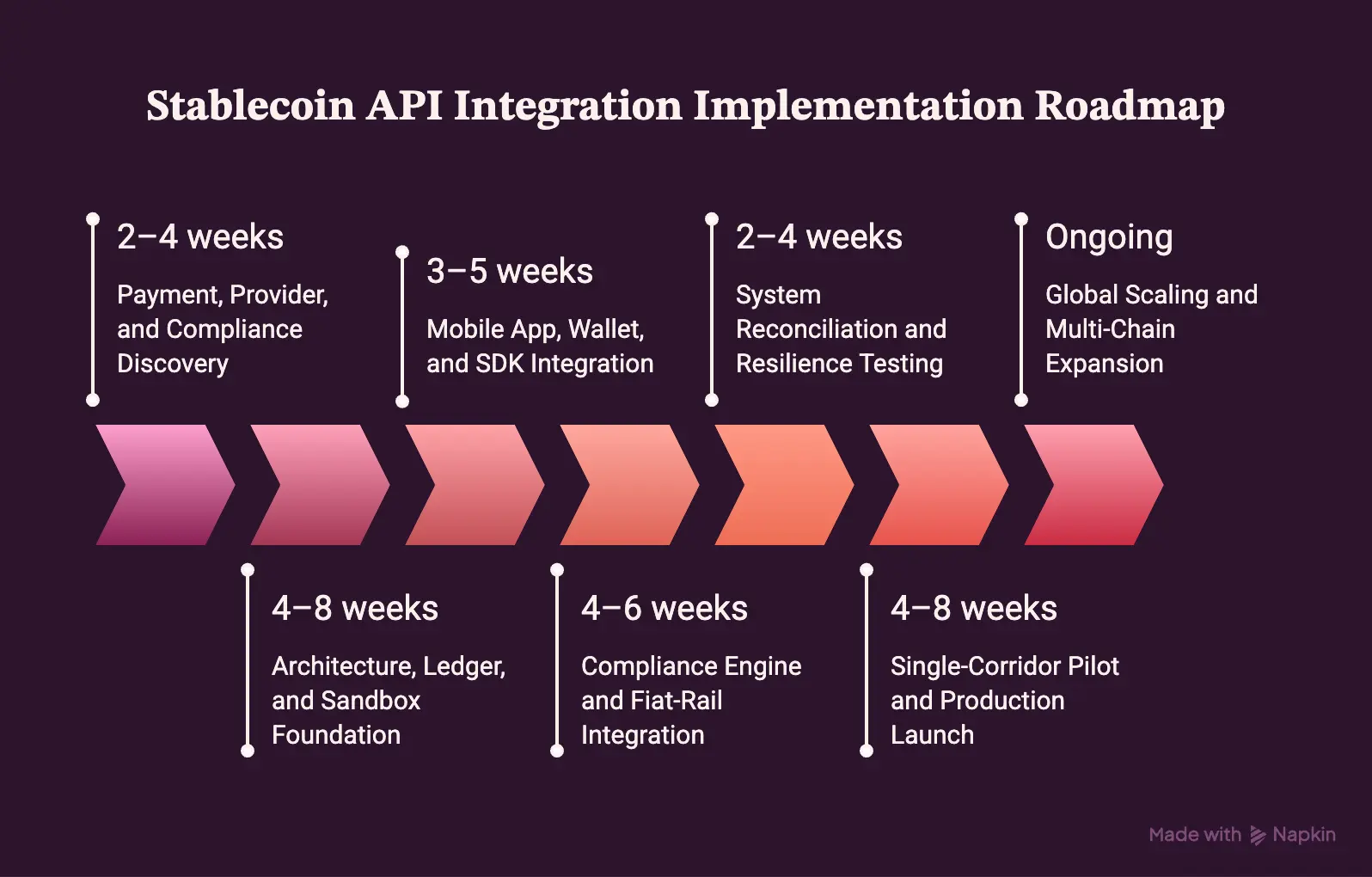
At Intellivon, we build stablecoin payment systems as modular, enterprise-grade software rather than simple checkout widgets. We systematically guide engineering teams through a 7-phase deployment framework.
As a result, this process ensures decoupled architecture, compliant fiat-to-crypto bridging, and automated balance matching from the start.
Phase 1 — Payment, Provider, and Compliance Discovery
Timeline: 2–4 weeks. Intellivon maps your regulatory scope, payment corridors, expected volume, and security posture before writing code.
| Activity | Primary Focus | Deliverable |
| Core Scope | Map target corridors, stablecoins, and customer types | Payment-flow diagram & MVP scope |
| Risk Analysis | Define regulatory duties and vendor dependencies | Jurisdiction matrix & threat model |
- Evaluate target corridors, volume projections, stablecoin selections, and licensing duties across operating regions.
- Shortlist API vendors, map data flows, conduct threat modeling, and define baseline infrastructure costs.
- Produce complete payment-flow diagrams, provider ownership matrices, initial architecture specs, and risk registers.
- Intellivon establishes governance boundaries, transitioning your engineering team smoothly into architecture design.
Phase 2 — Architecture, Ledger, and Sandbox Foundation
Timeline: 4–8 weeks. We construct your core orchestration layers, double-entry ledger database, and provider adapter frameworks.
| System Layer | Implementation Focus | Operational Purpose |
| API Layer | Gateway orchestration services | Idempotency & provider decoupling |
| Data Layer | Double-entry ledger architecture | Immutable balance reconciliation |
- Construct API gateways, internal data models, double-entry accounting ledgers, and modular provider adapters.
- Implement strict idempotency keys, webhook processing pipelines, sandbox environments, and automated CI/CD pipelines.
- Circle’s sandbox mirrors production API patterns using test networks and simulated transactions, enabling safe integration testing.
- Intellivon designs provider-agnostic adapter logic so that your core systems remain insulated from vendor lock-in.
Phase 3 — Mobile App, Wallet, and SDK Integration
Timeline: 3–5 weeks. We embed client SDK wrappers and secure wallet provisioning workflows directly into your mobile apps.
| Client Layer | Security Focus | Primary Feature |
| Native SDK | Hardware enclave binding | Biometric user sign-offs |
| Wallet Engine | Session tokens & key rotation | Non-custodial / MPC provisioning |
- Integrate native iOS, Android, React Native, or Flutter wrappers bound to device hardware keystores.
- Build automated wallet creation workflows, biometric authentication flows, and payment confirmation interfaces.
- Abstract complex blockchain concepts like gas, nonces, and mempools away from end users to boost conversion.
- Intellivon provides hardened client wrappers that treat mobile devices as untrusted, backend-dependent endpoints.
Phase 4 — Compliance Engine and Fiat-Rail Integration
Timeline: 4–6 weeks. We connect automated identity checks, Travel Rule messaging, and fiat on/off-ramps directly into transaction flows.
| Compliance Module | Vendor / Standard | Functional Requirement |
| Identity & AML | KYC/KYB & Screening APIs | Real-time sanctions and PEP checks |
| Fiat Off-Ramp | Bank APIs & FX Lock Engines | Guaranteed exchange rate execution |
- Embed automated KYC/KYB verification, real-time AML screening, and FATF Travel Rule messaging into payment logic.
- Connect fiat on/off-ramps with dynamic FX quote locking to eliminate market volatility during conversions.
- Build administrative compliance dashboards for manual audit overrides, transaction flagging, and payout holds.
- Intellivon integrates compliance directly into payment workflows instead of adding it as a fragile secondary layer.
Phase 5 — System Reconciliation and Resilience Testing
Timeline: 2–4 weeks. We stress-test double-entry ledger accuracy and system resilience against severe edge-case disruptions.
| Testing Domain | Scenario Evaluated | Success Criterion |
| System Resiliency | Network drops & chain re-orgs | Zero duplicate or dropped payouts |
| Ledger Audit | Out-of-order webhooks | 100% balance reconciliation |
- Run failure-case simulations covering dropped webhooks, provider outages, network congestion, and chain re-organizations.
- Execute high-throughput load testing and third-party security reviews to uncover vulnerabilities prior to launch.
- Validate automated double-entry ledger reconciliation against mock provider balances to prevent balance drift.
- Intellivon conducts end-to-end failure audits, guaranteeing operational stability under peak platform load.
Phase 6 — Single-Corridor Pilot and Production Launch
Timeline: 4–8 weeks. We deploy a restricted production pilot using one stablecoin, two chains, and a high-value corridor.
| Launch Parameter | Initial Production Scope | Risk Limit |
| Rail Scope | Single stablecoin on 1–2 networks | Capped transaction velocity |
| User Cohort | Whitelisted enterprise clients | Strict daily volume caps |
- Deploy to production with capped transaction velocity, limited customer cohorts, and strict daily volume thresholds.
- Maintain a single high-value payment corridor using one stablecoin, one custody model, and two chains.
- Monitor live provider performance, API response latency, block confirmation times, and real-time ledger settlement.
- Intellivon provides embedded technical monitoring during pilot execution, ensuring smooth operations before scaling.
Phase 7 — Global Scaling and Multi-Chain Expansion
Timeline: Ongoing. Intellivon expands your infrastructure across additional corridors, blockchains, and fiat rails based on pilot metrics.
| Expansion Vector | Growth Mechanism | Strategic Objective |
| Corridors | Multi-currency FX & local rails | Expanded global footprint |
| Asset Rails | Cross-chain bridges & mint-burn | Reduced payment friction |
- Scale transaction limits and open public access only after ledger reconciliation and compliance metrics remain stable.
- Integrate additional stablecoins, blockchain networks, local fiat off-ramps, and automated mint-and-burn protocols like CCTP.
- Establish continuous 24/7 incident response protocols, automated compliance reporting, and infrastructure optimization.
- Intellivon serves as your long-term technology partner, continually expanding your platform’s global settlement capabilities.
Intellivon builds enterprise stablecoin infrastructure through modular, phased execution by starting with single-corridor pilots before scaling multi-chain platforms.
Decoupling provider adapters, automating double-entry ledgers, and embedding compliance controls directly into payment logic eliminates downtime and regulatory risk.
Stablecoin Payment App API Integration Cost: $70K–$300K
Stablecoin API integration for a payment app generally costs $70,000 to $300,000, depending on custody, mobile platforms, fiat corridors, compliance scope, provider count, and transaction volume.
Consequently, establishing clear technical requirements early prevents scope creep and keeps development budgets predictable.
1. Cost Breakdown by Development Phase
The overall project budget splits into distinct engineering workstreams across the integration lifecycle.
| Phase | Planning Range |
| Product discovery and architecture | $6,000–$18,000 |
| Payment orchestration and internal ledger | $18,000–$60,000 |
| Wallet, custody, and blockchain integration | $12,000–$55,000 |
| On-ramp, off-ramp, FX, and liquidity APIs | $10,000–$50,000 |
| KYC, AML, sanctions, and Travel Rule integration | $10,000–$45,000 |
| Web, iOS, Android, React Native, or Flutter work | $8,000–$40,000 |
| Security, QA, DevOps, and production launch | $8,000–$32,000 |
- Discovery and Architecture: Establishes payment flow diagrams, provider selection, jurisdiction mapping, and threat models.
- Orchestration and Ledger: Builds double-entry accounting engines, API gateway routing, and provider adapter layers.
- Custody and Blockchain: Integrates MPC or HSM key management, network RPC nodes, and smart contract connections.
- Fiat and Liquidity: Connects banking rails, dynamic FX rate locking engines, and automated on/off-ramp partners.
- Compliance Framework: Implements automated KYC/KYB identity verification, sanction screening, and Travel Rule messaging.
- Mobile Client Apps: Builds native or cross-platform mobile user interfaces with Secure Enclave hardware binding.
- QA and Deployment: Executes load testing, third-party security audits, failure-case simulations, and cloud CI/CD setup.
2. Cost by Product Type
Total integration costs scale according to functional complexity, target corridors, and underlying platform architecture.
| Product Scope | Estimated Cost | Timeline |
| Hosted checkout or single-provider MVP | $70,000–$100,000 | 3–4 months |
| Custom fintech payment integration | $100,000–$180,000 | 4–6 months |
| Multi-corridor mobile payment platform | $180,000–$240,000 | 6–8 months |
| Enterprise multi-provider orchestration platform | $240,000–$300,000 | 7–9 months |
- Single-Provider MVP: Focuses on one stablecoin, one blockchain network, and basic hosted checkout interfaces for rapid launch.
- Custom Fintech Integration: Embeds direct wallet creation, double-entry ledgers, and automated fiat conversion inside existing financial apps.
- Multi-Corridor Platform: Supports multi-currency FX settlement across native mobile applications in several target regions.
- Enterprise Orchestration Platform: Delivers multi-provider failover routing, complex custody models, and institutional compliance tools.
3. Budgeting for Ongoing Operational Costs
Beyond initial software development, engineering teams must account for recurring platform operational expenses.
Consequently, Intellivon recommends budgeting 15%–25% of your initial development cost annually for software maintenance and platform updates.
- API Provider Fees: Includes per-transaction processing fees, merchant channel charges, and custodian basis-point costs.
- Network Execution Fees: Covers blockchain gas costs, network execution fees, and dynamic liquidity FX spreads.
- Compliance SaaS Services: Encompasses per-verification KYC/KYB costs, sanctions screening API calls, and Travel Rule messaging fees.
- Infrastructure Operations: Covers dedicated RPC node infrastructure, cloud hosting environments, and wallet management fees.
- Platform Governance: Funds continuous smart contract re-audits, third-party security reviews, and ongoing regulatory compliance updates.
For a wider infrastructure cost comparison, see our guide on Cost to Build a Stablecoin Payment Infrastructure Platform.
Build Stablecoin API Integration With Intellivon
Building an enterprise-grade stablecoin payment layer requires balancing complex blockchain mechanics with strict financial regulation.
Rather than treating stablecoins as a superficial checkout add-on, Intellivon engineers modular payment platforms designed for long-term operational control and regulatory compliance.
What Intellivon Builds
- Stablecoin Payment Orchestration: End-to-end payment routing logic that connects internal business applications to public blockchains and stablecoin payment rails.
- REST APIs and Mobile SDK Integrations: Production-ready backend REST API endpoints along with native iOS, Android, React Native, and Flutter wrappers.
- Provider Abstraction Layers: Decoupled adapter layers that insulate your core platform from vendor lock-in and provider API changes.
- Wallet and MPC Custody Integrations: Secure key management frameworks supporting multi-party computation, HSM modules, and self-custodial account abstraction.
- Double-Entry Ledgers: High-throughput internal ledger databases that guarantee immutable, audit-ready balance tracking and instant balance reconciliation.
- Fiat On/Off-Ramp Connectivity: Direct integration with global banking networks, local payment rails, and dynamic FX quote engines for smooth fiat conversion.
- FX and Liquidity Workflows: Automated quote locking, order book execution, and multi-currency liquidity management to mitigate asset volatility risks.
- KYC, AML, Sanctions, and Travel Rule Integration: Automated identity verification pipelines, real-time sanctions screening, and FATF Travel Rule messaging.
- AI-Supported Fraud and Anomaly Detection: Machine learning monitoring engines that analyze transaction patterns to flag potential fraud, exploits, or compliance risks in real time.
- Reconciliation and Audit Systems: Automated reconciliation pipelines that match internal ledger balances against on-chain status and provider data.
- Cloud, DevOps, Monitoring, and Production Rollout: Scalable Kubernetes cloud infrastructure, CI/CD deployment pipelines, continuous RPC node monitoring, and 24/7 incident response.
If you want to build a secure, compliant stablecoin payment platform tailored to your technical requirements, book a free strategy call with Intellivon’s experts today.
Conclusion
Integrating stablecoin APIs empowers enterprises to build fast, low-cost cross-border payment platforms. Success requires balancing backend-driven security, multi-chain liquidity, and strict regulatory compliance from day one.
By decoupling provider adapters, maintaining double-entry ledgers, and following a phased rollout, CTOs can launch scalable systems that minimize vendor lock-in.
Therefore, adopting these architectural standards ensures your payment application remains resilient, audit-ready, and prepared for global growth.
FAQs
Q1. Does a Stablecoin API Provider Handle All Compliance?
A1. No, compliance responsibilities are divided across partners. Specifically, the app operator manages customer onboarding and overall risk policies, while KYC vendors verify user identities. Additionally, custody and ramp providers enforce Travel Rule messaging and sanctions screening, meaning licensed financial partners handle localized money transmitter regulations across corridors.
Q2. Should a Mobile App Call the Stablecoin API Directly?
A2. No, privileged operations must never run directly on client devices. Instead, secret keys, transaction signing policies, compliance decisions, and ledger updates must remain strictly on your secure backend. Consequently, mobile apps should only interact with your internal backend API to prevent exposed credentials and unauthorized payment submissions.
Q3. How Should Payment Apps Handle Duplicate Webhooks?
A3. Payment apps prevent duplicate processing by verifying cryptographic signatures and tracking unique event IDs. Furthermore, engineering teams must implement idempotent consumers alongside persistent event storage. As a result, receiving duplicate webhook notifications triggers a safe replay mechanism that confirms status without executing redundant ledger updates or fund transfers.
Q4. Can One API Support USDC, USDT, PYUSD, and Multiple Chains?
Yes, certain providers support multiple stablecoins and networks through a single integration. However, broad network coverage does not guarantee equivalent liquidity, local fiat access, or regulatory support in every corridor. Therefore, teams must evaluate asset availability alongside regional banking rails before selecting a primary API partner.
Q5. Is a Direct API Better Than an Embedded Widget?
A5. The choice depends on your long-term product vision. Specifically, use an embedded widget for rapid deployment and limited project scope. Conversely, choose a direct API when complete customer experience design, custom workflow control, internal ledger ownership, provider portability, and deep enterprise integration matter most for your platform.
To Sum It Up:
- A stablecoin transfer endpoint can be connected in days. Building a payment system that survives duplicate events, compliance holds, and failed off-ramps takes months.
- The internal ledger should remain the financial source of truth. Provider dashboards and blockchain explorers are reconciliation sources, not substitutes.
- Buying licensed financial infrastructure does not require surrendering product control. The strongest platforms buy regulated capabilities while owning orchestration and workflow design.
- AI can improve fraud detection and compliance review. It should not independently sign, release, or reverse customer funds.