Key Takeaways:
-
The settlement layer controls fund movement, payment states, escrow release, split payments, and reconciliation across the marketplace.
-
Buyer funds move through programmable escrow into a double-entry ledger before splitting and settling to individual sellers.
-
Custom builds need a payment state machine, KYC/KYB, Travel Rule messaging, liquidity management, and local off-ramps.
-
Marketplace settlement platforms cost $70,000 to $300,000 and take 4 to 9 months depending on complexity.
-
How Intellivon uses AI selectively for fraud scoring, liquidity forecasting, route selection, and exception matching, not as the core settlement logic.
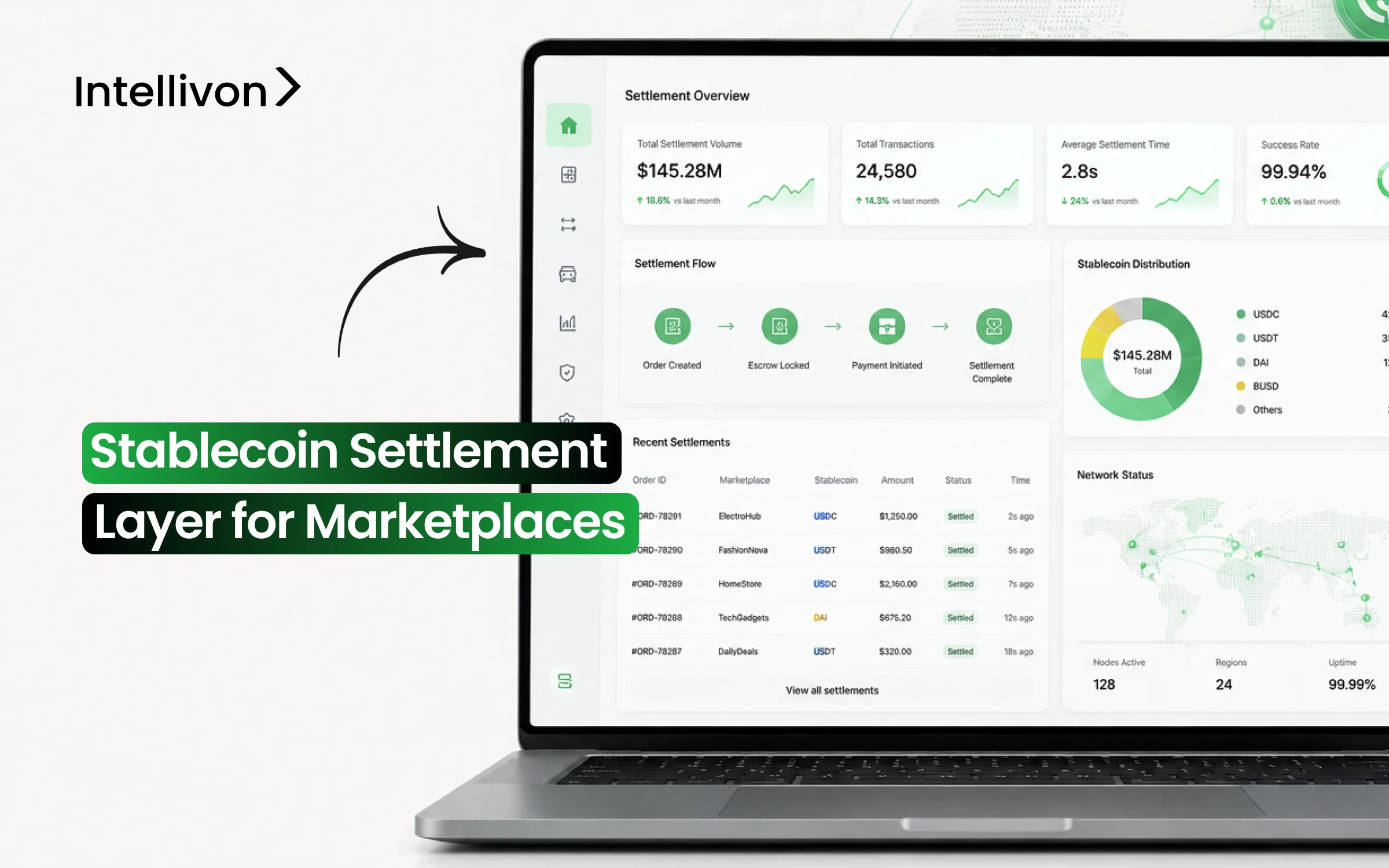
A stablecoin settlement layer for marketplaces holds a buyer’s payment, then splits it automatically between the seller and the platform once a delivery or service condition is met. That three-way split is what makes marketplace settlement fundamentally different from a direct merchant payment. Third-party sales across the top 100 marketplaces hit $3.2 trillion in 2025, according to a 2026 marketplace payments analysis, and nearly all of it runs through this exact hold-then-split mechanism.
However, most marketplaces still run that split manually, batching payouts weekly or monthly while sellers wait on cash they’ve already earned. Meanwhile, buyer-side payments have moved to real-time rails, so a seller stuck on a seven-day payout cycle is absorbing a timing cost the platform created. As a result, marketplaces that automate split payouts on confirmed delivery typically cut that payout cycle from days to minutes.
In this blog, we’ll cover how the settlement architecture actually holds and splits funds, what compliance looks like across sellers in different countries, and what a build like this costs to develop.

What Are Stablecoin Marketplace Payments?
Stablecoin marketplace payments represent an infrastructure model where digital dollar tokens handle atomic transfer and settlement, while a dedicated application layer orchestrates complex merchant operations.
Consequently, stablecoins serve as the underlying settlement asset while an off-chain ledger manages buyer collections, seller entitlements, platform commissions, escrow holds, automated refunds, and payout instructions.
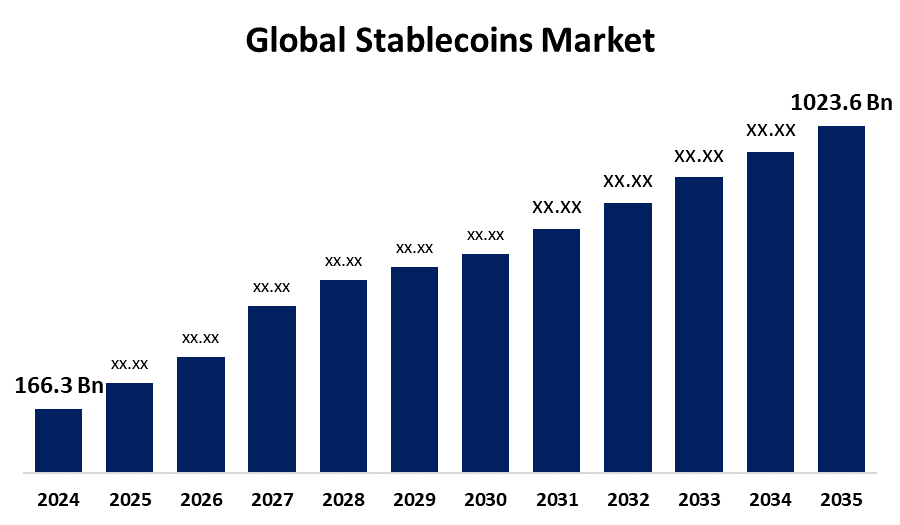
Furthermore, the global stablecoin payment market is expanding rapidly, growing from $3 billion in 2025 to over $58 billion by 2035 at a 34.5% CAGR. This rapid growth occurs because platforms actively replace legacy banking rails with 24/7 programmable settlement systems.
1. Payment Gateway vs Payout Provider vs Settlement Layer
A stablecoin marketplace payment setup relies on three distinct technical layers working in sync. However, mixing these operational boundaries often leads to accounting errors and compliance failures.
| Infrastructure Layer | Primary Role | Core Mechanism | Key Output |
| Payment Gateway | Accepts buyer funds | Converts fiat or routes on-chain transfers | Confirmed transaction hash |
| Payout Provider | Delivers seller funds | Executes local bank off-ramps or token payouts | Completed payout status |
| Settlement Layer | Determines ownership | Tracks double-entry balances and release rules | Immutable internal ledger state |
2. What the Marketplace Settlement Layer Controls
The settlement layer serves as the central source of truth for all marketplace fund flows.
Therefore, it operates off-chain to maintain real-time transaction processing speeds before committing final balance updates.
- Payment Intents: Maps incoming buyer stablecoin transactions directly to multi-vendor orders.
- Pending, Reserved, and Available Balances: Tracks hold periods and unvested funds before releasing payouts.
- Seller Sub-ledgers: Maintains segregated double-entry accounting records for every registered merchant.
- Platform Commissions: Automatically deducts marketplace software fees during checkout processing.
- Tax Withholding: Reserves local sales taxes or VAT before netting final seller earnings.
- Escrow Holds: Locks funds in programmatically controlled accounts until delivery conditions are met.
- Release Conditions: Triggers balance movements based on logistics API data or customer approvals.
- Refund Allocation: Reverses internal balances and calculates fee clawbacks across all marketplace parties.
- Dispute Status: Freezes specific sub-ledger allocations during active chargebacks or buyer claims.
- Payout Schedules: Groups available balances into automated daily, weekly, or on-demand payout batches.
- Reconciliation Records: Audit-matches on-chain blockchain events against internal database states.
3. Why a Wallet Is Not a Marketplace Settlement System
A crypto wallet balance only displays the total token inventory stored at a specific blockchain address. As a result, it cannot replace an internal double-entry ledger because it lacks transactional context, vendor attribution, and conditional accounting capabilities.
When multiple sellers’ earnings sit inside a single institutional omnibus wallet, the blockchain only sees one combined balance. Consequently, the marketplace settlement engine must maintain internal sub-ledgers to track true beneficial ownership across thousands of sellers in real time.
For a broader explanation of the complete payment stack, see our guide on How to Build a Stablecoin Payment Platform for Global Businesses.
Stablecoin Marketplace Settlement Architecture and Core Components
A scalable stablecoin marketplace settlement infrastructure design must separate internal ownership records from the physical movement of funds on-chain.
Consequently, the blockchain executes external value transfers, while an internal double-entry ledger determines true asset ownership, seller obligations, active holds, and available balances.
As a result, this separation prevents database race conditions, reduces unnecessary gas fees, and maintains strict auditability across high-volume multi-party payouts.
Key Components of Stablecoin Settlement Architecture
Therefore, understanding how each layer functions is critical when designing a high-throughput settlement engine.
| Settlement Layer | Primary Technical Responsibility | Core Operational Function |
| Marketplace Experience Layer | User interfaces & operational consoles | Manages buyer checkout, seller payouts, finance tracking, and dispute workflows. |
| API Gateway & Orchestration | Request routing & workflow state machines | Enforces rate limiting, idempotency, retry logic, and payment provider abstraction. |
| Double-Entry Ledger | System source of truth | Tracks balances, escrow liabilities, platform fees, reserves, and FX adjustments. |
| Escrow & Conditional Engine | Milestone & release triggers | Executes off-chain business logic alongside on-chain escrow smart contracts. |
| Wallet & Custody Layer | Key management & fund security | Enforces MPC, HSM-backed signing, multi-sig rules, and withdrawal allowlists. |
| Blockchain Connectivity | Node management & chain indexing | Handles transaction broadcasting, reorg protection, gas estimation, and indexing. |
| Compliance & Risk Layer | Regulatory screening & monitoring | Manages KYC/KYB, sanctions screening, Travel Rule messaging, and fraud checks. |
| FX, Liquidity & Payout Layer | Conversion & disbursement | Connects to liquidity pools, FX quote engines, on/off-ramps, and local bank payouts. |
| Data & Observability Layer | Auditability & system health | Generates immutable audit logs, accounting exports, real-time metrics, and alerts. |
For a deeper explanation of enterprise settlement models, see our guide on Stablecoin Settlement Infrastructure for B2B Payments.
A modular settlement architecture guarantees that your marketplace scales transaction volume without risking ledger drift or regulatory failure.
Consequently, decoupling ledger logic from on-chain execution ensures high availability, strict security, and total accounting accuracy. Building this infrastructure correctly from day one eliminates costly architectural retrofits as your multi-currency payment volumes expand.
Building Programmable Escrow, Release Triggers, and Disputes
Enterprise marketplace payments must separate payment finality from commercial finality. Payment finality happens when a blockchain confirms a transfer. Commercial finality, however, happens only when the buyer accepts the delivered goods.
Therefore, programmable escrow bridges this gap by holding funds until off-chain conditions trigger seller payout.
1. Escrow Implementation Models
Marketplace teams choose an escrow model based on their regulatory needs and risk limits.
| Escrow Model | Best Suited For | Main Limitation |
| Licensed Custodial / FBO | Regulated consumer & B2B platforms | Provider dependence & jurisdiction limits |
| Omnibus Wallet | Closed or partner-managed networks | Greater licensing & custody exposure |
| Smart Contract Escrow | Deterministic digital fulfillment | Oracle, upgrade & dispute complexity |
| Hybrid Escrow | Platforms needing automation & recourse | More integration & governance work |
2. Core Escrow Architecture and Triggers
Smart contract escrow logic controls key lifecycle states: deposit, lock, release, partial release, refund, expiration, pause, dispute, role permissions, upgrade controls, and emergency recovery.
- Release Triggers: State changes depend on buyer signatures, seller proof, carrier webhooks, admin overrides, API callbacks, oracle feeds like Chainlink, timeouts, or multi-sig approvals.
- Milestone Settlement: For example, this structure supports phased payouts across freelance, construction, real estate, healthcare procurement, media, and B2B supply chains.
- Refund Atomicity: In addition, cancellations reverse all transaction legs at once. As a result, seller earnings, platform fees, tax allocations, affiliate splits, and user credits return instantly in one operation.
3. Disputes and Safeguards
Active order disputes need human oversight instead of full automation. Consequently, platforms use dashboards for evidence submission, fund freezes, manual reviews, partial payouts, appeals, and audit tracking.
Finally, to prevent system failures, teams implement stale data checks, multi-source oracles, circuit breakers, timeout fallbacks, contract pausing, timelocks, and third-party code audits.
Decoupling ledger finality from delivery verification keeps payouts fast while protecting buyers and sellers against fraud.
Choosing Stablecoins, Blockchains, Custody, and Gas Strategy
Selecting the right underlying digital assets, settlement networks, key management frameworks, and transaction fee models dictates the long-term reliability of a marketplace.
Platform teams must balance regulatory clarity, network throughput, security, and user experience to ensure reliable settlement across global payout corridors.
1. Comparison of Core Settlement Assets
The matrices below evaluate primary stablecoins and blockchain environments across enterprise criteria.
| Asset | Issuer Regulation | Reserve Transparency | Liquidity | Freeze Controls | Jurisdictional Acceptance |
| USDC | US State/Federal Regulated | Monthly Audited Attestations | Deep Global Liquidity | Blacklist Capabilities | High (US, EU MiCA Compliant) |
| USDT | Non-US Offshore Regulated | Quarterly Attestations | Mass Global Market Share | Blacklist Capabilities | Moderate (Restricted in EU) |
| EURC | EU MiCA Regulated | Monthly Audited Attestations | European Focus | Blacklist Capabilities | High (EU Focus) |
| PYUSD | NYDFS Supervised | Monthly Public Reports | US Domestic Growth | Blacklist Capabilities | High (US Focus) |
2. Blockchain Network Selection Table
| Network | Finality | Average Tx Fee | Throughput | Stablecoin Liquidity | Primary Strengths |
| Ethereum | 12-15 Minutes | $1.00 – $15.00+ | ~15-30 TPS | Highest Total Volume | Institutional Security & Depth |
| Solana | Sub-Second | < $0.01 | 2,000+ TPS | Fast-Growing Volume | High Velocity & Low Latency |
| Base | ~2 Seconds | < $0.05 | High Scaling | Rapid Institutional Inflow | Ethereum L2 Ecosystem Access |
| Polygon | ~2-3 Seconds | < $0.02 | High Scaling | Wide Exchange Support | Enterprise & Retail Adoption |
| Avalanche | ~1 Second | < $0.05 | High Scaling |
3. Selection Criteria and Multi-Asset Architecture
Evaluating stablecoins requires checking issuer regulation, reserve transparency, redemption windows, liquidity, freeze controls, supported networks, banking relationships, and counterparty exposure.
Similarly, blockchain evaluation focuses on finality, transaction fees, throughput, liquidity, custody support, developer tools, indexing, network uptime, and off-ramps.
For a deeper breakdown of international ramps and payout corridors, see our guide on Building Cross-Border Payment Platforms Using Stablecoins.
- Single vs. Multi-Chain: Start with a single-chain MVP. Expand to multi-chain architectures only when vendors hold funds elsewhere, regional corridors demand specific rails, or partners require explicit networks.
- Multi-Stablecoin Risks: Supporting multiple assets increases liquidity fragmentation, reconciliation complexity, peg-risk monitoring, quote logic overhead, treasury rebalancing, and compliance management.
4. Key Management, Gas Abstraction, and Bridge Risk
Securing platform capital demands strict role segregation. Treasury funds require cold multi-sig MPC approval, customer deposits use isolated MPC addresses, escrow relies on smart contracts, and daily operational gas uses HSM signers.
Furthermore, account abstraction (ERC-4337), sponsored gas, stablecoin gas payments, and relayers eliminate UX friction.
Finally, native issuer transfers like Circle CCTP eliminate bridge risk, whereas third-party wrapped assets expose platforms to smart contract exploits.
Aligning asset selection, network performance, custody, and gas management creates a resilient foundation for enterprise settlement.
KYC, AML, and Marketplace Licensing Requirements
FATF reported in July 2026 that Travel Rule legislation had been passed in 83% of surveyed jurisdictions. Therefore, treating this requirement as a future concern creates severe legal risk for operators.
In addition, utilizing licensed partner models reduces direct licensing scope. However, outsourcing payment processing never removes platform-level AML obligations.
Warning: using an existing stablecoin does not remove the marketplace’s potential payment. In fact, FinCEN guidance treats the acceptance and transmission of monetary value as potential money transmission. FATF standards apply registration, supervision, and Travel Rule rules to virtual-asset service providers. Furthermore, European MiCA regulations establish strict operational standards.
Compliance Requirements For The Platform
| Compliance Area | Regulatory Driver and Scope | Core Implementation Controls |
| Participant Classification | FinCEN, MiCA, MAS, and FCA regulatory definitions | Identifies buyers, sellers, merchants of record, payment facilitators, custodians, and VASPs. |
| Seller KYC and KYB | Bank Secrecy Act and global AML/CFT mandates | Verifies business registration, beneficial owners, tax records, bank account ownership, and geographic risk. |
| Buyer Risk Verification | Risk-based AML customer identification programs | Applies stepped verification for high-value orders, cross-border flows, B2B buyers, and unhosted wallets. |
| AML & Transaction Monitoring | Suspicious Activity Reporting (SAR) compliance | Tracks velocity, structuring, rapid pass-throughs, circular transfers, account takeovers, and sanctioned wallets. |
| FATF Travel Rule | FATF Recommendation 15 global standards | Exchanges originator and beneficiary data securely across VASP transfers exceeding regional thresholds. |
| Jurisdictional Compliance | US FinCEN, EU MiCA, UK FCA, and MAS Singapore | Navigates state money-transmitter rules, Payment Services Acts, and regional crypto-asset frameworks. |
| Privacy & Data Governance | GDPR, CCPA, and regional data protection laws | Implements data minimization, zero-knowledge proofs, encrypted audit logs, and automated deletion rules. |
| Licensed Partner Models | Agent, sponsored, or API banking partnerships | Outsources regulated money transmission while retaining platform-level risk oversight and auditing. |
As a result, building automated compliance controls directly into the settlement workflow protects platform liquidity.
Furthermore, continuous monitoring prevents sanctions exposure and ensures multi-jurisdictional operating approval.
Where AI Fits in Stablecoin Marketplace Settlement
AI improves operational efficiency and risk decisions, but it must never replace double-entry ledgers, deterministic smart contracts, or human financial authority.
Instead, predictive machine learning models optimize secondary workflows while strict policy rules govern actual value execution.
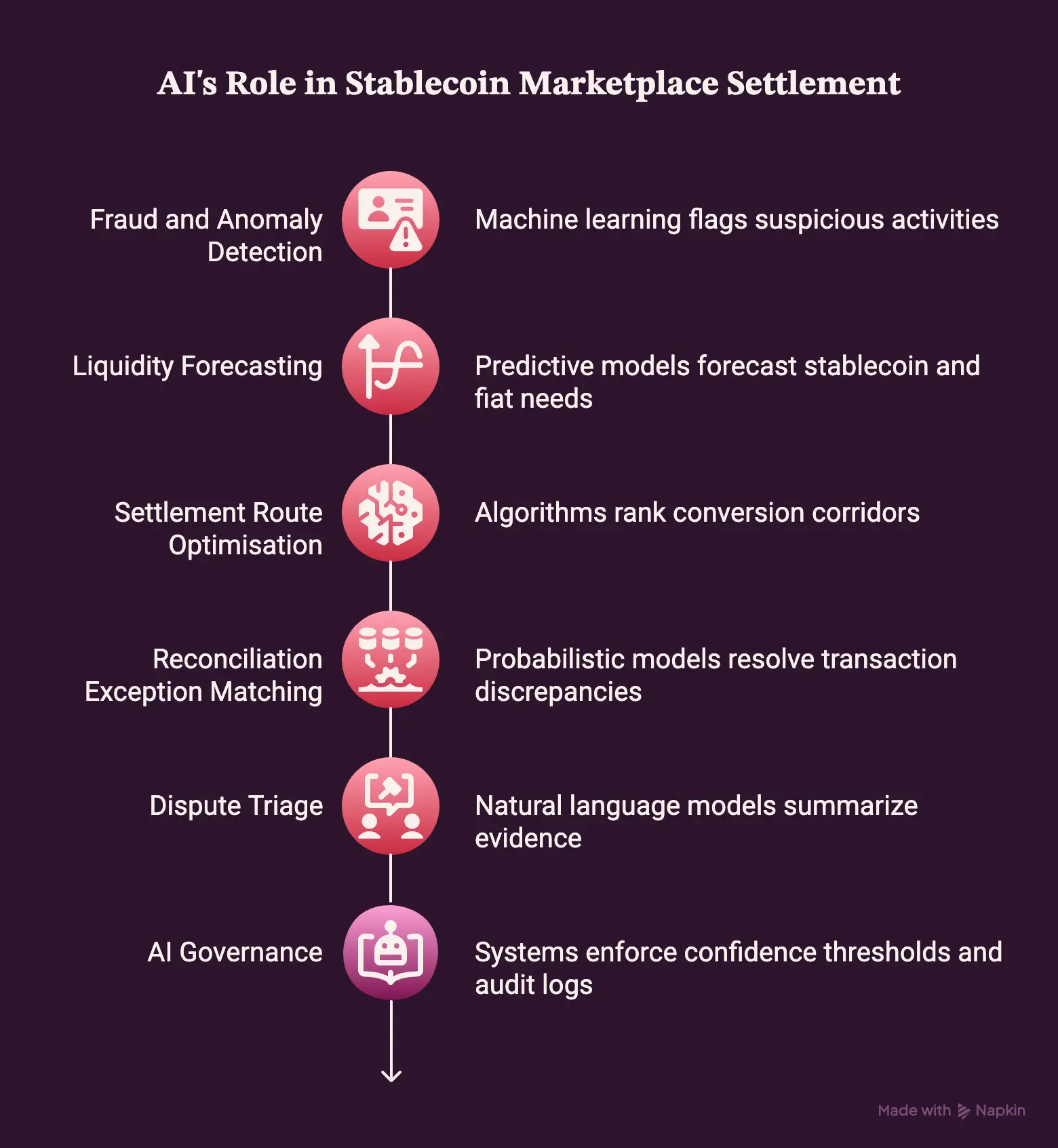
- Fraud and Anomaly Detection: Machine learning flags buyer-seller collusion, synthetic accounts, account takeovers, refund abuse, unusual payout destinations, velocity spikes, and linked high-risk wallets.
- Liquidity Forecasting: Predictive models forecast stablecoin and fiat requirements across corridors, seller cohorts, and seasonal demand peaks.
- Settlement Route Optimisation: Algorithms rank conversion corridors by FX rates, gas costs, liquidity depth, and payout SLAs while keeping final execution policy-bound.
- Reconciliation Exception Matching: Probabilistic models resolve missing transaction references, partial payments, time-window variances, and banking identifier mismatches.
- Dispute Triage: Natural language models summarize evidence and prioritize case risk, while human managers retain exclusive authority over material releases.
- AI Governance: Systems enforce confidence thresholds, drift monitoring, bias testing, restricted access, and complete audit logs without granting AI direct private-key control.
Consequently, embedding governed AI models provides real-time operational intelligence while keeping core financial settlement fully deterministic and secure.
How Settlement Design Changes Across Marketplace Models
Every business model handles money differently. For example, a site selling apparel processes fast, simple payments. A platform selling real estate or medical supplies, however, handles complex approvals, legal holds, and strict background checks.
Therefore, understanding these differences is critical before building your payout engine.
1. Settlement Requirements Across Marketplace Models
Here is a clear breakdown of how stablecoin payment workflows adapt based on what your marketplace sells:
1. Multi-Vendor E-commerce (e.g., Shopify-style platforms)
- What it does: Buyers put items from different sellers into one cart.
- How payments work: The platform splits the payment at checkout. In addition, it calculates local taxes, holds seller funds in reserve, and handles partial refunds.
- Main risk: Managing credit card chargebacks and verifying seller identities.
2. B2B Trading & Procurement (e.g., Wholesale supply platforms)
- What it does: Businesses buying large orders from suppliers using purchase orders.
- How payments work: Supports high payment limits, multi-step manager approvals, and invoice matching. As a result, partners can offset buying versus selling balances directly. Furthermore, this eliminates unnecessary wire transfers.
- Main risk: Corporate fraud, buyer credit checks, and cross-border tax rules.
3. Gig & Freelance Platforms (e.g., Upwork, Uber)
- What it does: Sending millions of micro-payments to workers worldwide.
- How payments work: Money sits in escrow until work is approved. Consequently, funds transfer instantly to local bank accounts or crypto wallets.
- Main risk: Identity fraud, tax reporting for global workers, and transaction fees on small payouts.
4. Real Estate Platforms
- What it does: High-value property transactions and earnest money deposits.
- How payments work: Money stays locked in secure legal escrow. Meanwhile, legal teams review property deeds and signatures. Therefore, final payout occurs only after all conditions pass.
- Main risk: Money laundering, verifying source of funds, and state property regulations.
5. Healthcare & Pharma Procurement
- What it does: Hospitals and clinics buying medical devices and medicine in bulk.
- How payments work: Payments require strict approval chains and lot number tracking. Furthermore, systems maintain detailed audit trails for every order.
- Main risk: Counterfeit suppliers, regulatory tracking, and strict buyer privacy laws.
6. Creator & Media Networks (e.g., Music, streaming, digital media)
- What it does: Distributing small royalty checks to multiple creators.
- How payments work: Revenue splits automatically between artists, producers, and writers. Specifically, payments trigger whenever content is streamed or downloaded.
- Main risk: Copyright disputes and fake accounts abusing micro-payouts.
7. Tokenized Assets & Digital Goods (e.g., NFTs, digital rights)
- What it does: Buying ownership of digital or real-world assets on-chain.
- How payments work: Smart contracts swap money and assets at the exact same second. Consequently, delivery happens instantly upon payment.
- Main risk: Unregulated crypto wallets, illegal asset trading, and token security rules.
2. Quick Comparison Table
The table below summarizes core payment goals, key system features, and main compliance challenges across marketplace types:
| Marketplace Type | Core Payment Goal | Primary System Feature | Main Compliance Challenge |
| E-commerce | Fast, high-volume checkout | Splits 1 cart payment to many sellers | Managing refunds and chargebacks |
| B2B Platforms | Paying large corporate invoices | Purchase order and invoice matching | Corporate background checks (KYB) |
| Gig / Freelance | Sending cheap, instant worker payouts | Milestone escrow and local bank cash-out | Global worker identity verification |
| Real Estate | High-value, legally binding transfers | Multi-signature legal escrow holds | Money laundering prevention |
| Healthcare | Buying regulated medical supplies | Batch tracking and multi-tier approvals | Supplier verification & strict audits |
| Creator / Media | Splitting small royalties | Automatic percentage splits on streams | Copyright and royalty disputes |
| Digital Assets | Instant asset-for-cash swap | Smart contract Delivery-versus-Payment | Unhosted wallet screening |
Designing payout rules around your specific market prevents costly system redesigns as your transaction volume grows.
Therefore, setting these rules early ensures long-term operational stability. In conclusion, tailoring your architecture upfront saves both time and engineering capital.
Stablecoin Marketplace Payment Settlement Development Cost
A custom stablecoin marketplace settlement platform costs approximately $70,000 to $300,000, depending on escrow complexity, seller volume, regulatory coverage, payout corridors, supported networks, custody, and enterprise integrations.
This overall range matches Intellivon’s current production estimates for stablecoin payment and cross-border settlement platforms.
1. Cost Breakdown by Platform Tier
Therefore, choosing the right scope depends on your business stage and feature needs:
| Platform Tier | Included Scope | Timeline | Estimated Cost |
| Focused MVP | 1 stablecoin, 1 network, basic seller onboarding, simple escrow, 1 payout route | 12–18 weeks | $70,000–$120,000 |
| Production Platform | Multi-seller support, programmable escrow, refunds, FX, compliance automation, 2–4 payout routes | 5–7 months | $130,000–$220,000 |
| Enterprise Layer | Multi-chain, multi-stablecoin, netting, custom custody, ERP integrations, advanced risk tools | 7–9 months | $220,000–$300,000 |
2. Development Phase Breakdown
Building this software requires several engineering stages. However, phase ranges overlap because a simple MVP does not need maximum scope in every category:
| Development Phase | Typical Cost |
| Product Discovery & Regulatory Setup | $8,000–$18,000 |
| UX & Operational Dashboards | $8,000–$22,000 |
| Ledger, Payment Gateway & APIs | $20,000–$50,000 |
| Wallet & Custody Setup | $12,000–$35,000 |
| Escrow & Refund Smart Contracts | $12,000–$35,000 |
| KYC, AML & Fraud Controls | $10,000–$30,000 |
| FX, On-Ramps & Off-Ramps | $12,000–$40,000 |
| Accounting & Enterprise Integrations | $10,000–$30,000 |
| Security Audits & Testing | $10,000–$30,000 |
3. What Pushes Costs Toward $300,000?
In addition, advanced technical requirements increase initial development budgets. For instance, costs rise when adding:
- Multi-seller cart splitters
- Milestone escrow contracts
- Automatic partial refunds
- Multilateral netting engines
- Five or more global payout countries
- Multi-chain routing across networks
- Self-managed MPC or HSM key custody
- Custom ERP integrations with NetSuite or SAP
- 24/7 high-availability infrastructure
For a deeper breakdown of infrastructure-level expenses, see our guide on Cost to Build a Stablecoin Payment Infrastructure Platform.
4. Ongoing Maintenance and Operational Costs
Furthermore, platforms require continuous upkeep. As a result, annual maintenance should be budgeted at 15% to 25% of the initial build cost.
Specifically, separate operational expenses include:
- KYC and KYB identity checks
- Blockchain risk analytics
- Travel Rule compliance messaging
- Wallet custody fees
- RPC node infrastructure
- Security re-auditing
- Local banking and payout provider fees
Planning your build around these budget tiers prevents unexpected financial surprises. Consequently, setting clear feature boundaries early ensures a fast, cost-effective launch.
How to Build a Stablecoin Settlement Layer for an Online Marketplace
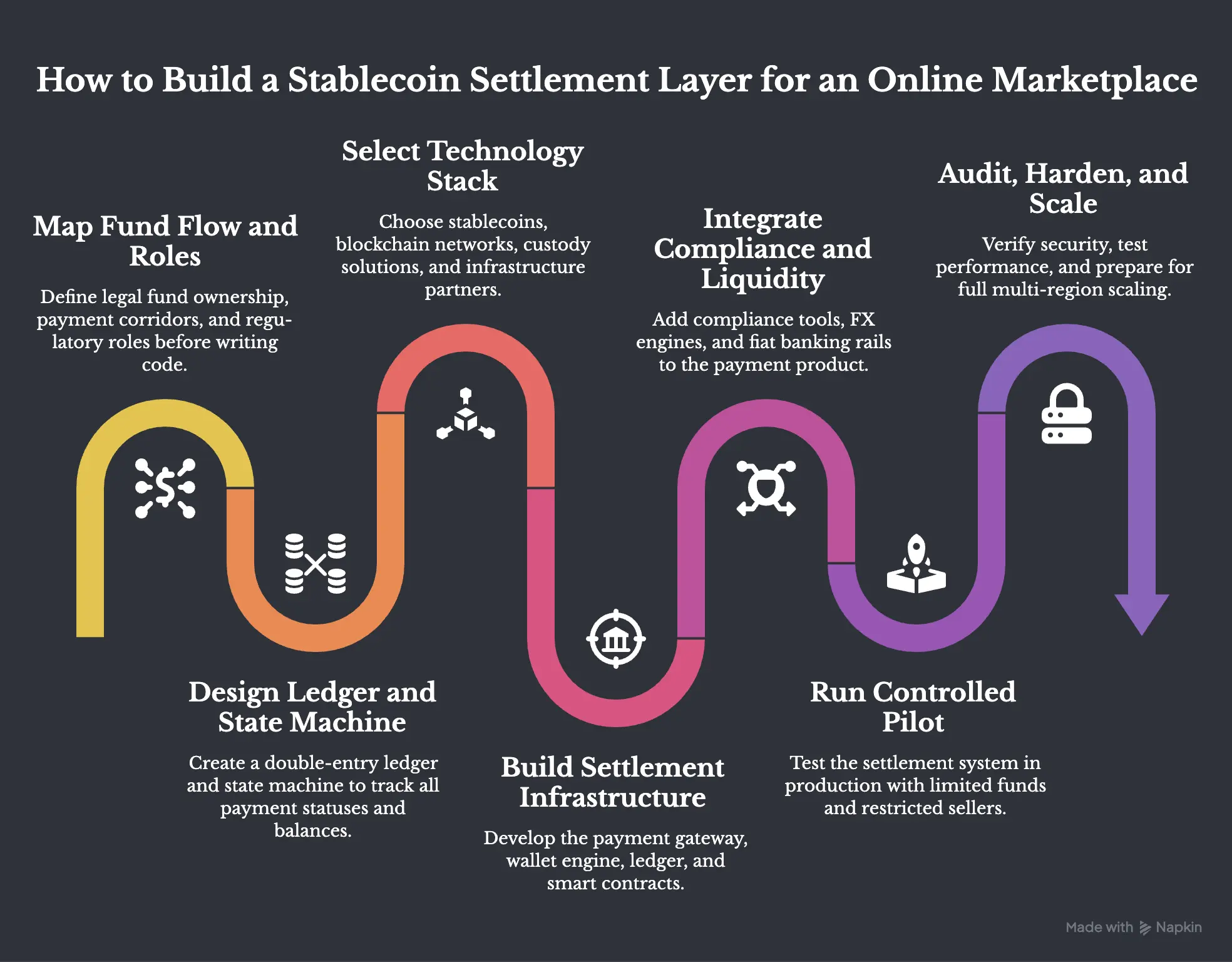
Building a stablecoin settlement layer for an online marketplace requires a structured engineering process that connects legal compliance, double-entry accounting, smart contract security, and global banking rails.
Therefore, following a clear step-by-step roadmap ensures your payout system handles high transaction volumes safely without running into regulatory bottlenecks.
Step 1 — Map the Marketplace Fund Flow and Regulatory Roles
Timeline: 2–3 weeks.
Building a marketplace settlement layer begins by defining legal fund ownership and payment corridors before writing code. This crucial step determines who holds, converts, and transfers funds at every stage. As a result, it prevents costly legal mistakes and clarifies money-transmission licensing needs early.
Technical Deliverables:
- Participant classification map
- Visual money-flow diagram
- Merchant-of-record decision framework
- Legal custody boundary definition
- Target payout corridor list
- Seller risk categorization matrix
- Escrow hold and release rules
- Regulatory licensing assessment
- Unit economics and fee model
Intellivon’s Practitioner Approach: Intellivon documents exactly who legally receives, owns, holds, converts, and transmits funds before choosing any blockchain or custody partner. Consequently, this upfront legal mapping saves our clients months of unnecessary smart contract refactoring.
Once fund flows are mapped, engineering teams can design the core accounting engine.
Step 2 — Design the Ledger and Settlement State Machine
Timeline: 2–4 weeks.
Designing the double-entry ledger creates the absolute source of truth for all buyer balances, seller earnings, platform fees, and escrow holds. Specifically, the state machine maps every possible payment status from pending to final payout. Therefore, this guarantees complete accounting accuracy even during network drops or API errors.
Technical Deliverables:
- Multi-account ledger hierarchy
- Double-entry journal rules
- Balance type definitions (available, pending, reserved)
- Payment lifecycle state machine
- Refund and cancellation workflows
- Dispute hold states
- Platform reserve calculation logic
- Bilateral and multilateral netting rules
- Automated daily reconciliation model
Intellivon’s Practitioner Approach: Intellivon validates every payment state against accounting entries and edge-case failure scenarios before building user interfaces. As a result, our ledgers prevent balance drift and pass strict financial audits.
With accounting logic locked in, teams proceed to select their underlying blockchain stack.
Step 3 — Select Stablecoins, Networks, Custody, and Providers
Timeline: 2–3 weeks.
Selecting your technology stack involves choosing stablecoins, blockchain networks, key custody, and infrastructure partners. Specifically, platform teams must balance speed, transaction costs, liquidity depth, and security. For instance, picking liquid assets and fast chains keeps user fees low while ensuring instant payouts.
Technical Deliverables:
- Stablecoin reserve and regulatory due diligence
- Blockchain performance evaluation scorecard
- Custody architecture blueprint (MPC vs. HSM)
- RPC node provider selection
- Blockchain analytics integration plan
- On-ramp and off-ramp partner agreements
- Institutional liquidity provider setup
- Travel Rule messaging provider selection
Intellivon’s Practitioner Approach: Intellivon evaluates blockchain rails based on real-world payout corridors rather than market hype. Consequently, we connect our clients to trusted custody partners like Fireblocks and top-tier banking rails.
After selecting infrastructure partners, core platform development begins.
Step 4 — Build the Core Settlement Infrastructure
Timeline: 6–10 weeks.
Building the core infrastructure brings together the payment gateway, wallet engine, double-entry ledger, and smart contracts. Consequently, this layer handles buyer deposits, locks funds in escrow, calculates fee splits, and routes outward disbursements. Therefore, it forms the functional heart of your marketplace payment system.
Technical Deliverables:
- Seller onboarding and account management APIs
- Buyer payment intent services
- High-throughput double-entry ledger engine
- Secure wallet and custody gateway
- Programmable escrow smart contracts
- Automated split-payment engine
- Dynamic marketplace fee calculator
- Payout orchestration service
- Administrative operations console
- Immutable system audit logging
Intellivon’s Practitioner Approach: Intellivon constructs settlement engines using event-driven microservices on Kubernetes. Furthermore, we decouple blockchain logic from platform business rules, keeping system performance fast and reliable.
Once core payments operate smoothly, teams integrate compliance and financial rails.
Step 5 — Add Compliance, FX, Liquidity, and Integrations
Timeline: 6–10 weeks.
Integrating compliance tools, foreign exchange engines, and fiat banking rails turns raw blockchain code into a complete enterprise payment product. For example, automated risk checks screen wallets and entities in real time. Meanwhile, FX engines lock in currency rates to ensure exact seller payouts.
Technical Deliverables:
- Automated KYC/KYB identity verification pipelines
- Real-time AML and sanctions screening
- On-chain wallet address risk scoring
- FATF Travel Rule compliance messaging
- Dynamic FX quote and conversion engines
- Automated liquidity rebalancing controls
- Integrated fiat on-ramp and off-ramp rails
- Order-management system (OMS) connectors
- ERP accounting data export tools
Intellivon’s Practitioner Approach: Intellivon embeds risk engines directly into payment state workflows. As a result, flagged accounts halt automatically without delaying legitimate seller disbursements.
With full integrations complete, the platform moves into controlled live testing.
Step 6 — Run a Controlled Marketplace Pilot
Timeline: 4–6 weeks.
Running a controlled pilot tests your settlement system in real production conditions using limited live funds and restricted sellers. Consequently, this soft launch stress-tests payment flows, off-ramps, and reconciliation tools under close operational supervision. Therefore, teams identify and fix issues before full public rollout.
Technical Deliverables:
- Single-stablecoin launch deployment
- Single-network settlement environment
- Focused single-vertical marketplace pilot
- Initial 1–2 target payout corridors
- Restricted pilot seller cohort
- Strict daily transaction limits
- Manual administrative review fallbacks
- Automated daily ledger reconciliation tools
Intellivon’s Practitioner Approach: Intellivon manages client pilot launches using strict operational guardrails and live monitoring dashboards. Consequently, our team reviews daily reconciliation logs alongside your finance operators to verify system accuracy.
After pilot testing succeeds, the platform undergoes final security hardening.
Step 7 — Audit, Harden, and Scale the Platform
Timeline: 4–8 weeks.
Auditing and hardening the platform verifies smart contract security, tests system performance under heavy load, and prepares operations for full multi-region scaling. In addition, independent security audits protect platform capital against exploits. As a result, your infrastructure gains enterprise-grade resilience.
Technical Deliverables:
- Independent third-party smart contract audit reports
- Penetration testing sign-off
- System load and stress testing results
- Disaster recovery and failover plans
- Provider outage fallback procedures
- Operational team training manuals
- Security incident response playbooks
- Complete regulatory compliance evidence packages
- Second-chain and second-corridor expansion roadmap
Intellivon’s Practitioner Approach: Intellivon subjects all code to rigorous penetration testing and independent smart contract audits before mainnet deployment. Furthermore, we train your internal engineering team to manage and scale the infrastructure independently.
Following a structured engineering methodology ensures your marketplace deploys a compliant, high-throughput stablecoin settlement layer. Consequently, combining rigorous accounting design, secure smart contracts, and automated banking rails positions your platform to scale cross-border transaction volume efficiently.
Build Stablecoin Marketplace Payments Infrastructure With Intellivon
Intellivon builds custom stablecoin settlement layers tailored around a marketplace’s actual commercial rules rather than forcing complex fund flows into a generic payment gateway.
We begin by defining your fund ownership model, double-entry ledger architecture, compliance scope, and seller payout requirements before selecting any blockchain rail or custody provider.
Our engineering team delivers production-ready settlement infrastructure across ten core capabilities:
- Marketplace fund-flow architecture & licensing design
- High-throughput double-entry ledger development
- Audited programmable escrow smart contracts
- Automated split-payment and netting engines
- Institutional MPC and HSM custody integration
- KYC, AML, and FATF Travel Rule compliance
- Multi-currency FX and liquidity orchestration
- Global seller bank payout integrations
- AI-supported fraud detection and reconciliation
- Mainnet production deployment and 24/7 monitoring
Work directly with our engineers who have built enterprise payment systems that handle real transaction volume safely.
Conclusion
Building a production engine for stablecoin marketplace payments requires unifying every transactional layer into a cohesive state machine. Consequently, platforms must seamlessly coordinate buyer collection, double-entry ownership accounting, programmable escrow, split settlement, atomic refunds, and global seller payouts alongside real-time liquidity and compliance.
To scale successfully, engineering teams must first validate fund flows and regulatory ownership, build the core accounting ledger, and utilize licensed providers for commodity infrastructure. Finally, expand to secondary chains and corridors only after your primary production flow reconciles reliably.
FAQs
Q1. Does a Marketplace Need a Money-Transmitter or VASP Licence?
A1. Licensing requirements depend entirely on who controls and transmits the underlying assets. Consequently, simply utilizing stablecoins or smart contracts does not exempt a platform from regulatory oversight. Therefore, if your architecture takes custody of buyer funds or directs seller payouts, money-transmission and VASP obligations apply immediately.
Q2. Are Smart Contracts Required for Stablecoin Marketplace Escrow?
A2. Not necessarily. For instance, off-chain ledgers suit fast micro-transactions, whereas custodial accounts handle enterprise deals. However, smart contracts excel when automated, transparent milestone releases are required. Ultimately, most platforms deploy a hybrid model, combining off-chain ledger speed with on-chain smart contract security for high-value conditional disbursements.
Q3. How Do Refunds and Chargebacks Work With Stablecoin Payments?
A3. Because blockchain transactions are final, traditional credit card chargebacks cannot occur on-chain. As a result, marketplaces must build custom refund engines supported by dedicated seller reserve accounts. Thus, when disputes are approved, the platform programmatically executes a reversal within its internal ledger or initiates a fresh return transfer.
Q4. Should We Build a Custom Settlement Layer or Use White-Label Software?
A4. Use white-label software if you need standard payouts and rapid deployment. On the other hand, build custom orchestration when your business demands proprietary escrow, multilateral netting, or complex revenue splits. In practice, most regulated enterprise marketplaces choose a hybrid model, pairing custom ledger logic with licensed payment providers.
Q5. Should a Marketplace Launch With One Blockchain or Several?
A5. Launch with a single liquid blockchain for your MVP. Otherwise, launching a multi-chain immediately causes liquidity fragmentation, expensive treasury rebalancing, and complex smart contract overhead. Therefore, you should expand to secondary networks only when specific vendor corridors, transaction volumes, or institutional partners explicitly require multi-chain support.
Q6. How Can a Marketplace Avoid Directly Holding Seller Funds?
A6. Platforms avoid direct custody by partnering with licensed custodians, utilizing FBO banking accounts, or integrating regulated payment facilitators. However, technical control must strictly match legal agreements. For example, if platform administrators retain private keys capable of moving funds unilaterally, regulators will still classify the business as a custodian.
To Sum It Up:
- A stablecoin transfer can settle in seconds while the seller still waits days for local fiat. At the same time, marketplace settlement speed must be measured from buyer payment to seller access.
- The blockchain should execute external value transfer. The marketplace ledger should remain the source of truth for ownership, reserves, refunds, and seller balances.
- Multi-seller refunds are harder than split payments. Every commission, tax allocation, reserve, and seller entitlement must reverse without creating a partially refunded state.
- Most marketplaces do not need to build custody, KYC, or local banking rails. They need to own the fund-flow logic that makes their marketplace different.
- A $70,000 MVP can validate one settlement flow. A $300,000 platform is justified only when multi-chain execution, netting, complex escrow, regulatory coverage, and enterprise integrations create measurable value.