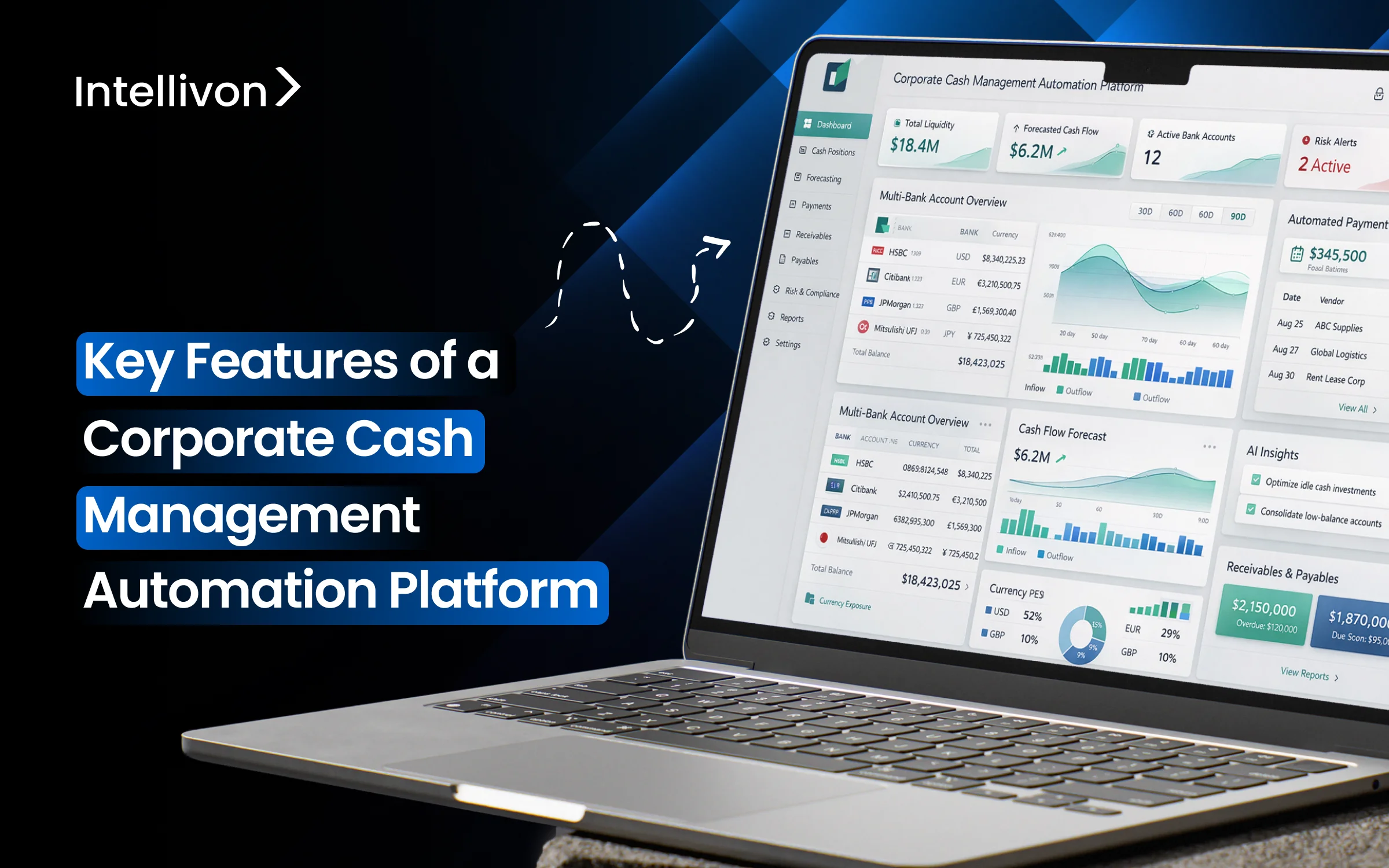
Large companies need cash to grow, stay stable, and invest. But many organizations make decisions about cash using information that is spread out across different banks, branches, and systems. This makes it hard to know how much cash they have, how to use it, or how to get it quickly when needed. Without automation, deciding where to put cash, planning ahead, and moving money often takes too long and depends on manual work. This can leave money unused, create surprise shortages, or make companies miss good chances to use their cash.
Corporate cash management automation platforms help companies move from just tracking cash to actually controlling it. These platforms bring together real-time data, automatic rules, and built-in checks. This helps finance teams manage cash as a useful resource, not just as a financial result.
At Intellivon, we make cash management platforms that connect financial systems. Our solutions show how cash really moves across branches, banks, and regions. We help companies make fast decisions and keep control, scale, and compliance in mind. In this blog, we’ll show the main features of a modern cash management platform and how these help companies manage cash more accurately and with more confidence.

Why Enterprises Are Moving Toward Automated Cash Infrastructure
Enterprises are moving toward automated cash infrastructure to manage growing financial complexity and the rise of digital payments. These systems provide real-time visibility into liquidity positions. As a result, they reduce manual errors and improve operational efficiency across treasury and finance functions.
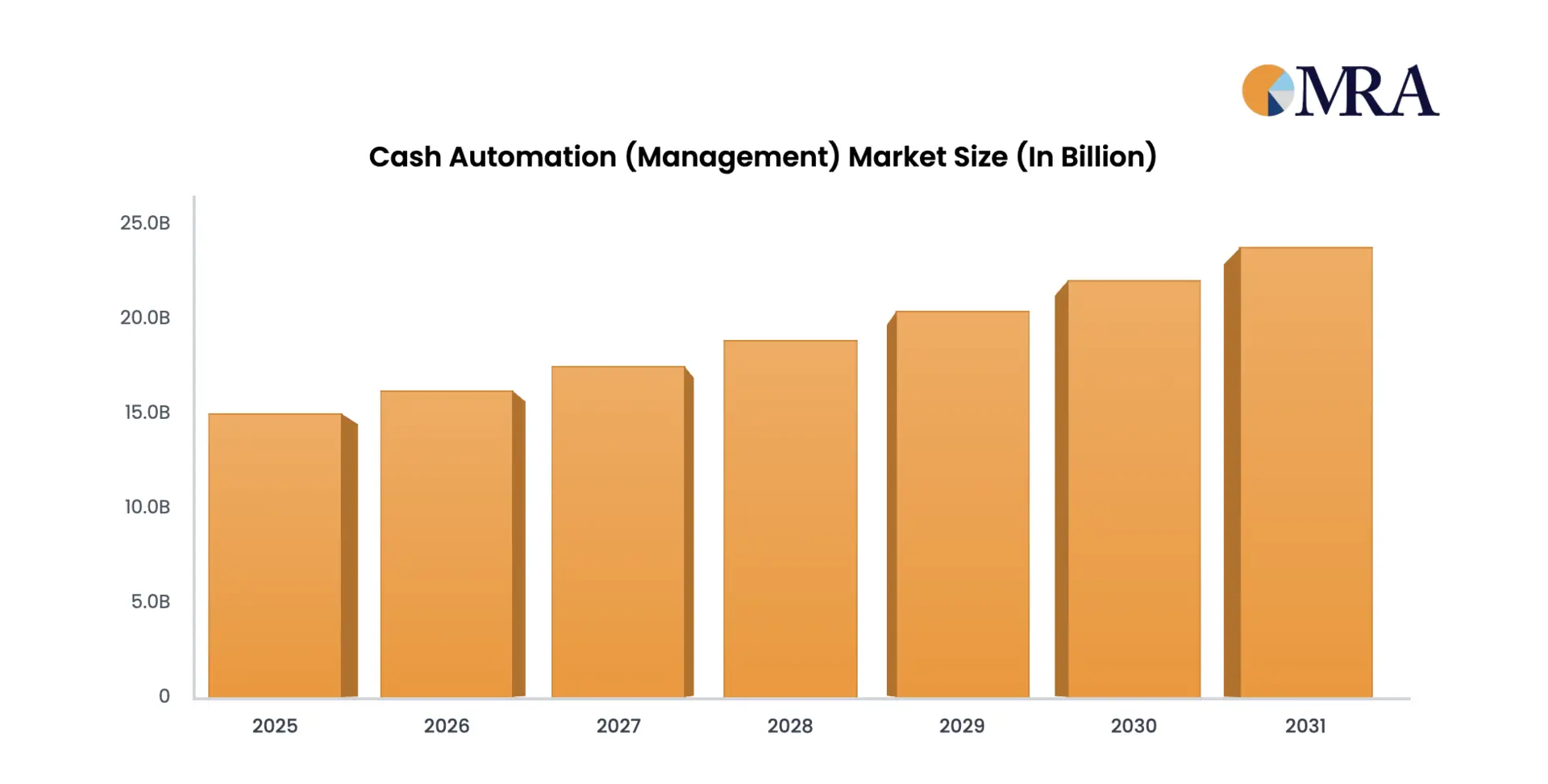
The global cash automation market is expanding steadily as organizations seek stronger security, adopt digital tools, and improve efficiency in handling funds. The market is expected to reach around $15 billion in 2025. Moreover, it is projected to grow at a compound annual growth rate of 8% through 2033, reaching nearly $28 billion by the end of the forecast period.
Market Growth Drivers:
- Ongoing financial volatility and growing cross-border transactions are pushing enterprises to adopt automated tools for liquidity management and forecasting.
- The Treasury Management System market is expected to grow from USD 6.8 billion in 2024 to USD 17.5 billion by 2033, at a CAGR of 11.2%.
- At the same time, regulatory pressures such as AML requirements are accelerating adoption, with nearly 70% of large firms now prioritizing real-time compliance capabilities.
Enterprises are rethinking how liquidity is managed as financial operations grow more complex. Cash now moves across regions, entities, and payment ecosystems at a much faster pace.
However, relying on delayed reporting and manual processes limits decision speed. As a result, automated cash infrastructure is becoming essential for maintaining control and visibility.
1. Rising Transaction Complexity
Digital payments and cross-border flows continue to increase across enterprise ecosystems. In fact, global real-time payment volumes are projected to exceed 575 billion transactions by 2028. Therefore, organizations need systems that track liquidity continuously rather than through periodic updates.
2. Pressure to Improve Cash Utilization
Idle cash remains a persistent challenge for large organizations. Studies suggest that enterprises may hold up to 20% of liquidity in low-yield environments.
Consequently, automation helps reposition funds more effectively and improves capital efficiency.
3. Demand for Real-Time Visibility
Many finance teams still struggle with fragmented insights. Nearly 60% of leaders report limited visibility into cash positions.
As a result, automated infrastructure provides live intelligence that supports faster funding and operational decisions.
4. Growing Regulatory Expectations
Compliance obligations continue to expand across jurisdictions. At the same time, nearly 70% of large firms now prioritize real-time monitoring to meet AML and reporting requirements.
Therefore, automation strengthens consistency and audit readiness.
5. Need for Predictive Decision-Making
Forecasting accuracy remains a concern for enterprise treasury teams. Many still depend on spreadsheets for short-term projections. However, automated platforms improve precision and enable proactive liquidity planning.
As financial environments evolve, enterprises are shifting toward automated cash infrastructure to improve timing, visibility, and control. With real-time intelligence and predictive insights, liquidity management becomes more strategic and less reactive.
What Is a Corporate Cash Management Automation Platform?
A corporate cash management automation platform helps organizations monitor, position, and move funds across accounts without relying on manual workflows. It brings together balances, inflows, and outflows from multiple banking relationships into one structured environment.
As a result, finance teams gain a clear view of available liquidity at any point in time. In addition, the platform supports forecasting, payment scheduling, and policy-driven fund allocation. This allows decisions to reflect actual cash movement rather than delayed reports.
Over time, it reduces operational friction and improves accuracy in liquidity planning. For enterprises operating across regions or entities, it also creates consistency in how cash is tracked and deployed. Therefore, liquidity management becomes more reliable and aligned with business priorities.
Components Of A Corporate Cash Management Automation Platform
A corporate cash management automation platform works through several interconnected layers that manage visibility, control, and execution. Each component supports how liquidity is tracked, positioned, and deployed across the enterprise.
Together, these elements help reduce delays, improve accuracy, and strengthen decision-making. As a result, finance teams can operate with greater confidence even as cash flows grow more complex.
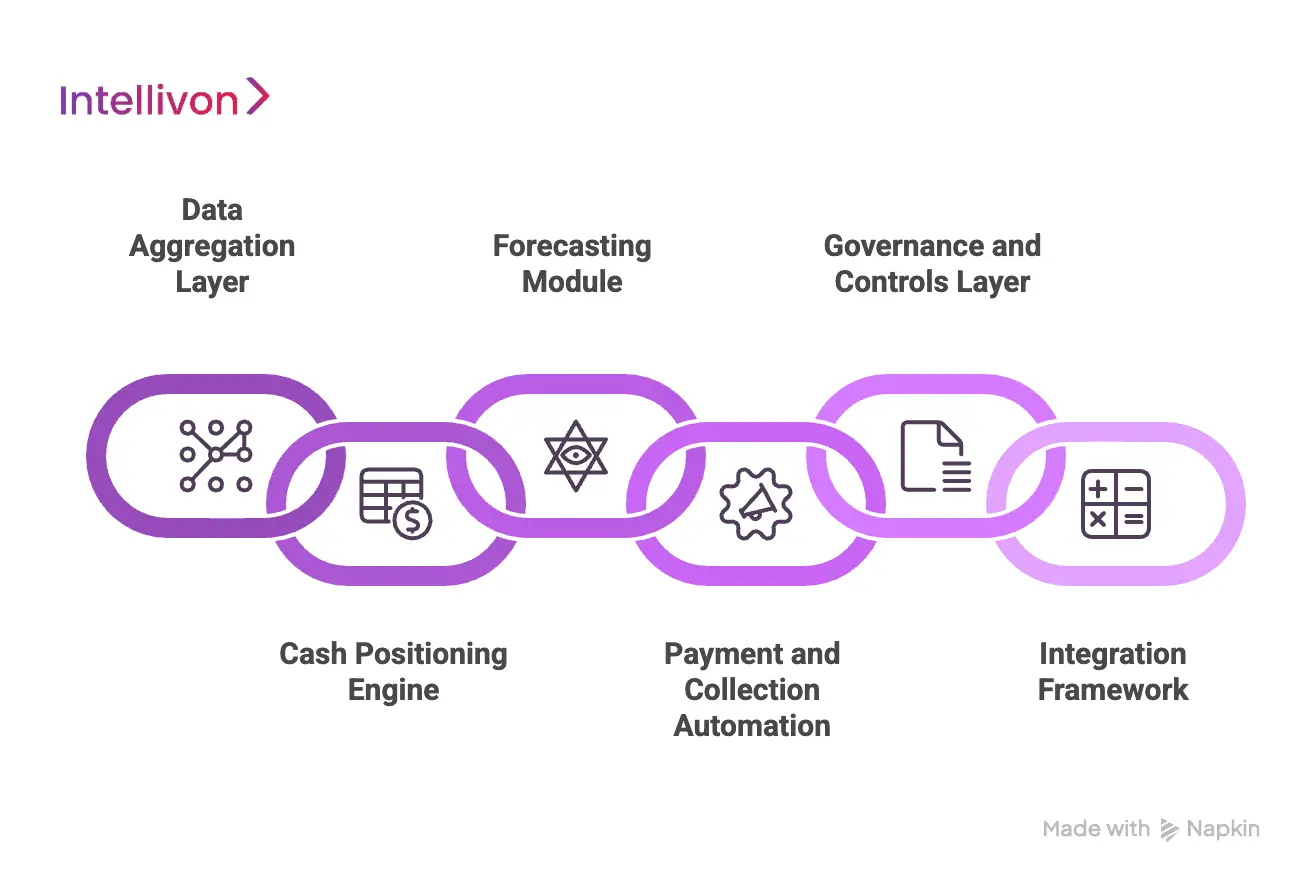
1. Data Aggregation Layer
This component gathers balances, transactions, and payment data from multiple banks and internal systems. It creates a unified view of liquidity across entities and regions. Therefore, teams can understand cash positions without relying on separate reports.
2. Cash Positioning Engine
The positioning engine organizes inflows and outflows into structured categories. It shows how much cash is available, committed, or expected. In turn, this helps identify shortfalls or surplus funds early.
3. Forecasting Module
This module analyzes historical patterns and planned transactions to estimate future liquidity needs. As a result, enterprises can prepare for obligations or investment opportunities.
4. Payment and Collection Automation
This component manages scheduled payments and incoming funds. It ensures execution follows defined rules. Additionally, it reduces manual processing errors.
5. Governance and Controls Layer
Approval workflows and policy rules operate here. They ensure fund movements align with internal standards and regulatory expectations. Therefore, consistency improves across operations.
6. Integration Framework
The integration layer connects ERP systems, banking APIs, and treasury tools. This allows data to move seamlessly between systems and keeps liquidity insights current.
Each component plays a role in turning fragmented cash data into structured, actionable insight. Together, they support faster decisions, stronger controls, and more reliable liquidity management across the enterprise.
How Automation Improves Treasury Decision-Making
Treasury decisions rely on timing, accuracy, and clarity. However, manual workflows often slow down access to reliable data. Automation changes this by introducing real-time intelligence and structured execution.
As a result, treasury teams can respond to changing liquidity conditions with greater confidence and speed.
1. Improves Visibility Into Cash Positions
Automation consolidates balances and transaction data from multiple banking relationships and internal systems. Therefore, treasury teams gain a near real-time view of liquidity across entities and regions. This reduces reliance on delayed reports and fragmented spreadsheets. In addition, teams can quickly identify available cash and committed funds.
Key improvements include:
- Faster access to consolidated balances
- Clear distinction between available and allocated funds
- Reduced dependency on manual reconciliation
2. Enhances Forecast Accuracy
Automated forecasting tools analyze historical patterns alongside planned payments and receivables. As a result, treasury teams receive more reliable projections of future liquidity needs. This helps reduce unexpected shortfalls and improves planning.
Automation supports:
- Short-term cash flow predictions
- Scenario-based planning
- Continuous forecast updates
3. Supports Timely Fund Allocation
Automation highlights surplus and shortfall positions early. Consequently, treasury teams can reposition funds before constraints affect operations. This improves working capital efficiency and prevents idle liquidity.
Benefits include:
- Early identification of funding gaps
- Better deployment of surplus cash
- Faster intra-group fund movement
4. Strengthens Risk Awareness
Real-time monitoring surfaces potential liquidity risks as they emerge. Therefore, treasury teams can respond before issues escalate. This supports more stable operations and reduces exposure to funding delays.
Automation enables:
- Early warning alerts
- Continuous exposure tracking
- Faster response to unexpected outflows
5. Enables Consistent Policy Execution
Rule-based workflows ensure that fund movements follow defined governance standards. As a result, treasury decisions remain consistent across regions and entities. This improves compliance readiness and reduces manual oversight.
Key outcomes include:
- Standardized approval workflows
- Reduced operational deviations
- Stronger audit traceability
Automation gives treasury teams clearer visibility and structured control. In turn, decisions reflect real-time conditions rather than delayed data, improving reliability and operational confidence.
Features Of A Corporate Cash Management Automation Platform
Enterprise liquidity cannot be managed effectively without clear visibility and structured execution. Yet many organizations still operate with fragmented cash insights spread across systems, entities, and banking partners. As a result, decision-making often relies on delayed data rather than real-time intelligence.
A modern corporate cash management automation platform brings together visibility, forecasting, execution, and governance into one connected environment. The feature groups below outline how these platforms support control, efficiency, and financial resilience at scale.
1. Cash Visibility & Positioning Features
Real-time, unified cash visibility forms the baseline of any enterprise-grade platform. However, many organizations still lack a complete view of their liquidity across regions and entities. Therefore, these features establish clarity before optimization becomes possible.
| Feature | What It Does | Why It Matters | Enterprise Impact |
| Real-Time Cash Position Dashboard | Aggregates balances across accounts, entities, and geographies into one live view | Eliminates manual reporting cycles and delayed insights | Faster liquidity decisions and reduced idle cash |
| Multi-Entity & Multi-Currency Consolidation | Combines cash data across subsidiaries and currencies in real time | Provides a true group-wide liquidity view | Lower inter-entity borrowing and FX inefficiencies |
| Bank Account Management | Centralizes account structures, mandates, and relationships | Reduces fragmented banking oversight | Fewer redundant accounts and improved cost control |
| Intraday Liquidity Monitoring | Tracks cash movements throughout the day | Supports same-day funding decisions | Reduced overdraft exposure |
2. Cash Forecasting & Planning Features
Forecasting separates reactive treasury functions from strategic liquidity planning. Therefore, these capabilities support forward-looking decisions.
| Feature | What It Does | Why It Matters | Enterprise Impact |
| AI-Driven Short-Term Forecasting | Predicts cash positions using historical patterns | Improves short-term planning accuracy | Reduced emergency borrowing |
| Scenario Modeling | Simulates future liquidity under multiple conditions | Supports capital allocation decisions | Better debt and investment timing |
| Variance Analysis | Compares forecasts with actual flows | Improves forecasting reliability | Stronger working capital efficiency |
| Event-Based Planning | Incorporates payroll, tax, and capex cycles | Prevents predictable liquidity gaps | Lower short-term funding costs |
3. Payment Automation & Processing Features
Payment execution directly affects efficiency and operational risk. Consequently, automation improves reliability and reduces financial leakage.
| Feature | What It Does | Why It Matters | Enterprise Impact |
| Straight-Through Processing | Automates payment lifecycle | Removes manual errors | Lower processing costs |
| Multi-Bank Connectivity | Connects to banks via APIs and SWIFT | Reduces portal dependency | Faster execution |
| Automated Approval Workflows | Routes payments through policy-based controls | Supports governance | Reduced fraud exposure |
| Duplicate Detection | Flags potential duplicate payments | Prevents financial leakage | Lower reconciliation effort |
| Payment Factory | Centralizes group payments | Improves visibility | Reduced banking costs |
4. Liquidity & Working Capital Optimization Features
Liquidity optimization directly influences financial efficiency. Therefore, these features support better use of internal capital.
| Feature | What It Does | Why It Matters | Enterprise Impact |
| Cash Pooling | Consolidates surplus funds | Reduces reliance on external credit | Lower borrowing costs |
| Intercompany Netting | Offsets intra-group obligations | Simplifies settlements | Reduced transaction volume |
| Investment Management | Identifies surplus cash for deployment | Improves yield | Enhanced returns |
| Credit Facility Monitoring | Tracks borrowing utilization | Optimizes funding | Lower interest expense |
5. FX & Risk Management Features
Currency and interest exposures can affect profitability. As a result, these tools support risk visibility.
| Feature | What It Does | Why It Matters | Enterprise Impact |
| FX Exposure Aggregation | Consolidates exposure across entities | Improves hedging accuracy | Reduced volatility impact |
| Hedge Automation | Supports execution of hedging strategies | Improves consistency | Lower risk management effort |
| Counterparty Monitoring | Tracks exposure limits | Supports compliance | Reduced financial risk |
| Interest Rate Modeling | Evaluates rate sensitivity | Supports financing decisions | Better refinancing timing |
6. Compliance, Controls & Reporting Features
Automation also strengthens governance. Therefore, these capabilities support audit readiness.
| Feature | What It Does | Why It Matters | Enterprise Impact |
| Audit Logging | Records transaction activity | Improves transparency | Faster audits |
| Policy Enforcement | Applies treasury rules | Supports consistency | Reduced policy breaches |
| Regulatory Reporting | Generates compliance reports | Reduces manual effort | Lower reporting risk |
| Close Automation | Supports financial closing tasks | Removes bottlenecks | Faster reporting cycles |
7. Integration & Technology Infrastructure Features
A platform delivers value only when connected across systems. Consequently, integration ensures operational alignment.
| Feature | What It Does | Why It Matters | Enterprise Impact |
| ERP Integration | Syncs treasury with finance systems | Reduces reconciliation effort | Faster close cycles |
| Banking Connectivity | Enables real-time data exchange | Improves liquidity accuracy | Reduced data delays |
| Market Data Feeds | Provides live pricing inputs | Improves valuation accuracy | Better forecasting |
| Role-Based Access | Controls system permissions | Supports security | Reduced internal risk |
| Cloud Architecture | Enables scalability | Supports growth | Lower infrastructure cost |
Together, these features transform fragmented liquidity data into structured control. As a result, enterprises can improve efficiency, reduce financial risk, and align cash management with broader strategic priorities.
Advanced AI Features in Corporate Cash Management Automation Platforms
Enterprise cash environments change quickly. Therefore, advanced AI has to do more than generate forecasts. It must support governed decisions, reduce risk, and improve capital efficiency.
The features below reflect enterprise-grade AI that works across multi-entity, multi-bank operations in a controlled way.
1) Self-Learning Cash Forecasting Models
AI models forecast cash positions across 1–30 days, and also learn from actual outcomes. As a result, accuracy improves over time without constant manual tuning. In addition, the model adapts when payment behavior or collection cycles change.
What this enables:
- Higher forecast stability during volatility
- Reduced need for large cash buffers
- Fewer last-minute funding actions
2) Scenario Intelligence and Stress Testing
AI can simulate multiple business scenarios using drivers like revenue changes, cost spikes, and payment delays. Therefore, teams can see how liquidity behaves under pressure. This supports better planning for debt, capex, and seasonal peaks.
Common scenarios include:
- Delayed receivables
- FX swings and rate changes
- High-volume payout periods
3) Forecast Explainability and Driver Attribution
Enterprise teams need to understand the “why,” not just the number. AI can highlight the factors driving forecast changes, such as payables timing or collection shifts. Consequently, treasury teams can validate outputs and act with confidence.
Outputs often include:
- Top drivers affecting liquidity
- Entity-level impact breakdown
- Variance reasons vs prior forecast
4) Cash Flow Classification and Auto-Categorization
AI can classify bank transactions into consistent categories across entities and geographies. Therefore, reporting becomes cleaner, and forecasting inputs become more reliable. This also reduces reconciliation workload.
It helps with:
- Mapping transactions to AP, payroll, taxes, and capex
- Detecting miscoded or unclear entries
- Improving cash flow statement accuracy
5) Real-Time Anomaly Detection for Cash Movements
AI flags unusual cash activity based on historical patterns and peer behavior across entities. As a result, treasury teams can investigate early and prevent leakage. In addition, the system can raise risk scores for repeated anomalies.
Examples include:
- Unexpected spikes in outflows
- Duplicate or near-duplicate payment patterns
- Unusual beneficiary or account changes
6) Intelligent Payment Timing and Liquidity-Aware Scheduling
AI can recommend when to release payments based on forecasted liquidity and policy rules. Therefore, enterprises can reduce overdraft risk and avoid unnecessary borrowing. This is especially useful during tight cycles.
It can optimize:
- Payment batching
- Release windows by entity
- Cash preservation during low-liquidity periods
7) Automated Liquidity Optimization Recommendations
AI can identify idle cash, trapped liquidity, and unnecessary external borrowing. Consequently, it can recommend actions such as sweeps, pooling, or internal rebalancing. This directly supports working capital optimization.
Recommendations often include:
- Intra-group fund transfers
- Pooling thresholds and sweep rules
- Surplus investment opportunities within policy
8) Counterparty and Concentration Risk Intelligence
AI can monitor exposure to banks, payment partners, and investment counterparties. Therefore, it can flag concentration risks early. This supports stronger risk governance across treasury operations.
It helps by:
- Tracking exposure vs policy limits
- Highlighting over-dependence on one provider
- Triggering alerts when limits approach breach
9) FX Exposure Prediction and Hedging Readiness
AI can estimate upcoming FX exposure based on expected payables and receivables. As a result, hedging decisions become more timely and consistent. In addition, teams can avoid last-minute hedges that increase cost.
Typical outputs include:
- Predicted currency exposure by period
- Entity-level exposure mapping
- Hedge readiness alerts tied to policy
10) Exception Triage and Action Prioritization
Enterprise treasury teams face many alerts. AI can rank exceptions by impact and urgency. Therefore, teams focus on the few events that truly matter.
It prioritizes:
- Funding gaps that affect payroll or debt servicing
- Payment failures with high business impact
- Variances that indicate structural forecast issues
Advanced AI features turn cash management from reporting into intelligent control. As a result, enterprises gain better forecasting, stronger risk visibility, and smarter liquidity deployment.
In addition, these capabilities reduce manual workload while keeping decisions governed and auditable.
How We Build Corporate Cash Management Automation Platforms
Building a corporate cash management automation platform requires more than connecting systems. It involves designing a structure that reflects how liquidity actually moves across the enterprise.
Therefore, each step focuses on improving visibility, control, and decision readiness. The goal is to support real financial operations rather than impose rigid treasury processes.
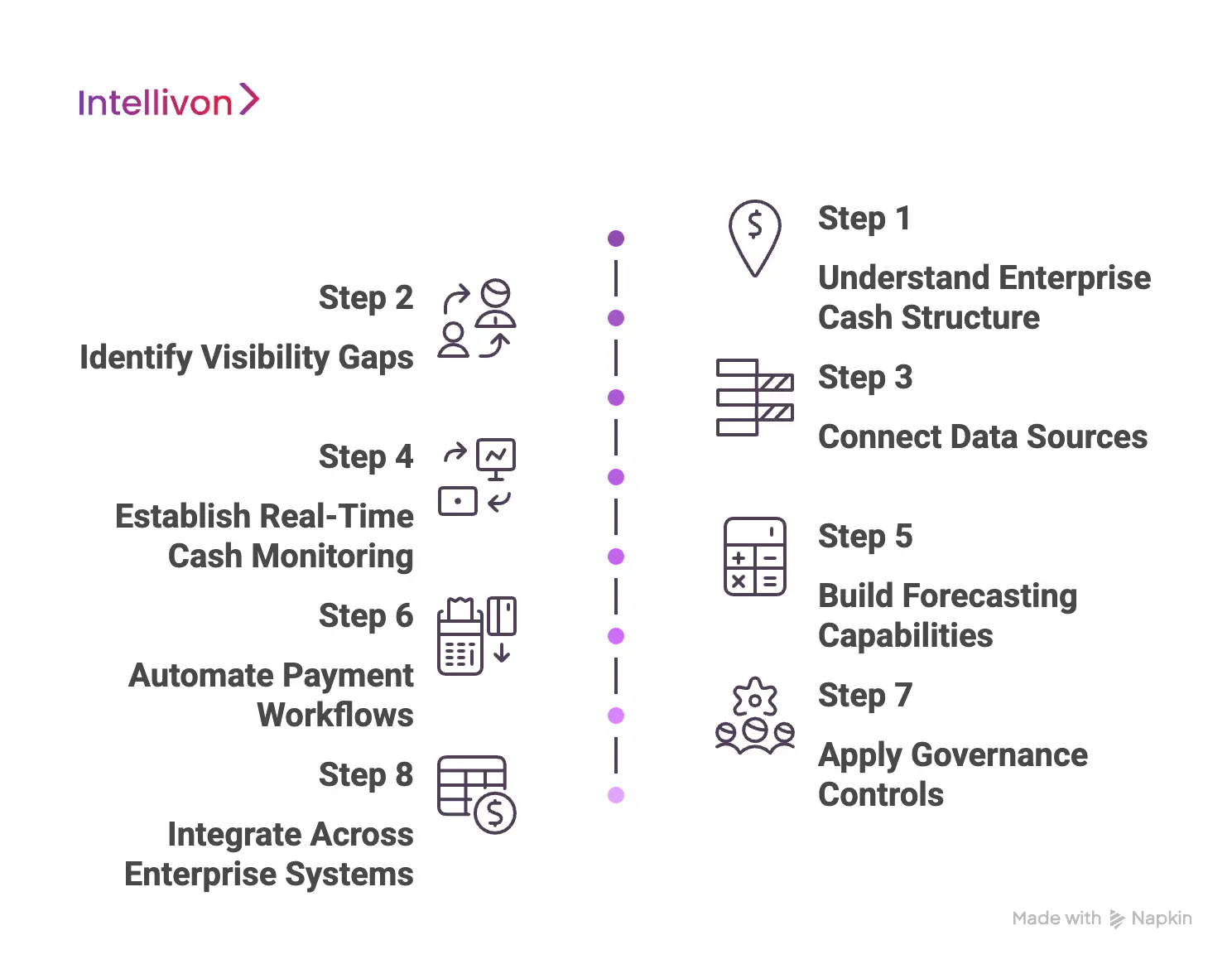
Step 1: Understand Enterprise Cash Structure
We start by studying how cash moves between entities, regions, and accounts during daily operations. This helps identify where liquidity sits and how it is used across the business.
As a result, we can understand dependencies between subsidiaries and funding flows. In addition, this step highlights how internal transfers support operations and investments. It ensures the platform reflects real financial behavior from the beginning.
This includes:
- Mapping inflows and outflows
- Reviewing entity-level dependencies
- Understanding intercompany funding
Step 2: Identify Visibility Gaps
Next, we evaluate where liquidity insights are delayed or unclear. Many enterprises depend on fragmented reporting from banks and internal systems. Therefore, treasury teams often lack a complete view of available cash.
This step helps uncover where manual reconciliation or delayed updates affect decisions. It also highlights areas where funding decisions rely on assumptions instead of live data.
We review:
- Reporting delays
- Data silos
- Manual reconciliation points
Step 3: Connect Data Sources
We then bring together banking data, ERP information, and treasury records into one environment. This creates a unified view of liquidity across the organization. In addition, it allows balances and transactions to reflect current activity.
As a result, teams no longer depend on separate data streams. This improves consistency and reduces the effort spent on gathering information.
This involves:
- Linking bank feeds
- Syncing ERP systems
- Standardizing data formats
Step 4: Establish Real-Time Cash Monitoring
Once data is connected, we enable continuous tracking of balances and movements. This allows treasury teams to see liquidity positions throughout the day. Therefore, funding decisions can be made based on live conditions.
In addition, teams can identify changes as they occur instead of waiting for daily updates. This reduces surprises and supports timely actions.
Key actions include:
- Setting live dashboards
- Tracking intra-day movements
- Monitoring cash concentration
Step 5: Build Forecasting Capabilities
We introduce forecasting tools that analyze past patterns and planned transactions. This helps estimate future liquidity needs.
As a result, teams can prepare for obligations and upcoming investments. In addition, scenario planning allows evaluation of different business outcomes. This step supports proactive liquidity management.
This supports:
- Short-term projections
- Event-based planning
- Scenario analysis
Step 6: Automate Payment Workflows
Automation is applied to payment initiation and execution. This reduces reliance on manual processes. Consequently, payment handling becomes more consistent and reliable.
In addition, approval workflows ensure alignment with internal standards. This step improves efficiency while maintaining oversight.
This includes:
- Structured approvals
- Policy-based execution
- Error detection
Step 7: Apply Governance Controls
Governance ensures that liquidity decisions follow defined policies. Therefore, approval hierarchies and limits are embedded into workflows. This helps maintain consistency across entities and regions.
In addition, activity tracking supports transparency. This strengthens internal control without slowing operations.
This covers:
- Role-based permissions
- Activity logs
- Policy enforcement
Step 8: Integrate Across Enterprise Systems
Finally, the platform is aligned with existing systems and processes. This ensures liquidity insights remain synchronized with financial operations.
As a result, teams can rely on consistent information across environments. Integration also reduces reconciliation effort and improves reporting accuracy.
This enables:
- Seamless data exchange
- Reduced duplication
- Consistent reporting
Through these structured steps, the platform evolves into a connected liquidity environment. In turn, enterprises gain clearer visibility and more reliable decision support across financial operations.
Conclusion
Managing enterprise liquidity has become more complex as cash moves across regions, entities, and systems. Therefore, relying on manual processes can limit visibility and delay decisions.
A corporate cash management automation platform brings structure to this environment by improving forecasting, payment execution, and governance.
As a result, finance teams gain clearer insights into how cash is positioned and deployed. In addition, automation reduces errors and supports more consistent policy execution. This allows organizations to respond faster to funding needs and market changes.
Over time, improved visibility and control help align liquidity management with broader business priorities and support stable financial operations across the enterprise.
Build a Corporate Cash Management Automation Platform With Intellivon
At Intellivon, we design enterprise-grade cash management automation platforms that bring visibility, control, forecasting, and governance into one connected environment.
These platforms reduce fragmentation by aligning banking data, payment workflows, and liquidity planning across entities and regions.
As a result, leadership gains a clearer view of how cash moves across the business and can make decisions with greater confidence.
Each platform is built to support complex enterprise operations. Solutions are compliant by design, resilient under operational load, and interoperable with existing financial systems. This ensures stability while supporting long-term liquidity planning from the start.
Why Partner With Us?
- Governance-First Architecture: Approval workflows, audit trails, and access controls are embedded directly into the platform. Therefore, financial oversight becomes a built-in capability rather than a manual effort.
- Workflow-Aligned Liquidity Management: Cash positioning, forecasting, and payment processes align with existing finance workflows. This allows treasury teams to operate within familiar structures without disruption.
- AI-Enabled Forecasting and Monitoring: AI supports liquidity planning, exposure tracking, and anomaly detection. As a result, teams gain clearer insights and respond faster to changes.
- Interoperable Integration: Secure APIs connect ERP systems, banking networks, and financial tools. This ensures flexibility without reliance on a single provider.
- Scalable Enterprise Foundation: The platform supports multi-entity and multi-region operations. Expansion can occur without restructuring financial processes.
- Security-Focused Operations: Encryption, monitoring, and role-based permissions protect sensitive financial data across workflows.
Book a strategy call with Intellivon to explore how a corporate cash management automation platform can improve liquidity control, strengthen visibility, and support scalable growth.
FAQs
Q1. What is the main benefit of a corporate cash management automation platform?
A1. A corporate cash management automation platform helps enterprises understand how liquidity moves across accounts, entities, and regions. Therefore, finance teams gain clearer visibility into available cash at any moment.
In addition, automation reduces reliance on manual reporting and fragmented data sources. This allows funding and allocation decisions to be made with greater confidence. Over time, improved visibility supports better working capital planning and reduces idle cash.
Q2. How does automation improve liquidity planning?
A2. Automation combines real-time data with structured forecasting tools. As a result, finance teams can anticipate future cash needs rather than reacting to shortages. In addition, predictive insights help identify potential funding gaps early.
This allows organizations to plan for obligations and investments in advance. Over time, improved planning supports more stable liquidity management.
Q3. Can a cash management automation platform support multi-entity operations?
A3. Yes, these platforms consolidate liquidity data across subsidiaries and currencies. Therefore, organizations gain a unified view of enterprise-wide cash positions. In addition, this reduces delays caused by entity-level reporting cycles.
Teams can make group-level decisions without waiting for separate updates. As a result, liquidity deployment becomes more consistent across regions.
Q4. How does automation reduce operational risk?
A4. Automation applies policy rules and approval workflows to fund movements. Therefore, transactions follow defined governance standards.
In addition, real-time monitoring helps identify unusual activity early. This reduces manual errors and improves oversight. Over time, consistent execution strengthens compliance readiness.
Q5. Is integration with existing systems possible?
A5. Most platforms integrate with ERP systems and banking networks through secure connections. As a result, liquidity data remains aligned with financial operations.
In addition, integration reduces reconciliation effort and supports consistent reporting. This allows organizations to enhance treasury capabilities without replacing existing infrastructure.