Key Takeaways:
- AI payment automation handles ERA processing, EDI 835 parsing, posting, reconciliation, and underpayment detection.
- OCR, NLP, payment matching models, and payer contract logic are core production architecture requirements.
- EHR integration, clearinghouse connectivity, HIPAA safeguards, PCI DSS controls, and audit trails are mandatory.
- Custom builds cost $50,000 to $170,000 with MVP timelines between 5 and 8 months.
- How Intellivon builds healthcare payment automation as a governed financial infrastructure.
Payment posting sits at the end of the revenue cycle and gets the least attention. How it works is that the ERA files arrive daily, payments get matched and posted, and the team moves on to the next queue. AI healthcare payment automation software closes that gap. Specifically, it ingests EDI 835 remittance files and matches each payment against the originating claim.
This software then compares the posted amount against the payer contract rate and flags variances before they get written off. Furthermore, it handles the paper EOB problem, which is the 10 to 15% of remittances that still arrive as PDFs or physical documents and get manually processed or skipped entirely.
Building one requires a specific set of components working together. Beyond ERA ingestion and parsing, the platform needs a payer contract intelligence layer that knows what each payer should have paid. On top of that, it needs an ML payment matching engine, underpayment detection logic, and HIPAA and PCI compliance controls built in from the start.
This blog covers all of it, including integration requirements and development costs by phase. At Intellivon, we build these systems for health systems and RCM platforms where payment accuracy needs to hold up at enterprise volume.
What Is AI Healthcare Payment Automation Software?
AI healthcare payment automation software is a platform that handles everything that happens after a payer sends a payment. Specifically, it reads the payment file, matches it to the right claim, and checks if the amount is correct. It then posts the payment to the billing system automatically. If something looks off, it flags it for a human to review. As a result, most payments move through without anyone touching them.
A. Core Distinctions in Financial Automation Workflows
To build an efficient revenue cycle platform, you must understand the clear differences between traditional formatting utilities, legacy rules engines, and advanced artificial intelligence systems.
The table below delineates these core software components across the modern healthcare technology stack.
Distinction Table
| System Type | Core Function | Technical Input | Primary Output |
| EDI 835 Processing | File parsing and structural validation | Raw X12 EDI 835 files | Normalized JSON or SQL data tables |
| ERA Automation | File ingestion and automated data entry | Electronic Remittance Advice | Populated payment fields in billing software |
| Payment Posting Automation | Bulk financial ledger updates | Normalized remittance data | Updated patient balances and account lines |
| Remittance Advice Reconciliation | Three-way financial matching | Remittances, deposits, and claims | Identified matched records and variance lists |
| Payment Reconciliation Software | General ledger balancing | Bank statements and system logs | Validated cash balances and deposit reports |
| AI-Powered Payment Reconciliation | Contextual anomaly resolution | Unstructured EOBs, ERAs, and banking APIs | Validated ledger postings and predicted fixes |
| Underpayment Recovery Automation | Payer contract compliance auditing | Fee schedules, allowed amounts, and paid claims | Generated appeals and underpayment alerts |
B. Understanding the Technology Components
To fully contextualize how these systems operate within an enterprise deployment, it is necessary to examine each functional component beyond the high-level matrix.
1. EDI 835 Processing
This component serves as the baseline data ingestion utility for the entire financial pipeline. It specifically handles the translation of HIPAA-standard ANSI X12 835 electronic files, which contain the specific claim payment and remittance advice details sent by insurance payers.
The software reads loops, segments, and elements to convert raw EDI data into structured data formats, stripping away the complex transaction formatting so downstream systems can use the financial payload.
2. ERA Automation
Electronic Remittance Advice automation expands on raw data processing by driving the electronic workflows that route these digital forms across your practice management software.
Instead of requiring administrative staff to log into individual payer portals to download forms, ERA automation pulls files directly via clearinghouse payment connectivity or secure FTP pipelines. This removes the manual collection bottleneck entirely and accelerates the overall velocity of your revenue cycle operations.
3. Payment Posting Automation
This mechanism acts directly upon the active financial ledger of a healthcare provider. Once remittance data is structured and verified, cash posting automation pushes those specific dollar amounts into the corresponding patient accounts.
The system handles the heavy lifting of adjusting outstanding balances, applying pre-determined write-offs, and calculating secondary payer balances without requiring manual typing from billing teams.
4. Remittance Advice Reconciliation
This workflow executes the rigorous mathematical validation required to verify that the money promised by an insurance company actually matches the medical services billed. It compares the remittance advice details against the original claim record to verify that every service line is accounted for.
The software highlights exact matches and separates items that require human intervention, preventing accounting errors from sliding into the system.
5. Payment Reconciliation Software
This broad class of financial software focuses on balancing the books between the healthcare entity and its banking institutions. It matches incoming bulk electronic funds transfer deposits visible on bank statements with the internal remittance records received from payers.
By automating this balance validation, organizations drastically reduce their days in AR and maintain an accurate, real-time view of their true cash positions.
6. AI-Powered Payment Reconciliation Software
This advanced infrastructure layer solves the structural limitations of legacy software by utilizing machine learning payment matching algorithms.
When a paper explanation of benefits arrives as a scanned PDF, the system applies OCR for paper EOB processing combined with natural language processing to extract the text.
The underlying machine learning model can intelligently infer matches even when patient IDs are truncated, check numbers vary slightly, or non-standard reason codes are used.
C. Core Records and Financial Touchpoints
A production-grade AI system must interact with several critical documents and system records simultaneously to maintain data integrity:
- EDI 835: The standardized electronic dataset containing insurance payment details and adjustment reasons.
- EFT Deposit: The actual electronic funds transfer record received by the provider’s bank account.
- EOB: The paper or digital Explanation of Benefits that outlines how a claim was processed for an individual.
- Payer Contract: The legal agreement defining the negotiated reimbursement rates for specific medical procedures.
- Fee Schedule: The matrix of pre-determined dollar values allowed for each medical billing code.
- Patient Ledger: The localized financial account tracking what an individual patient owes and has paid.
- Claim Record: The original EDI 837 submission file detailing the medical services rendered to the patient.
- General Ledger Entry: The final corporate accounting record that tracks overall revenue, cash, and adjustments.
Successfully unifying these discrete functional layers transforms the financial stability of a healthcare enterprise. Moving away from fragmented, rules-based utilities and transitioning to an integrated, intelligent platform directly cuts administrative overhead and eliminates costly posting lag.
Why Healthcare Teams Are Building Custom AI Platforms
Healthcare teams build custom AI healthcare payment automation platforms when manual posting, generic RCM tools, or fixed RPA bots cannot handle payer variation, underpayment detection, multi-site workflows, and financial reconciliation needs.
Custom development gives teams control over payer rules, contract validation, exception queues, analytics, compliance design, and product differentiation. Because of this, the strongest technology opportunities now sit in administrative workflows where an AI revenue cycle automation platform can prove direct ROI within 6 to 18 months.
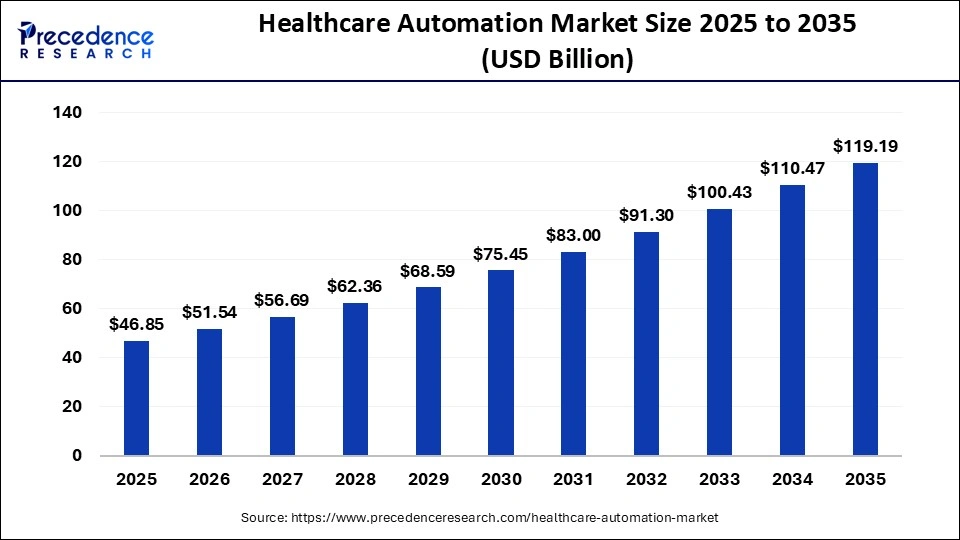
This massive scaling proves that enterprise buyers are moving away from isolated software bots and toward unified orchestration platforms. These modern platforms seamlessly connect EHRs, payer systems, documentation workflows, analytics, and compliance controls.
- Rapid Market Growth: The broader AI in healthcare market is expanding even faster, scaling from USD 36.67B in 2025 to USD 505.59B by 2033.
- Operational Pressure Over Innovation Hype: Growth is driven by thin hospital margins and staff shortages rather than experimental tech budgets, forcing a focus on immediate administrative workload reduction.
- Measurable Financial Targets: Revenue cycle operations are the preferred target for automation because every upgrade directly impacts financial performance metrics.
- Clear Performance Indicators: Systems prove their value rapidly by increasing clean claim rates, reducing days in AR, slashing denial rates, and lowering the total cost-to-collect.
2. Strategic Opportunities for Enterprises Entering This Market
Enterprises entering the AI RCM platform development space must focus on narrow, high-friction workflows before trying to build full-scale orchestration systems.
Software product leaders and hospital CTOs should prioritize workflows with measurable financial or operational ROI within a 6 to 18-month window.
By proving value with smaller deployments first, you secure the organizational alignment needed to expand into complete revenue workflow orchestration.
- Target High-Friction Gateways: Start with front-end and mid-cycle bottlenecks such as prior authorization, claim scrubbing, payment posting, or AR prioritization.
- Focus on Key Yield Metrics: Prioritize immediate denial prevention, automated documentation time reduction, and instant eligibility verification to accelerate cash collections.
- Build Dense Integration Layers: Engineer the software architecture around deep, native connections to EHRs, clearinghouses, and payer systems using modern data standards.
- Utilize Modern Standards: Implement native support for HL7 and FHIR R4 protocols to ensure smooth, secure communication across legacy healthcare networks.
- Bake Security Into the Core: Build strict HIPAA controls, detailed user auditability, role-based access governance, and PHI minimization rules from day one of development.
The rapid growth of AI-driven healthcare automation is driven forward by operational necessity, not market hype.
For enterprise builders and healthcare networks, this environment creates a rare, profitable alignment between market maturity, regulatory readiness, and measurable financial ROI.
Within the RCM sector specifically, companies that move early with a structured platform strategy will permanently reshape how revenue operations function across patient access, claims processing, denial management, payments, and financial analytics.
Custom development makes sense when payment automation affects revenue control, not only staff productivity. However, the system must be scoped around real payment workflows before AI models are selected.
Core Workflows The Platform Should Automate
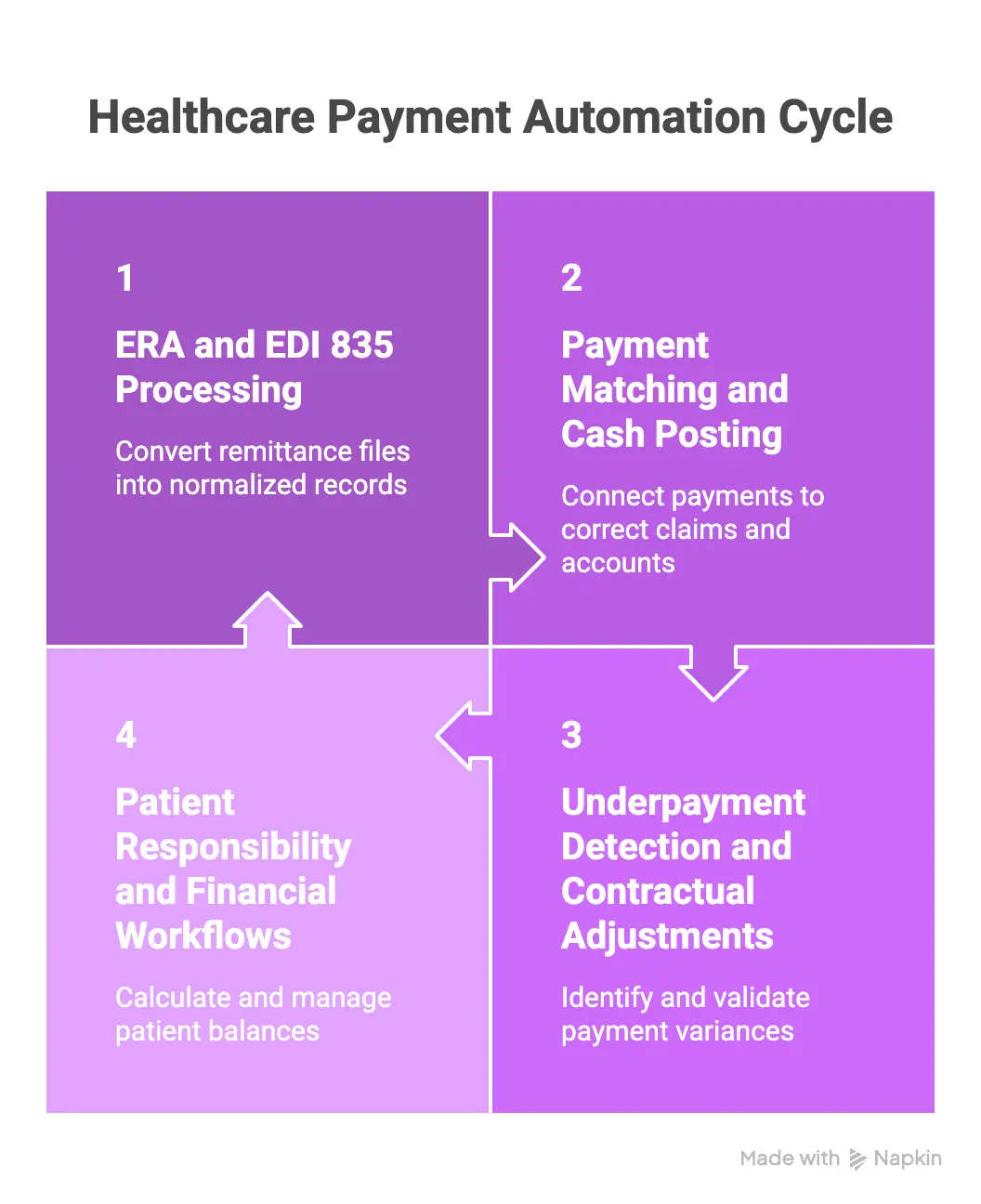
An AI healthcare payment automation platform should automate the highest-volume and highest-risk payment workflows first: ERA ingestion, EOB parsing, payment matching, cash posting, contractual adjustment validation, underpayment detection, denial payment reconciliation, patient responsibility calculation, and exception routing. These workflows protect cash flow because they connect payment speed with payment accuracy.
By systematically removing manual data extraction, the system prevents human errors from corrupting the financial ledger. This architectural optimization accelerates the end-to-end revenue cycle while establishing an immutable audit trail for every transaction.
1. ERA and EDI 835 Processing
ERA and EDI 835 processing should convert payer remittance files into normalized payment records that the billing system can match, validate, and post.
The platform should parse claim-level payments, service-line adjustments, CARC/RARC codes, patient responsibility, check or EFT references, and payer identifiers before any payment reaches the ledger.
Technical Architecture and Data Validation
The ingestion engine relies on a highly structured processing pipeline to handle the complexities of electronic remittance data:
- EDI 835 Parser: A specialized data parsing engine designed to read and break down complex X12 structural loops into clean JSON objects.
- Segment-Level Extraction: The software targets specific data points within the transaction, extracting claim payment data from the CLP segment and adjustment reasons from the CAS segment.
- Line-Item Resolution: It maps medical service details within the SVC segment, cross-references transaction codes via the REF segment, isolates entity names using NM1, and validates processing timestamps in the DTM segment.
- Payer Configuration Layer: A normalization utility that maps non-standard Claim Adjustment Reason Codes (CARC) and Remittance Advice Remark Codes (RARC) used by specific regional payers back to an enterprise standard taxonomy.
- Data Quality Checks: Automatic validation routines that execute balancing calculations to ensure the total payment amount matches the sum of the service-line payments plus adjustments.
Once the platform can read remittance data, it needs to match payments to the right claims and accounts.
2. Payment Matching and Cash Posting
Payment matching connects each remittance line to the correct claim, encounter, patient account, payer, provider, and service date. The system should use deterministic identifiers first, then apply fuzzy matching only when payer references are incomplete or inconsistent.
Human review should remain available for ambiguous, high-dollar, or compliance-sensitive cases.
Cash Posting and Clearinghouse Automation
The platform unifies disparate transaction streams into a single cash posting pipeline through several dedicated sub-systems:
- Deterministic Reconciliation: The software performs precise queries to match claims using primary identifiers, matching the internal claim control number, unique patient ID, and specific date of service.
- Fuzzy Match Models: When data is truncated, machine learning classifiers analyze secondary attributes like provider taxonomies and CPT/HCPCS procedure codes to calculate match probability scores.
- Multi-Channel Processing: The platform integrates directly with bank lockbox processing automation to capture and convert paper checks, uses secure tokenization for virtual card payment processing, and ingests standard ACH payment automation records.
- Batch Balancing: The system enforces strict accounting rules by verifying that every sub-batch totals zero before releasing the files to update the primary practice management database.
Posting speed matters, but the larger revenue opportunity comes from verifying whether the payment amount is correct.
3. Underpayment Detection and Contractual Adjustments
Underpayment detection compares payer-paid amounts against contracted rates, fee schedules, allowed amounts, and expected reimbursement rules.
The system should flag silent shortfalls and missed secondary billing opportunities before accounts move into write-off or zero-balance resolution.
Revenue Integrity and Variance Analysis
This module operates as an automated compliance auditor by running every adjudicated claim through a strict validation engine:
- Payer Contract Management: A secure, digitized repository that houses complex commercial payer contracts, including tiered fee schedules and case rate rules.
- Allowed Amount Verification: The engine reads the allowed amount populated in the EDI 835 and matches it against the expected contract value.
- Payment Variance Analysis: If the payment falls below the contracted fee schedule validation threshold, the system flags the claim as an underpayment variance.
- Adjustment Automation: The software automatically validates write-offs, flags unauthorized contractual adjustments, and manages credit balance resolution to prevent accounting inflation.
- Recovery Tracking: The platform generates appeal text and bundles the required historical claim data, moving the file into underpayment recovery automation queues.
After the platform validates payer payments, it must calculate what the patient owes without creating billing risk.
4. Patient Responsibility and Financial Workflows
Patient responsibility automation calculates what the patient owes after payer adjudication and secondary payer logic are applied.
The system should support patient payment estimation and price transparency workflows without confusing insurance balances with patient balances.
Compliance-First Patient Collections
The software manages patient-facing financial touchpoints. They do this by executing highly accurate calculations that match regulatory standards:
- Patient Responsibility Calculation: The system subtracts the payer-paid amount and verified contractual adjustments from the total charge to determine the exact remaining balance.
- Balance Billing Automation: The engine applies localized billing rules to prevent illegal balance billing practices, ensuring strict compliance with the No Surprises Act.
- Good Faith Estimates: The platform uses historical machine learning data to generate accurate patient payment estimation profiles prior to treatment, improving overall patient financial clearance rates.
- Collection Integration: The platform updates patient collections automation engines and routes cleared balances to secure, external portals via API-driven payment gateway integration.
The most defensible platforms connect all these workflows through one financial source-of-truth layer. Unifying these automated workflows protects enterprise revenue integrity and stabilizes operational cash flow.
AI Healthcare Payment Automation Platform Architecture
AI healthcare payment automation architecture should include ingestion, normalization, payment matching, contract validation, AI exception handling, human review, posting, reconciliation, analytics, security, and MLOps layers.
Each layer should remain modular because healthcare payment data comes from clearinghouses, payer portals, EHRs, practice management systems, banks, payment gateways, and finance platforms.
Building this platform as a decoupled, microservices-based system prevents legacy upstream format changes from causing cascading downtime across your core accounting environments.
System Layer Blueprints and Technical Specifications
A production-ready architecture requires clear isolation of concerns to handle high-throughput financial data safely. The table below outlines the responsibilities, input-output logic, and primary technical stacks required for each layer.
Architecture Table
| Architecture Layer | Layer Functional Responsibility | Primary Technology Stack |
| Data Ingestion | Ingests raw EDI 835 files, EOB PDFs, payer portal scraping outputs, lockbox logs, virtual card data, and ACH transaction feeds. | Secure SFTP, AWS S3 buckets, Apache Kafka, and custom webhook listeners |
| Normalization | Translates disparate inputs into a canonical schema, maps segments, standardizes CARC/RARC codes, and generates HL7 FHIR financial resources. | Python parsing engines, Node.js microservices, and HL7 FHIR R4 Financial Resources |
| Payment Matching | Executes deterministic matching on claim IDs, falls back to fuzzy matching algorithms, and coordinates secondary payer billing workflows. | PostgreSQL, Elasticsearch, and machine learning record linkage models |
| Contract & Variance | References active commercial payer contracts to execute allowed amount verification and underpayment detection logic. | Rules engines, Redis cache, and relational contract database schemas |
| AI Decisioning | Powers OCR for paper EOB processing, performs natural language processing for remittance parsing, and evaluates predictive payment analytics. | PyTorch, Hugging Face NLP models, and Tesseract / Amazon Textract OCR |
| Human Review | Isolates low-confidence matching actions into an exception queue with role-based access control and records immutable override audit trails. | React.js dashboard, Node.js backend, and encrypted system action logging |
| Posting & Reconciliation | Pushes finalized ledger balances to EHR payment modules and coordinates global accounts receivable automation balancing routines. | RESTful APIs, HL7 v2 messaging protocols, and ASC X12N 835 Integration Engines |
| Analytics & Reporting | Computes core revenue cycle KPIs, including cost to collect, straight-through payment processing rates, and days in AR reduction. | ClickHouse OLAP database, Apache Superset, and Python pandas libraries |
| Security & Compliance | Enforces the HHS HIPAA Security Rule via PHI tokenization, end-to-end data encryption, and zero-trust network access controls. | AES-256 encryption, HashiCorp Vault, and PCI DSS Compliance Filters |
| MLOps Pipeline | Handles continuous model drift monitoring, tracks real-time payer behavior updates, and maintains the active model training loops. | MLflow, Kubeflow, and automated model deployment retraining triggers |
This architecture keeps AI away from final financial action until rules, contracts, deposits, and review logic support the decision. The next step is choosing which AI models belong in each layer.
For a deeper breakdown of secure healthcare AI architecture, see our guide on [AI Medical Billing Software Development for Healthcare].
AI Models for Healthcare Payment Automation Platform Development
Healthcare payment automation platform development needs a mix of deterministic rules, OCR, NLP, classification models, entity extraction, fuzzy matching, anomaly detection, predictive analytics, and calibrated confidence scoring. AI should support interpretation and exception handling, while rules should control posting, contractual adjustments, compliance actions, and final ledger updates.
This dual-layer strategy ensures that machine learning interprets unstructured documentation while rigorous financial guardrails protect your core books. Utilizing specialized models for distinct documentation challenges minimizes processing errors and maximizes straight-through processing yields.
1. OCR Models for Paper EOB and Lockbox Processing
Paper-based records continue to arrive via traditional mail channels and banking lockboxes. The platform uses specialized Computer Vision and Optical Character Recognition (OCR) models to extract raw text data from these scanned documentation streams.
- Layout-Agnostic Extraction: Deep learning models parse unstructured text based on spatial relationships, easily adjusting to highly variable multi-page layout formats used across hundreds of commercial insurance companies.
- Low-Quality Scan Filtering: Pre-processing convolutional networks automatically enhances image contrast, correct skewed orientations, and removes background noise from degraded fax copies.
- Handwritten Note Recognition: Advanced neural networks isolate and convert handwritten margin notes, scribbled check numbers, or handwritten dates directly into machine-readable text blocks.
- Structured Data Structuring: Once text is captured, the system structures the information into a unified data layout, preparing the paper EOB processing engine for downstream matching.
Once physical documents are successfully digitized, natural language models interpret the underlying healthcare vocabulary.
2. NLP Models for Remittance and Payer Correspondence Parsing
Insurance companies communicate through diverse and often ambiguous textual documentation. At the same time, natural Language Processing (NLP) models convert this unstructured correspondence text into actionable system data.
- Denial Reason Extraction: Named Entity Recognition (NER) algorithms extract the core reasons for non-payment directly from complex explanation sentences, mapping them back to global standards.
- Correspondence Analysis: Classification models read unstructured letters from payers to identify hidden document types, including recoupment notifications or audit requests.
- Deadline Identification: Text parsing engines search incoming text streams for time-sensitive dates, automatically flagging strict appeal filing windows.
- Taxonomy Normalization: The system reads proprietary, payer-specific text explanations and normalizes them into uniform operational categories for automated workflows.
After text data is extracted and structured, payment matching models determine where to assign the funds.
3. Payment Matching Models
When deterministic matches fail due to truncated strings or missing reference keys, machine learning models execute probabilistic record matching.
- Multi-Field Attribute Scoring: Classification models calculate a compound match confidence score across claim numbers, patient names, service dates, CPT codes, and exact dollar balances.
- Cross-Reference Mapping: Embedded vectors match incomplete payer strings to your primary internal database schemas.
- Context-Aware Processing: The system tracks historic transaction trends to make intelligent pairing decisions when single bulk deposits span thousands of unique patient service lines.
Once payments match historical claim records, financial models audit the transaction for accuracy.
4. Underpayment and Variance Detection Models
Evaluating whether a payment matches your true contract rate requires continuous contract auditing.
- Deviation Analysis: Deep learning networks identify small payment deviations by running continuous evaluations across CPT codes, providers, modifiers, and service locations.
- Payer Trend Tracking: Classification algorithms analyze aggregated historical records to discover systemic, recurring underpayment shortfalls across specific healthcare networks.
- Contract Rule Validation: The software monitors allowed amount verification against digital contract repositories, alerting teams to unauthorized financial adjustments.
Detecting current underpayments enables predictive tools to anticipate future cash flow anomalies.
5. Predictive Payment Analytics
Predictive models help revenue cycle leadership anticipate financial bottlenecks before they disrupt operations.
- Delay Forecasting: Regression models evaluate historic payer processing velocity to predict exact payment timelines for outstanding claims.
- AR Worklist Prioritization: Optimization algorithms organize collection queues based on collection probability, maximizing financial yield.
- Aging Risk Mitigation: Anomaly detection models flag accounts at risk of crossing critical 60 or 90-day billing thresholds early.
To streamline human review for these predicted issues, an LLM layer generates a clear operational context.
6. LLM Support Layer
Large Language Models (LLMs) function as translation utilities to simplify complex financial exceptions for human operators.
- Exception Summarization: The system synthesizes complex multi-line CARC/RARC codes and historic ledger notes into short plain-language exception overviews.
- Automated Appeal Drafting: The model compiles contract data, original claims, and underpayment proof to draft precise, professional appeal letters.
- Routing Explanations: The engine provides human supervisors with a clear, step-by-step text explanation detailing exactly why an account was routed to an exception workflow.
AI improves speed only when the system knows when not to automate. That is why integrations and data access decide how reliable the platform becomes.
HIPAA and PCI DSS Compliance for a Payment Automation Platform
HIPAA-compliant payment automation software must protect electronic Protected Health Information (ePHI) across ingestion, processing, storage, model use, audit trails, and user access. If the platform touches card payments, PCI DSS requirements also apply.
At the same time, healthcare payment systems may also need No Surprises Act workflows, good-faith estimate automation, Business Associate Agreement (BAA) coverage, and secure vendor governance.
Designing security boundaries into the database layout keeps sensitive data safe from leaks. This strategy ensures the platform satisfies federal healthcare laws while passing strict financial auditing protocols.
1. HIPAA Security Rule Controls
Maintaining a defensible healthcare financial platform requires implementing multi-layered administrative, technical, and physical safeguards across the cloud ecosystem.
- Access Restrictions: Enforce strict role-based access control paired with mandatory multi-factor user authentication to restrict ledger visibility to authorized billing employees.
- Transmission Security: Secure all data in transit across public networks using TLS 1.3 protocols, preventing unauthorized eavesdropping during clearinghouse data transfers.
- Integrity Controls: Deploy hashing algorithms to verify that incoming EDI 835 transaction loops are never altered or corrupted during system ingestion.
- Comprehensive Monitoring: Maintain detailed logs of all data lookups, configuration changes, and file exports to create an audit-ready operational record.
Once identity access is secure, processing patient card transactions requires adding financial card safeguards.
2. PCI DSS Scope for Patient Payments
Processing patient credit cards for deductibles or copays means your software infrastructure must meet strict Payment Card Industry Data Security Standards (PCI DSS).
- Tokenized Interaction: Route all credit card inputs through secure payment gateway integration frames, keeping raw cardholder data completely outside your application infrastructure.
- Network Segmentation: Isolate point-of-sale API endpoints into standalone virtual private networks to minimize your overall PCI compliance audit scope.
- Zero Raw Storage: Ensure primary account numbers, card verification codes, or magnetic stripe data are never saved to internal system logs or database fields.
- Vendor Validation: Verify that all connected merchant accounts and payment processors maintain active Attestation of Compliance credentials.
Preventing cross-contamination between health data and financial card data requires separating information types.
3. PHI and Payment Data Separation
To minimize data exposure risks, your application architecture must split clinical demographic details away from transactional card tokens.
- PHI Tokenization: Replace identifiable patient data fields with randomly generated internal reference strings inside your operational payment tables.
- Isolated Vaulting: Store actual demographic definitions inside a highly restricted database layer that requires unique security clearances to view.
- Minimum Necessary Access: Restrict automated machine learning processes to look at only the narrow dataset needed to run matching algorithms.
- Zero-Trust Network Design: Require continuous token validation for every microservice interaction, assuming all internal networks are exposed to potential security risks.
Protecting information security enables you to run consumer transparency workflows safely.
4. No Surprises Act and Patient Billing Transparency
Modern compliance requires platforms to automate consumer protection workflows, ensuring patients receive accurate billing estimations before care begins.
- Estimation Automation: Analyze historical commercial insurance response timelines to calculate accurate patient payment estimation profiles before services are rendered.
- Good Faith Estimates: Generate automated price breakdown structures for self-pay or uninsured individuals to fulfill federal CMS Transparency Requirements.
- Balance Billing Restrictions: Embed protective logic rules that flag and stop prohibited out-of-network charge adjustments on emergency care claims.
- Dispute Recordkeeping: Save all generated cost estimates and payment rules into unalterable data records to quickly resolve future patient billing disputes.
Validating patient transparency rules requires establishing ironclad operational oversight logs.
5. Audit and Governance
Enterprise software deployments must maintain clear, historic evidence trails for every automated financial adjustment or ledger change.
- Immutable Action Trails: Store all system action logs within read-only, write-once databases to prevent the deletion or editing of financial history.
- Override Documentation: Require human users to select a verified operational reason code before changing an automated machine learning decision.
- Model Version History: Record the exact software build version and training dataset profile used for every automated matching output.
- Vendor Contract Coverage: Secure signed Business Associate Agreements with all third-party cloud service providers handling health data streams.
Compliance should not be added after development. Instead, it should shape data architecture, integration design, user permissions, AI model access, and audit logging from the first sprint.
How the System Knows What It Should Have Been Paid
An AI healthcare payment automation platform must know the exact amount an insurance company owes before it can spot mistakes. This crucial baseline data does not come from easy-to-read spreadsheets. It lives inside complex payer contracts, which contain special pricing rules based on the medical code, the treatment location, and the specific doctor.
Without an accurate way to read these documents, your software will create too many false alarms, making the system useless for your billing team.
1. The Ingestion and Parsing Problem
Payer contracts are incredibly messy, and traditional software cannot read them automatically.
- Messy Formats: Contracts usually arrive as scanned PDFs, long Word documents, or massive Excel sheets.
- Hidden Rules: Critical pricing details are often buried in small footnotes, complex legal prose, or separate update letters.
- Manual Bottleneck: Hospital staff must usually spend hours typing these rules into computers by hand, which leads to expensive errors.
2. The Contract Parsing Pipeline
To solve this problem, custom software uses artificial intelligence to turn messy text into a clean, searchable database.
Step-By-Step Parsing Pipeline
| Step in Pipeline | What the System Does | Technology Used |
| Document Scanning | Reads messy PDF pages and extracts text from tables | Advanced Layout OCR |
| Rule Extraction | Finds hidden terms, payment limits, and extra fees | Natural Language Processing |
| Database Storage | Saves the parsed rates cleanly by payer and medical code | SQL Relational Database |
3. The Temporal Rate Engine
Insurance contracts change frequently throughout the year. Instead, the platform uses a special calendar-tracking database to ensure it always uses the correct pricing version.
- Date-of-Service Matching: The software checks the exact day the patient received care, not the current date.
- Historical Rate Lookup: It finds the older pricing rules that were active on that specific past date.
- Accuracy Guarantee: This tracking step prevents false errors and ensures the system audits payments correctly.
4. Industrial Scale and Ownership
Owning this data gives you a massive financial advantage. For example, case studies on Fierce Healthcare show that large health systems routinely find over $30 million in hidden underpayments by using automated contract auditing tools.
Therefore, building a custom solution means your company completely owns this valuable data engine, avoiding expensive software vendor fees.
This dedicated contract service turns your payment platform into a real revenue protection system. It removes the guesswork from payment tracking and ensures you recover every single dollar you are legally owed.
How to Build AI Healthcare Payment Automation Software
To build AI healthcare payment automation software, start with payment workflow discovery, then design the payment data model, build ERA/EOB ingestion, create matching and reconciliation logic, add contract validation, integrate EHR and clearinghouse systems, implement AI exception handling, secure the platform, test posting accuracy, and roll out by payer volume.
Taking a phased approach ensures that your engineering team stabilizes core data ingestion before deploying complex machine learning components. This systematic method reduces development risk and guarantees absolute financial data integrity from day one.
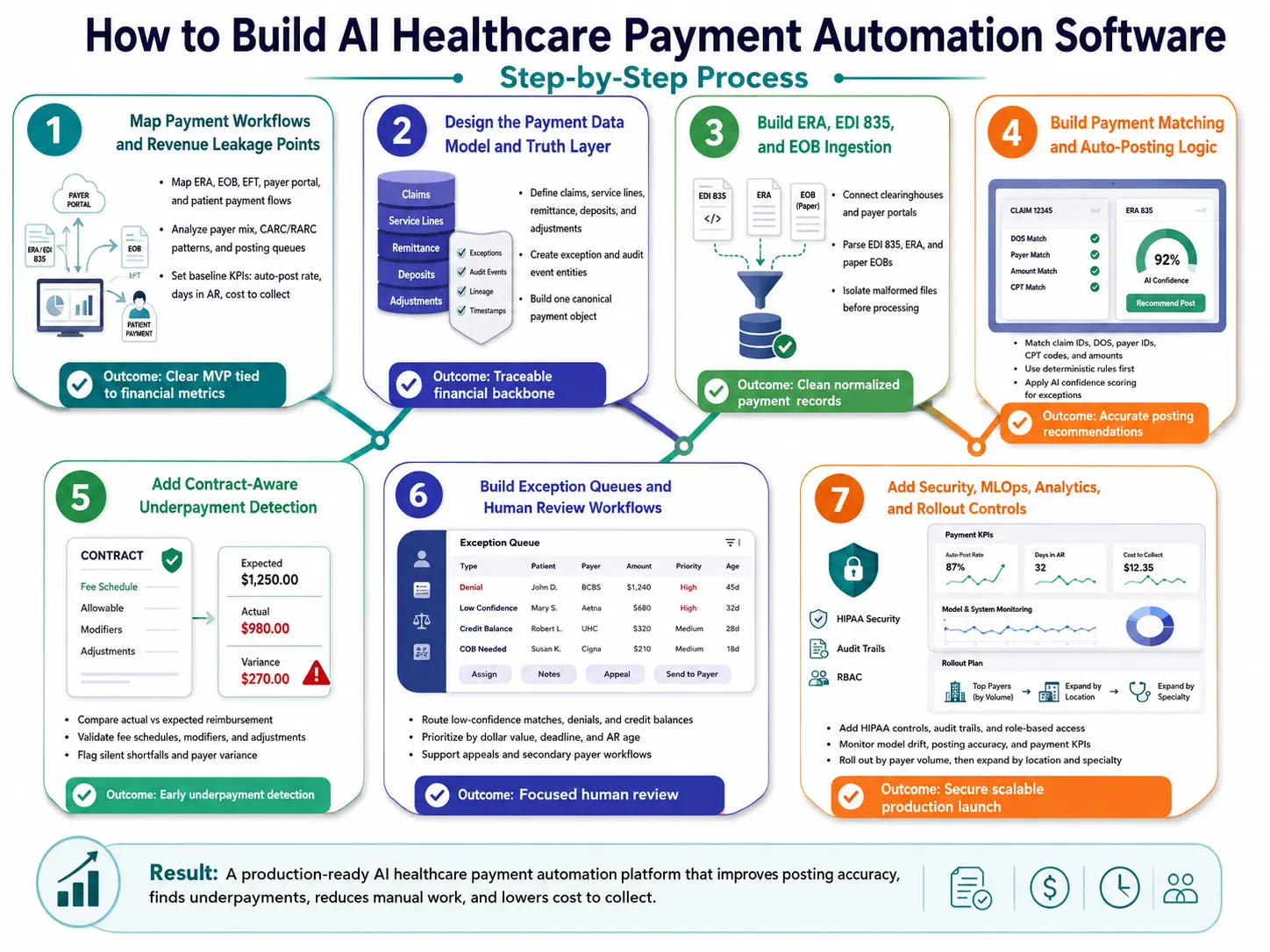
Step 1 — Map Payment Workflows and Revenue Leakage Points
The first step is mapping where money enters, where it gets delayed, and where errors or underpayments become write-offs. In fact, teams should document ERA sources, EOB workflows, EFT deposits, payer portals, patient payments, posting queues, adjustment rules, refund workflows, and AR follow-up before choosing AI features.
Technical Discovery Checkpoints
- Current Workflow Map: A visual chart showing how files move from clearinghouses to billing systems.
- Payer Mix Analysis: A breakdown of your top insurance payers by total claim volume and overall payment volume.
- Denial Tracking: Identification of your most frequent Claim Adjustment Reason Codes (CARC) and Remittance Advice Remark Codes (RARC).
- Baseline Metrics: Documentation of your current auto-post rate, average days in AR, underpayment recovery rate, and total cost to collect.
Intellivon turns this discovery phase into a concrete Minimum Viable Product (MVP) development scope tied directly to measurable financial metrics. Our team targets your highest-volume insurance payers and most predictable posting rules during the initial build phase to deliver fast, measurable business value.
Once workflows are mapped, the platform needs a shared payment data model.
Step 2 — Design the Payment Data Model and Truth Layer
The payment data model defines how claims, service lines, remittance records, deposits, adjustments, patient balances, contracts, and ledger entries connect. At the same time, this model becomes the system’s financial backbone. It prevents fragmented automation by giving every payment event a traceable relationship to the claim and expected reimbursement.
Core Entities to Define
- Canonical Payment Object: A single standardized data format that represents a payment transaction, regardless of its original file type.
- Claim-Line & Payer Contract Entities: Relational database tables that link individual medical service lines to active contractual fee schedules.
- Deposit & Adjustment Entities: Dedicated ledgers that track cash entering the bank and balance write-offs applied to patient accounts.
- Exception & Audit Event Entities: Safe data tables that record system errors and log every single automated or human modification for audit compliance.
Intellivon designs this comprehensive data model before writing any user interface code or training machine learning models. This upfront structural design prevents expensive database rebuilds when you add underpayment detection, automated reconciliation, and advanced analytics later.
After the data model is stable, the system can ingest payment records safely.
Step 3 — Build ERA, EDI 835, and EOB Ingestion
The ingestion layer should retrieve and parse electronic remittance advice files, EDI 835 transactions, paper EOBs, payer portal documents, and lockbox files. It should validate file structure, normalize payer-specific fields, extract adjustment codes, and create clean records that downstream matching and posting services can trust.
Ingestion Infrastructure
- Clearinghouse Connectivity: Direct secure API or SFTP pipeline links to national clearinghouses to pull daily electronic remittance advice files automatically.
- Payer Portal Retrieval: Automated background scripts that safely download remittance documents from insurance websites that do not connect to clearinghouses.
- Document Processing: Advanced OCR for paper EOB processing and natural language processing for remittance parsing to digitize paper streams.
- Malformed File Handling: A protective staging environment that isolates corrupted or broken files before they touch your main billing system.
Intellivon configures the ingestion engine to start with your top five insurance payers by total payment volume. This focused approach makes early payer-specific data mapping highly practical while driving up document extraction accuracy rates very quickly.
Clean ingestion creates usable data, but the system still needs to match payments to claims.
Step 4 — Build Payment Matching and Auto-Posting Logic
Payment matching should use exact identifiers first, and AI-supported matching only for incomplete or inconsistent records. At the same time, the platform should match claim numbers, patient IDs, dates of service, payer IDs, CPT codes, payment amounts, and batch references before generating a posting recommendation or auto-posting transaction.
Matching Engine Rules
- Deterministic Matching: Strict database queries that achieve straight-through payment processing by instantly pairing records with identical claim control numbers.
- Fuzzy Matching & Confidence Scoring: Machine learning scoring tools that pair incomplete check or patient files based on secondary data traits.
- Line-Level Balancing: Mathematical checks that verify the payment amount plus applied write-offs perfectly balance back to zero at the service line level.
- Posting File Generation: Software tools that format finalized matches into standard upload files for automated entry into your electronic health record system.
Intellivon separates recommendation logic from automated ledger posting during the early deployment phase. This setup allows your billing staff to review how the platform reaches matching decisions before you toggle on full hands-free automation.
After payments can be matched, the system must verify whether the payer paid correctly.
Step 5 — Add Contract-Aware Underpayment Detection
Contract-aware underpayment detection compares actual payer payments against expected reimbursement using fee schedules, payer contracts, allowed amounts, modifiers, service lines, and adjustment codes. At the same time, the platform should identify silent shortfalls, incorrect write-offs, recurring payer variance, and accounts that need appeal, rebilling, refund, or review.
Underpayment Audit Components
- Payer Contract Ingestion: A centralized digital library containing your commercial fee schedules and payment rule matrices.
- Allowed Amount Verification: Real-time checking tools that compare what the payer allowed against your contractually agreed rates.
- Variance Analysis: Software filters that automatically flag claims where the payment drops below the expected dollar threshold.
- Balance Controls: System rules that control automated write-offs and manage complex secondary payer billing or refund processing.
Intellivon builds contract intelligence as a standalone, highly configurable software service rather than hardcoding pricing rules into the main application. This structure allows your revenue cycle team to update contract terms easily without needing engineering help.
Once the platform identifies variance, it needs structured queues for human review.
Step 6 — Build Exception Queues and Human Review Workflows
Exception workflows route low-confidence matches, underpayments, unusual adjustments, denied payments, credit balances, secondary payer cases, and patient balance conflicts to the right team. Additionally, this system should prioritize work by dollar value, payer deadline, AR age, contract variance, and confidence score instead of sending every issue into one queue.
Workflow Management Features
- Smart Work Queues: Configurable dashboards that organize unresolved payment issues by financial value and filing deadlines.
- Denial Reconciliation Modules: User interfaces that group similar denial codes together so workers can resolve bulk insurance rejections faster.
- Coordination of Benefits Utilities: Step-by-step tools that help teams manage secondary payer billing and crossover claim processing efficiently.
- Automated Appeal Tools: Generative text features that bundle historical claim files and draft underpayment appeal letters instantly.
Intellivon creates clear human-in-the-loop validation checkpoints for all complex financial choices. This layout keeps automation highly useful while giving your revenue cycle management experts final control over subtle edge cases.
The platform can now process payment work, but production readiness depends on security, monitoring, and rollout design.
Step 7 — Add Security, MLOps, Analytics, and Rollout Controls
The final build step adds HIPAA controls, PCI scope management, model monitoring, payment analytics dashboards, audit reporting, and phased deployment controls. In fact, this rollout should begin with limited payer volume, then expand across locations, specialties, payers, and payment types after posting accuracy and exception rates meet target thresholds.
Production Management Layer
- Security Filters: Stringent role-based access control combined with unalterable audit trails to secure protected health information completely.
- Model Drift Monitoring: MLOps software pipelines that track machine learning accuracy and alert engineers if payer layout updates degrade parsing scores.
- KPI Dashboards: Real-time visual reporting tracking your automated posting rates, payment accuracy percentages, and drop in cost to collect.
Intellivon establishes a continuous data feedback loop that monitors system performance against active revenue cycle metrics. This live monitoring ensures the automation software adapts dynamically to shifting payer processing trends based on actual production data.
The right build path depends on whether the organization needs a custom platform, an AI module, or a vendor product.
The ERA Processing Pipeline And Automation Actually Works
Automating your Electronic Remittance Advice (ERA) pipeline is the fastest way to stop manual data entry errors. Healthcare companies often doubt that software can handle messy insurance data streams. However, a production-grade ingestion and matching pipeline turns unpredictable raw files into perfectly formatted bookkeeping records.
This section shows exactly how the software reads, matches, and fixes remittance data behind the scenes.
1. EDI 835 Ingestion and Parsing
An EDI 835 file is the official electronic document that insurance companies send to explain a payment. This contains data envelopes (ISA/IEA), claim payment details (CLP), specific service lines (SVC), and adjustment reason codes (CAS) that show why a claim was not paid in full.
The pipeline collects these files automatically via secure SFTP from your clearinghouse or through direct payer APIs.
- The Problem: Different insurance companies format these files inconsistently. Some leave out critical patient data fields, while others split a single payment across multiple files.
- The Solution: A validation layer scans every file before it touches your ledger. It fixes formatting layout errors and normalizes the data fields.
Once the platform parses the remittance data, it must link the payment directly to the original claim.
2. Payment Matching Logic — Tying Remittances to Claims
Every line in an incoming remittance file must link back to an exact claim line item, date of service, and medical procedure code from your original EDI 837 bill. Instead, the platform uses explicit, deterministic database rules to match clean records instantly.
- The Problem: Payer data is frequently messy. Insurers send split payments across separate files, combine secondary payer billing codes incorrectly, or scramble coordination of benefits documentation.
- The Solution: When traditional database rules fail to find a match, the system activates its machine learning payment matching models to look at secondary clues.
| Data Match Type | Best For | System Action |
| Deterministic Rule | Clean records with perfect keys | Instantly posts to the ledger |
| Probabilistic ML | Truncated IDs, missing check codes | Calculates match score |
Unmatched transactions are never dumped into a generic error bucket. The system routes them to automated crossover claims processing queues for rapid secondary verification. At the same time, after securing electronic data paths, the system must process the remaining paper documents.
3. Paper EOB and PDF Remittance Handling
Even with digital networks, a small portion of healthcare remittances still arrive as paper forms or unindexed PDF attachments. These documents often get ignored because converting them to digital records by hand takes too much time.
- The Problem: Manual data entry for paper files creates major backlogs and causes teams to miss critical appeal deadlines.
- The Solution: The platform routes these documents through an automated OCR for the paper EOB processing pipeline.
The software applies advanced text scanning to read layouts from specific payers, extracts the payment numbers, and builds a standard digital file. Additionally, a final balancing check verifies that all text figures add up correctly before sending the record to the ledger.
This integration ensures that paper-based explanation of benefits processing and EOB parsing workflows operate with the exact same speed as your digital streams. Therefore, building a reliable processing pipeline allows you to accurately measure the financial risks of your custom build.
AI Healthcare Payment Software Development Cost
AI healthcare payment software development cost usually ranges from $50,000 to $170,000 for a focused custom build, depending on workflow scope, ERA and EOB processing depth, EHR or PM integration needs, AI model complexity, HIPAA controls, PCI scope, payer connectivity, and analytics requirements.
This range works best for healthcare teams building a focused payment automation platform first. At the same time, a lean MVP may automate ERA ingestion, payment matching, and reviewer queues. On the other hand, a larger build may include EOB parsing, underpayment detection, payer contract validation, payment reconciliation, and deeper revenue analytics.
| Development Phase | Estimated Cost | What It Covers |
| Discovery and payment workflow mapping | $5,000–$12,000 | Payer mix, posting workflow, ERA sources, AR pain points, and KPI baseline |
| Product architecture and UX design | $6,000–$15,000 | Worklists, dashboards, reviewer screens, and payment flow design |
| EDI 835, ERA, and EOB ingestion layer | $8,000–$25,000 | Parsers, OCR, payer mapping, clearinghouse connectivity |
| Payment matching and posting engine | $10,000–$28,000 | Deterministic rules, fuzzy matching, confidence scoring, and posting controls |
| Contract and underpayment detection layer | $8,000–$24,000 | Payer contracts, fee schedules, allowed amount checks, and variance detection |
| EHR, PM, payer, clearinghouse, and gateway integrations | $10,000–$35,000 | EHR, PM systems, clearinghouses, payment gateways, banks, payer files |
| AI model development and MLOps | $12,000–$30,000 | OCR, NLP, anomaly detection, predictive analytics, model monitoring |
| HIPAA, PCI, audit, and security controls | $8,000–$22,000 | RBAC, encryption, audit logs, tokenization, BAA workflows |
| Testing, deployment, and rollout | $6,000–$18,000 | QA, UAT, posting accuracy testing, payer rollout, training |
MVP vs Enterprise Range
| Build Type | Estimated Cost | Best Fit |
| Focused MVP | $50,000–$75,000 | ERA processing, basic payment matching, reviewer queue, and limited payer scope |
| Mid-level production platform | $75,000–$120,000 | EOB parsing, payment posting automation, underpayment flags, analytics dashboard |
| Advanced healthcare payment automation platform | $120,000–$170,000 | Contract validation, payer variance analysis, EHR/PM integrations, AI reconciliation workflows |
Maintenance Cost
Ongoing maintenance usually costs 15%–25% of the initial build per year. This covers payer-rule updates, contract changes, AI model monitoring, security patches, integration maintenance, compliance updates, user support, and analytics improvements.
Need a Clearer Cost Estimate Before Development?
Get Intellivon’s AI Healthcare Payment Automation Roadmap to map your payment workflows, payer integrations, compliance scope, MVP features, and development budget before writing the first line of code.
Build AI Healthcare Payment Automation Software With Intellivon
Intellivon builds AI healthcare payment automation software around real payment workflows, payer data, compliance controls, secure integrations, AI models, and measurable revenue outcomes.
In fact, the work starts with payment workflow discovery, data readiness, payer integration planning, architecture design, MVP scope, compliance mapping, and KPI alignment before development begins.
1. Define the Right Payment Automation Scope
Intellivon maps the payment workflow before development starts, so the platform solves the highest-value revenue problems first.
- ERA, EOB, and EFT workflow mapping
- Patient payment and underpayment process review
- Denial reconciliation and AR workflow assessment
- MVP scope based on payer volume and cash-flow impact
- KPI planning for auto-post rate, accuracy, and recovery
2. Design the Payment Automation Architecture
Intellivon designs the platform architecture around payment accuracy, traceability, and compliance from the first stage.
- Data ingestion and normalization layer
- Payment matching and posting engine
- Contract validation and underpayment detection layer
- Exception review and approval workflows
- Analytics, security, and MLOps architecture
3. Build AI Models for Payment Intelligence
Intellivon builds AI models that support payment decisions with evidence, confidence scores, and human review controls.
- OCR for paper EOB and remittance documents
- NLP for remittance and payer correspondence parsing
- Machine learning for payment matching
- Anomaly detection for payment variance
- Predictive analytics for AR and underpayment risk
4. Integrate With Healthcare and Payment Systems
Intellivon plans integrations early, so payment automation connects with the systems revenue teams already use.
- EHR and practice management system integration
- Clearinghouse and payer portal connectivity
- Payment gateway, ACH, and lockbox integration
- Bank and finance system reconciliation
- Secure data exchange using APIs, EDI, HL7, FHIR, or SFTP
5. Make the Platform Secure and Monitorable
Intellivon designs compliance, access control, and monitoring into the platform before rollout.
- HIPAA-ready architecture and PHI controls
- PCI-aware payment data handling
- Role-based access control and audit logs
- PHI tokenization and encryption
- Model drift, payment accuracy, and exception monitoring
If you are planning to build AI healthcare payment automation software for payment posting, ERA reconciliation, underpayment detection, patient payment workflows, or revenue cycle SaaS products, Intellivon can help you define the roadmap before development begins.
Conclusion
AI healthcare payment automation works best when built as infrastructure, not a narrow shortcut. In fact, the platform must parse electronic remittance advice data, validate payer payments, match deposits, and detect underpayments with absolute data accuracy.
For technology and revenue cycle leaders, the decision comes down to control. This means if integration, ownership, and revenue protection matter, building a custom solution creates long-term enterprise value by turning complex payment records into an automated, private corporate asset.
Things To Know About AI Healthcare Payment Automation
Q1. How much does AI healthcare payment automation software cost?
A1. AI healthcare payment automation software usually costs $50,000 to $170,000 to build. At the same time, a focused MVP with ERA parsing, basic payment posting, and one EHR or PM integration sits near the lower range. Additionally, contract intelligence, underpayment detection, PCI controls, payer portals, and multi-site deployment increase cost.
Q2. How long does it take to build AI healthcare payment automation software?
A2. A focused AI healthcare payment automation MVP usually takes 5–8 months, while an enterprise rollout takes 9–15 months. Consequently, the timeline depends on payer volume, EDI 835 variation, EHR integration access, contract data quality, payment gateway scope, compliance review, and how many payment workflows need automation.
Q3. Can HIPAA-compliant payment automation software also support PCI DSS?
A3. Yes. HIPAA-compliant payment automation software can support PCI DSS when PHI and cardholder data are separated, card data is tokenized, payment gateways handle sensitive card fields, and access controls limit who can view payment information. At the same time, HIPAA protects ePHI, while PCI DSS protects cardholder data.
Q4. Can AI payment posting software integrate with Epic, Oracle Health, and clearinghouses?
A4. Yes. AI payment posting software can integrate with Epic, Oracle Health, athenahealth, eClinicalWorks, NextGen, clearinghouses, payer portals, banks, and payment gateways. Additionally, the integration method may use APIs, HL7, FHIR R4, EDI 837/835, SFTP, batch files, or database-level connectors, depending on system access.
Q5. When should teams choose custom AI payment automation over a vendor tool?
A5. Choose custom AI payment automation when you need proprietary payer logic, contract-aware underpayment detection, multi-site workflows, embedded SaaS capabilities, or deeper control over payment data. Additionally, choose a vendor tool when you only need basic ERA posting, standard reporting, and faster deployment with limited customization.