Key Takeaways:
- AI governance platforms require model inventory, risk intake, approval workflows, bias auditing, and explainability controls.
- EU AI Act mapping, NIST AI RMF controls, HIPAA safeguards, and FDA AI/ML documentation drive compliance complexity.
- Immutable logging, MLOps governance, and ONC transparency are non-negotiable enterprise governance architecture requirements.
- Governance MVPs start at $180,000 to $350,000 while enterprise builds reach $500,000.
- How Intellivon builds AI governance platforms as production compliance infrastructure, and not static regulatory dashboards.
AI governance platform development for an enterprise costs between $280,000 and $750,000, depending on regulatory scope, model inventory size, and whether you’re targeting the EU AI Act, NIST AI RMF, or both.
Without a phased build architecture tied to specific compliance milestones, that investment produces a framework that looks complete but fails operationally. In practice, enterprises that structure governance builds around regulatory checkpoints document 35 to 45% lower compliance costs and reach positive ROI within 18 months. That matters because the EU AI Act alone carries a fine exposure of up to €30 million for high-risk AI violations, which makes the cost-avoidance math straightforward to run.
Intellivon has spent over 10 years building AI governance infrastructure for healthcare and financial institutions, specifically using milestone-phased architecture that ties each build phase directly to a regulatory deadline. That is exactly the approach this blog unpacks. By the end, you will have a phase-by-phase cost breakdown, a build vs. buy decision framework, and a board-ready budget number.

What Is An Enterprise AI Governance Platform?
An enterprise AI governance platform is an active control system that tracks, evaluates, approves, monitors, and audits AI systems across their entire lifecycle. It connects model inventory, risk scoring, validation evidence, bias testing, explainability, human oversight, vendor assessment, and immutable audit trails.
This unified infrastructure allows business leaders to prove to regulators and internal boards that every deployed AI model is explicitly owned, independently reviewed, compliant, and continuously monitored.
Managing enterprise AI risk requires moving past manual spreadsheets and basic GRC software. A true governance platform acts as an active, automated system of record and control plane that enforces stage-gates before an algorithm can transition from development to production. It unifies complex engineering pipelines with compliance workflows to ensure absolute data and model integrity.
- Model Inventory & Registry: A centralized catalog and cryptographic repository tracking model code, training configurations, and data dependencies.
- Validation & Explainability Layer: Automated scripts for bias audit tooling, demographic parity analysis, and explainable AI implementation (SHAP/LIME).
- Operational Monitoring & Audit Trails: Continuous tracking of data drift, model versioning, and immutable logging for regulatory compliance.
- Risk & Incident Management: A dynamic AI risk register and response framework to manage algorithmic failure modes or vendor risks.
Spreadsheets fail the moment models influence critical clinical, financial, or operational decisions. True enterprise compliance requires an automated, software-driven control plane because you cannot protect what you cannot systematically audit.
How Much Does an Enterprise AI Governance Framework Cost?
A custom production-grade platform built via engineering-led AI governance platform development usually costs $500,000–$1.2M, while a narrower Minimum Viable Product (MVP) ranges from $180,000–$350,000. Annual operational maintenance commonly reaches $300,000–$600,000 in regulated enterprises.
This ongoing expense ensures compliance updates, monitoring pipelines, audit preparation, and active technical ownership remain current.
Calculating your enterprise AI governance software development cost requires evaluating core infrastructure blocks, ranging from algorithmic bias detection tooling to immutable audit trails. Rather than relying on ambiguous estimates, enterprises must analyze specific development phases alongside their concrete dollar ranges.
1. Phase-by-Phase Development Cost Breakdown
| Development Phase | Cost Range | What Drives The Cost |
| AI Governance Discovery | $20,000–$60,000 | AI estate mapping, stakeholder interviews, shadow AI discovery, risk scope |
| Framework and Control Design | $40,000–$120,000 | NIST AI RMF, EU AI Act, ISO 42001, HIPAA, FDA, ONC, SR 11-7 mapping |
| Model Inventory and AI Registry | $80,000–$220,000 | Metadata schema, model ownership, versioning, API ingestion, lineage |
| AI Risk Register and Scoring Engine | $60,000–$160,000 | Risk tiers, scoring logic, approval rules, workflow routing |
| Documentation and Model Cards | $45,000–$130,000 | Model cards, AI BOMs, training data documentation, audit packets |
| Bias Detection and Fairness Tooling | $90,000–$260,000 | Demographic parity, disparate impact, subgroup testing, bias reports |
| Explainability and Interpretability | $80,000–$240,000 | SHAP, LIME, feature attribution, LLM source traceability |
| Audit Trail and Immutable Logging | $70,000–$200,000 | Event logs, evidence storage, tamper resistance, access records |
| MLOps Governance Pipeline | $100,000–$300,000 | Drift detection, deployment gates, retraining approvals, retirement workflows |
| Compliance Reporting Dashboards | $75,000–$220,000 | Board reports, audit exports, regulatory evidence, risk heatmaps |
| Enterprise Integrations | $100,000–$350,000 | IAM, GRC, SIEM, EHR, data lake, MLOps, vendor APIs |
| Testing, Red Teaming, and Rollout | $70,000–$250,000 | AI red teaming, adversarial testing, UAT, security testing, pilot deployment |
2. Total Cost of Ownership (TCO) Benchmarks
- Governance MVP ($180,000–$350,000): Focuses on basic model inventory management, a functional AI risk register, manual model card generation, and foundational compliance mapping for a single business unit.
- Production-Grade Enterprise Platform ($500,000–$1.2M): Delivers fully automated MLOps governance pipelines, automated bias audit tooling, custom AI governance framework cost optimization, SHAP/LIME explainability engines, and deep SIEM/IAM integrations.
- Regulated Multi-Business-Unit Platform ($1.2M–$2.5M+): Supports global operations across cross-border environments, incorporating automated EU AI Act implementation cost controls, absolute HIPAA AI governance framework cost boundaries, real-time shadow mode deployment checking, and cross-framework reporting.
- Annual Ongoing Maintenance: Expect an annual run-rate of 25%–50% of the initial build cost ($300,000–$600,000 for large enterprises) to cover concept drift monitoring, regulatory updates, and ongoing pipeline adjustments.
Custom platform development requires balancing initial engineering outlays against long-term operational overhead. For a detailed breakdown of build structures, see our guide on [how much does enterprise AI governance framework cost].
Enterprises Need AI Governance Before AI Adoption Gets Too Large
Enterprises must establish an active AI governance platform before their operational model count fragments, because regulatory risk scales faster than engineering visibility. Deployed software applications often contain hidden algorithms, shadow LLM integrations, and unmonitored copilot tools that lack corporate oversight.
Implementing a formal governance infrastructure ensures that leadership relies on cryptographic evidence and automated pipelines rather than verbal vendor assurances.
1. Mitigating Shadow Infrastructure and Vendor Ingestion
Unregulated third-party SaaS tools introduce significant data privacy vulnerabilities and compliance gaps when employees quietly input proprietary corporate data into public consumer LLMs.
Without an automated model inventory registry, technical leaders cannot trace information flows or manage downstream algorithmic risks.
- Shadow AI Discovery: Scans internal enterprise networks to map unauthorized APIs, unapproved web applications, and hidden consumer LLM touchpoints.
- Third-Party Risk Management: Establishes objective technical criteria to vet vendor architectures, verify data retention policies, and score privacy risks.
2. Managing Autonomous Agents and Behavioral Drift
Deploying autonomous agentic AI systems that execute real-world actions like financial transactions or patient scheduling creates severe operational and safety exposure.
These dynamic networks require deterministic MLOps governance pipelines to control runtime permissions and log executable workflows.
- Human-in-the-Loop Safeguards: Enforce strict execution stage-gates requiring manual reviewer validation before any model completes high-risk external actions.
- Continuous Drift Detection: Tracks concept drift monitoring parameters to flag production anomalies before they disrupt core enterprise operations.
3. Verifying Deep Evidence for Enterprise Compliance
Securing board-level budget approval for expansive AI rollouts requires verifiable compliance reporting dashboards that prove adherence to strict regulatory frameworks.
Rather than focusing on abstract ethical principles, risk officers need structured technical artifacts that withstand intense external regulatory scrutiny.
- Automated Model Cards: Generate comprehensive performance benchmarks, training data documentation, and architectural lineage records automatically upon deployment.
- Immutable Logging Infrastructure: Implements secure write-once-read-many (WORM) event logs to create defensible audit trails for forensic validation.
Comprehensive governance infrastructure must exist before an algorithmic failure affects live patient outcomes, financial claims, or corporate compliance postures. For a breakdown of baseline architectural requirements, see our guide on [AI governance platform development].
AI Governance Market Growth Is Creating A Budget Moment
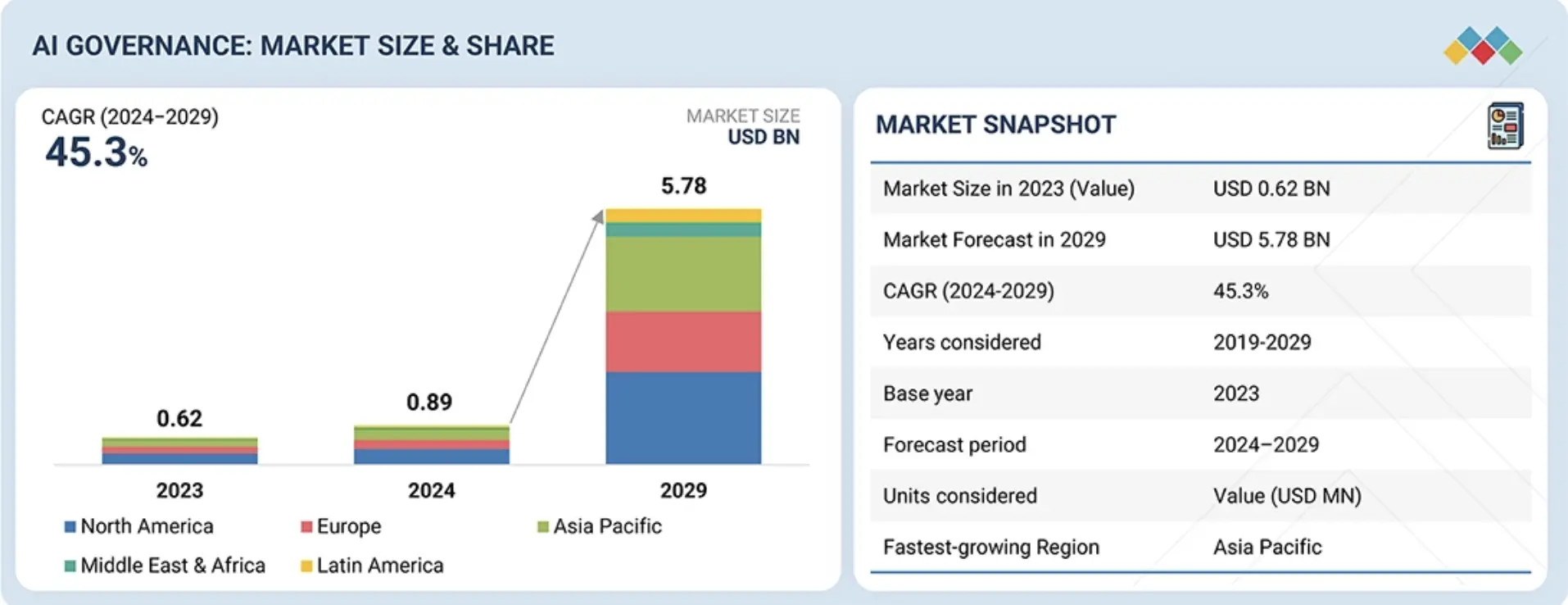
This rapid expansion reflects enterprises’ urgent need for software that operationalizes risk, compliance, model monitoring, and accountability under EU AI Act pressure and responsible AI expectations.
1. Enterprise Adoption Driving Budget Priority
AI governance is becoming a board-level budget line as compliance shifts from policy documents to the infrastructure layer.
Regulated industries like healthcare, fintech, and manufacturing are moving beyond generic governance features to custom workflows that meet GDPR, HIPAA, and FINRA requirements. At the same time, enterprises now demand auditable AI systems with explainability and bias mitigation capabilities.
2. Vendor Tools vs. Custom Enterprise Workflows
While vendor tools are growing rapidly, regulated enterprises still need tailored workflows connecting risk, compliance, security, engineering, and operations.
At the same time, Grand View Research forecasts the market reaching $3.59 billion by 2033, confirming this as a sustained enterprise software category rather than temporary hype.
This is becoming a real enterprise software and compliance category. Budget cycles are aligning with regulatory deadlines, making governance an operational necessity rather than optional investment.
Organizations recognize that AI governance software must integrate across departments to deliver measurable risk reduction and compliance efficiency.
AI Governance Framework Architecture That Drives Cost
AI governance framework architecture drives cost because every governance control needs data, workflow, evidence, and ownership behind it. The expensive layers are not UI screens.
They are model discovery, metadata ingestion, risk scoring, validation evidence, bias testing, explainability, monitoring, audit logging, regulatory mapping, and integrations with enterprise systems.
1. Architectural Layers and Capital Allocation
| Architecture Layer | What It Does | Cost Impact |
| AI Discovery Layer | Finds internal, vendor, and shadow AI systems | Raises discovery and ingestion cost |
| Model Inventory Layer | Stores AI system records and ownership | Requires metadata design and workflows |
| AI Model Registry | Tracks model versions, deployment status, and lineage | Adds MLOps integration cost |
| Risk Scoring Engine | Classifies AI systems by risk and regulation | Adds compliance logic cost |
| Documentation Layer | Creates model cards, AI BOMs, validation packets | Adds template and evidence automation |
| Bias and Fairness Layer | Runs fairness metrics and subgroup testing | Adds data science and testing cost |
| Explainability Layer | Shows why outputs or predictions happened | Adds SHAP, LIME, retrieval evidence, reviewer UI |
| Governance Workflow Layer | Routes approvals, exceptions, and human review | Adds role-based workflow cost |
| Monitoring Layer | Tracks drift, performance, incidents, and overrides | Adds telemetry and alerting cost |
| Audit Trail Layer | Preserves immutable logs and decision history | Adds storage, security, and retention cost |
| Reporting Layer | Produces board, audit, and regulatory reports | Adds dashboard and export cost |
2. Core Registry and Asset Discovery Infrastructure
Building an automated AI discovery layer requires continuous network scanning and API interception to map your entire model estate. Engineers must design custom metadata schemas to log active model ownership, version history, and software dependencies. This system of record serves as your baseline compliance foundation.
- Shadow AI Remediation: Automatically surfaces unapproved third-party SaaS models across corporate networks.
- Lineage Ingestion: Integrates directly with enterprise data lakes to map early training data sources.
3. Fairness Engineering and Automated Bias Audits
The bias and fairness layer demands specialized data science tooling to execute complex demographic parity and disparate impact analyses. This module requires active compute infrastructure to test live models continuously.
These automated scripts ensure outputs do not discriminate across protected classes.
- Subgroup Testing Tools: Evaluate model performance across intersecting user demographics to isolate hidden disparities.
- Fairness Metrics Logs: Generate automated compliance artifacts required by international regulatory bodies.
4. Model Explainability and Interpretability Engines
Implementing true transparency requires embedding advanced mathematical frameworks like SHAP values or LIME tooling directly into production pipelines. These tools calculate exact feature attribution scores for every inference, requiring dedicated database storage for retrieval.
This infrastructure lets compliance officers verify why an algorithm reached a specific conclusion.
- Black-Box Interpretation: Translates complex mathematical model weights into clear, legible feature importance charts.
- Traceability Ingestion: Maps retrieval-augmented generation sources to verify Large Language Model output accuracy.
5. Operational Monitoring and Immutable Logging
Passing rigorous corporate audits requires building a tamper-resistant audit trail layer using write-once-read-many storage configurations.
This framework automatically logs model drift parameters, operational overrides, and engineering versions to create an unalterable history. Telemetry systems alert security teams the moment a model breaches risk thresholds.
- Immutable Logging Infrastructure: Prevents historical data manipulation by saving transaction logs to secure environments.
- Telemetry Alerting Systems: Triggers instant incident management workflows when production models exhibit critical behavior drift.
Your core architecture should make corporate governance visible and enforceable across the entire software engineering lifecycle. Otherwise, it becomes another passive policy program that leaves your enterprise exposed to massive liability because it cannot technically prove control.
The AI Governance Evidence Backbone No One Budgets For
The AI governance evidence backbone is the artifact system that proves every AI system was reviewed, tested, approved, monitored, and governed. It stores model cards, AI BOMs, risk scores, training data records, validation results, bias audits, explainability reports, approval logs, incident records, vendor assessments, drift alerts, and human override history.
Software engineers often mistake a governance platform for a simple collection of data observation charts or policy checklists. However, corporate compliance officers and risk leaders require a completely different deliverable: an unalterable, automated verification engine. When an algorithm eventually faces an internal inspection or an official regulatory inquiry, verbal engineering assurances carry zero weight.
1. Automated Core Inventory and Structural Registries
The base of your evidence spine must capture precisely what algorithms exist and who retains operational ownership across the enterprise. Every production system requires an automated metadata manifest linking source code to data training dependencies.
This foundational mapping guarantees absolute inventory transparency for internal audits.
- AI System Inventory Record: Tracks active business use cases, system classifications, and corporate owners.
- AI Model Registry Entry: Locks cryptographic hashes of model weights and deployment environments.
- AI Bill of Materials: Documents precise software versions, framework wrappers, and base models.
2. Comprehensive Testing Validation and Reasoning Output
Your platform must preserve technical validation logs detailing how an algorithm behaved before entering production environments. Risk officers rely on these files to verify that models meet specific fairness thresholds and performance boundaries.
Storing these mathematical metrics protects the enterprise against severe liability claims.
- Bias Audit Report: Stores demographic parity calculations and disparate impact analysis records.
- Explainability Summary: Captures SHAP value distributions or LIME feature attribution charts.
- Risk Assessment Report: Calculates specific hazard scores based on your AI risk register.
3. Human Oversight and Operational Deployment Trails
Enforcing accountability requires capturing an unalterable history of every runtime modification and executive sign-off. If a compliance officer overrides an automated deployment block, the platform must log the underlying rationale.
This trail transforms passive software observations into enforceable operational authority.
- Approval Trail Log: Tracks role-based access control approvals and manual compliance overrides.
- Deployment Decision Log: Records model version changes, shadow mode testing, and A/B configurations.
- Human Oversight Record: Captures specific human-in-the-loop interventions during autonomous agent operations.
Automating your evidence pipeline frequently adds $100,000–$400,000 to your software development costs because it demands complex metadata mapping and strict storage retention rules.
Step-By-Step AI Governance Platform Development Roadmap
AI governance platform development should move through eight phases: AI estate discovery, framework design, model inventory, risk scoring, documentation automation, validation tooling, monitoring infrastructure, and operational rollout.
This order prevents teams from buying tools before they know which models, controls, owners, and compliance evidence the platform must support.
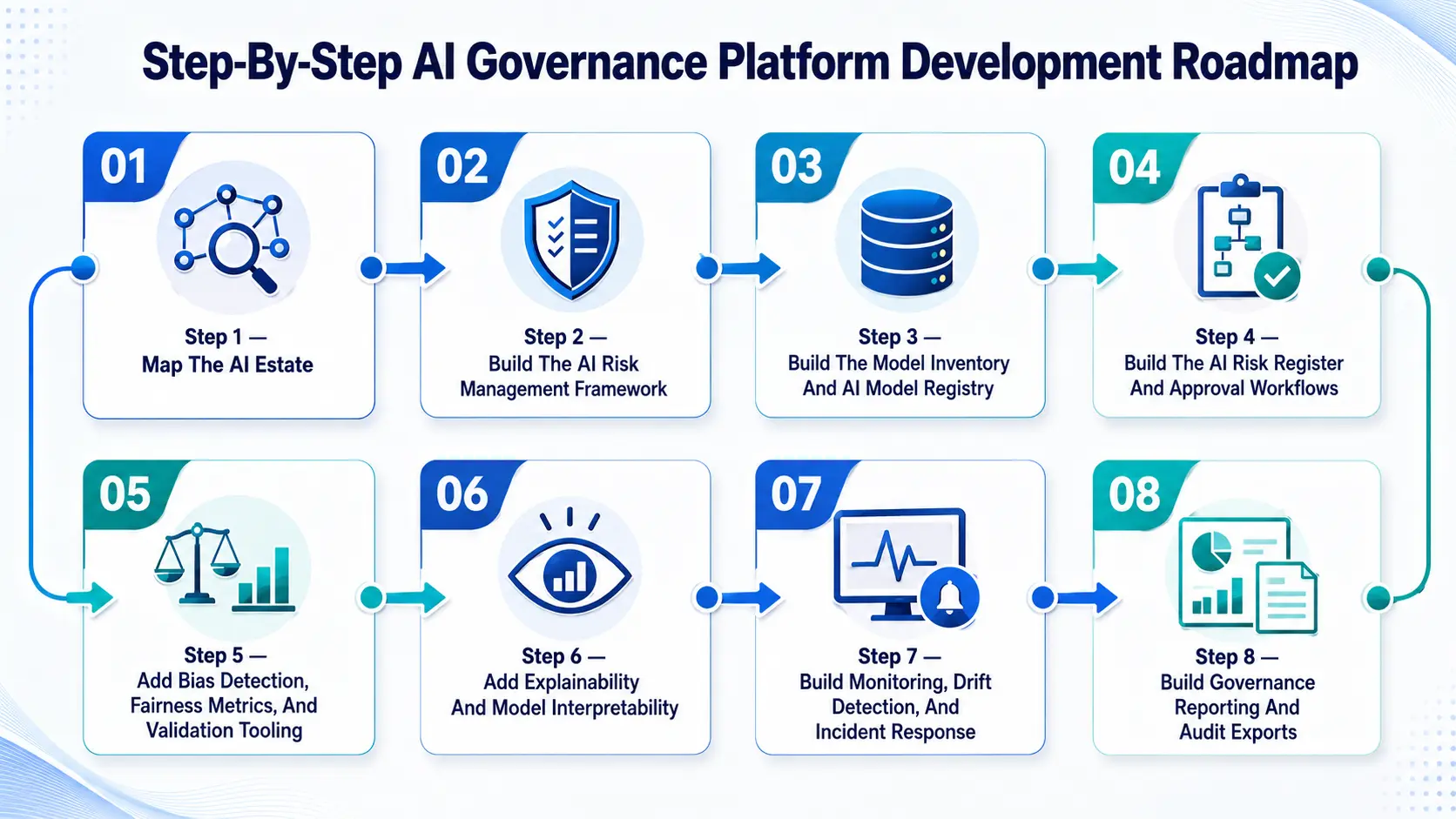
Step 1 — Map The AI Estate
The build starts by identifying every AI system, model, LLM app, agent, vendor AI tool, and shadow AI workflow across the enterprise. This creates the baseline model inventory and shows which departments already use AI without consistent ownership, risk scoring, documentation, validation, monitoring, or approval history.
Technical Implementation Requirements
Engineering-driven discovery requires executing programmatic network scans and monitoring active enterprise API traffic to capture unrecorded runtime endpoints. System architects must map inbound training data lineages alongside current server hosting environments. This phase eliminates structural visibility blind spots across fragmented corporate departments.
- Shadow AI Discovery: Scans internal subnets to identify unapproved web portals and corporate API keys.
- Asset Ownership Matrix: Cross-references active systems with distinct corporate business units and IT owners.
The Intellivon Engineering Approach
Intellivon treats discovery as both a technical and governance audit. The team maps systems, owners, data flows, and compliance exposure before recommending platform architecture.
Once the AI estate is visible, the team can design the risk framework.
Step 2 — Build The AI Risk Management Framework
The second step turns policies and regulations into risk categories, scoring rules, approval levels, and control requirements. This is where NIST AI RMF, EU AI Act, ISO 42001, HIPAA, FDA AI/ML guidance, ONC transparency rules, and financial model risk expectations become platform logic.
Technical Implementation Requirements
Developing the decision tier requires writing custom programmatic evaluation matrices that assign fixed risk scores based on application scope. Engineers must map structural control checkboxes directly to regional compliance parameters, establishing high-risk gates for automated delivery workflows. This code blocks non-compliant models from moving downstream.
- Prohibited Use Validation: Hardcodes explicit system boundaries that trigger immediate deployment rejections.
- Control-to-Evidence Logic: Connects individual compliance obligations directly to mandatory engineering artifact generation gates.
The Intellivon Engineering Approach
Intellivon designs the framework around operational controls, not abstract ethics statements. Each risk tier connects to review steps, documentation, testing, and monitoring requirements.
Once risk rules exist, the model registry can store them consistently.
Step 3 — Build The Model Inventory And AI Model Registry
The model inventory and AI model registry become the system of record for AI governance. They track each AI system’s owner, purpose, model type, version, data source, deployment environment, validation status, risk tier, approval history, monitoring status, vendor dependency, and retirement plan.
Technical Implementation Requirements
Building the core registry requires instantiating a highly structured schema database that tracks model weight histories via immutable cryptographic hashes. Developers must deploy Webhook listeners and native MLOps pipeline integrations to ingest metadata automatically during continuous delivery operations. This setup preserves clear structural version control.
- Cryptographic Asset Tagging: Signs model binaries and configuration files to ensure runtime file integrity.
- Lineage Ingestion Pipelines: Captures foundational training databases and early preprocessing configurations automatically.
The Intellivon Engineering Approach
Intellivon builds the registry around the evidence enterprises must produce during audit, not only the metadata engineers prefer.
After inventory and registry design, risk scoring can become automated.
Step 4 — Build The AI Risk Register And Approval Workflows
The AI risk register converts model information into risk decisions. It records each AI system’s risk level, reviewer assignments, required controls, exceptions, approval history, mitigation actions, and open issues. This gives legal, compliance, security, risk, and engineering one shared workflow for AI governance decisions.
Technical Implementation Requirements
Enforcing separation of duties requires creating dynamic, role-based access control (RBAC) schemas inside your central workflow engine. Architects must build conditional routing rules that automatically escalate high-risk operational anomalies to specialized validation boards. These automated approval loops replace manual tracking arrays.
- Conditional Workflow Routing: Evaluates real-time risk tiers to distribute system review tasks appropriately.
- Exception Escalation Logic: Triggers secondary compliance review alerts if an engineer requests model gate bypasses.
The Intellivon Engineering Approach
Intellivon designs workflows around actual enterprise roles. A clinical safety lead, CRO, security lead, model validation lead, and product owner should not see the same workflow.
Once approvals exist, the platform must prove model quality and fairness.
Step 5 — Add Bias Detection, Fairness Metrics, And Validation Tooling
Bias detection and validation tooling test whether AI systems behave safely, fairly, and consistently across users, populations, workflows, and time. This layer supports algorithmic bias detection, demographic parity analysis, disparate impact analysis, subgroup testing, model validation, outcome analysis, and fairness monitoring before and after deployment.
Technical Implementation Requirements
Fairness engineering requires writing automated statistical scripts that actively compute demographic parity indices and disparate impact ratios on live transaction datasets. The system must run subgroup performance testing across protected variable clusters before authorizing production code promotion. These mathematical gates stop biased outputs.
- Algorithmic Bias Testing: Calculates mathematical divergence across specialized user cohorts to flag software discrepancies.
- Automated Validation Frameworks: Run comprehensive regression tests against baseline evaluation sets to measure model degradation.
The Intellivon Engineering Approach
Intellivon connects fairness and validation outputs to approval decisions. The system should show what changed, who reviewed it, and whether the model can move forward.
Validated models still need explainability before business users can trust them.
Step 6 — Add Explainability And Model Interpretability
Explainability tooling helps reviewers understand why a model produced a prediction, recommendation, score, or generated output. This layer can include SHAP values, LIME explainability, feature attribution, prompt traces, retrieval evidence, source citations, decision logs, confidence signals, and reviewer-friendly explanation summaries.
Technical Implementation Requirements
Implementing interpretability layers requires hosting dedicated feature-attribution computation clusters running parallel SHAP or LIME background worker processes. Data pipelines must archive inference-level coefficient values inside accessible indices to enable rapid end-user dashboard retrieval. This architecture reveals the rationale behind black-box outputs.
- Feature Attribution Engineering: Extracts directional mathematical weights from active neural network branches per transaction.
- RAG Source Traceability: Captures vector database proximity steps to verify external LLM knowledge grounding.
The Intellivon Engineering Approach
Intellivon designs explainability for business review, not only data science debugging. A compliance officer should understand the evidence without reading model code.
After explainability, the platform needs production monitoring.
Step 7 — Build Monitoring, Drift Detection, And Incident Response
Production AI governance requires ongoing monitoring because model behavior can change after approval. The platform should track model performance, data drift, concept drift, bias drift, user overrides, hallucination patterns, latency, failed requests, safety alerts, incident reports, and retraining triggers across deployed AI systems.
Technical Implementation Requirements
Production telemetry requires setting up continuous streaming statistical comparisons between real-world inference vectors and historical training baselines.
If computed Population Stability Index (PSI) scores cross predefined tolerance boundaries, the system must trigger automated incident logging protocols. This alerts operations engineers before system errors compound.
- Data Drift Telemetry: Monitors real-time feature distributions to identify underlying operational data changes.
- Automated Incident Routing: Pushes urgent system status payloads to active corporate PagerDuty groups.
The Intellivon Engineering Approach
Intellivon connects monitoring alerts to governance actions. A drift alert should create a review task, not disappear inside a technical dashboard.
Finally, the platform must produce board, audit, and regulatory reports.
Step 8 — Build Governance Reporting And Audit Exports
Governance reporting converts technical controls into board-ready, audit-ready, and regulator-ready evidence. It should show model count, risk distribution, high-risk system status, open exceptions, fairness findings, monitoring alerts, overdue reviews, vendor risks, compliance gaps, and incident trends in a format leaders can act on.
Technical Implementation Requirements
The final reporting block requires building automated export routines that compile live registry schemas into standardized PDF compliance dossiers. Designers must build interactive executive heatmaps that display aggregate operational risk profiles without exposing raw background source code. This translates pipeline variables into scannable executive summaries.
- Conformity Bundle Generation: Packs immutable cryptographic logs into signed zip containers for external inspectors.
- ROI Dashboard Telemetry: Correlates automated risk mitigation parameters with avoided compliance penalty valuations.
The Intellivon Engineering Approach
Intellivon builds reporting around the questions executives and auditors actually ask. Reports should support budget review, compliance review, incident review, and model approval review.
The roadmap shows how the build happens. The next section should explain how compliance requirements change the cost.
Healthcare AI Governance Cost Multipliers
Healthcare and fintech AI governance platforms cost more because they must support sector-specific evidence, validation, privacy, documentation, and oversight.
At the same time, HIPAA, FDA AI/ML guidance, ONC transparency rules, SR 11-7, OCC model risk expectations, and FFIEC-style controls create deeper requirements for audit trails, model validation, data lineage, human oversight, and incident response.
1. Capital Impacts of Clinical Data Security and Medical Device Validation
Healthcare governance controls can add $150,000–$500,000 to your software engineering budget, depending on clinical risk, Electronic Health Record (EHR) integration, and validation depth.
Building software that complies with [HIPAA AI compliance cost](LINK: healthcare AI governance cost) metrics means writing specific technical safeguards to protect Electronic Protected Health Information (ePHI) across active pipeline boundaries.
Furthermore, if your model acts as a Software as a Medical Device (SaMD), you must allocate substantial budget to meet strict FDA AI/ML guidance compliance cost markers.
- EHR Integration Pipelines: Developing secure, identity-aware data connectors to ingest live health data from networks like Epic or Cerner safely.
- Predictive DSI Transparency: Engineering advanced documentation tools to satisfy ONC AI governance compliance cost mandates for Decision Support Interventions.
- Clinical Validation Frameworks: Building parallel testing environments to capture clinical trial outcomes, algorithmic bounds, and patient data lineage maps.
2. Structural Cost Overhead of Financial Model Risk Management
Fintech model risk controls can add $200,000–$700,000 to a custom platform build, driven by total model count, independent validation engineering, and deep regulatory reporting. Financial institutions operating under SR 11-7 model risk compliance cost parameters cannot use generic software observation charts.
At the same time, regulators from the OCC and FFIEC demand clear proof of independent, effective challenge and automated outcome analysis across all active decisioning systems.
- Independent Validation Gating: Developing strict staging workflows that isolate model development code from independent validation testing scripts.
- Explainable Underwriting Infrastructure: Integrating complex mathematical tools like SHAP and LIME to generate clear credit model explainability reports.
- Third-Party Vendor Assessment: Building dedicated ingestion tools to run outcome testing on third-party AI vendor assessment cost vectors.
Regulated AI governance is not a generic software platform build that you can solve with a standard off-the-shelf dashboard.
At the same time, healthcare and fintech applications require significantly deeper technical evidence, deterministic pipeline controls, and longer engineering validation cycles to survive external regulatory audits.
Build Vs Buy AI Governance Framework Cost
Build vs buy AI governance framework cost should be decided by control needs, regulatory exposure, integration depth, and ownership strategy. SaaS platforms work well for fast inventory, workflow, and compliance automation.
At the same time, custom development makes sense when governance must connect deeply to proprietary AI systems, sector workflows, internal risk models, and regulated evidence requirements.
1. Quantitative Evaluation Matrix
| Decision Factor | Buy SaaS | Build Custom | Hybrid |
| Speed | Best | Slowest | Moderate |
| Custom Workflows | Limited | Strong | Strong |
| Compliance Mapping | Strong in mature tools | Custom-built | Strong if integrated |
| Healthcare/Fintech Depth | May need customization | Strong | Strong |
| Model Registry Integration | Depends on vendor | Fully controlled | Best for mixed stacks |
| Long-Term Ownership | Vendor-controlled | Enterprise-controlled | Shared |
| Cost Predictability | Subscription-based | High upfront | Balanced |
| Differentiation | Low | High | Moderate to high |
2. Subscribing to Off-The-Shelf Software Packages
Purchasing an out-of-the-box SaaS solution significantly reduces your early implementation timeline from months down to days. These platforms provide standardized templates to help teams execute rapid corporate risk scoring and map core inventory categories immediately.
However, if your long-term goal requires deep programmatic ties into custom development environments, licensing fees can accumulate quickly.
- Predictable Subscription Modeling: Swaps intensive upfront engineering capital outlays for consistent, recurring multi-year vendor licensing commitments.
- Voluntary Compliance Mapping: Delivers pre-configured validation frameworks built to monitor broad international data standards automatically.
2. Commissioning Specialized In-House Architecture Builds
Developing a custom AI governance framework cost structure demands significant capital but guarantees total engineering control over your platform data. Large enterprises choose this route when they must tie risk validation scripts directly into highly sensitive, private execution layers.
Building your own system removes recurring vendor operational restrictions completely.
- Full Model Registry Control: Allows system architects to hardcode custom cryptographic validation rules directly into baseline delivery code.
- Zero Third-Party Dependability: Mitigates long-term enterprise AI governance software development cost creep by keeping all platform IP internal.
3. Executing a Balanced Coordinated Integration
The best answer for mature institutions is not always a binary choice between building or buying software. Instead, a hybrid architectural blueprint allows companies to minimize their AI governance framework total cost of ownership while maximizing operational flexibility.
This structure blends commercial software workflows with custom enterprise engineering extensions.
- Commercial SaaS Core Ingestion: Uses out-of-the-box vendor platforms to orchestrate basic inventory, questionnaires, and policy checklists.
- Custom Pipeline Extensions: Engineers internal background scripts to inject proprietary SHAP metrics directly into localized dashboards.
Enterprise technology leaders must evaluate their exact system dependencies before committing capital to a specific deployment track. For an analytical guide on matching compliance requirements to specific infrastructure layers, see our guide on how to build a robust AI governance framework for enterprises.
Who Should Own AI Governance Inside The Enterprise?
AI governance should be owned by a cross-functional AI governance board, but the platform needs clear operational owners. Risk or compliance should own governance policy, engineering should own technical controls, data science should own model evidence, security should own access and audit controls, and business teams should own use-case accountability.
1. Asset Origination and Structural Risk Tiering
The software delivery lifecycle begins when a product owner or business process owner creates an AI system record within the central catalog. The platform automatically triggers a multi-variable intake questionnaire that maps data dependencies and clinical or financial exposure.
The Chief Risk Officer (CRO) and Chief Compliance Officer (CCO) then review the computed risk score to establish formal control mandates.
- Asset Initialization: Product owners catalog active business goals, vendor APIs, and baseline operational limits.
- Risk Rule Validation: Compliance officers verify regulatory alignment against the EU AI Act or local guidelines.
2. Technical Validation and Cryptographic Code Signing
Once the risk tier is locked, the platform routes specific data tasks to the engineering and data science leads. The model validation lead runs continuous subgroup testing, while the clinical safety lead reviews diagnostic algorithms before deployment.
These teams own the validation evidence and must programmatically sign off on the system’s underlying mathematical fairness.
- Evidence Collection Automation: Data scientists export model cards, training data lineage logs, and SHAP charts.
- Deployment Gate Authorizations: Validation leads approve code promotion only when fairness metrics satisfy internal SLAs.
3. Runtime Threat Telemetry and Incident Mitigation
After production deployment, operational ownership transitions to the Chief Information Security Officer (CISO) and the infrastructure engineering teams. At the same time, automated monitoring pipelines track active data drift parameters and route system alerts directly to on-call security clusters.
If a model crosses a critical threshold, the platform activates a formalized incident response workflow to record manual human overrides.
- Active Telemetry Supervision: Security engineers monitor system logs, IAM access permissions, and hallucination signals.
- Retirement Workflow Triggers: AI oversight committees enforce model decommissioning when performance degrades permanently.
A governance platform must translate executive oversight into granular, role-based access controls and automated approval pipelines.
For a complete guide on defining engineering boundaries inside your deployment stack, see our blueprint on MLOps governance pipeline cost.
What AI Models And Systems Need Governance First?
Enterprises should govern high-impact, high-autonomy, high-data-sensitivity, and externally exposed AI systems first.
These usually include clinical AI, credit scoring, fraud detection, AML models, claims automation, pricing models, underwriting models, customer-facing LLMs, employee decision systems, AI agents, and vendor AI tools connected to regulated workflows.
1. Quantitative Triage and Risk Sequencing
| Priority Tier | AI Systems | Governance Depth |
| Tier 1 | Clinical, credit, fraud, AML, underwriting, claims, HR, compliance AI | Full governance |
| Tier 2 | Customer-facing LLMs, agentic workflows, RAG systems | Strong controls |
| Tier 3 | Internal copilots, analytics assistants, productivity tools | Lightweight controls |
| Tier 4 | Low-risk experiments and sandbox tools | Registration and usage policy |
2. Prioritizing Core Operational, Financial and Clinical Tiers
Your initial engineering allocation must focus entirely on Tier 1 systems where algorithmic choices carry significant legal or clinical exposure. Implementing an automated model validation framework cost structure helps teams systematically test high-risk credit or diagnostic models before code promotion.
Deploying these strict staging controls insulates your institution against catastrophic compliance failures.
- Voluntary Framework Mapping: Aligns critical system behaviors with internal security baselines to prevent data exposure.
- Mandatory Regulatory Compliance: Automates the gathering of performance evidence needed to survive external inspections.
2. Structuring Safeguards for Generative and Agentic Systems
The rapid adoption of external Large Language Models introduces unique enterprise structural challenges like data leakage and non-deterministic behavior drift.
Mitigating these risks requires budgeting for a specialized AI model registry development cost to anchor version hashes. These technical repositories ensure all customer-facing agents operate within hardcoded permissions.
- Deterministic Staging Gates: Prevents generative software from interacting with live audiences without safety validation.
- Prompt Trace Archiving: Logs foundational conversational streams to verify retrieval-augmented output accuracy.
3. Maximizing Resource Allocation Efficiency Across the Estate
A mature responsible AI framework development cost strategy avoids over-engineering controls for low-risk administrative scripts. Instead, technical leaders apply a practical rule: govern the highest-risk systems first, not the most technically interesting software.
This disciplined sequencing helps contain your broad AI compliance framework development cost enterprise-wide.
- Lightweight Catalog Registration: Tracks simple operational analytics tools via basic metadata entry fields.
- Dynamic Resource Redirection: Shifts active engineering capabilities away from sandboxes toward high-exposure pipelines.
Attempting to implement blanket governance controls across every single corporate experiment simultaneously will paralyze your engineering velocity and break your budget.
How Intellivon Builds Enterprise AI Governance Platforms
AI governance becomes useful when policy, engineering, risk, and compliance teams can work from the same evidence layer. Intellivon helps enterprises build AI governance platforms that track model inventory, risk scores, approvals, bias checks, explainability, monitoring alerts, audit trails, and regulatory evidence across the full AI lifecycle.
Our team supports:
- AI estate discovery and governance gap assessment
- Model inventory and AI model registry development
- AI risk register and approval workflow design
- Bias detection, fairness monitoring, and explainability tooling
- Audit trail, evidence workflow, and compliance dashboard development
- Integrations with MLOps, GRC, IAM, SIEM, EHR, fintech, and data systems
- Pilot rollout, control testing, staff training, and post-launch governance support
If your enterprise is preparing for the EU AI Act, NIST AI RMF, HIPAA, FDA AI/ML, ONC, or financial model risk requirements, Intellivon can help turn governance from a policy document into production-ready AI control infrastructure.
Conclusion
AI governance platform development is not a policy project. It is enterprise infrastructure for visibility, control, evidence, and accountability across every AI system. A focused MVP usually costs $180,000–$350,000, while a production-grade enterprise build typically ranges from $500,000–$1.2M. At the same time, large regulated enterprises should also plan $300,000–$600,000 in annual maintenance.
The highest cost drivers include model inventory, registry infrastructure, risk scoring, bias testing, explainability, monitoring, audit logs, compliance mapping, and integrations. Custom development makes sense when sector workflows and evidence requirements exceed standard SaaS. Often, a hybrid build is best. Enterprises that budget for the evidence backbone early move faster because governance becomes part of AI delivery, not a blocker after deployment.
H2: Things To Know About AI Governance Platform Development
Q1. How much does an enterprise AI governance framework cost?
An enterprise AI governance framework usually costs $500,000–$1.2M for a production-grade custom platform.
However, a focused MVP can start at $180,000–$350,000 when it only covers model inventory, risk intake, approvals, and audit logs. In addition, regulated enterprises should budget $300,000–$600,000 for annual maintenance.
Q2. What drives AI governance platform development cost the most?
The biggest cost drivers are model inventory depth, AI model registry development, risk scoring, bias audit tooling, explainability, immutable logging, compliance reporting, MLOps governance pipelines, and integrations.
Costs rise further when the platform must support EU AI Act, HIPAA, FDA AI/ML, ONC, SR 11-7, or vendor AI risk controls.
Q3. How long does AI governance platform development take?
A focused AI governance MVP usually takes 12–18 weeks when it covers discovery, model inventory, risk scoring, approvals, and basic audit trails.
However, a regulated enterprise platform usually takes 6–12 months because it adds bias testing, explainability, monitoring, compliance mapping, integrations, security testing, and multi-team rollout.
Q4. What is the AI governance framework total cost of ownership?
AI governance framework total cost of ownership includes initial development, maintenance, compliance updates, model onboarding, cloud infrastructure, monitoring, audit preparation, staff training, vendor assessments, and program management.
For large enterprises, annual maintenance often reaches 25%–50% of the initial build because governance must evolve with models, regulations, and incidents.
Q5. What should a HIPAA AI governance framework cost?
A HIPAA AI governance framework can add $150,000–$500,000 to the build when the platform governs ePHI, EHR integrations, access controls, audit controls, data lineage, clinical validation, and human oversight.
Costs increase further when AI affects patient care, claims, triage, care management, documentation, or predictive decision support.
To Sum Up
- AI governance platform development is expensive because every policy must become a workflow, every workflow must create evidence, and every evidence record must survive audit review.
- The hidden cost in enterprise AI governance is not the dashboard. It is the evidence backbone behind model inventory, approval trails, bias reports, explainability, monitoring, and incident history.
- A $500,000 governance platform can still be underbuilt if it cannot answer one question: who approved this AI system, using what evidence, under which risk rule?
- Build vs buy is the wrong first question. The better question is which governance controls must be owned, customized, integrated, and defensible inside the enterprise.
- Healthcare and fintech AI governance cost more because they need sector-specific proof, not generic responsible AI language.