Key Takeaways:
-
Supplier ESG risk platforms collect sustainability data, score ESG risk, and monitor supplier controversies automatically.
-
CSDDD, CSRD, UFLPA, and Modern Slavery Act compliance workflows are core regulatory requirements.
-
ERP integrations, AI risk models, third-party data connections, and audit workflows ensure production-grade operations.
-
Custom supplier ESG platforms cost $70,000 to $300,000 depending on supplier volume and integration depth.
-
How Intellivon builds supplier ESG systems with scoring engines, AI monitoring, supplier portals, and secure enterprise architecture.
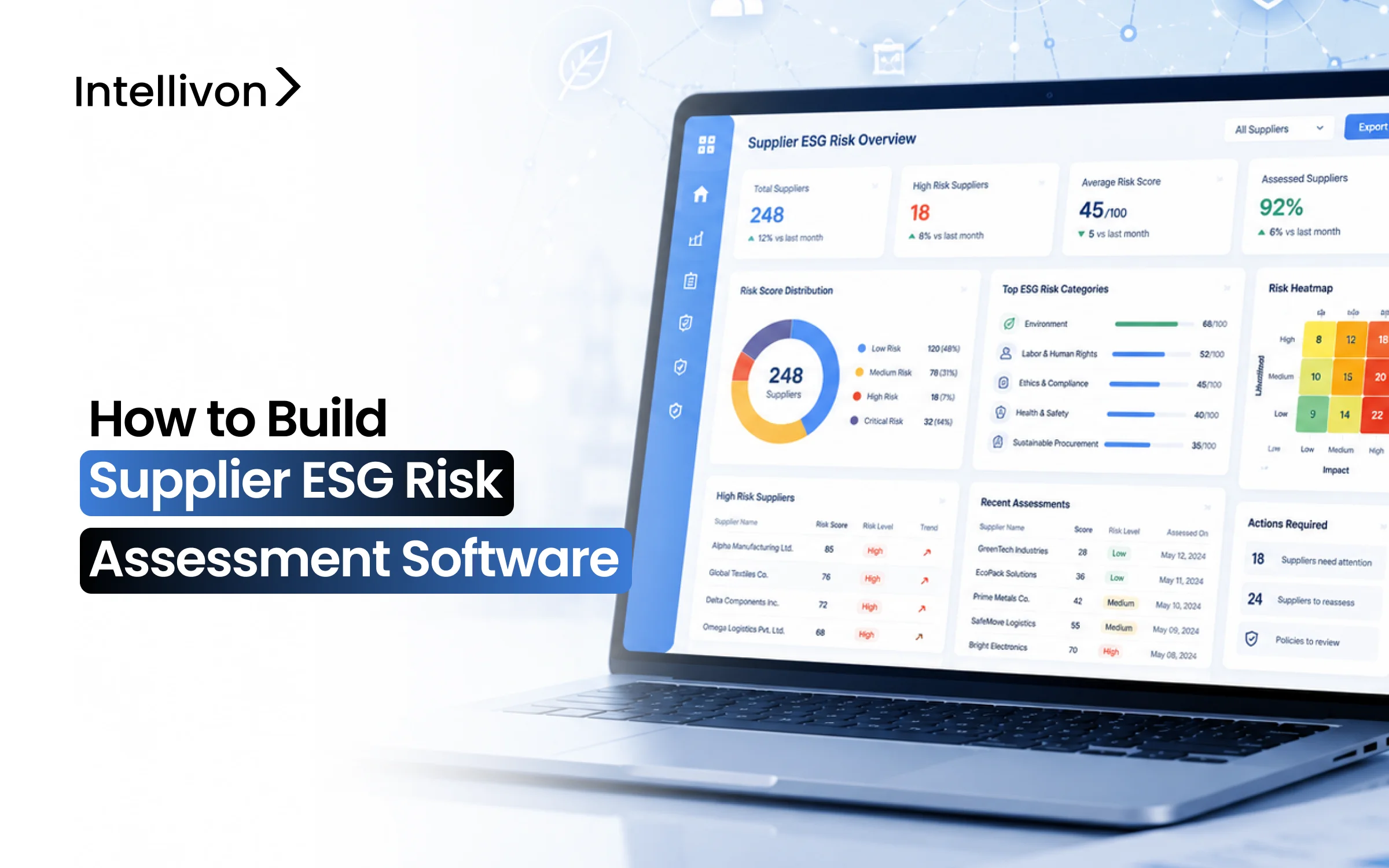
Building supplier ESG risk assessment software starts with the scoring methodology, and that methodology has to be dynamic rather than fixed. The platform collects supplier ESG data from questionnaires, third-party providers, and public disclosure sources, then normalizes it into a unified supplier taxonomy. From there, it applies risk scores that vary by supplier category, geography, and regulatory exposure, surfacing corrective action workflows and real-time controversy alerts.
This is where static platforms fall short. When a single scoring model is applied across all supplier types, the risk weights become uniform across every supplier. A Southeast Asian medical device manufacturer carries different regulatory exposure than a European logistics provider, yet a static model treats them identically. CSDDD carries fines of up to 5% of global annual turnover for non-compliance, making category-specific supplier risk scoring a legal requirement, not a design preference.
This blog draws from our experience of building such platforms and covers the full build from scoring architecture and third-party data integrations through AI model design, regulatory compliance mapping, and costs ranging from $70,000 to $300,000, leaving a clear blueprint to scope and commission this platform.
What Is Supplier ESG Risk Assessment Software?
Supplier ESG risk assessment software is a platform that helps enterprises collect and act on environmental and governance risks across their vendor base.
Therefore, it unifies supplier onboarding, automated questionnaires, third-party data feeds, and AI risk alerts into a single compliance workflow. This platform turns manual due diligence into a repeatable digital process.
What The Software Does
This software makes it easy to spot which suppliers are safe to work with and which ones pose a threat to your business.
- Gathers Data: It sends out and tracks digital forms to collect environmental and workplace data from suppliers automatically.
- Scores Risk: It grades every supplier from A to F based on their real sustainability practices.
- Tracks Evidence: It safely stores certificates and legal documents so companies can prove they checked their suppliers.
- Flags Danger: It alerts management the moment a supplier fails a safety rule or breaks a compliance law.
- Monitors News: It reads news articles across the internet to catch public scandals or environmental accidents instantly.
- Fixes Problems: It tracks step-by-step action plans to help suppliers clean up their acts when they fail an inspection.
- Shows Simple Dashboards: It builds clean visual charts so procurement, sustainability, and compliance teams can see their total risk at a glance.
Supplier ESG risk assessment software operates as an active risk management system rather than a static reporting tool. Supplier ESG software continuously evaluates external third-party risks across your entire vendor ecosystem to guide procurement decisions.
To get a deeper understanding of how ESG platforms work, check out our guide on How to Create A Sustainability Reporting Platform.
What Makes It Different From ESG Reporting Tools
Supplier ESG risk assessment software operates as an active risk management system rather than a static reporting tool. Supplier ESG software continuously evaluates external third-party risks across your entire vendor ecosystem to guide procurement decisions.
ESG Risk Assessment vs ESG Reporting Tools
| Feature | Internal ESG Reporting Tools | Supplier ESG Risk Software |
| Primary Focus | The enterprise’s own carbon footprint and internal policies. | External third-party vendor risks and supply chain vulnerabilities. |
| Core Function | Generates static annual reports for investors and regulators. | Powers an active operating system for day-to-day procurement. |
| Data Action | Aggregates historical data to hit disclosure targets. | Triggers real-time alerts to approve, audit, or block suppliers. |
Ultimately, this software serves as a supplier risk operating system that drives daily procurement, onboarding, and corrective workflows. It shifts your team from simply publishing historical compliance summaries to actively preventing multi-tier supply chain disruptions before they happen.
Before adopting this software, enterprises rely on a fragmented mix of spreadsheets, manual emails, annual questionnaires, and isolated third-party platforms. They collect static documents across scattered inboxes, using manual yes-or-no compliance checks that leave blind spots in the supply chain.
If you are still stuck in this phase, you might want to look into a supplier ESG risk assessment platform.
Use-Case Example:
A hospital buying surgical gloves uses this software to check labor risks, forced labor exposure, and emissions data before approval. Similarly, a fintech company can evaluate a KYC vendor’s data handling policies and adverse media signals. This establishes a clear operational understanding before diving into the underlying technical architecture.
Why Enterprises Need Supplier ESG Software
Enterprises deploy supplier ESG risk assessment software because reliance on manual vendor reviews creates systemic vulnerabilities.
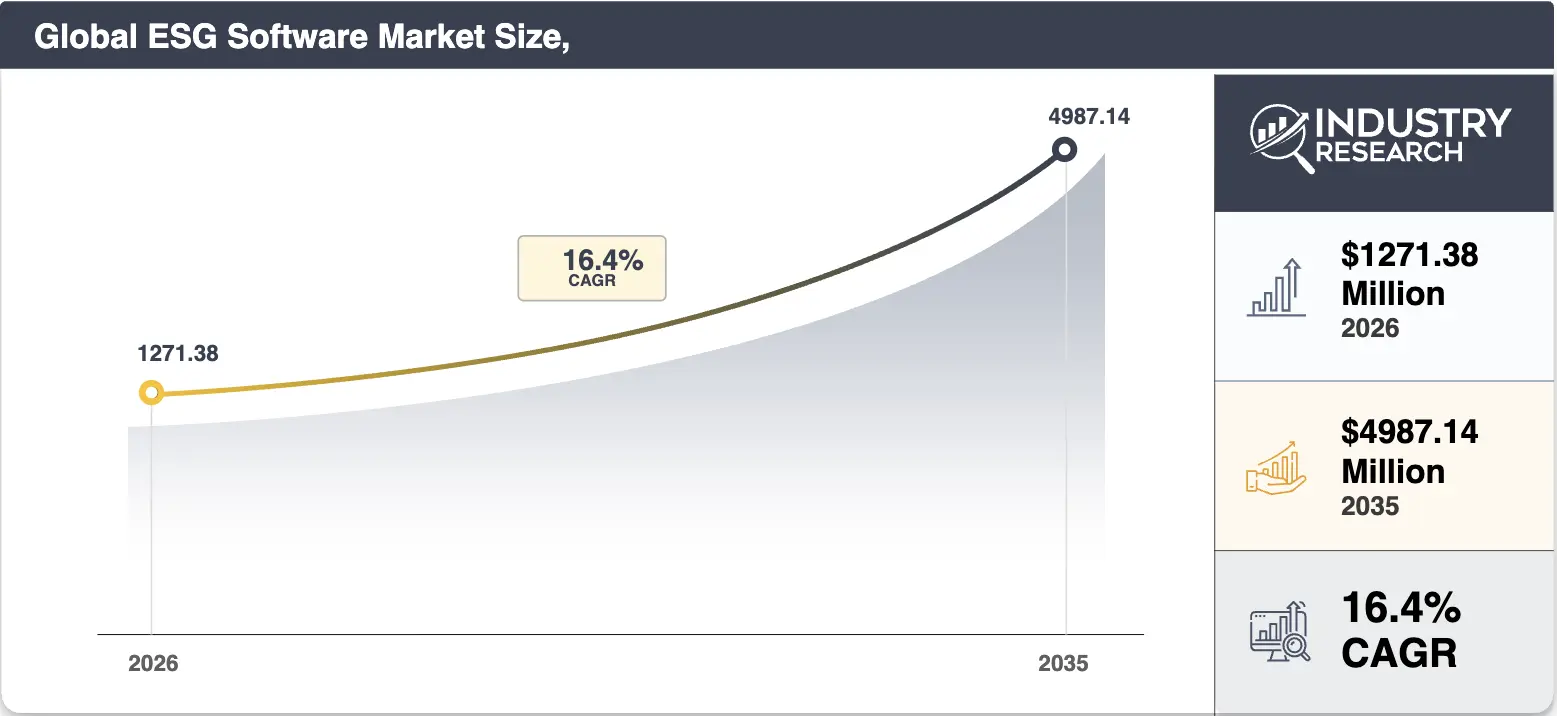
In fact, the global ESG software market size is growing quickly as companies automate their tracking. The industry is projected to grow from $1,271.38 million in 2026 to $1,479.89 million in 2027, according to data from Industry Research. Furthermore, this market is expected to reach $4,987.14 million by 2035. This represents a steady annual growth rate of 16.4% during the forecast period.
1. Manual Supplier Reviews Do Not Scale
Legacy vendor risk workflows slow down enterprise operations because evidence collections loop endlessly through scattered email inboxes.
- Procurement Bottlenecks: Vendor risk reviews frequently take longer than actual contract negotiations because documents move back and forth without clear criteria.
- Process Inefficiency: Industrial data from Tradeverifyd indicates that 69% of compliance and supply chain teams spend 11 or more hours each week entirely on manual data translation to standardize vendor formats for regulatory submissions.
- Supplier Fatigue: Suppliers face constant, repetitive evidence requests for the same certifications, while the enterprise mistakenly treats low-risk local vendors with the same scrutiny as high-risk global suppliers.
2. Regulations Now Reach Into Supply Chains
Modern regulatory frameworks legally bind global corporations to the environmental and human rights actions of their multi-tier vendors. This turns supply chain visibility into a strict legal mandate.
- Global Mandates: Enterprises must screen for intense global regulations like CSDDD, CSRD, UFLPA, the Modern Slavery Act, and the German Supply Chain Act.
- Compliance Checks: Platforms must handle continuous backend checks for conflict minerals, anti-bribery, and anti-corruption compliance.
- Evidence Mapping: Industrial data shows that while 93% of executives report high confidence in overall oversight, only 56% of organizations can actually trace material origins down to Tier-3 or Tier-4 sources to prove compliance.
3. Scope 3 Depends On Supplier Data
Corporate Scope 3 carbon accounting becomes highly vulnerable to regulatory audits and greenwashing lawsuits. This is because carbon footprints are calculated using generic, spend-based industry averages instead of verifiable, primary supplier data.
- Data Collection: Global data from Net0 indicates that Scope 3 accounts for roughly 75% of an average company’s total emissions, and over 90% in sectors like financial services and retail.
- Fallback Systems: The platform needs smart, spend-based fallback methods alongside primary data ingestion, yet a massive 62% of sustainability leaders cite internal data quality as a major hurdle.
- Quality Scoring: Every data point requires an automated quality score within the supplier carbon footprint assessment software to verify its accuracy.
Scope 3 reporting becomes incredibly weak and legally risky when supplier data is incomplete or built entirely on broad spend assumptions.
Automating data aggregation, compliance documentation, and risk scoring allows procurement and compliance executives to satisfy evolving global transparency laws. At the same time, they also protect production lines from unexpected, multi-tier vendor failures.
How To Tier Suppliers By ESG Risk Level
Supplier ESG tiering helps enterprises decide how much review each supplier needs by categorizing them based on spend, geographic origin, and operational criticality. At the same time, high-risk, high-spend, or heavily regulated vendors face deep, continuous evidence verification.
This structured separation prevents compliance reviews from slowing down procurement pipelines, keeping onboarding efficient for internal teams and vendors alike.
Tier-Wise Risk Supplier
| Risk Tier | Sourcing Attributes | Industry Examples | Required Evidence & Frequency |
| Tier 1: High Risk & Critical | High annual spend, single-source dependencies, high-risk geographic locations, direct patient or customer impact, heavy Scope 3 relevance. | Healthcare: PPE manufacturers, pharma API producers, medical device components.
Fintech: KYC vendors, cloud hosting providers, payment processors. |
Complete ESG questionnaires, validated compliance certificates, forced labor screening, real-time AI news monitoring. Updated annually. |
| Tier 2: Medium Risk | Moderate commercial spend, non-critical goods, standard regulatory exposure, generic operational importance. | Healthcare: Hospital cafeteria food service networks, environmental facility linen vendors.
Fintech: Office hardware suppliers, regional corporate travel services. |
Standard sustainability checklists, primary waste management tracking, basic carbon footprint data. Updated every 2 years. |
| Tier 3: Low Risk | Low annual spend, low operational criticality, minimal environmental or social regulatory exposure. | Healthcare / Fintech: Office stationery suppliers, local corporate training software SaaS, off-site corporate marketing agencies. | Basic ESG policy confirmation, automated global sanctions screening, instant adverse media flagging. Updated every 3 years or upon risk alert. |
Dividing your vendor base into clear risk tiers ensures that compliance resources are directed precisely where material exposure lives, saving time and money.
This structured framework keeps your procurement pipeline moving quickly while maintaining defensible, audit-ready compliance tracking across all operations.
To learn more about Scope 3 and how it works, check out our guide on How to Develop Scope 1, 2 & 3 Emissions Software.
How To See Beyond Tier 1 Suppliers
Enterprises need sub-tier visibility because critical carbon, forced labor, and conflict mineral risks hide deep within upstream supply chains. While companies know direct partners, a modern platform maps Tier-2 and Tier-3 vendors where material risk justifies the operational effort.
According to McKinsey, only 42% of supply chain leaders possess visibility past Tier-1 networks, creating dangerous operational blind spots.
- The Visibility Gap: Practitioners on supply chain forums confirm that organizations frequently lack data beyond direct vendors and a handful of large Tier-2 partners.
- Upstream Mapping: The software uses cascading requests to trace critical pharmaceutical ingredients, sterile medical packaging, and subcontracted fintech data centers to their real facility locations.
- Confidentiality Safeguards: Suppliers often resist sharing deep data due to competitive fears. The platform solves this with role-based access, letting vendors share verified risk scores without exposing private business relationships.
- AI Network Insights: Machine learning algorithms convert unstructured shipping registries, corporate ownership charts, and localized news into searchable network graphs to predictively flag UFLPA or environmental violations before they cause disruption.
Deep-tier mapping should start with high-risk vendor categories rather than your entire supply base to prevent supplier fatigue. Using privacy-safe, automated software to trace upstream layers satisfies modern transparency laws while protecting your production lines from hidden operational failures.
Where AI Fits In Supplier ESG Assessment
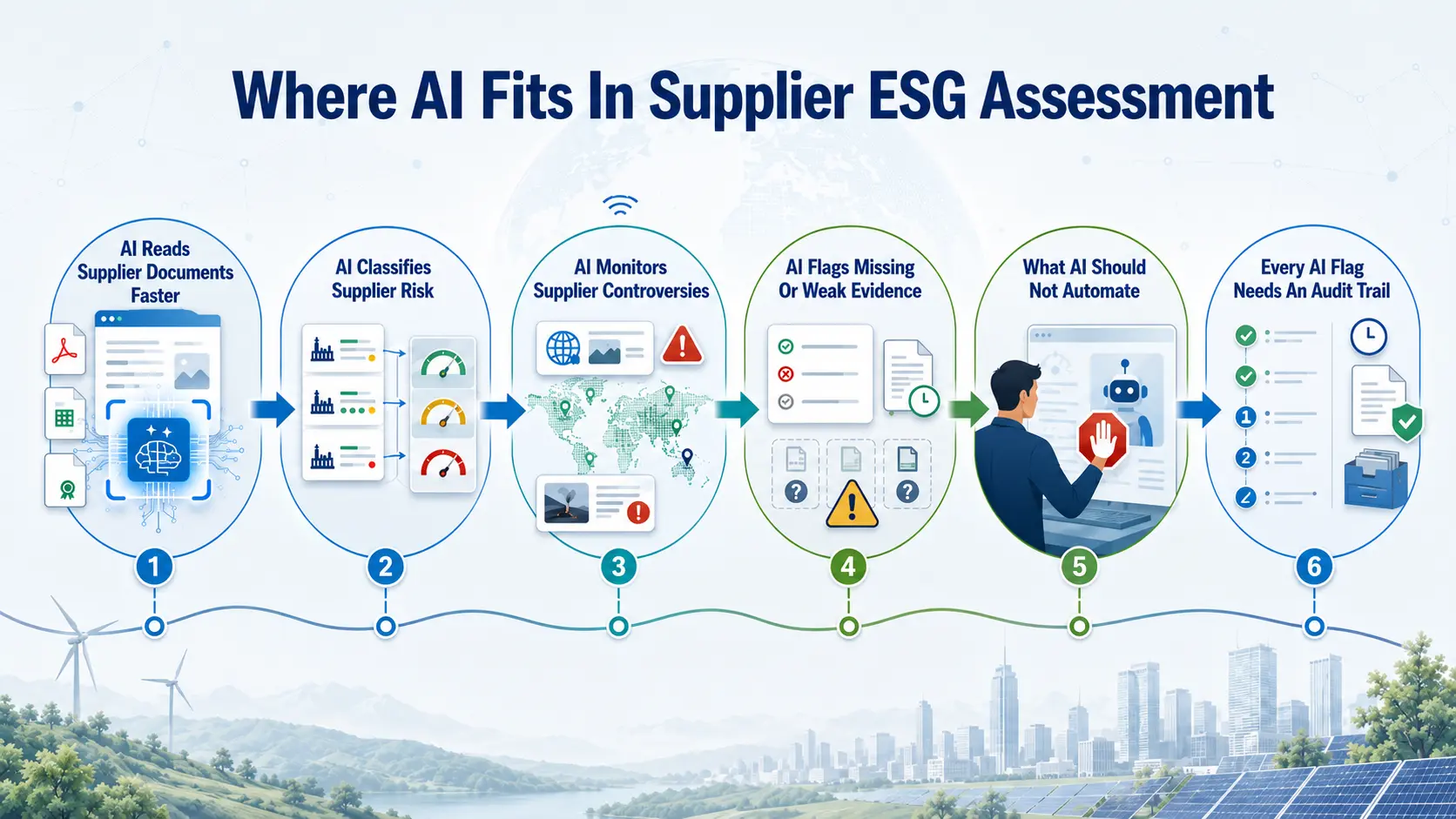
AI scales supplier ESG evaluation by automating data extraction and real-time risk classification.
According to IntegrityNext, AI tools perform best as decision-support frameworks to flag patterns across messy, unstructured data, allowing human procurement teams to maintain final strategic control.
1. AI Reads Supplier Documents Faster
The platform uses natural language processing (NLP) to read, structure, and verify qualitative corporate disclosures that would normally take hours to analyze manually.
- Automated Parsing: Machine learning models instantly scan long-form carbon disclosures, modern slavery reports, and conflict mineral certificates to extract specific operational insights.
- Context Verification: For instance, the system can parse a supplier’s human rights policy to check if it explicitly details worker grievance channels, subcontractor audits, and executive board approval.
2. AI Classifies Supplier Risk
The software processes parsed vendor documentation through machine learning classification models to predict dynamic risk tiers.
- Pattern Discovery: The system identifies subtle risk correlations by weighing localized country risk signals against historic performance anomalies and vendor spending volumes.
- Assisted Recommendations: Instead of silently changing vendor compliance status without human input, the system flags historical issues and suggests a risk tier for compliance teams to review.
3. AI Monitors Supplier Controversies
Continuous background monitoring changes your supply chain due diligence from a passive, once-a-year checklist into an active, protective security model.
- Media Tracking: Natural language algorithms process millions of global news sources, NGO data feeds, and local litigation registries in multiple languages.
- Real-Time Warnings: The platform immediately alerts internal risk owners if an onboarded supplier gets tied to a sudden environmental incident, factory safety violation, or corruption scandal.
4. AI Flags Missing Or Weak Evidence
The system acts as an automated quality gatekeeper, evaluating incoming data points to detect compliance gaps and unverified vendor sustainability claims.
- Inconsistency Checks: The platform instantly catches expired environmental certificates, conflicting survey answers, and weak, non-committal policy language.
- Data Boundary Flags: For example, if a Tier-1 supplier inputs greenhouse gas metrics but fails to declare the exact reporting boundaries or verification standard, the engine flags the record as weak data quality.
5. What AI Should Not Automate
Large companies cannot allow algorithms to run their supply chains autonomously because black-box sourcing decisions violate basic legal accountability.
- Human Override: Algorithms must never automatically reject suppliers, optimize purchasing entirely around price, or use a standalone ESG rating as an absolute binary filter.
- Explainable Logic: According to data-privacy research from TrustArc, high-risk compliance decisions demand absolute explainability under modern laws, meaning your procurement professionals need full visibility into why an AI ranked a supplier a certain way.
6. Every AI Flag Needs An Audit Trail
To survive strict corporate regulatory audits, every automated risk flag and recommendation must be backed by a clear, immutable history trail.
- Verification Data: The platform automatically logs the exact model version, prompt parameters, source document passages, and risk confidence scores behind every alert.
- Human Log: It records the final decision made by the human reviewer, documenting the date, time, and specific operational reasons why an automated flag was approved or overridden.
Integrating AI into your sustainability due diligence makes compliance checks dramatically faster and cleaner without turning your system into an unexplainable black box.
To know more about carbon tracking software, read our blog on What Does It Cost to Develop Carbon Tracking Software in 2026?
Main Use Cases For Supplier ESG Software
Supplier ESG software creates corporate value when it solves specific, compliance-driven vendor risk workflows. At the same time, healthcare, pharmaceutical, medical device, and fintech organizations require completely distinct risk lenses to manage their respective supply chains.
Rather than forcing every department into a single, generic questionnaire template, custom software structures specialized modules to address sector-specific liabilities.
1. Healthcare Supplier Risk Screening
Hospital networks deploy this module to screen massive vendor ecosystems without delaying urgent clinical procurement.
- The Exposure: Large hospital systems like Cardinal Health expand supply chain due diligence specifically to manage multi-tier human rights compliance, sterile waste handling, and PPE origin verification.
- The Workflow: The system screens suppliers of single-use medical goods for forced labor risks, packaging waste footprints, and environmental non-compliance before clearing them for Group Purchasing Organization (GPO) inclusion.
2. Pharma Supplier ESG Compliance
Pharmaceutical manufacturing demands rigorous facility-level auditing to satisfy strict global environmental and human rights regulations.
- The Exposure: Leading global manufacturers like Cipla must ensure their active pharmaceutical ingredient (API) providers maintain Zero Liquid Discharge (ZLD) status and strict environmental permits to mitigate brand and legal liability.
- The Workflow: The software digitizes on-site ESG audit workflows and manages automated corrective action plans when an API or cold-chain logistics partner fails a carbon emissions or labor rights screening.
3. Medical Device Supplier Screening
This module establishes absolute hardware component traceability across complex, multi-tiered electronics and raw material networks.
- The Exposure: Medical device companies face heavy regulatory fines unless they can trace hardware components back to conflict-mineral and UFLPA-compliant smelters.
- The Workflow: The system automatically maps lower-tier electronic sub-assemblies, validating supplier ethics and code of conduct compliance to insulate the enterprise from regulatory border seizures.
4. Fintech Vendor ESG Due Diligence
Financial services firms require a specialized framework to embed ESG metrics directly into traditional Third-Party Risk Management (TPRM) models.
- The Exposure: Institutional firms like Goldman Sachs use advanced modeling tools to track ESG variables across their vast networks of data processors and cloud providers.
- The Workflow: The platform pairs traditional cybersecurity vetting with vendor governance reviews, scanning for data-privacy handling, subcontractor ethics, and country-level political exposures.
5. Scope 3 Supplier Emissions Tracking
This module replaces broad, spend-based carbon footprint estimates with direct, verifiable greenhouse gas (GHG) data collected directly from vendors.
- The Exposure: Enterprises use this framework because indirect supply chain emissions represent the vast majority of their total carbon footprint, leaving them open to greenwashing lawsuits if their data is unverified.
- The Workflow: The system calculates a dynamic data quality score for every uploaded carbon record, automatically applying spend-based or hybrid method fallbacks when primary data is missing.
Specialized use cases demonstrate why generic reporting tools fail inside heavily regulated supply environments. Therefore, deploying tailored modules for your specific industry challenges ensures that your risk, procurement, and sustainability teams can act on highly precise, audit-ready vendor data.
What Evidence The Platform Must Collect
Supplier ESG software works by linking raw vendor files directly to specific compliance laws and human review notes. This creates an unalterable, audit-ready paper trail for every procurement decision.
This structured approach guarantees that every sourcing decision made across your procurement network is completely backed by unalterable, audit-ready data.
1. Evidence For CSDDD Due Diligence
The platform maintains comprehensive operational records to satisfy the strict human rights and environmental chain-of-custody requirements. These are mandated by the EU Corporate Sustainability Due Diligence Directive.
- Database Core Fields: The system automatically logs the supplier risk type, linked evidence files, assigned reviewer, current status, action owner, deadline, and final mitigation outcome.
- Engagement Records: It maps complete engagement histories, including documented supplier corrective action plans.
2. Evidence For CSRD Reporting
The database organizes multi-tier value chain insights to align directly with European Sustainability Reporting Standards (ESRS).
- Reporting Inputs: The system collects direct supplier ESG records, multi-tier value chain data, and raw Scope 3 greenhouse gas carbon metrics.
- Smart Mapping: To optimize performance, the data architecture maps a single supplier data point to multiple reporting needs simultaneously.
3. Evidence For UFLPA Screening
To protect supply chains from border seizures, the platform aggregates granular raw material traceability profiles and facility-level data.
- Traceability Records: The software captures exact country-of-origin logs, entity list screening histories, and beneficial supplier ownership structures.
- Import Logs: It matches real-time import documentation and facility geographic coordinates against global watchlists. This instantly archives forced labor risk flags and active vendor remediation evidence.
4. Evidence For Modern Slavery Reviews
The system tracks corporate workplace compliance metrics to fulfill regional regulatory reporting under global Modern Slavery Acts.
- Workplace Metrics: It requires suppliers to submit formal labor policies, modern slavery statements, and verified worker grievance channel data.
- Verification Proof: The software verifies employee training records, third-party audit findings, and professional compliance certificates.
5. Evidence For Conflict Minerals Checks
The platform builds a transparent, unalterable chain of custody for heavily regulated minerals including tin, tungsten, tantalum, and gold (3TG).
- Smelter Auditing: The module captures standardized supplier declarations and maps them directly against global certified smelter databases.
- Origin Mapping: It archives verifiable country-of-origin evidence and multi-tier chain-of-custody transactions to isolate unverified or high-risk mineral sources automatically.
6. Evidence For Governance And Ethics Risk
The software tracks core corporate governance behaviors to safeguard the enterprise against operational fraud and legal liabilities.
- Ethics Vetting: The platform runs automated screening for anti-bribery policies, corporate codes of conduct, and live global sanctions updates.
- Risk Modeling: It logs active litigation records, beneficial ownership data, and whistleblower policies to calculate a unified, dynamic corruption risk score.
Compliance workflows must be built around strict evidence mapping rather than superficial legal check-boxes. Therefore, tying every supplier document directly to an active risk rule, regulatory obligation, and human decision ensures your global supply chain stands up to rigorous legal audits.
Core Features Of The Platform To Build First
The initial build of your supplier ESG risk assessment software must establish a reliable data model and core scoring logic before layering on advanced automation. By focusing first on vendor data collection portals, risk scorecards, auditable evidence libraries, and corrective action workflows, you build an operational foundation that solves immediate compliance needs.
This phase delivers high business value while keeping early software architecture clean, predictable, and fully scalable.
Core Features Of The Platform
| Core Component | Key Technical Capabilities | Operational Value For Teams |
| Supplier Data Portal | Self-service vendor profiles, automated multi-language ESG questionnaires, secure evidence file uploads, tracking systems. | Eliminates manual email chains by allowing vendors to directly submit and update their sustainability records in a centralized portal. |
| Supplier Risk Scorecard | Individual environmental, social, governance, and compliance rating calculations combined with country risk matrices. | Converts messy, qualitative vendor disclosures into a single, standardized numerical grade that procurement teams can understand instantly. |
| Supplier Tiering Engine | Rule-based sorting for critical, high, medium, and low-risk categories with automated tier suggestions. | Prevents operational bottlenecks by matching the depth of compliance screening to the actual risk exposure of the vendor. |
| Supplier Risk Dashboard | Prioritized high-risk supplier lists, supply chain ESG risk heat map visualization, spend exposure cross-referencing, and geographic maps. | Gives compliance, sustainability, and procurement executives a macro-level view of systemic supply chain vulnerabilities in a single screen. |
| Corrective Action Workflow | Issue assignment fields, structured supplier remediation plan tracking, evidence resubmission portals, internal reviewer approvals, and automated procurement escalation rules. | Moves compliance teams from passive risk identification to active risk mitigation, tracking vendor improvements directly inside the software. |
| Compliance Evidence Library | Document-to-regulation mapping modules (covering CSDDD, CSRD, UFLPA, and Modern Slavery Acts) alongside immutable system audit trails. | Protects the enterprise during formal corporate audits by anchoring every vendor file directly to a regulatory requirement and human sign-off. |
| AI Risk Alert Module | Continuous open-source news scraping, adverse media tracking, supplier controversy monitoring, automated data gap flags, and confidence ratings. | Transforms due diligence from an outdated annual checklist into a continuous, proactive security system that detects vendor violations in real-time. |
Focusing your initial development on these core modules creates a practical Minimum Viable Product (MVP) that handles daily procurement decisions without overcomplicating your early technology stack. Once this data foundation is stable, your engineering teams can safely introduce advanced AI modeling and multi-tier supplier network mapping.
Now that the core software features are established, the next critical step is understanding the technical data architecture and third-party integrations needed to feed this system.
Build The ESG Supplier Risk Platform In Clear Phases
Building an enterprise-grade supplier ESG platform in controlled phases allows organizations to manage investment risk, align cross-functional stakeholders, and ensure smooth supplier adoption. Therefore, rushing straight into complex AI models before stabilizing your core data architecture leads to fractured workflows and unreliable risk ratings.
Executing development sequentially ensures that every layer of automation is anchored to a stable, defensible logic engine.
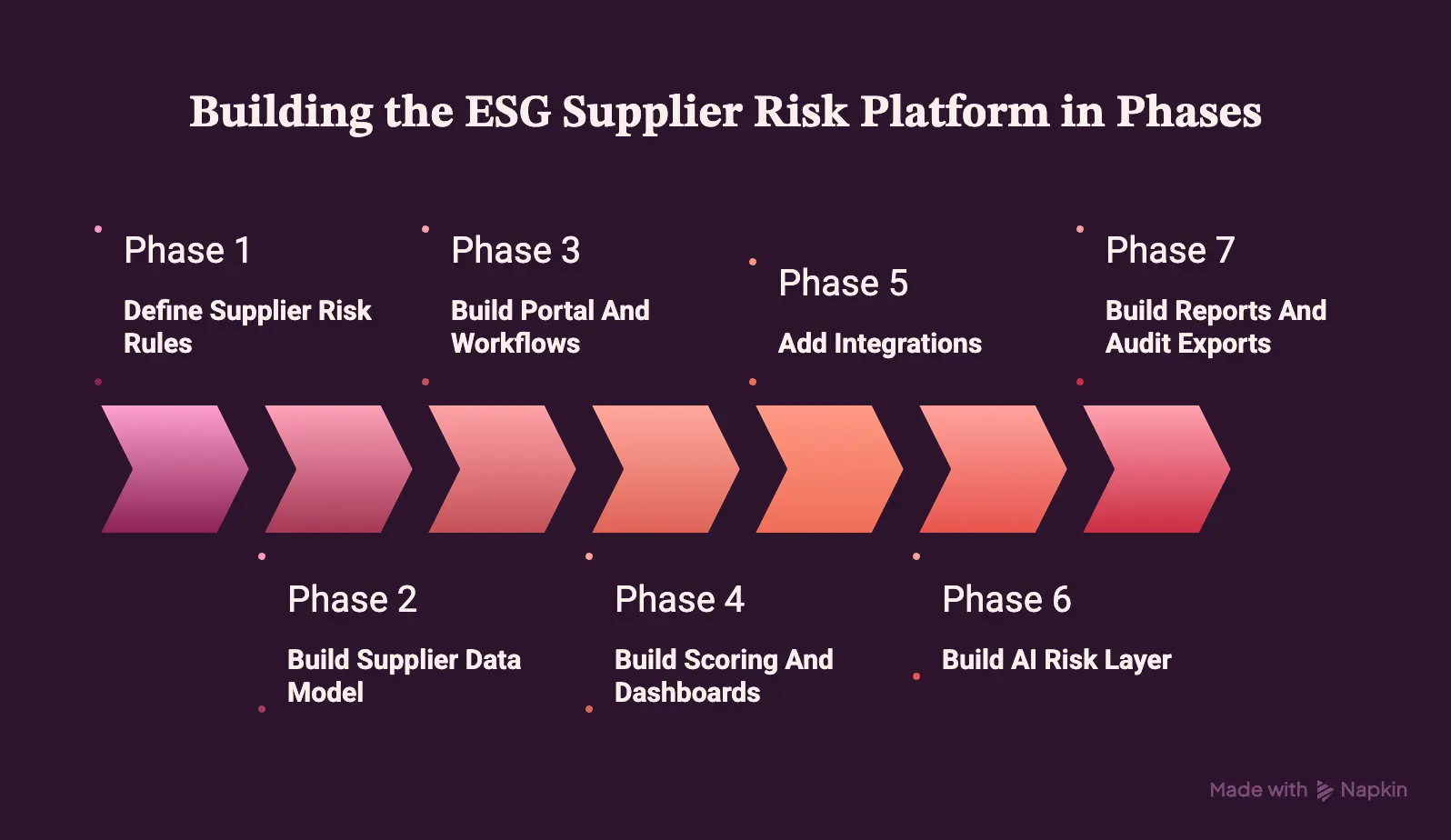
Phase 1: Define Supplier Risk Rules
Before writing any software code, compliance and procurement leaders must explicitly standardize the foundational rules that govern risk calculation across the entire supply chain.
This phase maps distinct supplier product categories, specific environmental and labor criteria, distinct risk weights, and strict tiering parameters. It also hard-codes clear internal review owners, approval rules, and escalation paths for non-compliant vendors.
Phase 2: Build Supplier Data Model
The data model serves as the structural skeleton of the platform, organizing how information flows across various corporate divisions.
At the same time, engineers establish relational database models to track master profiles, parent-child corporate entities, specific facility locations, product categories, annual spend figures, and sub-tier supplier connections.
Phase 3: Build Portal And Workflows
This phase translates your data models and compliance rules into a functional web application where suppliers and internal teams interact.
Development focuses on deploying the self-service supplier portal, an automated questionnaire engine, a secure file upload module, the internal reviewer queue, and automated vendor notifications.
Phase 4: Build Scoring And Dashboards
With the workflow capturing clean data, the platform begins calculating real-time risk scores and visualizing supply chain vulnerabilities.
Developers write the algorithms to compute weighted environmental, social, governance, and data quality scores, feeding this data into supply chain ESG risk heat maps and specialized role-based dashboards.
Phase 5: Add Integrations
Connecting the software to your existing corporate technology stack turns the platform from an isolated portal into a central risk operating system.
Engineering teams build secure API connections linking the platform to internal ERPs, procurement systems, external ESG data providers (like EcoVadis or Sustainalytics), and dedicated carbon accounting tools.
Phase 6: Build AI Risk Layer
With an integrated data pipeline running smoothly, artificial intelligence can now be safely introduced to automate document parsing and continuous media tracking.
This phase layers on natural language processing (NLP) for automated disclosure extraction, real-time controversy monitoring, sentiment alerts, and an MLOps framework to track model behavior.
Phase 7: Build Reports And Audit Exports
The final development phase focuses on generating comprehensive compliance packages that prove your organization has met its supply chain due diligence obligations.
Developers construct automated export engines that package supplier evidence, generate CSRD data sheets, produce CSDDD due diligence summaries, and compile UFLPA screening logs.
A phased build sequence ensures your enterprise never overspends on advanced features before verifying the reliability of your underlying supplier data. Establishing a rock-solid workflow foundation allows you to introduce high-value AI models seamlessly once your platform handles decision-grade data.
Supplier ESG Software Development Cost
A custom platform typically costs $70,000 to $300,000 to develop, depending on your supplier volume, integration requirements, and AI infrastructure depth. A focused Minimum Viable Product (MVP) handles core vendor portals and basic compliance checks at the lower end of the spectrum.
Conversely, an enterprise-tier deployment featuring live third-party data integrations and automated artificial intelligence news extraction scales toward the higher end of the range.
Development Cost Breakdown by Engineering Phase
Building this system requires structured development phases, with specific budgets allocated to data modeling, interface design, and algorithmic screening tools.
1. Cost Table
| Development Phase | Concrete Deliverables & Scope | Estimated Budget Range |
| Discovery & Risk Rules | Standardizing supplier risk taxonomy, categorization logic, weight distributions, and compliance scope matrices. | $8,000 – $18,000 |
| Data Architecture | Designing flexible supplier data models, parent-child corporate entity mapping, and evidence schemas. | $10,000 – $24,000 |
| Supplier Portal | Self-service portal builds, secure multi-language questionnaire flows, upload fields, and automated email reminders. | $14,000 – $34,000 |
| Scoring Engine | Writing weighted rating algorithms across environmental, social, governance, and data quality metrics. | $16,000 – $42,000 |
| AI Risk Layer | Integrating natural language processing (NLP) models, continuous open-source media scraping, and alert modules. | $18,000 – $48,000 |
| Integrations | Building API pathways to connect your master data with ERPs, procurement systems, and carbon accounting software. | $18,000 – $55,000 |
| Dashboards & Reports | Engineering supply chain ESG risk heat map visualizations, role-based dashboards, and audit-ready exports. | $12,000 – $30,000 |
| Security & DevOps | Hard-coding role-based access control (RBAC), end-to-end data encryption, audit trails, and secure deployment pipelines. | $14,000 – $37,000 |
2. Ongoing Maintenance Commitments
Running an enterprise-tier risk system demands consistent technical upkeep, typically averaging 15% to 25% of your original software build cost annually.
- Engineering Upkeep: This operational budget maintains stable API configurations when external procurement tools or global ERP endpoints push software updates.
- Model & Content Drift: Continuous maintenance covers regular machine learning model evaluation, security patching, and data normalization adjustments as evolving global supply regulations (such as CSDDD or CSRD updates) dictate new legal evidence parameters.
Build Supplier ESG Risk Assessment Software With Intellivon
Intellivon helps enterprises build supplier ESG risk assessment platforms that connect supplier data, ESG evidence, compliance workflows, and procurement decisions into one governed system.
The team designs custom platforms for healthcare, fintech, pharma, medtech, banks, insurers, and large supply chain teams that need more than standard supplier sustainability software.
- Supplier ESG risk architecture planning
- Supplier data portal and evidence workflow development
- ESG scoring and supplier risk tiering engine design
- Scope 3 supplier emissions data workflow development
- AI supplier document review and controversy monitoring
- CSDDD, CSRD, UFLPA, Modern Slavery Act, and conflict minerals mapping
- ERP, procurement, ESG data provider, and TPRM integration planning
- Audit trails, RBAC, SSO, data lineage, and MLOps controls
Plan Your Supplier ESG Risk Software Architecture With Intellivon by booking a free consultation call with us.
Conclusion
Supplier ESG risk assessment software helps enterprises move from scattered supplier documents to more defensible decisions. Moreover, it strengthens compliance, Scope 3 reporting, supplier accountability, and procurement confidence.
Therefore, by starting with data, scoring, AI review, and evidence workflows, teams can build a system that scales responsibly.
FAQs
Q1. How do companies collect ESG data from suppliers?
A1. Companies collect supplier ESG data through questionnaires and procurement system records. However, scattered collection quickly becomes hard to manage. Therefore, the software should centralize emissions data, policies, certificates, reminders, review status, and supplier risk scores in one controlled, searchable, and audit-ready workflow for compliance.
Q2. Why do supplier risk reviews take so long?
A2. Supplier risk reviews take so long when every vendor gets the same questions, and reviewers lack clear scoring rules. Moreover, documents often sit across emails and spreadsheets. Therefore, supplier ESG software should standardize requirements, reuse evidence, assign owners, and route suppliers by risk tier for faster approvals.
Q3. How should supplier ESG software reduce review delays?
A3. Supplier ESG software reduces review delays by separating low-risk, medium-risk, and high-risk suppliers. As a result, low-risk vendors complete shorter checks and operational review. Additionally, automated reminders, and clear approvals keep onboarding moving without weakening governance or audit readiness later.
Q4. Can AI help with supplier due diligence?
A4. Yes, AI can support supplier due diligence by reading documents, summarizing policies, and flagging risk changes. However, it should not approve or reject suppliers alone. Instead, AI should prioritize review, explain each flag, and leave final decisions to trained human reviewers with documented reasoning.
Q5. How do you know if a new supplier is reliable?
A5. A new supplier is reliable when its claims, documents, and early performance all support the same risk picture. Therefore, teams should combine RFQs, reference checks, audits, legal searches, small test orders, ESG evidence, and ongoing monitoring before approving long-term supplier relationships or larger contracts later.