Key Takeaways:
-
AI contract management platforms handle intake, drafting, clause review, approvals, obligation tracking, and renewal alerts.
-
NLP extraction, LLM-powered drafting, RAG-based clause retrieval, and fallback playbooks are core AI requirements.
-
DocuSign or Adobe Sign APIs, ERP integrations, RBAC, audit logs, and MLOps ensure production-grade operations.
-
Focused MVPs cost $70,000 to $120,000 while regulated enterprise platforms reach $180,000 to $300,000.
-
How Intellivon builds AI contract management as production infrastructure for healthcare, fintech, and legaltech teams.
Managing contracts across legal, procurement, and compliance simultaneously creates a data fragmentation problem. AI contract management software development solves it through a dual-layer model architecture. One layer handles contract drafting with a generative LLM, while the other extracts obligations with a purpose-built NLP model. Together, both layers connect through a shared contract data model to automate the full lifecycle.
Without separating these two AI layers from day one, the platform cannot prevent the revenue leakage it was built to address. When a single model handles both tasks, it predicts language rather than identifying specific legal obligations. WorldCC’s 2025 research found that businesses lose almost 9% of annual revenue through contract mismanagement. Therefore, separating the AI layers and connecting them through a shared data model is what closes that gap entirely.
Intellivon has over a decade of experience building compliance-grade AI platforms for healthcare and financial services. Our approach is always to design the contract intelligence data model before any AI model training begins. This blog covers LLM architecture, NLP model design, risk scoring, and HIPAA compliance.
What is AI Contract Management Software?
AI contract management software is an enterprise platform that uses artificial intelligence, natural language processing, and LLMs to automate the entire lifecycle of a legal agreement. The software automatically extracts data, drafts clauses, tracks obligations, and reviews risks.
Instead of relying on manual legal operations, it transforms static text documents into searchable, structured data assets for enterprise systems.
What Does An AI Contract Management Software Do?
An AI contract management software platform converts static text documents into dynamic operational data. At the same time, it accomplishes this by extracting key metadata, tracking milestones, and bridging the gap between drafting and post-signature execution.
The system provides a single, legally governed record that aligns legal, procurement, and finance teams around shared obligations.
These specialized contract intelligence platforms deliver value across several core operational capabilities:
- Operationalizing Data: The system automatically handles contract classification and entity extraction. It tags metadata, isolates specific clauses, and tracks hidden obligations.
- Workflow Integration: It connects pre-signature tasks like intake, template selection, and clause library management directly to post-signature execution. This covers automated redlining, approvals, e-signature routing, and searchable repository archiving.
- Cross-Department Governance: Legal operations, procurement, finance, and compliance teams work from the same live document. This unified access simplifies SLA monitoring, triggers renewal alerts, and automates contract performance tracking across the enterprise.
Custom AI contract software transforms static legal text into a structured, searchable data asset. This unifies pre- and post-signature workflows across legal, finance, and procurement teams.
Why Regulated Enterprises Need Contract AI Infrastructure Now
Regulated enterprises need AI contract infrastructure because contract risk now directly impacts operational resilience, compliance, and financial health. A legal document is no longer a static piece of paper; it is a critical corporate data asset.
The global contract lifecycle management AI market reached a valuation of $2.8 billion in 2025 and is projected to scale to $12.5 billion by 2033. According to a 2026 industry analysis by Dataintelo, this expansion represents a strong compound annual growth rate (CAGR) of 18.3%.
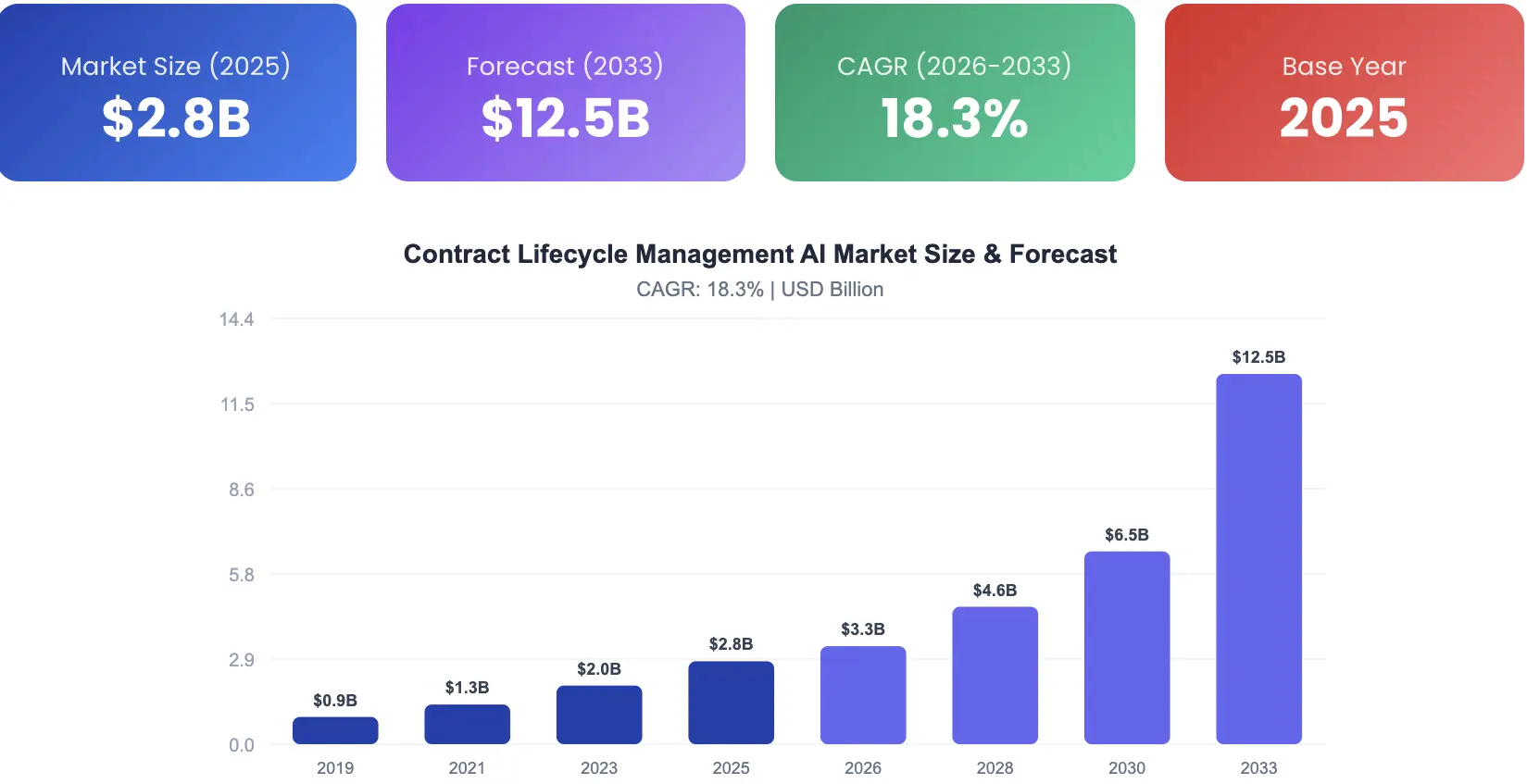
This rapid market acceleration is driven primarily by escalating regulatory compliance burdens, systemic revenue leakage, and the widespread enterprise transition from traditional document storage to automated, intelligent contract processing infrastructure.
Therefore, an enterprise platform must capture and track clauses, milestones, financial obligations, and compliance lineages across every transaction.
1. Contract Value Leakage Is A Board-Level Problem
Financial leakage from unmonitored agreements directly harms the bottom line. According to research by the World Commerce & Contracting Association (WorldCC), companies lose an average of 8.6% of their contract value due to poor post-award contract management.
- Missed Deadlines: Unmonitored renewals trigger auto-extensions with unfavorable pricing.
- Overlooked Escalators: Inflation adjustments go unbilled, shrinking project profit margins.
- Unclaimed Rebates: Volume-based supplier discounts remain completely untouched.
Custom AI contract management software development plugs these gaps by extracting these hidden parameters and putting them on automated execution schedules.
2. Agreement Workflows Still Waste Too Much Time
Legacy review cycles introduce major operational friction before negotiation even starts. A global study by Deloitte and DocuSign reveals that disconnected workflows waste over 55 billion hours globally every year.
- Too Many Handoffs: Contracts average 15 internal handoffs prior to client receipt.
- Manual Bottlenecks: Legal professionals spend hours searching for missing templates.
- Slower Turnaround: Administrative drag delays enterprise revenue recognition by several weeks.
This administrative friction stalls deals, increases labor costs, and keeps your legal team buried in routine paperwork instead of focusing on high-value advocacy.
3. Generic CLM Breaks In Healthcare And Fintech
Off-the-shelf contract lifecycle management platforms fail to handle highly specialized, regulated variables.
For a deeper breakdown of procurement workflow architecture, see our guide on AI procurement platform development.
- Compliance blindspots: Standard platforms cannot validate complex HIPAA business associate agreement management details.
- Regulatory failures: Systems lack specific fields for DORA operational resilience requirements.
- Data isolation: Off-the-shelf tools fail to integrate cleanly with legacy healthcare EHR systems.
Healthcare platforms must parse HIPAA Business Associate Agreements (BAAs), Group Purchasing Organization (GPO) schedules, and complex clinical trial agreements.
Fintech systems require real-time processing for ISDA Master Agreements and strict compliance with Digital Operational Resilience Act (DORA) operational limits.
Generic software cannot natively tag these industry-specific schemas without expensive, fragile workarounds.
Relying on manual oversight or generic software leaks substantial contract value and exposes highly regulated enterprises to compliance penalties. Building dedicated contract AI infrastructure protects your revenue and automates sector-specific regulatory guardrails.
Why Contract Intelligence Matters In Regulated Enterprises
Regulated enterprises need AI contract intelligence because contracts carry layered compliance, financial, and operational risks that directly impact organizational resilience. Consequently, when critical agreement metadata remains trapped inside static text files, companies face compounding financial penalties and missed milestones.
Therefore, an intelligent platform transforms these legal documents into operationalized data streams to prevent revenue leakage, protect supply chains, and surface real-time compliance tracking.
1. Contract Value Leakage Creates A CFO-Level Problem
Financial degradation from unmonitored agreements presents a severe threat to corporate profitability.
Specifically, enterprise research from the World Commerce & Contracting Association (WorldCC) demonstrates that corporations lose an average of 9.2% of their annual revenue strictly to poor post-signature contract management.
- Missed Rebates: Volume-based pricing tiers pass completely unnoticed by financial teams.
- Supplier Penalties: Service level breaches lack systematic enforcement mechanisms.
- Auto-Renewals: Unfavorable contracts extend automatically because termination windows pass unmonitored.
Subsequently, custom AI contract management software development plugs these financial drains by using natural language processing to extract financial triggers, mapping them directly to enterprise billing systems.
2. Agreement Workflows Waste Time Before Signing Even Starts
Administrative inertia significantly delays revenue recognition and partner onboarding. Furthermore, joint industry research from Deloitte and DocuSign reveals that disconnected workflows force teams to spend up to 18% extra time managing administrative agreement overhead.
- Excessive Handoffs: Contracts pass through an average of 15 internal hands before reaching a counterparty.
- Manual Redlining: Lawyers spend hours rewriting standard boilerplate terms from scratch.
- Version Chaos: Inconsistent drafts spread across disconnected email threads, halting progress.
As a result, by deploying custom automated workflows, enterprises cut out manual intervention, moving documents rapidly from intake through multi-party negotiation and final e-signature routing.
3. The CLM Market Is Growing Because Contracts Are Becoming Data
The rapid global transition from paper archives to operational data frameworks is driving significant technology investments. Accordingly, market analysis by Grand View Research shows the global contract lifecycle management software market was valued at $1.62 billion in 2024 and is projected to reach $3.24 billion by 2030, growing at a steady CAGR of 12.7%.
- Data Extraction: Algorithms structure legacy document archives into organized metadata fields.
- Audit Lineage: Systems track every alteration, user permission change, and approval step.
- Platform Scalability: High-speed indexing engines support instantaneous portfolio-wide searching.
Therefore, this strong commercial growth emphasizes a structural market shift away from passive cloud storage repositories toward proactive, AI-driven transaction management infrastructure.
4. Healthcare And Fintech Contracts Need More Than Generic CLM
Standard, off-the-shelf contract tools lack the domain-specific logic needed to handle highly complex, regulated legal agreements.
- Healthcare Schemas: Tools must automatically manage HIPAA Business Associate Agreements, clinical trial agreements, and GPO purchasing schedules.
- Fintech Standards: Platforms require deep classification fields to monitor complex ISDA Master Agreements and strict lending portfolios.
- Regulatory Shifting: Systems need built-in compliance monitoring for moving targets like DORA, GDPR, and FDA guidelines.
Consequently, custom development ensures your platform natively reads, extracts, and validates these exact industry clauses without requiring brittle, expensive manual adjustments.
Moving beyond basic document storage to a data-centric AI platform protects enterprise margins and eliminates manual cycle times. Ultimately, tailoring this system to specific healthcare and financial data schemas ensures complete compliance in heavily scrutinized markets.
The AI Contract Management Platform Architecture Blueprint
An enterprise AI contract management platform architecture relies on an integrated multi-tier framework that safely transforms legal text into structured data streams. Consequently, the blueprint decouples heavy ingestion services from live large language model computation to maintain strict uptime and security.
By partitioning the system into distinct operational modules, engineering teams ensure high-speed processing, absolute version lineage, and explainable compliance governance across all business units.
Enterprise Core Architecture Specifications
| Architecture Layer | Core Microservices & Components | Primary Data Schema & AI Models | Technical Integration Points |
| Contract Repository & Version Control | Automated contract repository management, version delta engines, amendment linking, document lineage trackers. | Normalization schemas, JSON metadata stores, immutable file trees. | Amazon S3 bucket stores, local database cluster webhooks. |
| Document Intelligence & Ingestion | Scanned contract processing, advanced OCR engines, DOCX parsers, PDF layout extraction. | LayoutLMv3, custom PyTorch models, text bounding arrays. | Tesseract OCR clusters, custom cloud document parsing APIs. |
| Clause Library & Playbook Automation | Contract template library management software, fallback clause engines, and position validators. | Domain-specific taxonomy trees, legal playbook policy JSONs. | Internal legal front door, legal operations UI dashboards. |
| AI Review, Redlining, & Risk Assessment | LLM-powered contract clause analysis, risk scoring, counterparty risk assessment, anomaly detectors. | Fine-tuned Llama-3-70B, custom embedding layers, XGBoost risk arrays. | Real-time redlining collaboration software webhooks. |
| Workflow, Approval, & Collaboration | Contract collaboration workflow automation, approval gates, multi-party negotiation engines. | State-machine event graphs, RBAC permission vectors. | Corporate IAM platforms, legal front door intake queues. |
| Integration & Enterprise Event Layer | Contract management microservices architecture, ERP data synchronizers, CRM sync nodes. | Bidirectional enterprise schemas, XML transaction envelopes. | DocuSign API, Adobe Sign API, SAP, Oracle, Salesforce. |
| Governance, Audit, & MLOps Pipeline | Zero-trust contract management platform security, MLOps contract AI model pipelines, drift monitors. | Strict cryptographic SHA-256 logs, weights, prompt arrays. | SIEM platform clusters, secure vector databases. |
A modern AI contract management platform relies on a decoupled, microservices-driven architecture to scale safely.
By anchoring ingestion, review, and integration within a zero-trust governance framework, enterprises convert liabilities into predictable, structured data assets.
For a deeper breakdown of procurement workflow architecture, see our guide on Building a Procurement Orchestration Platform.
How To Build AI Contract Management Software In Phases
Executing enterprise AI contract management software development requires a phased engineering approach rather than a simple feature checklist. Consequently, development must prioritize database stability and metadata definition before deploying advanced language models.
By structuring the build into independent milestones, engineering teams maintain data integrity and deliver measurable operational value without disrupting active corporate negotiation pipelines.
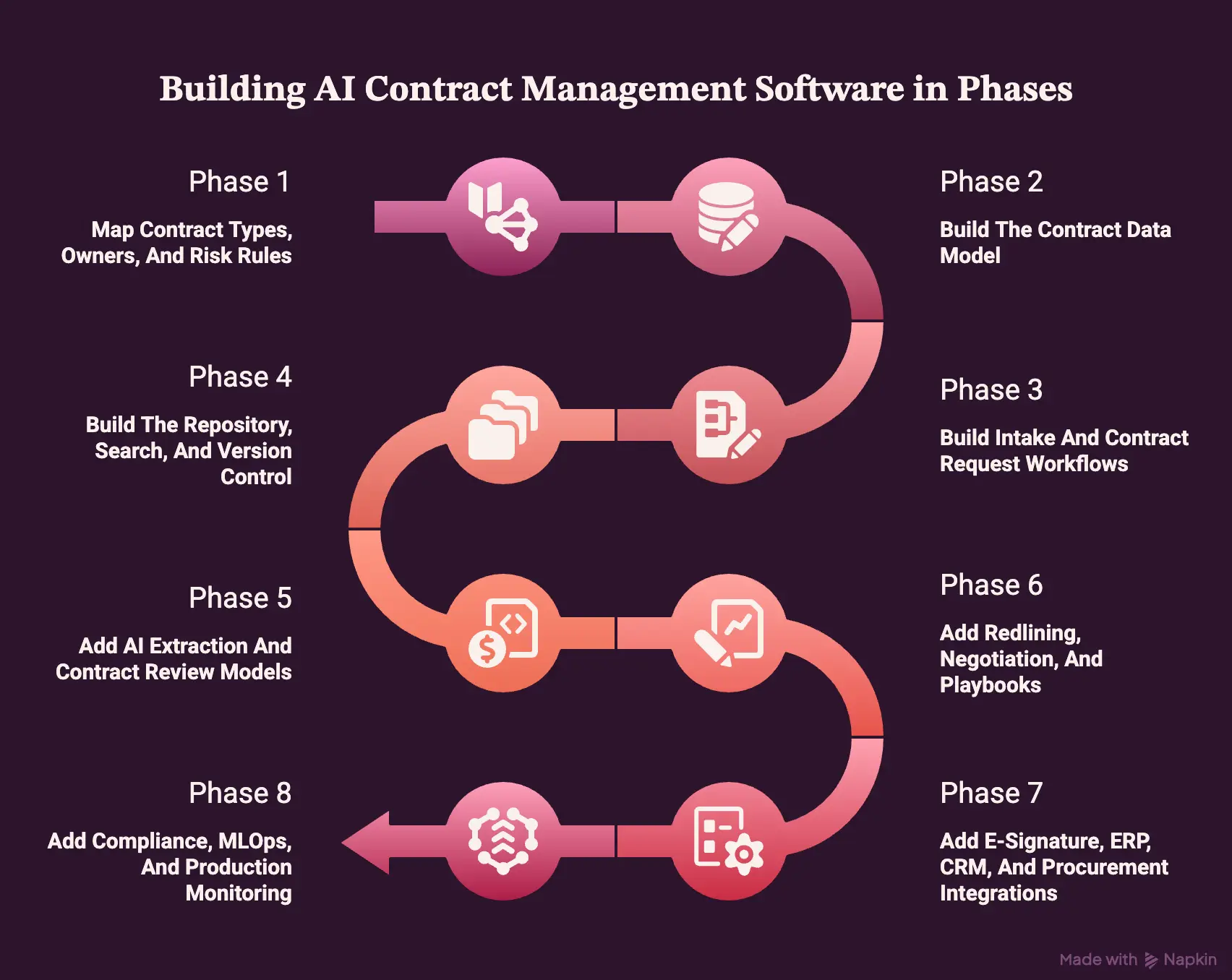
Phase 1: Map Contract Types, Owners, And Risk Rules
Before writing a single line of application code, engineers must catalog the complete taxonomy of target corporate agreements.
Specifically, this catalog includes standard Non-Disclosure Agreements (NDAs), Master Service Agreements (MSAs), Statements of Work (SOWs), Business Associate Agreements (BAAs), and Data Processing Agreements (DPAs). Furthermore, specialized portfolios like Clinical Trial Agreements (CTAs), Group Purchasing Organization (GPO) contracts, supplier quality agreements, and ISDA master files require distinct tracking criteria.
- Business Owners: The software links specific departmental administrators to their respective contract lines automatically.
- Approval Thresholds: High-value liability variables require explicit financial and executive sign-off constraints.
- Risk Tiers: Agreements are dynamically categorized based on indemnification limits and jurisdictional exposure.
Subsequently, Intellivon maps these structural validation workflows, mandatory clauses, and cross-departmental authorization paths during initial system architecture design.
Consequently, this deep preliminary discovery ensures that the underlying technology mirrors your actual operational risk parameters perfectly.
Phase 2: Build The Contract Data Model
Building a functional enterprise platform requires a normalized, relational database schema rather than a basic document cloud folder. Therefore, the data architecture must treat every transactional parameter as an independent, indexable entity vector.
- Core Entities: The base schema establishes explicit relationships between contracts, signing parties, and specific counterparties.
- Operational Attributes: Columns map individual clauses, compliance obligations, renewal timelines, and active amendments.
- Facility Tracking: Tables break down agreements by hospital facility, corporate department, and regulatory jurisdiction.
As a result, this clean foundation guarantees absolute file lineage, unalterable audit logging, and consistent signature verification across millions of active rows.
Ultimately, this foundational design prevents the storage layer from degrading into an unorganized, unsearchable repository over multi-year transactional cycles.
Phase 3: Build Intake And Contract Request Workflows
To eliminate fragmented, unmonitored communication paths, the development team prioritizes an intelligent legal front door entry framework. Accordingly, this module serves as the primary gateway for all corporate transaction requests.
- Dynamic Request Forms: UI components adapt fields in real time based on the selected contract category.
- Automated Type Routing: System routers push uploaded drafts directly to designated legal evaluation queues.
- Business Justification: Requesters must provide explicit operational reasoning and target metadata before submission.
Consequently, Intellivon engineers these initial workflows to enforce role-based access controls from the exact moment of document creation.
Therefore, the enterprise completely eliminates random, non-compliant email attachments and centralizes all pre-signature intents inside a single monitored ecosystem.
Phase 4: Build The Repository, Search, And Version Control
An enterprise repository must manage complex multi-layered document histories without introducing data collisions. Specifically, the storage platform tracks active drafts, counterparty redlines, and executed final files simultaneously.
- Parent-Child Logic: The system anchors downstream amendments and addenda directly to the original foundational master contracts.
- OCR Indexing Engines: Ingestion pipelines extract text arrays from low-resolution scans and locked PDF files.
- Semantic Vector Search: Deep embedding indices allow legal professionals to query underlying conceptual terms rather than exact keywords.
Thus, this structure maintains source-document traceability across every revision step.
As a result, users pull complete contract negotiation lineages instantly, protecting the organization during internal audits and public regulatory disclosures.
Phase 5: Add AI Extraction And Contract Review Models
Once the repository functions stably, engineers deploy the machine learning models required for specialized AI contract analysis and review software development.
Specifically, this layer relies on fine-tuned transformer networks to parse dense legal blocks into clear operational readouts.
- Metadata Extraction: Algorithms automatically isolate counterparties, financial values, execution dates, and expiration milestones.
- Obligation Isolation: The processing engine isolates precise delivery terms and alerts responsible parties to pending tasks.
- Confidence Scoring: Natural language components apply probability metrics to every extraction to trigger human-in-the-loop validation.
Subsequently, Intellivon implements custom pipeline staging using dedicated MLOps frameworks to systematically control model hallucinations.
Consequently, your operational teams receive hyper-accurate, explainable summaries that surface critical risk variables without requiring extensive manual reviews.
Phase 6: Add Redlining, Negotiation, And Playbooks
Automating real-time negotiation requires combining generative language models with structured legal playbooks. Therefore, the software compares incoming counterparty text adjustments directly against approved corporate safety positions.
- AI Redline Suggestions: The platform automatically inserts fallback language when a counterparty rejects primary enterprise terms.
- Clause Deviation Alerts: Interactive UIs highlight exact semantic shifts away from standard corporate templates.
- Escalation Triggering: High-risk modifications automatically forward the active file to senior council members for review.
Accordingly, Intellivon designs these collaborative interfaces to preserve hidden internal annotation threads separate from client-facing documents.
This technical boundary ensures that internal strategic discussions remain secure while moving negotiations forward rapidly.
Phase 7: Add E-Signature, ERP, CRM, And Procurement Integrations
To extract maximum value, the contract platform must act as an automated data bridge across your entire corporate infrastructure. Specifically, the integration engine uses secure microservices to pass validated metadata tokens between disconnected systems.
- E-Signature Handshakes: Webhooks orchestrate secure document deliveries directly via the DocuSign API and Adobe Sign API.
- CRM Data Synchronization: Completed legal agreements push milestone parameters back to Salesforce opportunity nodes automatically.
- ERP Accounting Flows: Validated financial obligations propagate natively into SAP, Oracle, Coupa, and specialized procurement platforms.
Consequently, Intellivon builds these connections using decoupled event queues to avoid database lockups during heavy transaction periods. Therefore, your financial ledgers stay perfectly synchronized with active legal parameters without manual data entry.
Phase 8: Add Compliance, MLOps, And Production Monitoring
The final phase establishes the long-term governance, security controls, and optimization loops necessary for continuous enterprise production. Specifically, engineers deploy automated monitoring systems to watch both the infrastructure layers and live machine learning accuracy.
- Zero-Trust Access: Cryptographic identity verification protects confidential legal agreements from unauthorized internal exposure.
- Model Drift Detection: Automated evaluation jobs flag instances where shifting terminology drops extraction precision scores.
- Prompt Injection Defense: Input filtering sanitizes model interactions to protect the software from malicious data exploitation.
As a result, this comprehensive layer guarantees absolute data lineage tracking and smooth software deployment pipelines.
Ultimately, Intellivon stabilizes the entire environment to ensure your platform remains highly secure, fully performant, and completely audit-ready under heavy multi-tenant enterprise loads.
Custom contract software development succeeds by building a secure, data-mapped repository before launching advanced machine learning features.
For a deeper breakdown of procurement workflow architecture, see our guide on What Does It Cost to Develop Procurement Software?
Features That Make AI CLM Useful Beyond Basic Repository
An advanced AI-powered contract lifecycle management software build must actively optimize corporate operational velocity rather than simply storing static electronic files. Consequently, the application layer should run real-time contextual analysis to protect enterprise profit margins and eliminate manual administrative friction.
By embedding machine learning directly into active legal workflows, companies transform historical legal risk parameters into searchable, actionable business intelligence assets.
1. AI Contract Drafting And Generation Software
Automating contract creation requires combining dynamic user questionnaires with a pre-approved repository of corporate legal terms. Specifically, business users input basic transaction parameters through an accessible, front-end intake form.
- Template-Based Drafting: The platform instantly assembles complex Master Service Agreements using compliant boilerplate blocks.
- Approved Clause Insertion: System rules inject customized regional terms based on the counterparty’s primary operating jurisdiction.
- Legal Review Checkpoints: High-value or non-standard contract variations are routed to internal counsel for final approval.
Consequently, engineering teams develop these generative AI contract creation platform features to bypass manual legal writing completely. Therefore, corporate procurement and sales teams launch negotiations within minutes while remaining within strict corporate safety boundaries.
2. LLM-Powered Contract Clause Analysis
Evaluating incoming third-party agreements requires advanced large language models capable of interpreting complex semantic legal text. Accordingly, the parsing engine audits every line to detect variations from the organization’s standard playbooks.
- Fallback Clause Comparison: The software evaluates the risk level of alternative liability terms automatically.
- Missing Clause Alerts: Systems instantly flag the complete absence of mandatory indemnification or data privacy terms.
- Non-Standard Term Detection: The application isolates toxic language patterns that create unmonitored enterprise liabilities.
As a result, this real-time LLM-powered contract clause analysis provides clear explanations of legal risks. Ultimately, these immediate insights allow non-technical business professionals to negotiate minor contract changes safely without delaying corporate timelines.
3. Contract Obligation Extraction And Alerts
Preventing financial penalties requires continuous tracking of post-signature operational and regulatory requirements. Therefore, dedicated AI contract obligation extraction software scans signed documents to surface hidden corporate commitments.
- Milestone Management: The system maps delivery deadlines directly to operational workflow tracking dashboards.
- Renewal Alerts & Expiry Tracking: Automated alerts flag termination windows months before contract expiration dates occur.
- SLA Enforcement: The platform flags payment deadlines, rebate obligations, and notice periods to prevent revenue loss.
Subsequently, developers build these obligation engines to feed data tokens directly into external accounting and enterprise ERP systems. Consequently, your operational managers receive proactive alerts that eliminate compliance oversights and protect vendor relationships.
4. AI Contract Risk Scoring Engine
Evaluating portfolio-wide compliance requires calculating objective risk metrics across all active business transactions. Specifically, the processing engine runs custom statistical models against extracted data arrays to establish a unified safety score.
- Clause-Level Risk Scores: The software isolates specific indemnification caps and rates their financial exposure.
- Counterparty Vulnerabilities: Risk models cross-reference third-party financial stability scores against active contract values.
- Compliance Impact Analysis: Algorithms evaluate documents against evolving standards like DORA, HIPAA, and GDPR.
Therefore, this continuous risk monitoring provides executive teams with immediate clarity on corporate liability trends. As a result, the enterprise mitigates systemic liabilities long before they cause expensive litigation or regulatory penalties.
5. Contract Analytics And Executive Dashboards
Transforming legal documents into data assets allows management to run complex portfolio-wide benchmarking analyses. Accordingly, the reporting dashboard extracts data trends across thousands of active corporate agreements.
- Spend Analytics Integration: Financial systems cross-reference contract pricing tiers against actual procurement invoices.
- Cycle-Time Reporting: Managers track internal approval bottlenecks to identify departments that slow down transactions.
- Savings Identification AI: Algorithms surface redundant supplier contracts and highlight consolidated volume discount opportunities.
Consequently, development teams implement these contract KPI tracking platforms using high-speed data indexing engines. Therefore, your executive leadership team maintains a real-time view of contract risks, operational efficiencies, and hidden cost savings.
An intelligent contract system delivers maximum value by turning static legal text into a proactive operational tool. Building advanced drafting, analysis, and tracking features ensures that your software actively drives business efficiency while protecting corporate revenue.
AI Models For Drafting, Review, Redlining, And Risk Scoring
A resilient enterprise software implementation cannot rely on a single, generic language model to execute every transactional task. Instead, custom AI contract management software development requires a decoupled, multi-tier intelligence architecture.
By pairing high-performance transformer models with deterministic rules engines, developers provide absolute legal accuracy, explainable audit data, and real-time risk scores that scale securely under enterprise transaction loads.
Core Model & Intelligence Architecture Mapping
| Cognitive Domain | Underlying Technical Stack & Models | Primary Operational Tasks | Technical Validation Method |
| Contract Data Extraction | Bidirectional NLP pipelines, LayoutLMv3, custom PyTorch models. | Entity extraction, clause classification, contract metadata tagging, party recognition. | F1-Score optimization, character-level bounding box intersection checks. |
| Playbook Compliance | Vector database RAG pipelines, dense embeddings, hybrid keyword index layers. | Pulling from approved templates, fallback clause comparison, clause library matching. | Semantic distance scores, text-source citation matching audits. |
| Generative Workflows | Fine-tuned LLMs, domain-adapted parameter layers, secure contextual windows. | AI contract summarization, first-draft generation, surgical phrase rewrites. | Token entropy scoring, adversarial prompt injection input filtering layers. |
| Governance Execution | Deterministic state engines, strict Boolean logical matrices, hard boundary limits. | SLA enforcement tracking, auto-renewal blocks, non-standard indemnity escalations. | Absolute code execution testing, structural JSON validation checks. |
| Quality & Alignment | Expert-curated evaluation harnesses continuous pipeline accuracy checks. | Baseline performance tracking, hallucination testing, false-negative error reduction. | Comparative validation against expert human legal consensus benchmarks. |
A reliable contract system avoids generic AI shortcuts by connecting specialized NLP, RAG, and deterministic logic layers into a single platform. Validating these systems against domain-specific legal benchmarks ensures high extraction precision, complete data traceability, and secure enterprise workflow automation.
Fintech Contract Controls For DORA, ISDA, And GDPR
Financial services contract management platforms require rigid, domain-specific controls to govern Information and Communication Technology (ICT) outsourcing, systemic counterparty exposures, and international data processing obligations.
Consequently, relying on general text parsing tools exposes institutional capital to severe regulatory sanctions and operational vulnerabilities.
By embedding automated compliance frameworks directly into the underlying database schema, financial institutions maintain strict audit readiness and protect trading volumes under heavy transactional loads.
Regulatory & Transactional Control Matrix
| Financial Regulatory Framework | Mandatory Contractual Control Elements | Primary AI Extraction & Schema Variables | Downstream Compliance Workflows |
| DORA (Digital Operational Resilience Act) | Critical function mapping, concentration tracking, vendor exit strategies, immediate incident notification limits. | Legal Entity Identifiers (LEIs), data centers at rest, recovery point objectives (RPOs), critical service flags. | Automated annual Register of Information export generation in validated XBRL-CSV formats. |
| ISDA Master Agreement Framework | Multi-party netting provisions, credit support annex collateral parameters, bilateral termination events. | Valuation timelines, dynamic credit rating downgrade thresholds, cross-default margin minimums. | Real-time liquidity exposure recalculation triggers linked to core capital risk models. |
| GDPR Data Processing Governance | Article 28 data controller mandates, downstream subprocessor authorizations, cross-border transfer protections. | Explicit categories of data subjects, retained PII storage duration variables, and security measures. | Continuous subprocessor inventory validation loops and automated erasure handling webhooks. |
| Commercial Lending & Portfolio Assets | Loan origination collateral ties, portfolio investment guidelines, localized insurance policy exclusions. | Debt-service coverage ratios (DSCR), active financial covenant caps, and jurisdiction limitation arrays. | Proactive financial covenant monitoring and cross-system ledger update alerts. |
A specialized financial contract platform delivers essential control layers by converting dense regulatory requirements into indexable, active data fields. Therefore, structuring your architecture to handle DORA, ISDA, and GDPR data parameters natively eliminates critical compliance gaps while protecting institutional transaction velocity.
For a deeper breakdown of procurement workflow architecture, see our guide on How to Build an AI Procurement Platform Like Jaggaer.
Enterprise Integrations For Contract Data And Workflows
Enterprise contract workflows cannot operate in functional isolation without introducing manual transcription errors and disconnected business logic. Consequently, custom AI contract management software development must prioritize high-throughput API connections to systems where transactional dependencies actually live.
By building an event-driven integration layer, development teams ensure that legal variables propagate smoothly across the corporate architecture to automate downstream billing, provisioning, and resource allocation.
Core Enterprise Integration Architecture
| System Category | Targeted Platforms & API Architectures | Core Data Fields Transferred | Automated Workflow Triggers |
| Electronic Signature | DocuSign API contract integration, Adobe Sign REST API, e-signature compliance management nodes. | Signer metadata, electronic envelope status hashes, cryptographic certificates of completion. | Auto-ingest executed PDFs, tag document versions, update lifecycle stages from pending to active. |
| Enterprise Resource Planning | SAP contract lifecycle management integration, Oracle CLM API integration, web services. | Vendor master records, cost center codes, line-item pricing tiers, baseline payment terms. | Generate purchase orders upon signature, lock vendor budgets, flag off-contract invoice variances. |
| Customer Relationship | Salesforce CRM contract integration, HubSpot API, custom CPQ data layers. | Closed-won deal terms, account names, original quote configurations, revenue metrics. | Generate contract requests from opportunities, auto-populate templates, and trigger renewal opportunities. |
| Procurement & P2P | Coupa API, SAP Ariba procurement platform contract module integration, P2P sync. | Supplier onboarding profiles, vendor risk classifications, item catalogs, performance SLA metrics. | Unblock vendor payments on milestone achievement, flag supplier compliance gaps, update risk tiers. |
| Data Warehousing | Snowflake, Google BigQuery, Amazon Redshift, Power BI, Tableau data bridges. | Aggregated risk metrics, cycle-time tracking logs, contract spend analytics, liability caps. | Push daily delta tables, update executive risk heatmaps, refresh corporate contract KPI metrics. |
An intelligent contract system achieves maximum utility when it functions as an open data bridge across the corporate software stack. Building robust, automated connections to ERP, CRM, and e-signature engines removes manual workflow dependencies and protects your baseline profit margins systematically.
AI Contract Management SaaS Platform Development Cost
Developing a custom AI contract management SaaS platform typically requires an investment ranging from $70,000 to $300,000, depending heavily on workflow depth, model training complexity, and enterprise integration scope.
Consequently, the ultimate financial blueprint is determined by whether an organization builds a targeted Minimum Viable Product (MVP) or commissions a multi-tenant, compliance-ready enterprise platform.
Custom Development Investment Breakdown
| Development Phase | Focused MVP Cost | Enterprise Platform Cost |
| Discovery, Workflow Mapping & Taxonomy | $5,000–$10,000 | $10,000–$18,000 |
| Product Architecture & Data Modeling | $8,000–$14,000 | $15,000–$28,000 |
| Repository, Metadata, Search & Version Control | $12,000–$20,000 | $25,000–$40,000 |
| Intake, Approvals, Templates & Clause Libraries | $14,000–$24,000 | $30,000–$48,000 |
| NLP Extraction, LLM Review & Redlining Engine | $16,000–$28,000 | $42,000–$70,000 |
| Obligations, Renewals, SLAs & Risk Scoring | $8,000–$15,000 | $22,000–$38,000 |
| E-Signature, ERP, CRM & Procurement Connections | $10,000–$18,000 | $28,000–$50,000 |
| Security, Regulatory Compliance & MLOps Pipelines | $8,000–$16,000 | $25,000–$45,000 |
| Testing, Data Migration, Rollout & Team Training | $7,000–$15,000 | $18,000–$35,000 |
| Total Estimated Initial Investment | $70,000–$120,000 | $180,000–$300,000 |
Ongoing Maintenance Cost
Operating an enterprise software platform requires allocating a recurring annual maintenance budget equal to 15% to 25% of the initial application build cost. Furthermore, these ongoing funds prevent operational degradation and insulate the software from changing external data vectors.
- Model Drift Tuning: Regular validation checks adjust neural networks to keep text extraction accuracy high over time.
- API Maintenance: Engineering groups update connection configurations when external ERP, CRM, or e-signature software targets shift.
- Infrastructure Security: Continuous server patching, identity rotations, and compliance updates protect confidential records from exposure.
Thus, planning for these infrastructure realities ensures long-term system stability. Consequently, the application remains fully secure, responsive, and performant during heavy multi-tenant transactional spikes.
Build AI Contract Management Software With Intellivon Safely
Regulated enterprises build AI contract management software with Intellivon when off-the-shelf software configurations cannot handle specialized compliance, risk, and transactional complexities.
As an enterprise product development partner, Intellivon designs custom, audit-ready architectures tailored specifically to highly scrutinized operational workflows.
- Architecture-First Build: Engineers decouple systems into an immutable contract repository, localized data models, advanced workflow engines, centralized clause playbooks, risk scoring metrics, and append-only audit tracking logs.
- Healthcare Contract Depth: Platforms natively support HIPAA business associate agreement management, PHI-safe workflows, GPO pricing schedules, clinical trial agreements, vendor credentialing tracking, and Joint Commission evidence logs.
- Fintech Contract Control: Systems deliver dedicated modules for DORA ICT contract register workflows, complex ISDA master portfolios, Article 28 DPAs, loan origination data matching, and real-time counterparty exposure tracking.
- AI with Governance: Advanced large language models handle automated clause extraction, contract summarization, fallback comparisons, and redlining support under strict human-in-the-loop validation parameters and MLOps monitoring pipelines.
- Enterprise Integrations: Microservices build bidirectional event connections with standard enterprise software including DocuSign, Adobe Sign, Salesforce, SAP, Oracle, Coupa, Ariba, SharePoint, and corporate IAM systems.
- Production-Grade Delivery: Backed by an engineering culture with over 500,000 compiled development hours, Intellivon provides secure, zero-trust deployment environments, strict model evaluation pipelines, and long-term production support.
Talk to Intellivon’s AI contract management software development team to scope your platform, estimate your build cost, and decide whether custom AI CLM is the right move.
Conclusion
Transitioning from static document repositories to active contract intelligence frameworks is now essential for modern enterprise resilience. Failing to secure agreement text under robust data models drives value leakage and invites severe regulatory penalties.
By executing a phased development blueprint that combines specialized NLP extraction, RAG playbooks, and deterministic state rules, companies eliminate manual processing friction. Ultimately, treating legal agreements as structured data assets future-proofs corporate transaction velocity.
FAQs
Q1. Can Generative AI Safely Draft And Redline Contracts?
A1. Generative AI safely assists drafting and redlining when working within approved templates, playbook clause libraries, and defined human checkpoints. Consequently, the system acts as an advisor by suggesting compliant text adjustments and highlighting semantic deviations. Therefore, it should never autonomously approve high-liability variables like indemnity caps, data processing boundaries, or jurisdictional limits.
Q2. What Integrations Matter Most In An AI CLM Platform?
A2. System integrations dictate whether a platform operates efficiently or becomes completely isolated. Specifically, developers must build secure API hooks to electronic signature tools, enterprise ERP accounting ledgers, and frontend CRMs. Prioritizing platforms like DocuSign, Salesforce, and SAP guarantees that legal operational data flows cleanly across core transaction points before activating advanced machine learning features.
Q3. Should Legaltech Founders Build A White-Label AI Contract SaaS?
A3. Founders achieve the highest ROI by building white-label software targeting specific, highly regulated business lines. Conversely, general contract review markets face overcrowded, commoditized competition. Focusing on unique domain-specific frameworks, including healthcare business associate agreements or fintech transaction portfolios, allows a B2B product to capture high-value enterprise market share.
Q4. How Accurate Is AI Contract Extraction In Real Workflows?
A4. System extraction accuracy relies heavily on physical document quality, text scanning resolutions, and model validation data. To run reliable automated pipelines, technical teams must establish strict database confidence thresholds and process false positives. Furthermore, industry benchmarks show that real production software requires continuous human verification to track subtle linguistic shifts accurately.
Q5. Is AI Contract Management Safe For Confidential Contracts?
A5. The platform remains entirely safe only when developers implement a strict zero-trust data architecture. Specifically, this environment requires isolated tenant containers, role-based access permissions, and secure private cloud routing. Furthermore, checking data handling rules ensures that corporate files are never used to train external public language models, protecting sensitive enterprise intellectual property from exposure.
To Sum Up
- Contracts do not create value when they sit in repositories. They create value when clauses, obligations, renewals, and risks become workflow triggers.
- AI redlining is only useful when the platform has approved fallback clauses, escalation rules, and a legal playbook behind it.
- A $70,000 AI CLM MVP should prove extraction, review, and workflow value before expanding into enterprise integrations.
- Healthcare contract AI needs BAA, GPO, clinical trial, supplier quality, and PHI-safe controls from day one.
- Fintech contract AI needs DORA, GDPR, ISDA, counterparty, and ICT third-party risk fields built into the data model.