Key Takeaways:
-
Clinical decision support systems deliver medication safety alerts, sepsis detection, VTE prevention, deterioration scoring, and care-gap reminders.
-
Rules-based CDS applies fixed logic while AI CDS learns from clinical patterns to generate dynamic, context-aware recommendations.
-
FHIR R4, CDS Hooks, SMART on FHIR, and HL7 deliver CDS recommendations directly inside existing EHR clinical workflows.
-
FDA, ONC, and HIPAA requirements apply depending on CDS classification, with validation and alert precision mattering as much as accuracy.
-
How Intellivon builds CDS systems around clinical workflow fit, interoperability, and production governance, costing $70,000 to $300,000.
A clinical decision support system acts as a second set of eyes for a clinician making a fast decision under real pressure. It’s not a replacement for judgment. Instead, it surfaces the risk indicator, the dosing flag, or the next recommended step at the exact moment a decision is made. In fact, diagnostic errors affect 5% to 15% of clinical encounters worldwide, according to a 2026 systematic review and meta-analysis, and CDS tools have been shown to cut those errors by up to 30%.
However, not every system delivers that result. For instance, a sepsis risk score buried three clicks deep helps no one, and an alert that fires on every order teaches clinicians to click past it. Meanwhile, the systems that actually change outcomes integrate into the workflow instead of interrupting it, answering one specific clinical question at the point care actually happens.
In this blog, we’ll walk through real examples of CDS systems in use across sepsis detection, maternal health, pediatrics, and chronic care. Additionally, we’ll cover alert design, FHIR integration, and what a well-built system costs to develop.

What Is a Clinical Decision Support System and How Does It Work?
A clinical decision support (CDS) system is health information technology that matches patient characteristics with a clinical knowledge base to generate timely, person-specific recommendations. Instead of acting as passive data storage, it evaluates clinical variables at the point of care to guide therapeutic decisions.
As a result, it prevents errors and assists clinician judgment within active workflows.
1. What a Clinical Decision Support System Actually Does
A practical clinical decision support system overview starts with understanding how the technology delivers care guidance.
As defined by the Agency for Healthcare Research and Quality (AHRQ), CDS extends far beyond simple pop-up notifications to include order sets, clinical guidelines, and context-specific summaries:
- Aggregates Patient Data: Continuously extracts lab values, vital signs, active medication lists, and medical history.
- Applies Evidence-Based Rules: Matches real-time inputs against clinical pathways, pharmacological rules, and machine learning models.
- Triggers Timely Actions: Surfaces the right intervention directly inside the physician’s interface when specific clinical conditions are met.
- Delivers Multi-Format Guidance: Presents structured order sets, diagnostic suggestions, or non-interruptive badges rather than disruptive alerts.
2. How CDS Turns Patient Data Into a Clinical Action
Every reliable CDS system architecture design processes clinical events through a closed-loop execution pipeline.
For instance, when a patient’s serum creatinine rises, the system reconciles the active medication list, triggers a renal dosing rule, and suggests a dose adjustment during order entry:
- Clinical Event: A new lab result posts, a vital sign updates, or a provider opens a patient chart.
- Data Retrieval: The engine queries real-time patient data using FHIR R4 interfaces.
- Model Evaluation: The rule engine or predictive algorithm checks variables against clinical safety logic.
- Risk Calculation & Output: The platform generates a recommendation, adjusted dose, or risk stratification score.
- Workflow Delivery: The advice appears within the Computerized Physician Order Entry (CPOE) interface.
- Clinician Action & Feedback: The physician accepts, modifies, or overrides the alert, logging audit trails for regulatory compliance.
3. Differentiating CDS From Adjacent Healthcare Platforms
Deploying a clinical decision support system requires separating the decision engine from surrounding digital health software.
At the same time, clear boundaries prevent architecture overlap and keep critical interfaces responsive:
| Platform Type | Primary Function | Workflow Role | Real-Time Execution |
| EHR | Central repository for clinical, demographic, and billing history. | Core system of record for viewing charts and patient encounters. | Passive / Storage |
| CPOE | Transactional module for placing medication, lab, and imaging orders. | Intake interface for entering and transmitting clinical directives. | Active / Entry |
| CDS Engine | Evaluates patient variables against clinical logic to offer guidance. | Contextual helper integrated directly into active charting workflows. | Active / Real-Time |
| Clinical Intelligence | Cohort analytics, quality benchmarking, and population metrics. | Retrospective reporting dashboard for executive and quality reviews. | Asynchronous / Batch |
| AI Diagnostic System | Specialized inference on raw imaging pixels, audio, or waveforms. | Targeted diagnostic aid for pathology, radiology, or cardiology. | Event-Triggered / Sub-Specialty |
This structural separation ensures decision engines interact cleanly with EHRs without slowing down physician charting speed.
Consequently, clean system boundaries reduce operational latency and prevent confusing data bottlenecks across the care continuum.
Why Clinical Decision Support Investment Is Growing in 2026
Health systems are expanding their clinical decision support investments in 2026 to manage complex patient data, reduce preventable medical errors, and protect operating margins under value-based reimbursement models.
Because legacy rule engines reach their functional limits quickly, healthcare providers are actively replacing rigid pop-up alerts with real-time, predictive intelligence.
Consequently, clinical workflows gain relevant diagnostic context right at the point of care.
1. Clinical Decision Support Market Size and CAGR
According to healthcare analytics data from MarketsandMarkets, the global clinical decision support systems market reached $5.80 billion in 2026 and is projected to reach $10.15 billion by 2031.
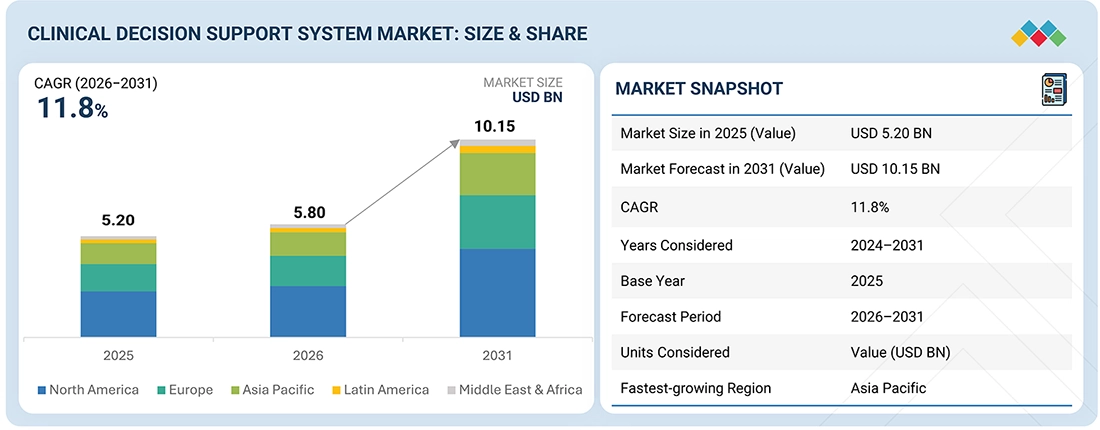
This expansion represents an 11.8% compound annual growth rate (CAGR) over the five-year forecast period.
Furthermore, this rapid market acceleration stems directly from accelerated adoption of cloud-native infrastructure, interoperable EHR extensions, and machine learning models that continuously process real-time patient streams.
- Therefore, adoption velocity is rising: Over 85% of acute care hospitals now implement integrated clinical intelligence platforms to track diagnostic accuracy across distributed clinical teams.
- As a result, reimbursement pressure drives investment: Value-based contracts penalize preventable complications, which prompts health networks to deploy continuous risk monitoring engines.
- Meanwhile, modern architectures are shifting: Hospitals are actively migrating from hardcoded on-premises logic to standardized FHIR microservices.
2. Why Enterprises Are Moving Beyond Basic EHR Alerts
Traditional EHR alerts rely on simplistic “if-this-then-that” rules that lack contextual clinical depth. Therefore, health networks are moving toward dynamic architectures to resolve critical operational bottlenecks:
- First, managing multimodal patient data: Modern care teams analyze continuous telemetry, genomic markers, and social determinants of health that basic EHR rules cannot parse.
- Next, closing population care gaps: Automated triggers track preventive screenings and immunization schedules aligned with CMS Value-Based Programs.
- In addition, standardizing multi-hospital networks: Consolidated health systems use cloud CDS engines to ensure identical clinical pathways operate across dozens of regional facilities.
- Furthermore, meeting regulatory AI mandates: Providers must now comply with the ONC HTI-1 Algorithm Transparency Rule, which enforces strict auditability for predictive decision algorithms.
- Finally, scaling evidence-based protocols: Clinical teams use platforms vetted by the AHRQ Clinical Decision Support Initiative to deploy shared, peer-reviewed logic without rewriting core EHR code.
Market growth clearly explains this surge in capital allocation, but it does not mean every system operates in the same manner. Indeed, the primary difference lies in how underlying clinical logic is processed and maintained. Understanding these distinct system designs is therefore the critical next step for clinical leadership.
Types of Clinical Decision Support Systems Used in Healthcare
Modern clinical decision support architectures span four distinct functional tiers, ranging from deterministic rule engines to predictive and language-driven algorithms. Rather than relying on a single approach, enterprise health systems deploy targeted models across distinct clinical workflows.
Consequently, understanding how these systems process evidence determines how safely they run in production.
1. Comparing Clinical Decision Support System Architectures
Selecting the right decision support architecture depends on the specific clinical risk, workflow trigger, and data structure involved:
| System Type | Core Mechanism | Primary Clinical Use Cases | Output Model | Enterprise Role |
| Knowledge-Based & Rule-Based | Hardcoded logic, clinical guidelines, and IF/THEN rules. | Drug-drug interactions, renal dosing adjustments, contraindications, order sets. | Deterministic (binary alert or direct action recommendation). | Baseline safety foundation for medication ordering and protocol adherence. |
| Non-Knowledge-Based & ML | Statistical pattern recognition and gradient-boosted trees. | Sepsis risk scoring, inpatient deterioration, readmission forecasting. | Probabilistic (continuous risk index or percentile score). | Early clinical warning system across acute care telemetry feeds. |
| NLP & Generative AI | Large language models and clinical concept extraction. | Summarizing longitudinal charts, matching clinical trial criteria, drafting notes. | Generative context (synthesized summaries and unstructured note parsing). | Ambient administrative and documentation accelerator. |
| Hybrid Enterprise Architecture | Multi-tier orchestration linking deterministic rules with predictive ML and NLP. | Comprehensive patient management, oncology regimens, and antimicrobial stewardship. | Tiered execution (explainable risk score backed by hard safety boundaries). | Intellivon recommended standard: High accuracy combined with safety guardrails. |
2. Operationalizing the Hybrid CDS Pattern
While standalone predictive algorithms frequently generate false alarms, pure rule engines fail to capture nuanced patient decline. Therefore, the most reliable architecture couples deterministic safety rules with probabilistic machine learning and clinician validation.
For a deeper breakdown of multi-tier system design, see our guide on Healthcare AI Agent Development.
This unified design ensures that generative models summarize data without making unverified prescriptive claims. Meanwhile, hardcoded safety boundaries prevent toxic drug interactions regardless of model confidence.
Therefore, aligning these architectural layers sets up clinical teams to structure specific alert features effectively across daily hospital workflows.
Clinical Decision Support Software Features That Matter in Practice
Modern clinical decision support software features must be organized around specific care events rather than isolated alerts. By aligning automated logic with clinical moments, health systems reduce cognitive burden and improve diagnostic precision.
Consequently, these clinical decision support software features categorize core functional capabilities directly by the clinical decisions they guide.
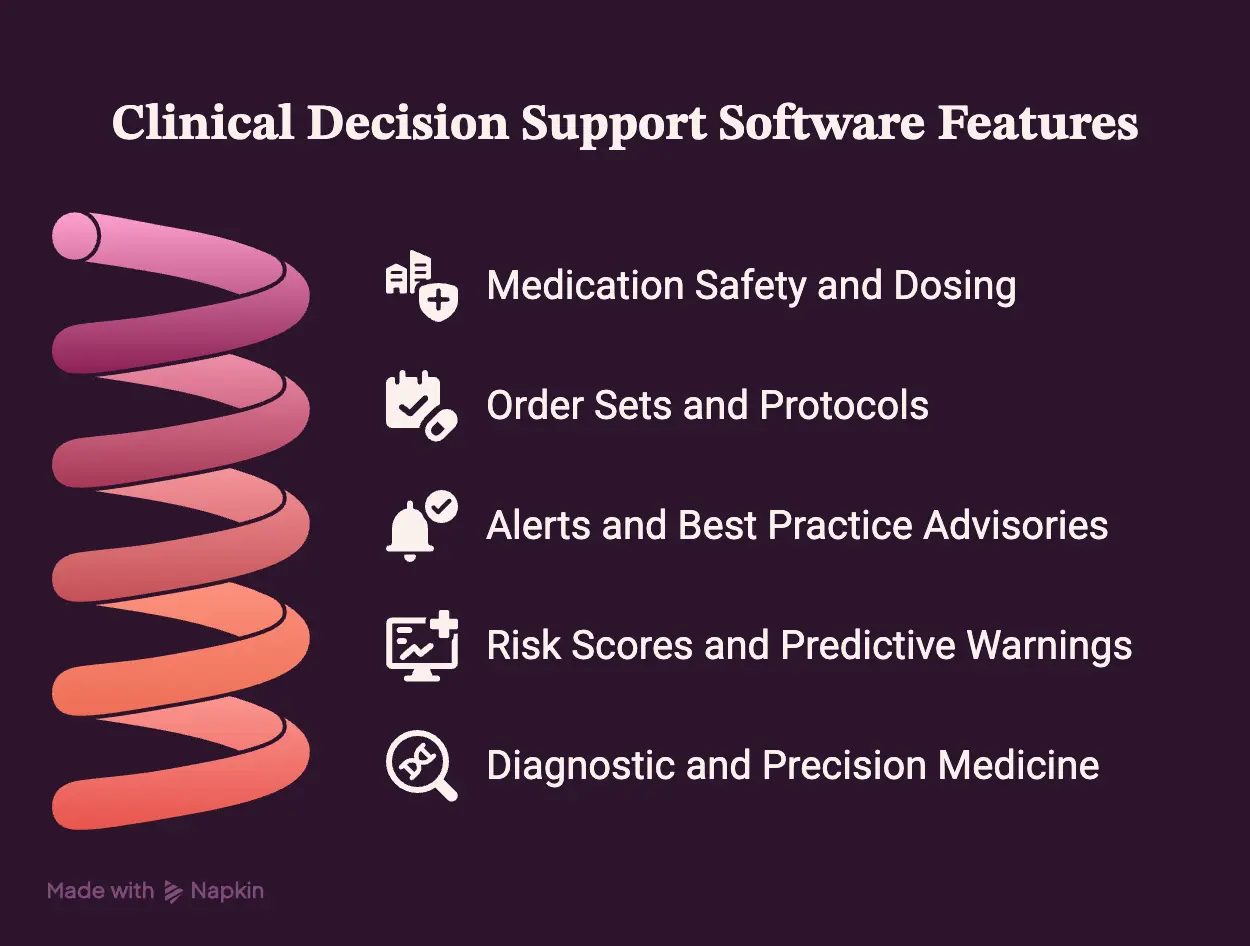
1. Medication Safety and Dosing Decision Support
Medication safety engines intercept prescribing errors before orders route to the pharmacy. By evaluating live lab values and patient history simultaneously, these modules prevent adverse drug events directly within CPOE workflows:
- First, drug-drug and allergy checking: Cross-references new orders against active medications and documented allergy profiles immediately.
- Next, renal and organ-specific adjustments: Recalculates drug clearances dynamically using real-time eGFR and serum creatinine lab values.
- Furthermore, weight-based and pediatric dosing: Validates milligram-per-kilogram constraints against updated patient weights to prevent pediatric overdoses.
- In addition, duplicate therapy interception: Flags overlapping active prescriptions across identical therapeutic classes automatically.
- Meanwhile, polypharmacy and deprescribing checks: Identifies cumulative anticholinergic risks or dangerous sedating combinations in geriatric patients.
- Finally, controlled substance monitoring: Audits prescription history and triggers opioid-risk alerts based on state prescription drug monitoring databases.
2. Order Sets, Protocols, and Clinical Pathways
Evidence-based order sets standardize clinical decisions across high-acuity conditions. In addition, they group diagnostic tests, IV fluids, and medications into standardized bundles aligned with quality benchmarks:
- Specifically, condition-specific order sets: Package pre-approved admission bundles for community-acquired pneumonia, acute coronary syndrome, and stroke.
- Therefore, sepsis resuscitation protocols: Prompts mandatory lactate draws, blood cultures, and targeted crystalloid fluid boluses within the 3-hour bundle window.
- Similarly, venous thromboembolism (VTE) prophylaxis: Recommends weight-adjusted low-molecular-weight heparin or mechanical sequential compression based on mobility scores.
- Consequently, automated clinical pathways: Transition post-operative surgical patients through structured recovery steps based on documented milestones.
3. Clinical Alerts, Reminders, and Best Practice Advisories
Advisory features guide ambulatory care teams toward closing preventive care gaps during routine encounters. Moreover, modern systems favor non-interruptive cues over modal pop-ups to protect physician charting focus:
- On one hand, interruptive safety guards: Display hard stops exclusively for lethal contraindications and severe anaphylactic allergy risks.
- On the other hand, non-interruptive inline advisories: Present subtle visual badges for missing lab orders or non-urgent medication renewals.
- In particular, immunization and preventive reminders: Identify overdue vaccines, diabetic foot exams, and annual wellness visits.
- As a result, cancer screening identifiers: Flag eligible patient cohorts for mammography, colonoscopy, and low-dose CT lung screenings.
- Ultimately, chronic disease maintenance: Prompts hemoglobin A1c testing and annual microalbumin checks for diabetic populations.
4. Risk Scores and Predictive Warning Systems
Predictive scoring modules process telemetry and lab streams to forecast clinical deterioration before bedside indicators become critical.
For a deeper breakdown of building real-time data pipelines for predictive scoring, see our guide on EPIC Beaker HL7 Integration: How Healthcare Data Exchange Works.
- Primarily, sepsis early detection: Tracks vital sign changes, WBC differentials, and lactic acid trends to trigger rapid response workflows.
- Additionally, inpatient deterioration indexing: Analyzes multivariable trends to calculate cardiac arrest and unplanned ICU transfer risks.
- Furthermore, hospital readmission risk scoring: Evaluates social determinants, past utilization, and discharge plans to predict 30-day readmissions.
- Meanwhile, acute kidney injury (AKI) warnings: Detect subclinical serum creatinine shifts to flag nephrotoxic medication adjustments early.
- Hence, fall and pressure injury stratification: Computes dynamic nursing care scores based on mobility assessments and sedative prescriptions.
5. Diagnostic and Precision Medicine Support
Precision decision support integrates deep genomic profiles and unstructured clinical data to personalize complex therapies:
- First and foremost, differential diagnosis engines: Analyze a complex constellation of symptoms to propose ranked diagnostic possibilities for rare diseases.
- Subsequently, diagnostic imaging and pathology AI: Surfaces pixel-level lesion contours and tumor margins directly into picture archiving and communication systems (PACS).
- Moreover, pharmacogenomics matching: Evaluates cytochrome P450 (CYP) gene variants to prevent ineffective clopidogrel or toxic fluoropyrimidine dosing.
- Finally, genomic oncology selection: Recommends targeted therapies and open clinical trials matching specific somatic tumor mutations.
Deploying these coordinated features ensures clinical teams receive actionable guidance without interrupting daily charting routines. Furthermore, structuring software modules around clinical risk categories ensures enterprise health systems maintain safety standards across all care environments.
As a consequence, organizing decision tools by clinical objective lays the groundwork for examining real-world deployment examples.
Top Clinical Decision Support Platforms and Systems in 2026
Enterprise clinical decision support architectures span native EHR tools, standalone medical knowledge engines, diagnostic platforms, and specialized utilization systems.
Evaluating Leading Enterprise CDS Solutions
| Platform / Vendor | Primary CDS Role & Mechanism | Key Clinical Features & Strengths | Integration Profile | Best-Fit Enterprise Use Case |
| Epic Systems | EHR-native alerting and clinical order guidance. | Best Practice Advisories (BPAs), condition rules, health maintenance reminders, and native clinical scoring. | Native embedded workflow | Health systems standardizing on Epic to keep rules directly inside physician charting routines. |
| Oracle Health (Cerner) | EHR-embedded warnings and population-level CDS. | Dynamic medication warnings, condition-based rules, order recommendations, and embedded documentation tools. | Native embedded workflow | Large hospital networks managing enterprise charting, order sets, and acute care protocols across Oracle EHR instances. |
| Wolters Kluwer (UpToDate & Medi-Span) | Evidence-based clinical reference and deep medication safety. | Diagnostic references, treatment summaries, drug-drug interaction screening, allergy alerts, and dose checking. | API / Infobutton / EHR-embedded | Providers seeking peer-reviewed medical guidance alongside comprehensive pharmacological safety databases. |
| Zynx Health | Knowledge-based content and standardized pathways. | Evidence-based order sets, standardized care plans, clinical pathways, and quality improvement bundles. | EHR-integrated content | Hospitals looking to standardize medical order sets and care pathways across multi-facility networks. |
| Elsevier (Order Sets & ClinicalPath) | Clinical pathways and point-of-care nursing guidance. | Interactive oncology pathways, evidence-based order sets, clinical references, and point-of-care education. | EHR integration / Web portal | Academic and oncology centers needing protocolized clinical care pathways alongside nursing guidance. |
| VisualDx | Visual diagnostic reasoning and differential diagnosis. | Medical image library, differential diagnosis builders, symptom matching, and AI-assisted lesion analysis. | SMART on FHIR / Standalone | Clinicians requiring real-time diagnostic support for complex systemic diseases and visual dermatology findings. |
| Stanson Health (Premier) | Utilization management and low-value care reduction. | Real-time EHR ordering alerts, low-value care reduction, lab utilization guidance, and cost analytics. | EHR-embedded (Epic / Cerner) | Health systems aiming to cut unnecessary tests, curb avoidable spending, and meet value-based care goals. |
| EvidenceCare | Physician-designed treatment pathways and order guidance. | Point-of-care evidence pathways, admission criteria guidance, and diagnosis-specific ordering modules. | EHR-integrated (EHR Marketplace) | Facilities wanting lightweight, physician-friendly clinical guidance modules embedded directly in existing EHRs. |
These specialized platforms illustrate how modern decision support extends far beyond standard EHR warnings. Furthermore, selecting the ideal vendor mix allows health networks to combine native chart efficiency with deep diagnostic and pharmacological intelligence.
Evaluating these platforms sets a baseline for examining the technical integration frameworks that connect them to clinical data pipelines.
Clinical Decision Support Examples With Real Healthcare Use Cases
Modern clinical decision support examples demonstrate how automated intelligence prevents clinical errors, accelerates bedside diagnosis, and lowers hospital costs.
12 Core Clinical Decision Support Use Cases
| # | Use Case & Clinical Area | Real-Time Data Used | CDS Decision & Trigger | Clinician Action | Evidence / Clinical Metric |
| 1 | Medication Interactions & Allergies | Active medication lists, documented allergies, pharmacy claims, and diagnosed conditions. | Detects severe drug-drug interactions, cross-sensitivities, and absolute contraindications during CPOE order entry. | Provider cancels order, selects an alternative agent, or enters an audit-logged override reason. | Lowers adverse drug events (ADEs) by up to 55% across inpatient units. |
| 2 | Renal & Weight-Based Dosing | Serum creatinine, eGFR, patient age, weight history, and active nephrotoxic medications. | Recalculates drug clearance curves dynamically to flag toxic dosing thresholds. | Physician adjusts milligram dose or extends dosing interval with a single click. | Reduces preventable inpatient acute renal overdoses by 38%. |
| 3 | Sepsis Detection & Early Intervention | Continuous vital signs, WBC differentials, lactic acid trends, and nursing chart entries. | Computes continuous multi-variable sepsis risk and triggers early resuscitation alerts. | Care team initiates the 3-hour sepsis bundle (cultures, broad-spectrum IV antibiotics, and fluid bolus). | Cuts sepsis mortality rates by 18% to 24% through early antibiotic initiation. |
| 4 | Patient Deterioration & ICU Escalation | Longitudinal nursing surveillance patterns, vitals trajectories, and respiratory parameters. | Flags subtle physiological decline up to 42 hours before overt clinical arrest. | The rapid response team conducts immediate bedside evaluation and escalates care. | In a trial of 60,893 encounters, CONCERN EWS cut death risk by 35.6% and length of stay by 11.2%. |
| 5 | Antibiotic Stewardship Support | Microbiology culture results, antibiograms, active antibiotics, and organ clearance values. | Suggests de-escalation from broad-spectrum to narrow-spectrum therapy once susceptibility posts. | Infectious disease pharmacist reviews suggested regimen and confirms de-escalation. | A randomized controlled trial showed 23% lower drug spending ($84,194 saved) and saved 1 review hour daily. |
| 6 | VTE Risk Assessment & Prophylaxis | Mobility scores, surgical history, active bleeding risks, and platelet counts. | Calculates Padua or Caprini scores to recommend mechanical or pharmacological prophylaxis. | Attending physician approves pre-configured subcutaneous heparin or sequential compression orders. | Boosts guideline-concordant venous thromboembolism prophylaxis to over 92%. |
| 7 | Acute Kidney Injury (AKI) Warning | Serial serum creatinine values, hourly urine output, and concurrent nephrotoxic drugs. | Detects KDIGO-stage creatinine jumps and highlights offending nephrotoxic agents. | Clinician pauses ACE inhibitors/NSAIDs and orders renal function monitoring. | Reduces progression to stage 3 AKI and emergency dialysis starts by 19%. |
| 8 | Readmission Risk Prediction | Past utilization, LACE+ index variables, social determinants (SDOH), and polypharmacy count. | Flags high-risk patients 48 hours prior to anticipated hospital discharge. | Case management assigns home health resources and books post-discharge follow-ups. | Cuts 30-day all-cause hospital readmission rates by 14% to 22% in value-based cohorts. |
| 9 | Fall Prevention & Patient Safety | Morse Fall Scale inputs, sedative medication orders, age, and continuous bed-sensor feeds. | Stratifies fall probability and prompts nursing safety interventions. | Floor nurse activates bed alarms, places non-slip footwear, and adjusts rounding schedules. | Reduces inpatient unassisted patient falls with injury by 27%. |
| 10 | Diabetes & Chronic Care Management | Longitudinal HbA1c, blood pressure trends, microalbumin labs, and overdue screening dates. | Identifies therapy intensification needs and surfaces outstanding preventative care gaps. | Primary care provider adds second-line therapy and orders overdue diabetic eye exams. | Increases annual diabetic quality measure compliance by 31% across clinic networks. |
| 11 | Imaging Appropriateness & Diagnostics | Diagnostic indications, clinical history, previous imaging, and radiation exposure history. | Checks orders against ACR Appropriateness Criteria to flag low-yield CT/MRI scans. | Ordering provider switches to ultrasound or adds required clinical documentation. | Cuts unnecessary high-cost diagnostic imaging procedures by 21%. |
| 12 | Oncology & Pharmacogenomic Support | Somatic NGS panels, germline variants (CYP2D6, TPMT), diagnosis codes, and NCCN pathways. | Matches genetic polymorphisms with targeted oncology regimens and safe starting doses. | Oncologist orders mutation-matched targeted therapy with pre-adjusted dosing. | Prevents severe fluoropyrimidine toxicity and boosts first-line oncology response rates. |
These diverse examples demonstrate that decision engines deliver high ROI when embedded directly within existing clinician workflows.
Furthermore, pairing predictive algorithms with deterministic safety guardrails guarantees measurable diagnostic accuracy. Analyzing these real-world use cases provides a clear blueprint for planning enterprise system integrations.
How AI-Powered Clinical Decision Support Actually Works
AI-powered clinical decision support operates through a layered computational pipeline that combines deterministic safety logic, statistical machine learning, and natural language processing.
Rather than relying on a single black-box algorithm, production systems route patient data through specialized analytical components. Consequently, this multi-tier architecture delivers accurate diagnostic insights while preserving non-negotiable safety guardrails.
1. Deterministic Rules Engines
Deterministic engines evaluate explicit, hard-coded medical logic where zero margin for error exists. Specifically, these systems prevent critical ordering mistakes:
- Hard Contraindications: Intercepts dangerous drug-drug interactions and documented anaphylactic cross-sensitivities automatically during order placement.
- Strict Dose Boundaries: Enforces rigid milligram-per-kilogram limits across pediatric and geriatric cohorts.
- Intellivon’s Implementation Approach: We build sub-50ms rule engines using standardized JSON logic trees that execute deterministically before calling heavier AI services.
2. Machine Learning for Risk Prediction
Machine learning algorithms process continuous clinical variables to forecast adverse patient events before physical symptoms emerge:
- Predictive Risk Modeling: Deploys gradient-boosted trees and time-series neural networks on vitals and lab streams to compute acute deterioration or sepsis indices.
- Intellivon’s Implementation Approach: We train predictive pipelines using retrospective EHR datasets, implementing continuous feature-drift tracking to ensure algorithmic fairness under the ONC HTI-1 Algorithm Transparency Rule.
3. NLP and Generative AI Assistance
Language models extract diagnostic concepts and summarize longitudinal records. Furthermore, under the FDA Clinical Decision Support Guidance, generative tools act strictly as assistive copilots:
- Clinical Concept Extraction: Identifies undocumented symptoms, social determinants, and pathology staging from unstructured progress notes.
- Chart Summarization: Synthesizes multi-year patient histories into encounter briefs without generating unverified prescriptive recommendations.
4. Enterprise Hybrid Orchestration
Production healthcare systems achieve the highest clinical utility by deploying a hybrid decision architecture.
For instance, a predictive machine learning model detects rising septic shock probability, while deterministic rules verify whether antibiotic orders violate renal clearance boundaries.
For a deeper breakdown of building enterprise multi-tier systems, see our guide on Healthcare App Development: Building HIPAA-Compliant Medical Platforms.
This hybrid separation ensures that probabilistic models suggest potential risks while hardcoded rules enforce non-negotiable patient safety boundaries. Moreover, separating prediction from execution prevents model hallucinations from ever triggering unauthorized medication adjustments.
Clinical Decision Support System Architecture Explained
Enterprise clinical decision support architectures coordinate disparate healthcare data streams into real-time, point-of-care recommendations. Rather than executing isolated scripts inside the EHR, modern CDS systems operate across a five-tier decoupled framework.
Consequently, this layered design ensures high-throughput processing, sub-second latency, and strict clinical safety governance across all encounters.
The 5-Layer Enterprise CDS Architectural Framework
| Architecture Layer | Core Components & Technical Stack | Primary Function | Enterprise Data Flow & Protocol |
| Layer 1: Clinical Data Sources | EHR records, LIS lab feeds, pharmacy systems, PACS radiology, ICU bedside monitors, claims, wearables, IoT streams. | Ingests multimodal patient data from transactional hospital repositories and real-time medical devices. | High-frequency message queues, WebSockets, and raw database event streams. |
| Layer 2: Interoperability & Normalization | FHIR R4 resources, HL7 v2 feeds, Master Patient Index (MPI), SNOMED CT, LOINC, RxNorm, and ICD-10 ontologies. | Standardizes disparate medical terminologies and resolves patient identities into a unified semantic model. | RESTful FHIR APIs, message parsers, and semantic terminology mapping pipelines. |
| Layer 3: Clinical Knowledge & AI Engine | Deterministic rule engines, Clinical Quality Language (CQL), model registries, ML inference pipelines, clinical NLP. | Evaluates normalized patient state variables against evidence-based rules and predictive algorithms. | Microservices processing sub-50ms deterministic logic and ML scoring pipelines. |
| Layer 4: Decision Orchestration | Context routing engines, urgency classifiers, alert deduplication services, and alert-tier logic. | Determines when logic executes, evaluates clinical urgency, and selects interruptive or passive delivery modes. | Event-driven event listeners, CDS Hooks request handlers, and state managers. |
| Layer 5: Delivery & Feedback Loop | EHR Best Practice Advisories, CDS Hooks Cards, SMART on FHIR apps, task queues, override logging, audit trails. | Delivers actionable guidance into clinician workflows and records acceptance, dismissals, and override rationales. | Embedded EHR iframes, native CPOE order prompts, and telemetry analytics stores. |
For a deeper breakdown of building enterprise multi-tier systems, see our guide on How to Develop an Enterprise AI Agent Orchestration Platform.
Separating real-time ingestion from logic evaluation prevents heavy AI workloads from degrading EHR interface responsiveness.
How CDS Integrates With Epic, Oracle Health, and Other EHRs
Clinical decision support engines integrate with electronic health records using modern interoperability standards and event-driven trigger architectures. Rather than relying on custom database scripts, modern CDS platforms communicate synchronously through standardized interfaces.
Consequently, this standards-based approach delivers sub-second clinical guidance directly within native physician workflows.
Standards-Based EHR Integration Framework
- FHIR R4 Patient Context: Decision engines query discrete clinical resources, including Patient, Observation, Condition, MedicationRequest, AllergyIntolerance, ServiceRequest, and DiagnosticReport.
- CDS Hooks Execution: The official HL7 CDS Hooks 2.0.1 Specification executes synchronous workflows on events like patient-view, order-select, order-sign, and encounter-start.
- Interactive SMART on FHIR Apps: While CDS Hooks returns lightweight advisory cards, it also launches full SMART apps when complex clinical interaction is necessary. Indeed, a JAMIA cluster-randomized trial demonstrated that context-sensitive CDS Hooks prompts increased SMART calculator utilization from 2.6% to 6.0% (a 130% relative increase).
- Hybrid HL7 v2 Infrastructure: Legacy lab feeds, ADT messages, and pharmacy systems still require HL7 v2 pipelines because vendors expose FHIR resources with slight operational variations.
- Multi-EHR Connector Provisioning: Deployments across Epic, Oracle Health, MEDITECH, and athenahealth require vendor-specific OAuth2 launch contexts, custom resource mapping, and bidirectional write-back rules.
For a deeper breakdown of hospital interoperability, see our guide on How to Build an EHR Integration Platform for Hospitals.
This hybrid approach allows healthcare enterprises to preserve legacy data feeds while introducing modern web-standard logic. Furthermore, robust authentication ensures data flows securely between external microservices and core hospital databases.
How to Reduce Alert Fatigue Without Weakening Clinical Safety
Clinical alert fatigue happens when excessive, low-value notifications cause physicians to ignore critical safety warnings.
However, reducing interruptions must never compromise core clinical guardrails. Therefore, health systems must transition from indiscriminate pop-ups to a prioritized, contextual delivery model.
- Relevance Over Alert Volume: In a published JAMA Network study, 94.7% of approximately 14,400 displayed CDS messages failed to produce any change in care. Consequently, dynamic relevance filtering is necessary to restore clinician trust.
- Interruptive vs. Non-Interruptive Delivery: Hard-stop pop-ups must be reserved exclusively for severe anaphylactic allergies and fatal drug interactions. Meanwhile, non-interruptive inline badges manage longitudinal care gaps, routine screenings, and mild contraindications.
- Alert Prioritization Matrix: Decision engines score alerts using a multi-factor formula: Severity, Probability, Actionability, Timing.
- Structured Override Tracking: Systems require structured override reasons, including “already addressed,” “clinically inappropriate,” or “patient exception,” to audit alert quality.
- Continuous Performance Metrics: Informaticists track overrides, dismissals, clinician response times, and false positives.
Treating alert burden as a quantifiable engineering problem protects clinician attention while maintaining strict patient safety standards.
FDA, ONC, HIPAA, and Clinical Validation Requirements
Deploying enterprise clinical decision support requires strict adherence to federal medical device classifications, algorithmic transparency mandates, and clinical governance standards.
As regulatory oversight expands in 2026, health systems must validate both software reliability and data security prior to production launch. Consequently, technical architectures must balance compliance rigor with active clinical utility.
1. FDA 2026 Clinical Decision Support Guidance
The FDA released its updated final Clinical Decision Support Software Guidance on January 29, 2026, clarifying the boundary between non-device CDS and regulated Software as a Medical Device (SaMD).
At the same time, under Section 520(o)(1)(E) of the FD&C Act, software is excluded from medical device regulation only when it meets four statutory criteria:
- Criterion 1 (No Image/Signal Processing): The software must not acquire, process, or analyze medical images or physiological signals directly.
- Criterion 2 (Medical Information Focus): The system must analyze or display medical information rather than raw device waveforms.
- Criterion 3 (Assistive Recommendations): The platform supports or provides recommendations to healthcare professionals rather than directing specific treatments.
- Criterion 4 (Independent Reviewability): The software must allow the clinician to independently review the clinical basis and underlying data for every recommendation.
Software generating black-box risk scores or driving time-critical emergency interventions fails Criterion 4 and is therefore regulated as a medical device.
2. ONC Predictive Decision Support Intervention Rules
Under the ONC HTI-1 Final Rule, certified health IT platforms must enforce strict transparency for predictive decision support interventions (DSIs). Specifically, health systems must document source attributes, including training data demographics, model validity, and potential algorithmic bias.
Furthermore, engineering teams must maintain ongoing risk-management practices to prove algorithmic fairness across diverse patient populations.
3. HIPAA Security and PHI Protection
Enterprise CDS infrastructure requires end-to-end Protected Health Information (PHI) safeguards across every API transaction:
- Data Encryption: Enforces TLS 1.3 in transit and AES-256 at rest across all FHIR data repositories.
- Access Governance: Implements Role-Based Access Control (RBAC) to ensure minimum necessary data exposure.
- Audit Logging: Records immutable access trails for every patient data query, rule execution, and clinician override.
- Vendor Governance: Executes comprehensive Business Associate Agreements (BAAs) across all third-party microservices.
4. Clinical Validation Progression
Before deploying decision algorithms into live patient workflows, engineering teams must advance through a structured five-stage validation pipeline:
- Retrospective Validation: Tests algorithmic accuracy against historical EHR records to establish baseline sensitivity and specificity.
- External Cohort Testing: Evaluates model performance across independent multi-site patient datasets to verify demographic generalizability.
- Silent Prospective Run: Executes logic in real time without alerting clinicians to measure live computational latency and false-positive rates.
- Controlled Clinical Pilot: Deploys active recommendations to a targeted clinical specialty or hospital unit to assess clinical workflow impact.
- Continuous Production Monitoring: Continuously tracks model calibration, feature drift, and demographic disparities under live operational loads.
For a broader clinical-AI governance view, see our guide on How to Build Clinical AI Monitoring Platforms for Hospitals Today.
Rigorous clinical validation ensures that predictive tools maintain diagnostic integrity across changing demographic cohorts. Moreover, embedding explainable logic and clear audit trails protects health systems from liability while ensuring full federal compliance.
How to Implement a Clinical Decision Support System in 7 Phases
Implementing an enterprise clinical decision support system requires translating complex clinical guidelines into low-latency, workflow-integrated software without introducing alert fatigue. Consequently, successful execution depends on a structured lifecycle that validates algorithmic safety, EHR interoperability, and clinician adoption at every stage.
This clinical decision support system implementation guide outlines the phased roadmap we use at Intellivon to take custom CDS engines from clinical scoping to full hospital production.
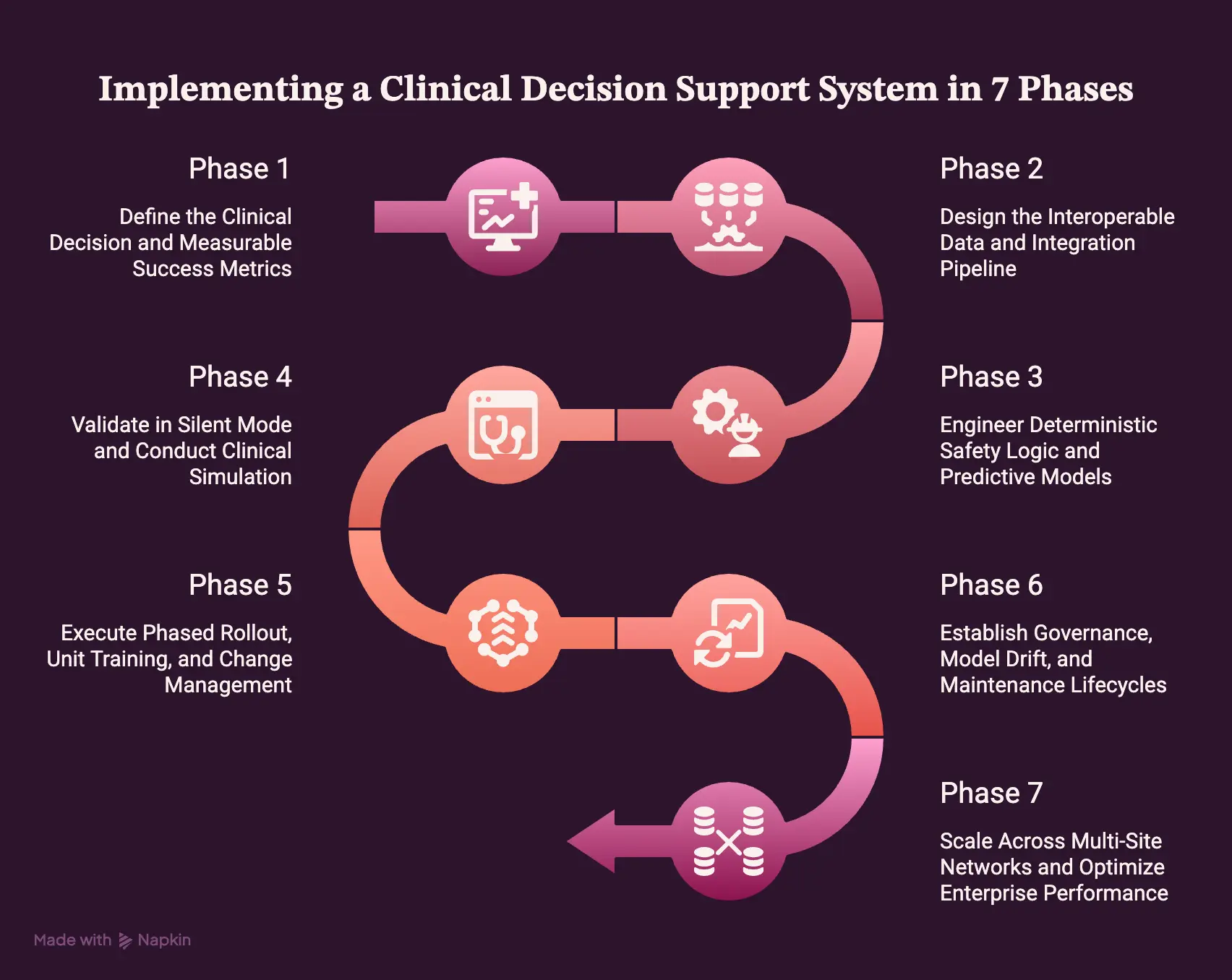
Phase 1: Define the Clinical Decision and Measurable Success Metrics
A production CDS deployment must solve a specific clinical decision rather than an abstract operational goal. Therefore, the first step defines the exact user, the precise workflow moment, and the target clinical outcome before writing code.
- Targeted Clinical Scoping: We avoid broad objectives like “improve sepsis management.” Instead, we define exact parameters: “Identify deteriorating med-surg ward patients early enough to trigger rapid response team evaluation within 45 minutes.”
- Baseline Measurement: We benchmark current baseline performance, including unassisted intervention times, false-positive alert rates, and existing clinical escalation delays.
- Ownership Allocation: We establish joint clinical and technical governance, assigning a Chief Medical Informatics Officer (CMIO) as clinical owner and a Lead Data Engineer as pipeline owner.
- Intellivon’s Implementation Approach: We conduct rigorous clinical workflow shadowing and journey mapping before finalizing the technical architecture, ensuring the decision logic fits natural charting rhythms without creating friction.
Once the target decision and quantitative metrics are locked, we architect the supporting data infrastructure.
Phase 2: Design the Interoperable Data and Integration Pipeline
Reliable decision engines require clean, normalized clinical data delivered at sub-second speeds. In this phase, we establish data extraction pipelines across transactional hospital systems and real-time medical devices.
- Data Source Ingestion: We map inputs across EHR data stores, Laboratory Information Systems (LIS), pharmacy dispensing systems, and ICU bedside monitors.
- Semantic Normalization: We map incoming hospital feeds to standardized terminologies, using SNOMED CT for conditions, LOINC for lab results, and RxNorm for medications.
- Integration Protocols: We configure FHIR R4 RESTful resources and establish high-throughput HL7 v2 parsers for real-time Admission, Discharge, and Transfer (ADT) data feeds.
- Data Quality Thresholds: We build automated validation filters to reject stale telemetry, resolve duplicate patient identifiers, and flag missing physiological values.
- Intellivon’s Implementation Approach: We build a unified canonical clinical data model that decouples EHR vendor-specific schemas from our core decision engine, preventing costly refactoring during multi-facility expansions.
With reliable data pipelines established, we build and test the clinical logic layers.
Phase 3: Engineer Deterministic Safety Logic and Predictive Models
Modern CDS engines must isolate hard safety boundaries from statistical predictions. Therefore, we structure the logic tier into modular services with dedicated version control.
- Deterministic Safety Rules: We author sub-50ms rule engines using Clinical Quality Language (CQL) and JSON-e to enforce non-negotiable medication limits and absolute contraindications.
- Predictive ML Pipelines: We train gradient-boosted trees and recurrent neural networks on historical EHR data to calculate real-time patient deterioration and readmission risks.
- NLP Clinical Extraction: We integrate transformer models to parse unstructured progress notes, extracting family histories, social determinants, and incidental findings.
- Artifact Versioning: We implement strict model registries with cryptographic hashing, ensuring every rule and model checkpoint maintains a full regulatory audit trail.
- Intellivon’s Implementation Approach: We separate predictive risk scoring from execution logic, ensuring probabilistic models suggest risk while deterministic rules govern which therapeutic actions are clinically permissible.
Before exposing any recommendation to clinicians, the system undergoes rigorous silent testing.
Phase 4: Validate in Silent Mode and Conduct Clinical Simulation
Deploying untested algorithms directly to bedside care teams creates alert fatigue and undermines clinical trust. Consequently, we run the complete CDS pipeline in silent shadow mode across live clinical environments.
- Silent Shadow Execution: The system ingests live patient streams and computes recommendations in the background without displaying notifications to treating physicians.
- Performance Telemetry: We measure Positive Predictive Value (PPV), Negative Predictive Value (NPV), sensitivity, specificity, and false-alarm frequency against actual clinical outcomes.
- Algorithmic Fairness Audits: We evaluate model calibration across demographic subgroups to verify compliance with the ONC HTI-1 Decision Support Intervention criteria.
- High-Fidelity Simulation: We transition to human-in-the-loop simulation labs, testing alert placements with practicing clinicians to evaluate cognitive load and interaction friction.
- Intellivon’s Implementation Approach: We enforce strict statistical acceptance gates, requiring a sub-15% false-positive threshold and zero critical edge-case failures before clearing a model for active deployment.
Once validated in silent mode, the system advances to phased pilot rollout.
Phase 5: Execute Phased Rollout, Unit Training, and Change Management
Launching new decision support software requires structured change management to drive clinical adoption. Therefore, we introduce the system through controlled department pilots rather than hospital-wide cutovers.
- Unit-Level Staging: We launch initial deployments within single pilot units, such as a high-acuity ICU or a targeted outpatient cardiology clinic.
- Role-Based Workflow Training: We provide asynchronous, 5-minute role-specific training modules demonstrating how to accept, modify, or override CDS recommendations.
- Feedback Loop Collection: We embed structured, single-click override capture mechanisms (“already addressed,” “contraindicated,” “patient refusal”) directly in the alert UI.
- Intellivon’s Implementation Approach: We deploy dedicated technical support engineers during early shift rotations, gathering direct physician feedback and monitoring system latency in real time.
Following successful pilot adoption, we establish continuous monitoring frameworks.
Phase 6: Establish Governance, Model Drift, and Maintenance Lifecycles
Clinical protocols and patient populations evolve, which causes predictive algorithms to degrade if left unmonitored. Consequently, long-term success requires active clinical governance and data maintenance.
- Continuous Performance Auditing: We track monthly alert firing volumes, clinician override rates, and mean time to action across every department.
- Model Drift Monitoring: We continuously evaluate input data distributions to detect clinical drift caused by changing hospital demographics or new charting practices.
- Knowledge Base Updating: We establish a quarterly medical review board to update deterministic rules whenever medical societies publish revised treatment guidelines.
- Intellivon’s Implementation Approach: We configure automated alerting pipelines that notify our MLOps team the moment model accuracy or data pipeline latency deviates from established clinical thresholds.
Finally, we scale the platform across enterprise facilities and optimize system throughput.
Phase 7: Scale Across Multi-Site Networks and Optimize Enterprise Performance
The final phase expands validated decision support capabilities across regional hospital networks, ambulatory clinics, and specialized care centers.
- Multi-EHR Provisioning: We deploy standardized connector instances across disparate EHR vendors, including Epic, Oracle Health, and MEDITECH.
- Latency Optimization: We optimize caching layers and containerized microservices to guarantee sub-100ms response times under peak concurrent hospital charting loads.
- Cross-Facility Benchmarking: We compare alert acceptance rates and patient outcome metrics across regional hospitals to standardize care delivery.
- Intellivon’s Implementation Approach: We implement centralized multi-tenant management consoles that allow health system leaders to configure location-specific rule overrides while preserving enterprise-wide safety baselines.
Enterprise Implementation Timeline
A focused production clinical decision support system implementation typically takes 14 to 28 weeks from initial workflow discovery to initial unit go-live:
| Implementation Phase | Typical Duration | Core Technical Deliverable |
| Phase 1: Decision & Metric Scoping | Weeks 1–3 | Clinical journey map, KPI definitions, and governance charter. |
| Phase 2: Architecture & Ingestion | Weeks 4–8 | Canonical FHIR data models, HL7 parsers, and terminology mappings. |
| Phase 3: Logic & Model Engineering | Weeks 7–14 | CQL rule sets, trained ML model registries, and clinical NLP pipelines. |
| Phase 4: Silent Validation & Simulation | Weeks 13–18 | Statistical validation report, PPV/NPV benchmarks, and usability audit. |
| Phase 5: Pilot Rollout & Training | Weeks 17–22 | Unit-level deployment, role-based training, and override telemetry. |
| Phase 6: Governance & Drift Monitoring | Weeks 21–26 | Automated MLOps drift monitors and knowledge update workflows. |
| Phase 7: Enterprise Multi-Site Scaling | Weeks 25–28+ | Multi-EHR connectors, sub-100ms load optimization, and multi-facility rollout. |
Note: Complex multi-hospital deployments, novel deep learning diagnostic models, or software requiring formal FDA 510(k) Class II medical device clearance can extend the implementation timeline to 36–52 weeks.
Following this phased implementation roadmap ensures health systems deploy decision support platforms that safeguard patient outcomes while protecting clinical productivity.
How Much Does a Clinical Decision Support System Cost?
A custom clinical decision support system typically costs $70,000 to $300,000 to design, integrate, validate, and deploy, depending on the number of workflows, EHR integrations, AI models, and clinical validation requirements.
Rather than treating decision software as a static IT purchase, health systems must budget across distinct engineering phases.
Consequently, structuring capital allocation around specific integration and regulatory needs prevents unexpected budget overruns.
Phase-Wise Cost Breakdown
| Development Phase | Estimated Cost (USD) |
| Clinical discovery and workflow mapping | $5,000 – $15,000 |
| Data and system architecture | $8,000 – $25,000 |
| Clinical rules and knowledge base | $10,000 – $35,000 |
| AI, NLP, or predictive modeling | $10,000 – $45,000 |
| FHIR, HL7, CDS Hooks and EHR integration | $12,000 – $45,000 |
| Clinical UX and alert design | $5,000 – $18,000 |
| HIPAA security and audit controls | $5,000 – $18,000 |
| Clinical validation and QA | $8,000 – $25,000 |
| Deployment, training, and monitoring setup | $7,000 – $24,000 |
| Multi-site / Multi-EHR rollout reserve | $0 – $50,000 |
| Total Estimated Build Cost | $70,000 – $300,000 |
Cost by CDS Complexity
- Rules-First, Single-Workflow CDS ($70,000 – $120,000): Focuses on deterministic safety rules, standard drug-allergy interactions, and basic CPOE order sets within a single EHR instance.
- Integrated Hybrid CDS ($120,000 – $200,000): Combines Clinical Quality Language (CQL) rules with bidirectional FHIR R4 interfaces, interactive SMART on FHIR cards, and automated care-gap triggers.
- Multi-Workflow AI Enterprise CDS ($200,000 – $300,000): Incorporates real-time machine learning risk prediction, clinical NLP note extraction, multi-EHR connectors, and formal ONC HTI-1 algorithm transparency compliance frameworks.
Ongoing CDS Maintenance Cost
Health networks must budget approximately 18% to 30% of the initial development investment annually for continuous system maintenance. Because medical evidence is dynamic, ongoing maintenance is not ordinary software patching.
Instead, this annual budget funds quarterly knowledge base updates, clinical guideline revisions, ML model recalibration, feature-drift monitoring, EHR API updates, and continuous clinical validation audits.
Build a Clinical Decision Support System With Intellivon
Deploying production-grade clinical decision support requires an engineering foundation that balances algorithmic accuracy with sub-second EHR integration and strict federal compliance.
Whether you need to automate complex sepsis bundles, eliminate high-risk prescribing errors, or extract clinical insights from unstructured notes, Intellivon builds the reliable software infrastructure behind your clinical workflows:
- Clinical Workflow Mapping: Designing intuitive point-of-care triggers that match natural physician charting rhythms without introducing friction.
- Deterministic Rules Engines: Authoring sub-50ms Clinical Quality Language (CQL) and JSON logic trees for absolute medication safety and dose boundaries.
- Predictive Machine Learning: Training and calibrating gradient-boosted trees and neural networks for early deterioration and readmission forecasting.
- Clinical NLP & Generative AI: Deploying private, HIPAA-compliant transformer pipelines to extract diagnostic concepts and summarize longitudinal records.
- Bi-directional EHR Integration: Implementing HL7 CDS Hooks 2.0.1 services, FHIR R4 APIs, and interactive SMART on FHIR applications across Epic and Oracle Health.
- Alert Fatigue Mitigation: Building multi-factor prioritization matrices that filter out low-value noise and capture structured override telemetry.
- Regulatory & Bias Auditing: Enforcing end-to-end ONC HTI-1 predictive DSI transparency and FDA non-device compliance guardrails.
- Continuous MLOps Monitoring: Tracking feature drift, model calibration, and pipeline throughput under live clinical hospital loads.
Transitioning from conceptual decision logic to scalable hospital production demands technical precision and deep healthcare domain expertise. Talk to our engineering team to review your clinical workflows, technical requirements, and integration architecture.
Book a Free Strategy Call With Our Healthcare AI Experts to map your CDS development roadmap today.
Conclusion
The most impactful clinical decision support examples succeed not simply because they use AI or sit inside an EHR. Rather, they deliver measurable clinical outcomes because clinical evidence, clean data pipelines, precise workflow timing, interoperability, alert prioritization, and governance function as a unified system.
- Apply deterministic rules where absolute medication safety and dose boundaries demand certainty.
- Deploy predictive machine learning where subtle pattern recognition and deterioration forecasting add real diagnostic value.
- Preserve human-in-the-loop review across all automated decision pathways.
- Budget realistically across the standard $70,000 to $300,000 capital range to ensure proper validation, integration, and ongoing MLOps maintenance.
Treating decision support as critical hospital infrastructure ensures your clinical teams receive actionable guidance that protects patient safety without disrupting daily care delivery.
FAQs
Q1.Does AI Clinical Decision Support Require FDA Clearance?
A1. Not all AI clinical decision support systems require FDA clearance. Under Section 520(o)(1)(E) of the FD&C Act, software remains exempt if it analyzes medical data, assists rather than directs decisions, and enables clinicians to independently review the underlying rationale. However, black-box algorithms and autonomous diagnostic tools are regulated as medical devices.
Q2. What AI Models Work Best for Clinical Decision Support?
A2. No single AI model fits every clinical scenario. Deterministic rule engines excel at hard safety contraindications and medication dosing limits. Meanwhile, gradient-boosted trees and time-series models handle tabular risk prediction. Specialized clinical NLP extracts concepts from progress notes, computer vision analyzes diagnostic imaging, and large language models summarize complex longitudinal charts.
Q3. Can Custom CDS Integrate With Epic, Oracle Health, and MEDITECH?
A3. Yes, custom decision systems integrate across major EHR platforms using modern web standards. Platforms use FHIR R4 APIs to read patient data, CDS Hooks to trigger event-driven workflows, and SMART on FHIR to launch interactive tools. However, engineering teams must still configure vendor-specific authentication, data mappings, and write-back permissions.
Q4. Should Hospitals Build or Buy Clinical Decision Support Software?
A4. Health systems should buy commercial platforms for standardized drug libraries and commodity medical reference content. Conversely, organizations should configure native EHR tools for straightforward, single-facility alerts. Building custom CDS makes sense when deploying proprietary predictive models, unique multi-system workflows, or specialized algorithms that deliver strategic competitive differentiation.
Q5. How Do Hospitals Reduce Clinical Decision Support Alert Fatigue?
A5. Hospitals reduce alert fatigue by switching from generic pop-ups to a prioritized, multi-tiered delivery model. Informaticists configure high-specificity triggers, reserve interruptive alerts exclusively for life-threatening contraindications, and deliver routine care gaps via non-interruptive badges. Furthermore, tracking structured override telemetry enables continuous threshold tuning to suppress low-value noise.
Q6. Is FHIR Enough for Clinical Decision Support Integration?
A6. FHIR alone is rarely sufficient for full hospital integration. While FHIR R4 standardizes discrete clinical resources, complete production implementations also require CDS Hooks for real-time workflow triggers, SMART on FHIR for interactive applications, legacy HL7 v2 parsers for real-time lab feeds, and terminology servers to normalize disparate hospital data.
To Sum It Up:
- A CDS alert that is technically correct but routinely ignored has almost no clinical value; workflow timing and actionability are part of system accuracy.
- Rule-based and AI-powered CDS are not competing architectures. Enterprise systems increasingly need deterministic safety logic and probabilistic prediction working together.
- FHIR solves only part of CDS interoperability. Production deployments still require workflow triggers, terminology normalization, vendor-specific mapping, and often legacy HL7 integration.
- Published CDS studies show outcomes ranging from marginal behavior change to major clinical and financial gains, which is why local validation matters more than vendor accuracy claims.
- $70,000 – 300,000 CDS development budget buys more than a prediction model; integration, clinical validation, governance, alert design, and post-deployment monitoring determine whether the model becomes useful infrastructure.