Key Takeaways:
- Choosing the right stablecoin payment API requires comparing developer experience, supported chains, assets, ramps, compliance, and reliability.
-
Different APIs own different parts of the payment stack, making direct category comparison essential before any build decision.
-
Categories include custody APIs, payment orchestration, on/off-ramp providers, compliance layers, and blockchain connectivity providers.
-
API-first approaches work for standard use cases while custom orchestration layers suit complex, regulated, or high-volume operations.
-
How Intellivon builds vendor-neutral stablecoin payment infrastructure costing $70,000 to $300,000 when a single API falls short of full-stack coverage.
Every stablecoin payment API lists the same features on its landing page, which include multi-chain support, webhooks, and KYC integration. However, what actually separates providers is what happens after launch, not what’s on the comparison chart. In fact, general payment API integrations that lock a business into the wrong vendor cost 100% to 200% more over time, according to a 2026 API-first payments guide, once slow migrations and vendor lock-in get factored in.
That gap comes down to one thing most feature lists don’t show, which is how a provider handles compliance under real transaction volume. For instance, FATF travel rule support looks identical across two APIs until one flags a transaction correctly and the other doesn’t. Meanwhile, uptime SLAs read the same on paper, but only one provider has actually been tested at scale. As a result, the real evaluation should confirm whether a provider’s compliance and reliability claims hold up once volume gets real.
In this blog, we’ll compare stablecoin payment API providers on SDK quality, latency, pricing, and compliance coverage, then look at when building your own infrastructure makes more sense than integrating a third-party API.

What Is a Stablecoin Payment API and What Does It Handle?
A stablecoin payment API exposes programmatic endpoints to send, receive, convert, settle, and off-ramp digital currencies like USDC or USDT across blockchains. Consequently, different providers control vastly different layers of the infrastructure stack.
While Circle handles core transfers and liquidity, Stripe manages merchant checkout, and Fireblocks secures underlying wallet custody. Therefore, understanding these boundaries is essential.
1. Payment API vs Wallet API vs RPC API
Before selecting a vendor, developers must distinguish core payment rails from wallet custody and node infrastructure.
Otherwise, choosing the wrong category creates major gaps in compliance and settlement capabilities.
| Category | What it gives developers | Examples to evaluate |
| Payment Orchestration | Pay-ins, payouts, settlement, transaction state tracking | Circle, BVNK, Ripple |
| Merchant Payment API | Embedded checkout interfaces and merchant acceptance | Stripe |
| Ramp API | Fiat-to-stablecoin and stablecoin-to-fiat conversion | Transak, MoonPay, Ramp |
| Wallet/Custody Infrastructure | Wallet creation, key signing, multi-sig policy controls | Fireblocks, Circle Wallets |
| Blockchain/RPC Infrastructure | Chain reads, writes, raw nodes, data indexing | Alchemy, Infura, QuickNode, Helius, Ankr, Stellar Horizon, XRPL |
Ultimately, the primary vendor selection criterion is not chain count, but rather which lifecycle stages your engineering team needs the provider to own. Furthermore, building an in-house integration requires managing security and compliance across every single layer.
For a deeper look into the technical strategies of stablecoin platforms, read our breakdown on building custom enterprise stablecoin payment architecture.
As a result, enterprise teams often collaborate with partners like Intellivon to architect custom middleware that bridges legacy ERP systems directly with multi-chain payment APIs.
How We Evaluated Stablecoin Payment APIs for Developers
Evaluating a stablecoin payment API requires moving past surface-level marketing claims to inspect core developer mechanics directly. With real-world stablecoin payment volume exceeding $400 billion and processing at a projected CAGR of over 22%, engineering teams cannot afford integration bottlenecks or fragile infrastructure.
To systematically evaluate providers, we built a 100-point developer scorecard. This standardized benchmark eliminates biased assertions, allowing engineering leaders to objectively evaluate API completeness, resilience, and operational costs.
1. Stablecoin API Developer Scorecard
| Evaluation area | Weight | What gets evaluated |
| Payment lifecycle coverage | 12 | Pay-in, payout, wallet creation, FX swaps, settlement, and ERP reconciliation |
| Developer experience | 12 | Quality of documentation, SDKs, runnable examples, OpenAPI specs, and error clarity |
| Sandbox and testing | 8 | Testnet environment quality, mock fiat rails, test KYC triggers, and webhook simulation |
| Reliability | 15 | SLA guarantees, automated retries, idempotency key handling, and failure handling |
| Chain and asset coverage | 10 | Production support for L1/L2 networks and major fiat-pegged stablecoins |
| Fiat ramps and FX | 10 | ACH, SEPA, wire, card rails, exchange rate locking, and spread transparency |
| Security | 10 | Custody architecture, key signing mechanisms, RBAC, IP whitelisting, and secret management |
| Compliance | 10 | Integrated KYC/KYB, automated AML, sanctions screening, and FATF Travel Rule support |
| Pricing and TCO | 8 | Transaction fees, FX spreads, monthly minimums, and network gas fee handling |
| Portability | 5 | Data export capabilities, abstraction layers, and vendor migration complexity |
| Total | 100 |
Furthermore, teams must verify how gracefully the API handles sudden gas price surges on EVM chains or block confirmation delays on Solana.
Stablecoin Payment APIs Compared: 2026 Feature Table
Selecting the right stablecoin payment API depends on whether your team requires merchant checkout, programmable wallet infrastructure, or broad multi-chain liquidity.
Furthermore, different providers specialize in distinct operational layers. Consequently, the matrix below evaluates the top ten providers using our 100-point developer scorecard.
Stablecoin Payment API
| Provider | Primary Role | REST API | Native SDKs | Supported Stablecoins | Wallet Model | Pay-ins / Payouts | On/Off Ramps | Best Suited For | Main Technical Limitation |
| Circle | Payment Orchestration & Minting | Yes | JS, Python, Go | USDC, EURC | Programmable (MPC) | Yes / Yes | Yes | Issuer-native payouts & cross-chain movement | Strict endpoint rate limits require retry queues |
| Stripe | Merchant Payment API | Yes | JS, Python, Ruby, Go | USDC, USDT, PYUSD | Merchant custodial | Yes / Yes | Yes | SaaS & e-commerce merchant checkout | Higher per-transaction fees than native rails |
| Coinbase CDP | Onchain Payments & Wallet Stack | Yes | JS, Python, Swift, Kotlin | USDC, USDT, EURC, PYUSD | Smart Account / MPC | Yes / Yes | Yes | Embedded wallet & agentic payment app flows | Vendor lock-in within the Coinbase ecosystem |
| Crossmint | Orchestration & Embedded Wallets | Yes | JS, TS, Python, Unity | USDC, USDT, PYUSD | Non-custodial / MPC | Yes / Yes | Yes | Cross-chain pay-ins and NFT/app checkout | Dependent on third-party liquidity providers |
| BVNK | B2B Settlement & Banking Rails | Yes | TS, Python, Java, Go | USDC, USDT, EURC, PYUSD | Custodial ledger | Yes / Yes | Yes | Cross-border B2B payments & FX trading | Custom pricing requires sales negotiation |
| Ripple | Institutional Cross-Border Rails | Yes | JS, Java, Python | RLUSD, XRP | Enterprise Custody | Yes / Yes | Yes | High-value cross-border treasury settlement | Restricted public self-service onboarding |
| Fireblocks | Custody & Asset Management | Yes | JS, Python, Go, Java | USDC, USDT, Multi | MPC Vaults | Yes / Yes | Partner | Enterprise wallet security & asset custody | Lacks turnkey consumer fiat checkout UI |
| Transak | Ramp API & Fiat Gateway | Yes | JS, iOS, Android, Flutter | USDC, USDT, PYUSD | Non-custodial | Yes / Yes | Yes | Embedded user fiat-to-crypto onboarding | Variable KYC friction during high-volume spikes |
| MoonPay | Ramp & Embedded Checkout | Yes | JS, iOS, Android | USDC, USDT, EURC | Non-custodial | Yes / Yes | Yes | Consumer apps needing instant card-to-crypto | Higher retail processing fees on fiat ramps |
| Ramp Network | Global Ramp API | Yes | JS, iOS, Android | USDC, USDT, EURC | Non-custodial | Yes / Yes | Yes | Global fintech app fiat conversions | Regional banking rail coverage varies |
Specifically, Circle’s current developer stack covers stablecoin payments, wallets, USDC transfers, and cross-chain functionality. Meanwhile, Stripe’s documentation supports direct merchant acceptance.
In addition, Crossmint exposes an integrated orchestration layer spanning wallets, pay-ins, payouts, swaps, and fiat connectivity.
For a deeper breakdown of multi-chain abstraction strategies, see our guide on designing scalable fintech microservices. As a result, enterprise development partners like Intellivon assist engineering teams in implementing these API abstractions seamlessly.
Best Stablecoin Payment APIs for Developers in 2026
Choosing a stablecoin payment API requires matching your technical stack with the vendor’s core infrastructure. Below are detailed evaluations of the leading developer platforms based on their architectural focus, SDK maturity, and compliance features.
1. Circle — Best Fit for USDC-Centric Payment Infrastructure
Circle owns the foundational issuance, minting, and transfer mechanisms for USDC and EURC. Its API surface exposes balances, transfers, payouts, deposits, payment intents, webhooks, and cross-currency operations.
Consequently, developers receive direct access to programmable wallets and Cross-Chain Transfer Protocol (CCTP) endpoints.
- SDKs & Networks: Official SDKs support JavaScript, Python, and Go across Ethereum, Solana, Polygon, Avalanche, and Stellar.
- Testing & Compliance: Sandbox environments mirror mainnet execution with testnet USDC faucets. Built-in compliance handles wallet screening and transaction monitoring seamlessly.
- Ramps & Payouts: Direct integration with banking rails provides instant 1:1 fiat-to-USDC minting and redemption.
However, strict endpoint rate limits require developers to implement custom retry queues for high-volume spikes. Ultimately, Circle is the ideal choice when your product architecture is intentionally USDC-centric rather than asset-agnostic.
2. Stripe — Best Fit for Existing Merchant Checkout Stacks
Stripe embeds stablecoin acceptance directly into its established Payment Intents and Checkout APIs. Completed stablecoin payments automatically settle into the merchant’s Stripe balance in local fiat currency.
Furthermore, Stripe’s updated documentation now explicitly separates one-time stablecoin payments from recurring subscription billing workflows.
- SDKs & Networks: Native libraries cover JavaScript, Python, Ruby, Go, iOS, and Android across Ethereum, Solana, and Polygon.
- Testing & Compliance: Developers can test flows using simulated stablecoin checkout sessions in Stripe’s standard test mode. Merchant KYC and OFAC sanctions screening are handled automatically.
- Ramps & Payouts: Fiat conversion happens instantly at checkout, routing funds into existing merchant bank accounts.
Watch out: merchant payment acceptance is not equivalent to owning an end-to-end cross-border stablecoin treasury or custom payout stack. Consequently, Stripe works best for traditional SaaS companies adding crypto checkout options alongside credit cards.
3. Coinbase Developer Platform — Best for Onchain Products
Coinbase Developer Platform (CDP) provides unified APIs for onchain payments, smart wallets, gasless transactions, and the x402 open payment protocol. Importantly, Coinbase unified Coinbase Commerce into Coinbase Business during 2026.
As a result, developers now integrate directly with Coinbase Business APIs for compliant, custodial payment collection.
- SDKs & Networks: Robust SDKs support TypeScript, Python, Swift, and Kotlin, with deep optimization for the Base L2 ecosystem.
- Testing & Compliance: CDP provides extensive testnets, faucet integrations, and automated KYB verification for merchant accounts.
- Ramps & Payouts: Direct connectivity to Coinbase exchange liquidity ensures fast fiat off-ramping into US and international bank accounts.
However, the platform creates strong vendor lock-in within the Coinbase and Base product ecosystem. Therefore, CDP is best suited for teams building decentralized applications, AI agentic payment flows, or Base-native financial products.
4. Crossmint — Best for Embedded Stablecoin Workflows
Crossmint delivers a full-stack orchestration platform combining embedded wallets, treasury management, and global fiat connectivity. Its documentation explicitly groups treasury wallets, pay-ins, payouts, swaps, and withdrawals into a single platform API.
Furthermore, Crossmint provides regulated payout layers that process bank transfers across 160 countries.
- SDKs & Networks: Developer tools support JavaScript, TypeScript, Python, and Unity across 50+ blockchains including EVM networks, Solana, and Stellar.
- Testing & Compliance: Includes sandboxes with automated AML screening, sanctions checks, and FATF Travel Rule infrastructure under a MiCA CASP framework.
- Ramps & Payouts: Supports card processing, ACH, SEPA, mobile money, and local cash pick-up locations worldwide.
Nevertheless, relying on Crossmint means accepting third-party liquidity routing dependencies. Ultimately, Crossmint shines when apps require embedded non-custodial wallets and global payout rails within one integration.
5. BVNK — Best for Fiat and Stablecoin Payment Orchestration
BVNK bridges institutional banking infrastructure with digital asset settlement. Unlike pure Web3 frameworks, BVNK combines core ledger accounting with local fiat clearing rails like ACH, SEPA, and Faster Payments.
Consequently, businesses can accept stablecoins and settle immediately into multi-currency corporate bank accounts.
- SDKs & Networks: REST APIs and SDKs support TypeScript, Python, Java, and Go on Ethereum, Polygon, Solana, and TRON.
- Testing & Compliance: Full sandbox testing complements enterprise-grade regulatory licensing across the US, UK, and Europe.
- Ramps & Payouts: Built-in FX trading engines enable automated conversion between stablecoins and 30+ fiat currencies.
However, developer onboarding requires formal enterprise contracting, preventing instant self-service signups. Thus, BVNK is ideal for global fintechs and cross-border B2B platforms managing high-volume enterprise payments.
6. Ripple Payments — Best for Enterprise Cross-Border Flows
Ripple Payments delivers an institutional payments API designed specifically for high-value enterprise payout corridors. The API manages quote generation, route optimization, and liquidity sourcing automatically.
Furthermore, Ripple integrates its native RLUSD stablecoin directly into established cross-border settlement channels.
- SDKs & Networks: Enterprise libraries support JavaScript, Java, and Python with direct settlement on the XRP Ledger and EVM chains.
- Testing & Compliance: Comprehensive sandbox portals allow rigorous testing of multi-currency corridor routing and automated sanctions screening.
- Ramps & Payouts: Global banking partner networks provide local currency payout endpoints in over 80 payout markets.
Importantly, implementation complexity is high, and corridor availability depends heavily on regional banking partnerships. Consequently, Ripple Payments is best for licensed financial institutions and large remittance operators rather than small SaaS developers.
7. Fireblocks — Best for Custody and Transaction Control
Fireblocks provides secure Multi-Party Computation (MPC) wallet infrastructure, governance engines, and policy controls.
Crucially, Fireblocks is not a direct merchant checkout API like Stripe. Instead, engineering teams use Fireblocks as the foundational custody and key-signing layer inside custom payment platforms.
- SDKs & Networks: Features production-grade SDKs in TypeScript, Python, Java, and Go supporting 35+ blockchain networks.
- Testing & Compliance: Provides sandbox workspaces, hardware security module (HSM) integrations, and automated Travel Rule compliance screening tools.
- Ramps & Payouts: Integrates with third-party liquidity providers to execute programmatic treasury payouts and off-ramps.
Because Fireblocks lacks pre-built consumer checkout UIs, developers must build front-end payment flows from scratch.
Therefore, Fireblocks is the best choice for enterprise teams requiring maximum key security and custom transaction policy enforcement.
8. Ramp Specialists: Transak, MoonPay, and Ramp Network
Ramp specialists focus specifically on fiat-to-stablecoin on-ramps and stablecoin-to-fiat off-ramps. Furthermore, developers integrate these APIs when they already possess wallet infrastructure but need compliant payment gateways for credit cards, bank transfers, and local payment methods.
- Capabilities: Transak, MoonPay, and Ramp Network offer customizable SDK widgets alongside headless REST APIs. They support card payments, Apple Pay, Google Pay, ACH, and SEPA transfers across 150+ countries.
- Developer Experience: Integration requires minimal code, offering pre-built KYC verification flows that handle user verification in seconds.
- Pricing & Spreads: Fees range between 1% and 3.5% per transaction, with exchange rate markups applied during conversion.
However, relying solely on ramp APIs leaves developers without native treasury ledger management or programmatic payout orchestration. Consequently, these tools are best used as complementary plugins rather than standalone payment backends.
Enterprise teams often work with development partners like Intellivon to integrate ramp APIs cleanly into broader microservices architectures.
Chains, Stablecoins, Fiat Ramps and FX Compared
Selecting a stablecoin payment API requires evaluating network speeds, asset support, and banking integrations. Consequently, production execution demands verifiable settlement across specific chains and local fiat rails rather than superficial interface integrations.
Therefore, engineering teams must evaluate underlying settlement architecture directly to ensure long-term platform resilience.
Multi-Chain and Multi-Stablecoin Coverage
True asset support means an API executes on-chain payment operations, liquidity routing, and automated transfers in production environments.
The table below details live settlement support across primary blockchain networks and digital assets.
| Provider | Networks Supported | Stablecoins Supported |
| Circle | Ethereum, Solana, Polygon, Avalanche, Stellar, Arbitrum | USDC, EURC |
| Stripe | Ethereum, Solana, Polygon | USDC, USDT, PYUSD |
| Coinbase CDP | Base, Ethereum, Solana, Polygon, Arbitrum, Optimism | USDC, USDT, EURC, PYUSD |
| Crossmint | Ethereum, Solana, Polygon, Base, Arbitrum, Optimism, Stellar | USDC, USDT, PYUSD |
| BVNK | Ethereum, Polygon, Solana, TRON | USDC, USDT, EURC, PYUSD |
| Ripple Payments | XRP Ledger, Ethereum, Polygon | RLUSD, XRP |
| Fireblocks | Ethereum, Solana, Polygon, Base, Arbitrum, Avalanche, TRON | USDC, USDT, EURC, PYUSD, RLUSD |
| Transak | Ethereum, Solana, Polygon, Base, Arbitrum, Optimism, Stellar | USDC, USDT, PYUSD |
| MoonPay | Ethereum, Solana, Polygon, Base, Arbitrum | USDC, USDT, EURC |
| Ramp Network | Ethereum, Solana, Polygon, Base, Arbitrum, Optimism | USDC, USDT, EURC |
For instance, Circle supports native payment workflows around USDC and EURC while enabling cross-chain movements via CCTP.
For a deeper breakdown of the underlying settlement stack, see our guide on How Stablecoins Reduce Cross-Border Payment Costs.
Consequently, enterprise teams partner with engineering firms like Intellivon to integrate multi-chain settlement engines into legacy treasury systems cleanly.
Security and Compliance Features Developers Must Compare
Evaluating a stablecoin payment API requires mapping compliance controls directly to your technical application stack.
Consequently, developers must distinguish between provider-managed security infrastructure and the compliance obligations that remain the engineering team’s responsibility.
1. Authentication, Custody and Transaction Security
Core security extends beyond standard API key management and OAuth 2.0 authentication. Therefore, production platforms enforce granular policy controls to protect funds and API keys at every layer.
- Secrets & Access Controls: Systems use HMAC or JWT request signing, strict IP allowlisting, and automated API key rotation via secret managers.
- Custody & Signing Architecture: Hardware Security Modules (HSM) and Multi-Party Computation (MPC) vaulting secure private keys without exposing raw seed phrases.
- Transaction Policies: Real-time engines enforce multi-signature approval queues, withdrawal allowlists, velocity caps, and mandatory webhook signature verification.
2. KYC, KYB, AML and Sanctions Responsibilities
Next, teams must define which compliance duties belong to the provider and which remain internal. Providers may handle KYC, KYB, AML scoring, sanctions screening, wallet checks, and Travel Rule messaging. Meanwhile, developers manage data collection, user controls, and escalation workflows.
Furthermore, integrations with Chainalysis, Elliptic, or TRM Labs can automate risk screening. However, enterprises still retain responsibility for compliance decisions and reporting.
3. Jurisdiction and Compliance Due Diligence
Navigating global regulatory frameworks requires asking one fundamental question: “What compliance work disappears because I selected this API, and what responsibility remains mine?”
Specifically, teams must evaluate licensing requirements across major operational frameworks:
- EU MiCA & US Regulations: Ensure providers operate as licensed Crypto Asset Service Providers (CASP) or Money Services Businesses (MSB).
- Travel Rule & BSA: Confirm automatic VASP-to-VASP data exchange to satisfy FinCEN and FATF obligations.
- Data Security & Privacy: Maintain strict SOC 2 Type II, ISO 27001, GDPR, and PCI DSS standards wherever card rails intersect with crypto workflows.
For a detailed analysis of custody architecture and key-management tradeoffs, see our guide on Stablecoin Wallet Development for Enterprises.
As a result, engineering leaders frequently collaborate with Intellivon to design zero-trust payment middleware that satisfies strict CISO security requirements.
Stablecoin Payment API Pricing and Total Cost Compared
The cheapest transaction fee rarely identifies the lowest-cost stablecoin API because production TCO also includes FX spreads, ramp fees, network fees, compliance costs, engineering work, and operational overhead.
Consequently, evaluating vendor pricing requires inspecting both explicit rate cards and variable infrastructure expenses.
Cost Component Checklist for Developers
Before selecting an API, developers must verify these eleven pricing components across vendor contracts:
| Cost Component | What Developers Need to Verify |
| Platform Fee | Monthly or annual baseline subscription fees and minimum spend commitments. |
| Transaction Fee | Flat per-transaction costs or percentage-based processing fees. |
| On-Ramp Fee | Card processing fees, ACH transfer costs, or wire intake charges. |
| Off-Ramp Fee | Fiat bank payout fees and local rail clearing costs. |
| FX Spread | Markup on rate quotes versus mid-market spot prices. |
| Blockchain Fee | Whether gas fees are passed through at cost, absorbed, or marked up. |
| Wallet Fee | Monthly active wallet (MAW) charges or custodial storage fees. |
| KYC/KYB | Per-verification screening costs versus bundled compliance pricing. |
| Premium SLA | Additional costs for dedicated support, custom rate limits, and uptime guarantees. |
| Volume Discounts | Volume tier thresholds that trigger lower unit fees. |
| Failed Transaction Cost | Whether unconfirmed or retried transactions incur full processing charges. |
For bespoke setups, custom middleware developed with partners like Intellivon allows companies to bypass multi-vendor fee markups.
Which Stablecoin Payment API Fits Each Use Case?
Selecting a stablecoin payment API requires matching your functional application requirements directly with the vendor’s core architectural strengths.
Consequently, engineering teams should evaluate vendors using use-case-specific scorecards rather than generic feature breakdowns.
Stablecoin API Decision Framework
The table below maps specific product architectures to the primary capabilities required and the corresponding API provider class:
| Use Case | Capabilities That Matter Most | Provider Type to Shortlist |
| Ecommerce Checkout | Checkout UX, conversion optimization, dispute handling, local refunds | Merchant Payment API (Stripe, MoonPay) |
| SaaS Subscriptions | Recurring billing authorizations, subscription state management, card auto-updates | Merchant / Payment API (Stripe, Crossmint) |
| Neobank Platform | Multi-asset wallets, fiat ramps, core ledger tracking, integrated compliance | Payment Orchestration + Custody (Circle, BVNK, Fireblocks) |
| Global Remittance | Low-cost FX quotes, corridor liquidity, automated local bank payouts | Cross-Border Orchestration (BVNK, Ripple Payments) |
| Global Payroll | Automated batch payouts, KYB/KYC verification, multi-currency ledger reconciliation | Payout Orchestration API (Circle, BVNK, Crossmint) |
| Gig Economy | Low-latency micro-payouts, programmatic wallet generation, mobile push notifications | Marketplace / Payout API (Circle, Crossmint) |
| Two-Sided Marketplace | Automated split settlement, subaccount provisioning, merchant KYB verification | Platform API (Stripe, Crossmint) |
| B2B Cross-Border | Enterprise treasury controls, multi-sig approval workflows, ERP reconciliation | Enterprise Payment API (BVNK, Circle, Ripple) |
| Conditional Escrow | Programmatic release triggers, smart contract controls, internal ledger balance management | Custom Hybrid Infrastructure (Circle + Fireblocks, Custom Middleware) |
| Agentic AI Payments | Micropayments, HTTP 402 header negotiation, autonomous wallet signing | x402-Compatible Stack (Coinbase CDP, Crossmint) |
Furthermore, enterprise engineering partners like Intellivon assist organizations in designing modular, multi-rail integration layers tailored to complex product requirements.
How We Integrate Stablecoin Payment APIs Into Your Product
Integrating a stablecoin payment API into enterprise software requires careful architectural planning rather than basic SDK integration. At Intellivon, we follow a rigorous eight-step engineering framework to design, deploy, and maintain resilient payment infrastructure.
Consequently, this structured approach ensures high throughput, strict regulatory compliance, and zero downtime for core business applications.
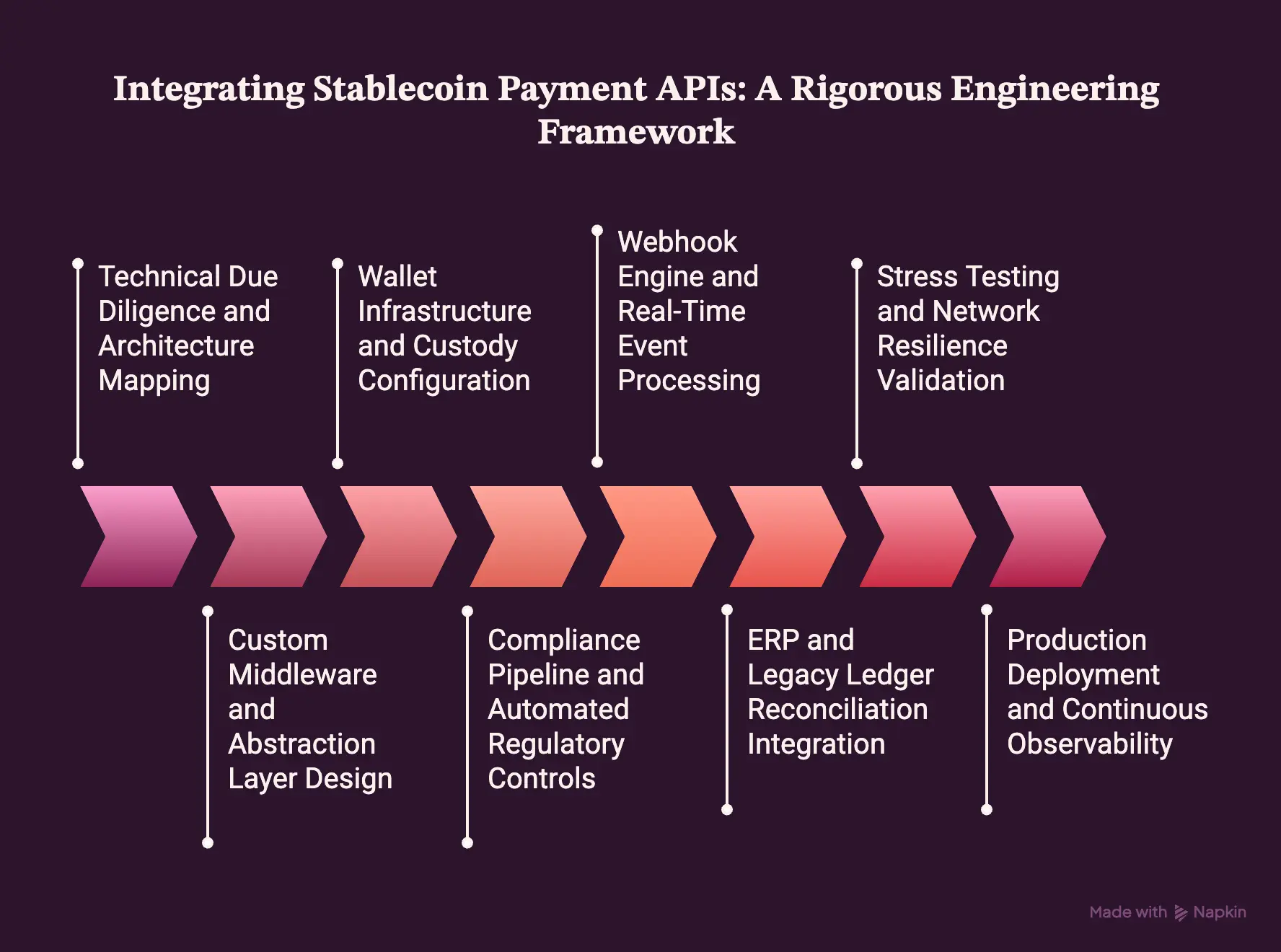
Step 1: Technical Due Diligence and Architecture Mapping
First, our senior architects assess your operational requirements to identify missing lifecycle capabilities and select optimal API vendors.
- Infrastructure Audit: We evaluate existing payment flows, ERP systems, and database schema compatibility.
- Vendor Scorecarding: We rank candidate payment APIs using our 100-point developer evaluation framework.
- Architectural Blueprint: Our team designs a microservices topology that abstracts vendor APIs behind unified internal services.
Step 2: Custom Middleware and Abstraction Layer Design
Next, we engineer a custom abstraction middleware layer to decouple your application core from single-vendor API dependencies.
- Unified API Interfaces: We wrap third-party payment endpoints in standardized internal REST and GraphQL schemes.
- Vendor Fallback Routing: The middleware automatically routes transactions to secondary providers if primary network endpoints fail.
- Request Normalization: We standardize payload structures across multiple chains to simplify downstream data processing.
Step 3: Wallet Infrastructure and Custody Configuration
Next, we configure the wallet infrastructure around the organization’s custody model, transaction policies, and regulatory requirements. To secure this layer, Intellivon can integrate Multi-Party Computation (MPC) with hardware security modules (HSMs) to strengthen key management and reduce single-point signing risk.
In addition, policy controls can enforce multi-signature approvals, spending limits, withdrawal whitelists, and role-based transaction rules before funds move. At the same time, these controls help enterprises align wallet activity with internal governance and compliance requirements.
Finally, where scalable wallet creation is required, programmable wallets can be provisioned through APIs using non-custodial or developer-controlled models based on the product architecture.
Step 4: Compliance Pipeline and Automated Regulatory Controls
After establishing custody layers, we integrate automated compliance tools to manage risk and satisfy local regulatory frameworks.
- Identity Verification: We connect automated KYC and KYB verification pipelines directly into user onboarding workflows.
- Transaction Monitoring: Real-time wallet screening checks transactions against OFAC sanctions lists via tools like Chainalysis.
- Travel Rule Messaging: We implement protocols to exchange originator and beneficiary data seamlessly between VASPs.
Step 5: Webhook Engine and Real-Time Event Processing
Simultaneously, we build an idempotent, high-performance event processing engine to track on-chain transaction status reliably.
- Idempotency Locks: We implement Redis-backed message keys to eliminate duplicate transaction processing.
- Signature Validation: Every incoming webhook payload undergoes strict HMAC signature verification before execution.
- Automated Retry Queues: Failed webhook notifications automatically enter exponential backoff retry cycles.
Step 6: ERP and Legacy Ledger Reconciliation Integration
Furthermore, we bridge crypto settlement data directly into corporate financial software like SAP, Oracle, and NetSuite.
- Automated Ledger Sync: On-chain payouts and receipts translate automatically into double-entry accounting entries.
- FX Spread Accounting: We track and log real-time exchange rate markups to streamline treasury reporting.
- Auditable Trail Generation: The system records complete transaction histories to simplify annual financial audits.
For a deeper breakdown of enterprise ledger synchronization, see our guide on Stablecoin API Integration for Payment Apps.
Step 7: Stress Testing and Network Resilience Validation
Before going live, we execute end-to-end stress tests across simulated testnets and mock fiat payment rails.
- Load Testing: We simulate high-volume transaction spikes to measure rate-limit handling and database concurrency.
- Chaos Engineering: Our engineers deliberately simulate RPC node dropouts, bank rail delays, and gas spikes.
- Security Auditing: We conduct thorough penetration testing and static code analysis on all custom middleware components.
Step 8: Production Deployment and Continuous Observability
Finally, we deploy the integrated payment architecture into multi-region cloud environments with continuous monitoring.
- Containerized Deployment: We deploy microservices on Kubernetes using AWS, Azure, or Google Cloud infrastructure.
- Real-Time Observability: Customized Datadog dashboards track API latency, gas costs, failure rates, and webhook health.
- Ongoing Engineering Maintenance: Our team provides 24/7 maintenance, API version updates, and emergency response support.
Ultimately, partnering with Intellivon ensures your stablecoin payment stack remains secure, scalable, and fully aligned with enterprise compliance standards.
When Should You Use Third-Party APIs vs Custom Payment Infrastructure?
Deciding between third-party stablecoin payment APIs and custom infrastructure depends primarily on your transaction volume, required feature flexibility, and long-term operating margin goals.
1. Build vs. Buy Decision Framework
The table below outlines key operational trade-offs across development timelines, operational costs, and control metrics:
| Strategic Criteria | Third-Party Payment APIs | Custom Payment Infrastructure |
| Speed to Market | Fast launch (1 to 4 weeks). | Extended development (4 to 9 months). |
| Initial Capital Expenditure | Low initial cost ($0 to $5,000 onboarding). | Production build costs ($70,000 to $300,000). |
| Recurring Operational Cost | High variable fees (0.5% to 3.5% per flow). | Fixed maintenance costs; low network gas fees. |
| Data & Feature Control | Restricted by vendor feature roadmaps. | Complete ownership of ledger and user data. |
| Vendor Dependency | High risk of rate limits or deplatforming. | Zero vendor lock-in; multi-rail fallback. |
For a detailed cost analysis, see our guide on How Stablecoins Reduce Cross-Border Payment Costs.
Consequently, enterprise development partners like Intellivon assist engineering teams in evaluating these financial trade-offs and building custom, scalable payment engines
How Much Does Stablecoin API Integration and Custom Development Cost?
A custom stablecoin payment API and orchestration layer should be budgeted at approximately $70,000–$300,000, depending on chains, custody, fiat rails, compliance workflows, SDKs, and enterprise availability requirements.
Consequently, understanding this breakdown helps engineering leaders balance third-party usage fees against long-term custom infrastructure builds.
1. Custom Development Phase Cost Breakdown
The table below details the capital expenditure required across every phase of an enterprise build:
| Development Phase | Estimated Budget |
| Discovery and Architecture | $8,000 – $15,000 |
| Core APIs, Ledger and Payment State Engine | $18,000 – $55,000 |
| Wallet, Custody and Multi-Chain Integrations | $12,000 – $45,000 |
| On/Off-Ramps, FX and Compliance Integrations | $10,000 – $40,000 |
| SDKs, Developer Portal and Enterprise Integrations | $8,000 – $35,000 |
| Security, Testing, Observability and Deployment | $14,000 – $55,000 |
| Enterprise HA, Redundancy and Provider Failover | $0 – $55,000 |
| Total Build Cost | $70,000 – $300,000 |
2. Development Tiers and Scope Allocation
Furthermore, overall project scopes break down into three distinct implementation tiers:
- $70K–$120K (Focused MVP): Single-corridor or focused payment app with one primary payment provider, limited chain support, and standard compliance screening integrations.
- $120K–$220K (Multi-Chain Platform): Scaling fintech product featuring a custom double-entry ledger, automated fiat ramps, automated reconciliation, and multi-vendor integrations.
- $220K–$300K (Enterprise Orchestration): Full provider abstraction, multi-region cloud deployment, automated failover routing, advanced travel rule compliance, and high-volume treasury operations.
3. Ongoing Maintenance and Operational Costs
In addition to initial development, teams must plan roughly 15–20% of the original build cost annually for ongoing platform maintenance.
Consequently, this annual budget covers upstream SDK/API version updates, blockchain network upgrades, security patches, evolving regulatory requirements, and infrastructure optimizations.
For a broader TCO breakdown, see our detailed guide on the Cost to Build a Stablecoin Payment Infrastructure Platform.
Integrate Stablecoin APIs Into Your Software With Intellivon
Building resilient, multi-chain payment software requires an architectural abstraction layer that decouples your core business logic from third-party API dependencies.
Intellivon designs custom enterprise payment middleware that unifies provider endpoints, enforces strict deterministic state, and guarantees auditability across high-volume transaction flows.
- Provider Adapter Layer: Modular integration wrappers that normalize external payloads into canonical internal payment objects.
- Deterministic State Machine: A localized ledger and state engine that tracks payment lifecycles independently of third-party webhooks.
- Resilient Routing & Failover: Health-monitoring microservices that track provider uptime and automatically route traffic to secondary rails during latency spikes.
- Centralized Compliance Engine: Microservice-level policy controls for real-time wallet screening, sanctions checks, and FATF Travel Rule execution.
- Idempotency & Event Processing: Redis-backed deduplication locks combined with event-driven reconciliation to prevent double-spending and ledger drift.
- Secrets & Identity Security: Zero-trust key management leveraging Multi-Party Computation (MPC), automated key rotation, and isolated HSM vaults.
- Targeted ML Utility: Machine learning deployed strictly for anomaly detection, transaction-risk scoring, routing optimization, and automated reconciliation exception triage, and never as an authoritative ledger or compliance signing authority.
- Enterprise Operations: Complete API versioning, migration tooling, distributed tracing, and centralized observability for zero-downtime upgrades.
If you want to build a compliant, multi-chain stablecoin payment architecture tailored to your specific technical stack, book a free strategy call with our experts at Intellivon.
Conclusion
There is no universal winner when selecting payment infrastructure. Ultimately, the right provider depends on what layer it owns, payment lifecycle coverage, SDK maturity, failure handling, chain/stablecoin support, fiat ramps, compliance frameworks, total cost of ownership, and data portability. Furthermore, evaluating our Stablecoin Payment APIs Compared for Developers guide clarifies how operational trade-offs shape product architecture.
The best API is not necessarily the one that completes the fastest demo. Instead, it is the one whose operating model still works when volume and engineering requirements become more complicated.
FAQs
Q1. What Is the Best Stablecoin Payment API for Developers in 2026?
A1. Determining the best API depends entirely on your specific architectural priorities rather than a single universal winner. Consequently, merchant checkout platforms favor Stripe, USDC-native protocols favor Circle, and complex global payout orchestrations favor Crossmint or BVNK. Furthermore, evaluating vendor ownership across custody, liquidity, and compliance dictates the optimal fit.
Q2. Which Stablecoin API Has the Best SDK and Sandbox?
A2. Evaluating developer experience requires testing SDK completeness, type definitions, and sandbox parity instead of trusting landing page claims. Therefore, top-tier platforms supply native libraries across major languages, active GitHub repositories, complete testnet faucets, mock bank clearing rails, and deterministic webhook simulation portals.
Q3. Can Stablecoin APIs Handle Recurring Subscriptions?
A3. While public blockchains lack native pull-payment mechanics like credit cards, modern APIs enable subscriptions via pull-authorization smart contracts or account abstraction. Furthermore, platforms like Stripe and Coinbase CDP manage recurring billing states off-chain, prompting user wallet signatures or executing automated debit permissions upon each billing cycle.
Q4. Do I Still Need KYC and AML if My API Provider Has Compliance?
A4. Yes, because compliance follows a shared-responsibility model between the application developer and the API provider. Therefore, while vendors run sanctions screening, wallet analytics, and Travel Rule messaging, developers remain strictly responsible for user onboarding UI collection, front-end identity verification, application audit logging, and suspicious activity escalations.
Q5. How Do I Benchmark Stablecoin API Latency and Webhooks?
A5. Benchmarking requires measuring p50, p95, and p99 API response times alongside webhook delivery lag under peak congestion. Consequently, developers must stress-test how fast an API ingests payment intents, monitors memory pools, processes block confirmations, handles RPC node dropouts, and executes asynchronous HTTP retry webhooks.
Q6. Should I Integrate One API or Build an Abstraction Layer?
A6. Teams processing under $10M annually across a single chain should integrate a single provider directly to maximize speed. However, once payment volume scales, multi-chain operations expand, or failover resilience becomes mandatory, building a custom middleware abstraction layer eliminates single-vendor lock-in and protects operating margins.
To Sum It Up
- A fast REST response does not prove fast settlement. At the same time, API latency, blockchain finality, webhook delivery, and fiat availability are four different metrics.
- Two vendors can both claim “stablecoin payments” while owning completely different portions of the transaction lifecycle.
- The most expensive API is not always the one with the highest transaction fee. At the same time, FX, ramps, compliance, and engineering lock-in often determine TCO.
- A provider abstraction layer becomes valuable before multi-provider failover becomes urgent, because migration gets harder after provider IDs spread across the product.
- For many fintechs, the best architecture is neither pure build nor pure buy. It is a proprietary ledger and orchestration layer over regulated third-party rails.