Key Takeaways:
- Scalable web development starts with business capacity requirements, mapping users, transactions, data, and geographies before choosing architecture.
- Modular, API-first design allows teams to update individual components without rebuilding the entire platform from scratch.
- Database scalability, caching, asynchronous workloads, autoscaling, and CI/CD pipelines keep performance stable as transaction volume grows.
- Security, observability, and healthcare or fintech compliance must be built into the architecture from day one.
-
How Intellivon builds scalable web platforms costing $70,000 to $300,000, following architecture, build, integration, testing, deployment, and optimization phases.
Every engineering team has hit this moment. The app runs fine for months, then a launch or a press mention sends traffic up fast, and suddenly pages are timing out that never did before. Web development best practices for scalability exist precisely to prevent that scramble by getting the architecture right before growth forces the issue.
However, the expensive part rests in how long it takes to fix once you’re already live. In fact, enterprise downtime now averages more than $300,000 an hour, according to a 2026 downtime cost analysis, and a large share of that traces back to infrastructure that simply wasn’t built to absorb the load it got. Meanwhile, database design and caching strategy tend to be where teams cut corners early, since they’re invisible right up until traffic makes them visible. As a result, once a system’s in production, fixing that foundation takes far longer than building it right the first time.
In this blog, we’ll get into architecture patterns, database and caching design, CI/CD, and observability. Additionally, we’ll cover what holds up specifically in healthcare and fintech applications where uptime and compliance both matter.

What Makes Web Development Scalable for Enterprises?
A scalable web application handles more users, data, and traffic without crashing or becoming too expensive to run. Instead of buying bigger, more expensive servers through vertical scaling, scalable systems add more small servers through horizontal scaling.
As a result, this modern scalable web application architecture design keeps application load fast and prevents system downtime during peak hours.
However, scalability goes far beyond handling simple web traffic. Specifically, true enterprise scalability covers five main operational areas:
- User Growth: Supporting thousands of new users logging in at the same time because system load is distributed evenly.
- Transaction Growth: Processing more credit card payments or medical records without delays so that workflows stay smooth.
- Data Growth: Storing millions of new records while keeping search results fast and responsive.
- Feature Growth: Adding new tools or AI capabilities without breaking existing software features.
- Global Growth: Expanding into new countries via smart geographical scalability patterns to serve distant users.
Furthermore, enterprise leaders must understand the difference between speed, scaling, and reliability. While performance optimization makes an app fast for one person, scaling keeps that same speed when millions use it at once.
Consequently, reliability ensures the app stays online without crashing. Industry guidelines from the Google Cloud Architecture Framework recommend stateless design for better system health.
In addition, technical guidance from the AWS Architecture Center emphasizes spreading workloads across servers to improve high availability, boost throughput, and lower latency.
Ultimately, your application is truly scalable when business growth does not force you to rebuild software from scratch. For a deeper breakdown of modern architecture, see our guide on Intellivon web application development.
Why Enterprises Need Scalability Before Demand Grows
Enterprises build scalable platforms because applications sit directly inside revenue-generating workflows. When digital infrastructure fails under sudden load spikes, companies lose immediate transactions and long-term customer trust.
Consequently, according to research from Gatling on IT Downtime Costs, enterprise application downtime can cost up to $15,000 per minute in lost revenue and emergency remediation.
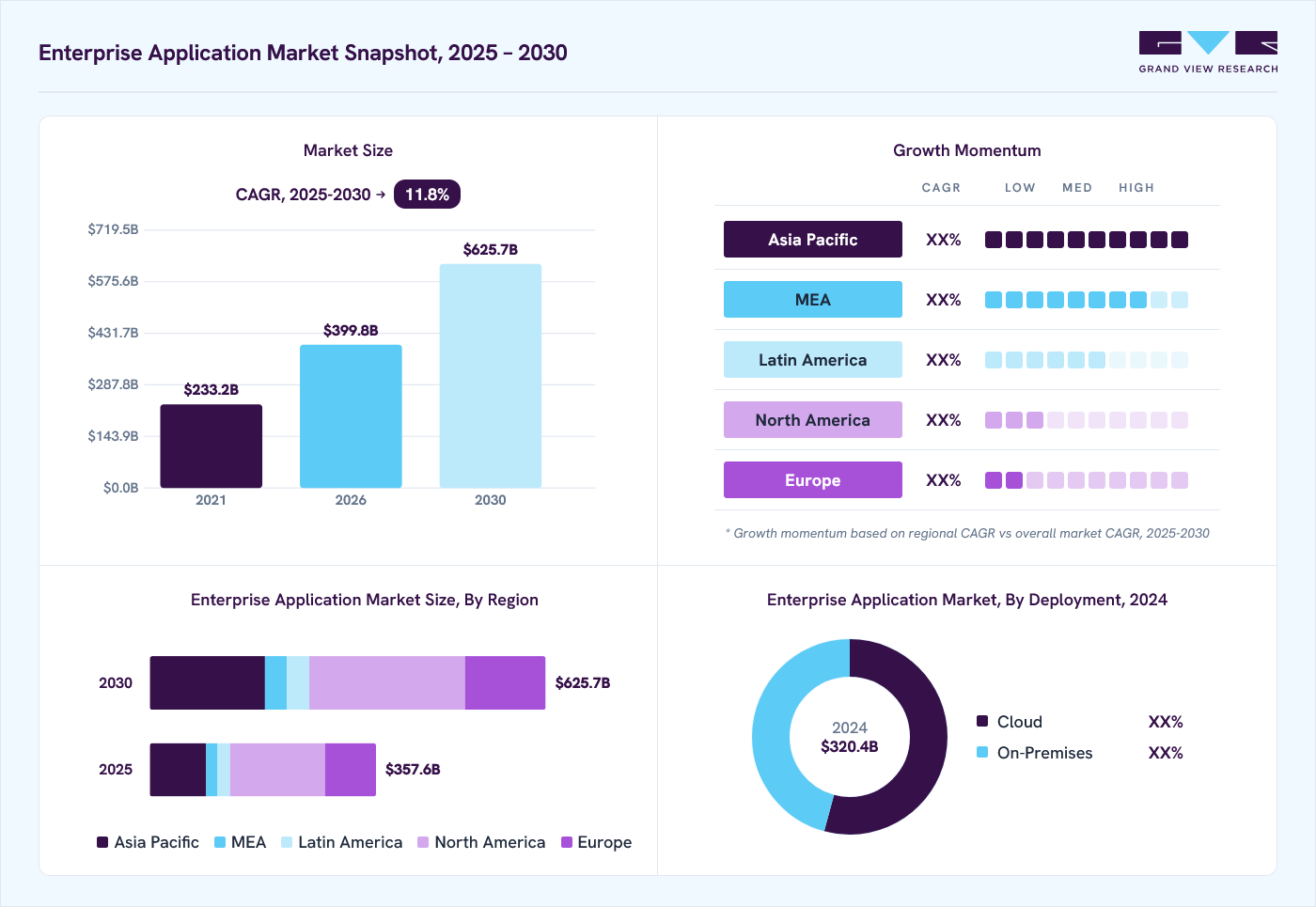
The global enterprise application market is projected to expand from $399.8 billion in 2026 to $625.7 billion by 2030, exhibiting an 11.8% CAGR according to market data from Grand View Research. This rapid growth reflects increasing business investments in cloud-native digital infrastructure to handle expanding transaction volumes.
Furthermore, as highlighted by Technavio’s Enterprise Software Market Analysis, modern enterprises are shifting toward modular architecture to ensure operational continuity.
Comparing Strategic Approaches to Growth
Enterprise platforms fail or succeed based on architectural planning decisions made before user demand surges. Specifically, leaders must choose between reactive fixes and proactive design.
| Architectural Dimension | Without Scalability Planning | With Scalability Planning |
| Feature Velocity | New features require major core changes. | Modules evolve independently across teams. |
| Infrastructure Cost | More traffic inflates fixed infrastructure costs. | Capacity follows real-time demand automatically. |
| System Integrations | API connections create tight dependencies. | API layer isolates and secures core systems. |
| Database Performance | Central database becomes a central bottleneck. | Data workload is distributed across services. |
| Deployment Risk | Software releases become high-risk events. | Automated delivery pipelines reduce release risk. |
| Market Expansion | Regional expansion requires full replatforming. | Architecture accommodates new markets smoothly. |
Enterprise leaders must define expected growth projections before choosing technology stacks. For a deeper breakdown of modernization models, see our guide on scalable web application development best practices.
Web Development Best Practices for Scalable Applications
Building scalable enterprise applications requires a systematic approach across architecture, data management, security, and deployment.
1. Define Business Scalability Targets Before Architecture
Development teams often waste months over-engineering platforms for mythical traffic surges. Instead, engineering choices must start with clear, quantifiable business capacity targets.
- Expected Concurrent Users & RPS: Define normal baseline active users and calculate required requests per second (RPS) alongside peak-to-average traffic multipliers.
- Transaction Throughput & Growth: Project transactions per minute (TPM) and monthly database storage growth rates across key target markets.
- Service Level Objectives: Establish strict Service Level Agreements (SLAs), Service Level Objectives (SLOs), Recovery Time Objectives (RTO), and Recovery Point Objectives (RPO).
- Performance Budgets: Set firm max limits on latency budgets (e.g., sub-200ms API response time) and client-side page load times.
Intellivon’s Approach: We translate business financial models and usage forecasts into concrete architectural capacity limits during discovery, ensuring infrastructure spend scales strictly alongside revenue.
Consequently, setting explicit performance boundaries prevents both under-provisioning outages and premature microservices complexity. Next, let us evaluate how to match high-level architecture directly to these defined targets.
2. Choose Architecture Around Growth
Enterprise teams often treat microservices as an inevitable operational requirement rather than an architectural trade-off. However, system designs must reflect organizational domain boundaries and independent scaling requirements rather than industry trends.
| Architectural Pattern | Ideal Use Case | Operational Trade-Offs |
| Modular Monolith | Single domain platforms where code logic remains closely linked. | Highly cost-efficient, but requires strict code boundaries to prevent software decay. |
| Microservices | Complex enterprise apps requiring independent deployments and scaling. | Excellent fault isolation, but introduces network latency and high infrastructure overhead. |
| Serverless | Event-driven apps with highly unpredictable, bursty usage patterns. | Zero idle infrastructure costs, but risks vendor lock-in and cold-start latency spikes. |
| Event-Driven Architecture (EDA) | Systems processing high-volume, asynchronous workflows using patterns like CQRS. | Outstanding decoupled throughput, but significantly increases tracing and debugging complexity. |
Intellivon’s Approach: We architect domain-driven systems that start modularly and break out into microservices only when isolated scaling, security boundaries, or team velocity demands it.
As a result, selecting the right architectural pattern prevents premature complexity while preserving room for massive expansion.
3. Build API-First Applications for Enterprise Integration
Growing platforms inevitably need to connect with external partner ecosystems, legacy software, and third-party tools. Consequently, without an API-first web application design, each new integration tightly binds core code to external dependencies.
- API Gateways: Centralize traffic management, request throttling, and authentication at the network edge.
- Protocol Selection: Deploy RESTful API scalability for public endpoints, GraphQL for flexible mobile data fetching, and gRPC API scalability for high-speed internal microservice calls.
- Resilience Protocols: Enforce strict idempotency keys for transaction processing alongside web application rate limiting to prevent denial-of-service conditions.
Intellivon’s Approach: We isolate core system logic behind robust API gateways equipped with automated schema validation, token bucket rate-limiting, and backwards-compatible semantic versioning.
For a deeper breakdown of building secure financial API layers, see our guide on How to Develop an Open Banking Platform with Secure API Integration.
4. Keep Frontend Experiences Fast as Products Grow
As web platforms gain features, frontend code bundles expand rapidly, increasing client load times and degrading user retention. Therefore, frontend scalability must focus on delivering instant interactive states regardless of feature complexity.
- Code Splitting & Lazy Loading: Use frameworks like Next.js or React to break application bundles into smaller dynamic chunks loaded on demand.
- State Management: Modernize state frameworks using lightweight tools like Redux Toolkit to prevent unnecessary component re-renders during high-frequency user interactions.
- Edge Content Delivery: Host static assets on global Content Delivery Networks (CDNs) while enforcing aggressive browser caching strategies.
- Core Web Vitals Enforcement: Maintain strict image optimization pipelines and responsive layout boundaries to protect SEO visibility, mobile performance, and digital accessibility.
Intellivon’s Approach: We build modular frontend component libraries with dynamic code-splitting and edge-cached server-side rendering, keeping initial client load times under 1.2 seconds.
Consequently, optimizing client-side performance ensures rapid feature delivery never compromises customer engagement or global usability.
5. Design Databases for Growing Transaction Volumes
Unoptimized database queries represent the single most common cause of enterprise application slowdowns under heavy traffic.
So, rather than debating SQL versus NoSQL, architectures should select data stores tailored directly to specific workload characteristics.
- Query & Index Optimization: Write efficient queries and build targeted composite indexes to avoid full table scans.
- Connection Pooling: Implement connection proxy tools to manage high-volume concurrent client requests without exhausting memory.
- Read Replicas: Separate read and write paths, directing heavy reporting queries to specialized read replicas.
- Sharding & Partitioning: Distribute large relational tables across distinct physical database nodes based on tenant or geographic keys.
- Use PostgreSQL or MySQL for ACID-compliant transactional records.
- Deploy MongoDB or Cassandra for high-throughput, unstructured document storage and horizontal write availability.
Intellivon’s Approach: We design hybrid data architectures utilizing connection pooling, read/write splitting, and automated database sharding to maintain sub-10ms query execution across billions of records.
Proper data layer design prevents transaction bottlenecks and lays the foundation for high-throughput application caching.
6. Use Caching and Async Processing to Absorb Demand
Direct database reads and synchronous request handling severely limit peak system throughput. Therefore, combining multi-tier caching with asynchronous message queues allows platforms to absorb sudden traffic spikes gracefully.
- Edge & CDN Caching: Cache static content and public API responses at the network edge to minimize origin server load.
- In-Memory Caching: Deploy Redis or Memcached clusters for user session states, configuration data, and frequent database queries using explicit TTL invalidation rules.
- Offload long-running operations, such as report generation, email notifications, and data processing, to background worker tasks.
- Utilize high-throughput event streaming platforms like Apache Kafka, RabbitMQ, or AWS SQS to handle asynchronous message processing smoothly.
Intellivon’s Approach: We implement event-driven architectures utilizing Redis caching and Kafka message streams, decoupling heavy operations from primary API response loops.
As a result, buffering heavy workloads protects database health and keeps critical user interfaces fast.
7. Scale Infrastructure With Demand Instead of Forecasts
Over-provisioning fixed hardware wastes capital, whereas under-provisioning risks sudden outages during usage spikes. Consequently, modern enterprise platforms scale infrastructure dynamically based on real-time resource utilization.
- Container Orchestration: Package applications into Docker containers managed by Kubernetes clusters to automate scaling, health monitoring, and self-healing.
- Infrastructure as Code (IaC): Define cloud resources using Terraform and Helm charts, ensuring environment consistency across multi-cloud deployments.
- Dynamic Autoscaling & Load Balancing: Use Horizontal Pod Autoscaling alongside intelligent load balancers, deploying round-robin, least-connections, or sticky session algorithms based on traffic profiles.
- Serverless Execution: Utilize AWS Lambda or Azure Functions for intermittent event handlers to minimize idle compute costs.
Intellivon’s Approach: We build automated IaC pipelines on AWS, Azure, and Google Cloud that dynamically scale compute resources in response to real-time traffic demand.
Dynamic resource allocation optimizes operational expenditure while guaranteeing uptime during unexpected peak usage.
8. Build Security and Compliance Into the Architecture
Retrofitting security onto a live platform creates severe vulnerabilities and compliance violations. Therefore, enterprise applications must incorporate zero-trust principles and regulatory safeguards directly into their core architecture.
- Enforce OAuth 2.0 framework authentication and short-lived JWT authorization tokens paired with fine-grained Role-Based Access Control (RBAC).
- Safeguard edge endpoints using Web Application Firewalls (WAF), automated rate limiting, and DDoS protection layers.
- Protect data at rest using AES-256 encryption and data in transit using TLS 1.3, alongside strict secrets management tools.
- Mitigate modern application risks by strictly aligning code development with the OWASP Top 10:2025 standard.
- Healthcare (HIPAA): Enforce technical safeguards, encrypted audit trails, and strict data-minimization practices for electronic Protected Health Information (ePHI).
- Fintech (PCI DSS v4.0.1 & SOC 2): Implement isolated tokenization vaults, strict access logging, and immutable audit logs to secure payment card data.
Intellivon’s Approach: We integrate automated dependency vulnerability scanning, zero-trust token verification, and continuous compliance audit trails into every deployment layer.
Building robust compliance safeguards into the delivery pipeline protects sensitive data and streamlines security testing before release.
9. Test Scalability Before Customers Test It for You
Relying on live users to discover application performance limits compromises customer trust and risks business continuity. Comprehensive load, stress, and failure testing must occur continuously throughout development.
- Unit & Integration Testing: Validate core business logic and API endpoints using Cypress and Playwright test suites.
- Load & Stress Testing: Simulate peak expected user traffic using k6, Apache JMeter, or Gatling to identify latency degradation points.
- Spike & Endurance Testing: Subject the platform to sudden extreme traffic spikes and prolonged high-volume loads to uncover memory leaks and database connection locks.
- Chaos Engineering: Inject infrastructure component failures deliberately to verify system redundancy and automated failover mechanics.
Intellivon’s Approach: We execute automated k6 load-testing scripts within CI/CD pipelines, validating that every production release satisfies target throughput limits under simulated peak conditions.
Thorough pre-launch load testing isolates performance bottlenecks before code reaches production environments.
10. Make Deployment and Observability Part of Scalability
You cannot scale a system responsibly if operational teams lack visibility into system performance and transaction failures. At the same time, high-throughput application management requires continuous delivery pipelines combined with full-stack observability.
- Safe Deployment Strategies: Implement blue-green deployments and canary releases using feature flags to roll out updates gradually with instant automated rollback capabilities.
- OpenTelemetry Observability: Standardize the collection of metrics, distributed traces, and application logs using OpenTelemetry standards.
- Real-Time Dashboards & Alerting: Visualize infrastructure health via Prometheus and Grafana, while routing anomaly alerts to operational teams using Datadog or the ELK stack.
Intellivon’s Approach: We construct automated CI/CD pipelines paired with end-to-end OpenTelemetry distributed tracing, providing complete visibility into every microservice interaction.
Establishing full operational visibility ensures engineering teams detect, isolate, and resolve system anomalies long before they impact end users.
Healthcare and Fintech Applications Need Extra Controls
Scaling enterprise applications becomes significantly more complex when software supports regulated workflows.
While general consumer apps focus primarily on traffic volume, healthcare and fintech platforms must scale without compromising regulatory compliance or transaction integrity.
1. High-Volume Clinical Architecture and ePHI Safeguards
Healthcare applications like patient portals, RCM software, and clinical dashboards manage sensitive electronic Protected Health Information (ePHI).
Specifically, security guidelines from the U.S. Department of Health & Human Services (HHS) mandate administrative, physical, and technical safeguards.
- Data Isolation: Encrypt ePHI at rest using AES-256 and enforce strict Role-Based Access Control (RBAC).
- Interoperable APIs: Build scalable FHIR APIs for high-frequency EHR data exchanges without dropping context.
- Audit Logging: Maintain immutable audit trails alongside high-availability disaster recovery pipelines.
- Intellivon’s Approach: We construct HIPAA-compliant clinical portals featuring isolated data vaults, automated audit trails, and zero-trust API boundaries.
For a deeper breakdown of compliant medical platforms, see our guide on Healthcare Software Development: A Complete Guide.
2. Financial Transaction Concurrency and Compliance
Fintech platforms like payment engines and banking suites demand absolute precision under heavy traffic.
Consequently, because standards enforced by the PCI Security Standards Council set strict requirements for payment data, financial web applications require targeted transaction controls.
- Idempotency Controls: Use idempotency keys across API gateways to prevent duplicate charges during network timeouts.
- Real-Time Fraud Streams: Route live payments through asynchronous risk models without slowing down checkout speeds.
- PCI DSS v4.0.1 Compliance: Isolate card numbers inside secure tokenization vaults to reduce audit exposure.
- Intellivon’s Approach: We engineer high-concurrency payment platforms using idempotent API gateways and distributed real-time fraud engines.
Ultimately, scaling carries different operational risks when a delayed request transitions from a minor user inconvenience into a halted payment or delayed clinical workflow.
How Intellivon Builds Scalable Enterprise Web Applications
Building an enterprise platform capable of supporting millions of concurrent transactions requires a disciplined execution strategy. Consequently, instead of rushing directly into writing code, Intellivon follows a structured six-step engineering framework designed to eliminate technical debt and ensure long-term system resilience.
As a result, our development process guarantees high performance under heavy traffic spikes.
Step 1 — Map Business Growth and Application Workloads
Before choosing technology stacks, engineering teams must establish precise operational capacity assumptions based on real business projections.
- Workload Discovery: We map peak concurrent users, requests per second, transaction volumes, geographic expansion goals, and regulatory requirements across all core workflows so that capacity aligns with revenue goals.
- Technical Debt Assessment: Furthermore, our architects audit existing software bottlenecks, database locks, and API dependencies to isolate performance risks early.
- Intellivon’s Approach: We translate business financial forecasts into clear performance budgets and capacity maps during discovery, thereby ensuring infrastructure scales predictably alongside company growth.
Consequently, defining these workload boundaries prevents costly architectural redesigns as customer demand increases.
Step 2 — Design Architecture, Data, and Integration Layers
With clear capacity targets established, engineering teams must design decoupled systems capable of handling expanding data flows.
- Core Architectural Choices: We evaluate trade-offs between modular monoliths, microservices, and event-driven patterns based on team velocity and domain isolation needs because every application workload behaves differently.
- Data & API Topology: In addition, our teams select specialized SQL and NoSQL databases, build multi-tier caching, and design secure RESTful or gRPC API gateways.
- Intellivon’s Approach: We construct domain-driven systems that isolate data storage, streamline third-party integrations, and incorporate custom AI models only when specific automation workflows require them.
Step 3 — Construct Core Frontend and Backend Systems
Once architectural blueprints are validated, core development begins with a strict focus on modular code quality and performance optimization.
- Frontend & Backend Execution: We build responsive frontend interfaces using Next.js or React while constructing secure backend microservices equipped with rate-limiting and access controls.
- Asynchronous Buffering: Meanwhile, our engineers integrate Redis caching alongside message queues like Kafka or AWS SQS to handle heavy background workloads smoothly.
- Intellivon’s Approach: We build modular software components using strict coding standards, thus ensuring rapid client-side rendering and sub-100ms API response times under load.
As a result, building clean application foundations prepares the platform for seamless third-party software integrations.
Step 4 — Embed Security and Regulatory Compliance Controls
Because enterprise applications handle financial transactions or health records, they require continuous security validation built directly into the codebase.
- Zero-Trust Access Implementation: We integrate OAuth 2.0 authentication, role-based access control (RBAC), data encryption standards, and automated vulnerability scanning so that endpoints remain protected.
- Industry-Specific Compliance Gates: Specifically, healthcare builds incorporate HIPAA technical safeguards and FHIR access controls, while fintech systems enforce PCI DSS tokenization vaults.
- Intellivon’s Approach: We embed compliance validation tools into early development cycles, thereby establishing immutable audit logs and zero-trust security boundaries across all data layers.
Consequently, enforcing security controls early ensures the platform passes rigorous load and penetration testing before going live.
Step 5 — Validate Performance via Load and Failure Testing
Relying on live users to expose system bottlenecks creates massive operational risks for modern enterprise brands. Therefore, comprehensive pre-launch testing is non-negotiable.
- Rigorous Scalability Testing: We execute automated k6, Apache JMeter, and Gatling test scripts to stress-test system throughput under extreme simulated traffic spikes so that failure limits are known.
- Chaos Engineering & Failover: Additionally, our QA engineers inject deliberate database and network outages to verify automated self-healing mechanisms and failover reliability.
- Intellivon’s Approach: We continuously benchmark platform response times against target SLAs, hence resolving database locking issues and memory leaks before production deployment.
Indeed, thorough pre-launch validation ensures operational pipelines remain stable during major customer onboarding events.
Step 6 — Deploy, Observe, and Optimize Production Scale
Launching a platform is simply the beginning of long-term application sustenance and cloud performance management. Instead of walking away after launch, we maintain continuous oversight.
- Automated Cloud Delivery: We deploy containerized workloads using Kubernetes, Terraform, and automated CI/CD pipelines supporting blue-green and canary releases so that updates cause zero downtime.
- Full-Stack Telemetry: Simultaneously, our teams configure OpenTelemetry distributed tracing alongside Prometheus and Grafana dashboards to monitor real-time SLO metrics.
- Intellivon’s Approach: We conduct regular capacity reviews and cloud-cost optimizations, thereby proactively resolving emerging technical debt while keeping infrastructure spend efficient.
Ultimately, this systematic engineering process allows enterprise platforms to scale reliably while maintaining high availability, security, and low operational overhead.
Furthermore, through continuous observability and proactive maintenance, Intellivon keeps mission-critical web applications performing smoothly as business demand accelerates.
How Much Does a Scalable Web Application Cost?
Enterprise scalable web application development typically costs $70,000–$300,000 within the scope covered in this guide, depending on architecture, integrations, security requirements, data volume, cloud complexity, and modernization needs.
| Development Phase | Cost Range |
| Discovery and Scalability Assessment | $7,000–$15,000 |
| UX, Product, and Architecture Design | $8,000–$20,000 |
| Frontend and Backend Development | $25,000–$70,000 |
| Data and Enterprise Integrations | $15,000–$50,000 |
| Cloud, DevOps, and Scalability Engineering | $10,000–$35,000 |
| Security, Compliance, and QA | $10,000–$35,000 |
| Deployment and Production Observability | $5,000–$15,000 |
Because these engineering phases overlap during execution, total investment should not be calculated by adding all upper bounds together. Instead, project budgets align directly with specific enterprise delivery tiers:
- $70,000–$110,000 (Focused Scalable MVP): Establishes core application logic, modular database architecture, basic API endpoints, and cloud infrastructure ready for early user growth.
- $120,000–$200,000 (Growth-Ready Business Application): Delivers full multi-tier caching, automated CI/CD pipelines, complex third-party integrations, and robust role-based security controls. Furthermore, this tier ensures stable throughput as active usage scales.
- $200,000–$300,000 (Enterprise Scalable Platform): Constructs high-throughput microservices, isolated compliance vaults for HIPAA or PCI DSS, automated load testing, and multi-region cloud deployment so that global systems remain resilient.
Consequently, engineering teams must also account for operational continuity after release. Plan approximately 15–25% of the initial build cost annually for ongoing maintenance, infrastructure optimization, security updates, real-time monitoring, and technical-debt management.
Planning a scalable enterprise web application? Get an architecture and development-cost assessment from Intellivon before you commit the full build budget.
How to Measure Whether Scalability Is Paying Off
Investing in enterprise application scalability is ultimately a financial and operational decision rather than a purely technical exercise.
While engineering teams focus on keeping systems online, executive leaders must measure concrete performance metrics to verify that architectural investments deliver real business value.
According to framework standards from OpenTelemetry, system reliability requires ensuring that a service performs the exact behavior users expect under load, rather than simply maintaining basic server uptime.
Consequently, executives should track technical performance indicators across three primary operational categories:
- System Performance Metrics: Track p95/p99 response latency, request throughput, system error rates, overall service availability, and database query latency to ensure fast user interactions.
- Resource & Infrastructure Efficiency: Monitor cache hit ratios, queue depth, CPU/memory utilization, and net cost per transaction to prevent unnecessary cloud expenditure.
- Engineering Velocity & Stability: Measure deployment frequency, change failure rates, mean time to recovery (MTTR), and third-party integration delivery timelines to evaluate development speed.
Ultimately, improvements in these underlying technical metrics translate directly into tangible executive outcomes. Lower request latency and higher uptime protect core transaction revenue, decrease active customer churn, and accelerate feature delivery across new geographic markets.
Furthermore, optimizing infrastructure utilization controls cloud unit economics, ensuring that business growth expands operating margins instead of inflating fixed overhead costs.
Conclusion
Applying enterprise web development best practices ensures technology never becomes a bottleneck to business expansion. By aligning modern architecture, database design, API integrations, and cloud infrastructure, engineering teams create systems that handle rapid user growth smoothly.
Furthermore, embedding zero-trust security, rigorous performance testing, and full-stack observability protects revenue workflows while controlling cloud spend. Ultimately, building scalable applications guarantees that your software evolves alongside market demand, driving long-term profitability and sustainable operational success.
FAQs
Q1. Do scalable applications always require microservices?
A1. No, scalable applications do not always require microservices. Well-architected modular monoliths scale horizontally to millions of requests at lower cost. Instead, use microservices only when independent deployment cycles, distinct organizational team ownership, isolated fault domains, or highly asymmetric resource demands across services make distributed architecture necessary.
Q2. When should an enterprise scale an existing application?
A2. An enterprise should scale an existing application when technical metrics signal clear operational bottlenecks. Therefore, key triggers include rising p95/p99 latency, database CPU or I/O saturation, unmanageable message queue growth, severe traffic peaks causing errors, deployment release bottlenecks, or an increasing infrastructure cost per transaction.
Q3. Should enterprises build or buy scalable web applications?
A3. Enterprises should build custom scalable web applications when workflows represent core proprietary IP, require complex integrations, or demand unique compliance models. Conversely, buying off-the-shelf software makes sense for generic business operations. Custom builds ensure complete data ownership, tailored security frameworks, and unconstrained long-term architectural control.
Q4. What compliance requirements affect scalable web development?
A4. Compliance requirements depend strictly on specific application workloads and data types. Healthcare workloads handling ePHI must implement HIPAA technical safeguards, while payment systems must satisfy PCI DSS v4.0.1 requirements. Additionally, platforms must align with GDPR data privacy rules, SOC 2 operational controls, and OWASP Top 10 security standards.
Q5. How do AI features change web application scalability?
A5. AI features introduce non-deterministic workloads requiring dedicated model gateways, vector retrieval pipelines, GPU hardware provisioning, and asynchronous inference queues. Consequently, AI integration increases token costs and API response latency. However, ordinary web applications do not require an AI model simply to achieve high technical scalability.
To Sum It Up
- Scalability starts with business capacity assumptions, and not with choosing Kubernetes or microservices.
- A modular monolith that can scale horizontally may be a better enterprise architecture than prematurely operating dozens of microservices.
- Infrastructure scalability without database, API, and integration scalability simply moves the bottleneck somewhere else.
- The best scalability metric is not server count. It is whether transaction capacity can grow without proportional growth in failures, latency, or cost.
- Enterprise scalability means designing a credible path to growth without paying for hypothetical scale years before the business needs it.