Key Takeaways
-
Healthcare billing AI automates charge capture, coding, eligibility, claims submission, and revenue analytics workflows.
-
FHIR R4 APIs, HL7 feeds, payer rules engines, and EDI 837/835 are foundational architecture requirements.
-
Explainable AI, human-in-the-loop review, audit logs, and MLOps monitoring ensure production-grade reliability.
-
Custom builds cost $70,000 to $200,000, depending on EHR integrations, NLP depth, and SaaS scalability.
-
How Intellivon builds this: production revenue infrastructure connecting payer rules, AI workflows, and compliance controls together.
Building a healthcare billing AI platform comes down to five components. These include a rules engine that tracks payer behavior, a language layer for clinical notes, an EHR integration framework, a denial prediction model, and a compliant data architecture. Practices that skip this sequence see claim rates improve for a year, then stall, because the platform they use is not built to scale.
The part standard build plans overlook is payer monitoring built into the AI’s learning cycle. Without it, rule changes and policy updates quietly erode performance over 12 to 18 months, and patients start connecting billing errors with the practice itself. When monitoring and retraining are built in from day one, practices implementing AI-driven claim validation have reported denial rates falling by as much as 42%, with administrative cost per claim dropping by nearly 25%, doubling the platform’s ROI in year one.
Intellivon has spent over 10 years building healthcare AI systems with an integration approach that makes billing data usable by an AI model, which is the step standard build plans skip. This blog covers architecture, model requirements, integration specs, compliance controls, and real cost ranges, so you finish with a plan you can act on.
What a Healthcare Billing AI Platform Actually Automates
A healthcare billing AI platform automates everything between a clinical note and a paid claim, like coding, payer validation, claim submission, payment posting, denial prevention, and patient billing. It is not a standalone claims tool. Instead, it connects patient access, coding, billing, clearinghouse, payer, and finance workflows into one system, so revenue does not fall through the gaps between them.
1. Front-End Patient Clearance
The platform verifies insurance eligibility, confirms benefits, tracks prior authorizations, and estimates patient responsibility before a claim is created.
This eliminates the most common denial triggers, like missing authorizations and incorrect coverage data, before they ever reach the payer.
2. Charge Capture and Code Generation
AI captures charges directly from clinical documentation, generates superbills, and applies fee schedule rules automatically, removing manual charge entry and the coding lag that delays claim submission.
3. Claim Submission and Denial Prevention
The platform scrubs and submits claims while simultaneously scoring each one for denial risk.
Salesforce notes that AI billing systems now handle coding accuracy, claim prediction, and fraud detection as core functions, and not optional add-ons.
4. Payment Posting and Revenue Integrity
After adjudication, the platform posts payments, processes remittance advice, flags underpayments, and identifies revenue leakage patterns.
It also manages patient billing and payment plan workflows, closing the loop between payer reimbursement and patient collections.
Once the workflow scope is clear, the next decision is where AI should support judgment and where deterministic billing rules must stay in control.
Why Enterprises Are Building Billing Intelligence Now
Hospitals and clinics lose millions of dollars every year because health insurance companies refuse to pay their claims. To fix this, companies are building smart healthcare billing AI platform systems. These systems help doctors get paid much faster, lower the cost of managing paperwork, and stop common mistakes before they happen.
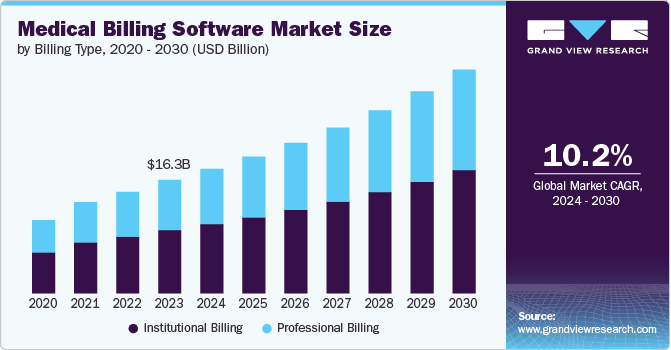
Because insurance rules change constantly, old software cannot keep up anymore. As a result, the medical billing software market is growing incredibly fast. It was worth $16.34 billion in 2023 and will hit $32.18 billion by 2030.
1. Some Market Insights:
- Big companies are investing heavily in this technology right now. For example, a tech firm named Commure raised $70 million at a huge $7 billion valuation in May 2026.
- Their smart AI software automatically handles more than 85% of hospital billing tasks.
- Another major billing company called Waystar made $1.099 billion in 2025 with very high profits.
These numbers prove that building automated software to handle healthcare payments is a massive business opportunity.
2. Where the Profit Opportunity Comes From
The real profit does not come from selling simple AI features. Instead, it comes from controlling the actual flow of money between doctors and insurance companies.
A custom billing platform makes money by fixing expensive mistakes in the payment cycle. It stops lost revenue like denied claims, missed billing codes, and slow manual data entry.
- Monthly Subscriptions: Hospitals and local clinics pay you a steady monthly fee to use the software.
- Pay-Per-Claim Fees: You charge a small transaction fee every single time a doctor submits a bill.
- Bonus Recovery Fees: You take a percentage of the lost money that your AI successfully wins back from insurance companies.
3. Why Enterprises Must Have AI Billing Infrastructure
Healthcare companies need their own AI infrastructure because tracking insurance paperwork by hand ruins cash flow. Legacy systems are too simple and make too many errors.
However, a custom AI platform reads doctor notes just like a human clerk. It instantly catches missing details before any bills are sent out.
- Adapts to Insurance Rules: The AI learns new insurance rules instantly to stop flat-out rejections.
- Automates Medical Coding: It translates medical procedures into standard billing codes without human errors.
- Speeds Up Payments: The system processes digital receipts instantly to get cash into the bank faster.
The market has officially moved from old manual billing software to automated billing intelligence. The next big opportunity belongs to teams that build AI directly into everyday medical coding, claims, and hospital workflows.
Why Smart Billing AI Should Start Before the Claim Is Created
Traditional billing tools start working far too late in the process by scanning bills only after a clerk enters the charges.
A smart billing platform must start working during the actual doctor visit, checking documentation, coverage, coding, and prior authorization status to stop expensive financial mistakes before the formal claim even exists.
1. Encounter-to-Claim Readiness
The system evaluates the complete clinical encounter in real time to ensure all background compliance checks match before creating an itemized bill. This step prevents broken records from ever formatting into a standard claim layout.
2. Documentation Completeness
The platform reads unstructured doctor notes using clinical language understanding to flag missing clinical details instantly.
- Fixes Blanks Instantly: The software alerts the clinical staff to fill in missing details before the patient even leaves.
- Reduces Back-and-Forth: Doctors do not have to reopen old charts weeks later to answer basic billing questions.
- Improves Record Accuracy: Accurate notes provide a clear coding audit trail that easily survives strict insurance audits.
3. Charge Capture Risk
Hospitals lose significant revenue simply because they forget to bill for items used during treatment, which is a problem called charge capture risk.
- Spots Forgotten Items: The system scans for related supplies, lab tests, or extra facility fees automatically.
- Prevents Undercharging: It cross-references the internal hospital fee schedule management system to maximize legitimate revenue.
- Eliminates Manual Audits: Software replaces slow human chart reviews, which drastically reduces the overall cost to collect.
4. Missing Modifier Detection
Medical bills use special two-digit codes called modifiers to explain unique treatment situations. If a bill is missing a modifier, insurance computers reject it instantly.
- Applies Rules Automatically: The system adds necessary billing modifiers based on the specific combination of medical procedures.
- Checks Medical Necessity: It checks Local Coverage Determinations to ensure the diagnosis code completely justifies the treatment
- Validates Complex Coding: The tool verifies evaluation and management coding levels to prevent risky over-billing.
5. Medical Necessity Checks
The system scans the International Classification of Diseases codes against local coverage rules to verify that the insurance provider explicitly covers the performed treatment.
This prevents immediate rejections based on policy mismatching.
6. Prior Authorization Dependency
Many expensive medical treatments require official approval from an insurance company before the procedure happens.
The smart platform automatically verifies this approval status ahead of time to prevent flat-out rejections.
- Checks Benefits Instantly: The software runs insurance eligibility verification through electronic data interchange networks.
- Tracks Active Approvals: It links the approved authorization number directly to the digital superbill generation system.
- Estimates Patient Costs: The tool calculates the patient responsibility estimation so clinics can collect copays upfront.
7. Payer-Specific Claim Risk
The platform monitors historic payment patterns across individual commercial insurers to predict customer rejection patterns before submission.
Consequently, the software routes high-risk bills to human billing specialists for manual review.
8. Clean Claim Probability
An internal compliance engine scores each potential claim on an accuracy scale before sending the file to an external clearinghouse.
Therefore, only bills with a verified high clean claim rate advance into your active accounts receivable pipeline.
Intercepting data at the point of care stops revenue leakage before it compounds into an expensive billing denial. Moving your compliance validation upstream guarantees that your administrative team handles clean data from day one.
Transforming Healthcare Revenue Cycle Management with AI Agents is highly relevant here because it showcases how a multi-agent system orchestrates clinical coding, claims processing, and compliance monitoring directly inside the modern revenue cycle.
The Claim-Readiness Layer (Core of the Platform)
A healthcare billing AI platform needs a core claim-readiness layer to score every medical encounter before it is ever sent out. Instead of fixing bills after they get rejected, this layer acts like an automated stop sign that grades data quality in real time.
Consequently, it checks clinical evidence, payer rules, coding logic, and coverage details simultaneously. This proprietary scoring model prevents broken medical claims from entering your active billing pipeline.
Therefore, your administrative team only spends time handling records that have a guaranteed chance of getting paid immediately.
1. Documentation Readiness Score
This scoring module checks if the doctor’s typed clinical notes actually support the procedures listed on the bill. For example, if a note mentions treating a broken bone but leaves out the X-ray details, the AI spots the gap.
- Flags Missing Proof: The software calculates a percentage score showing how complete the supporting clinical text is.
- Alerts Doctors Early: It prompts clinical staff to fix empty chart descriptions before the patient finishes checking out.
- Secures Clean Audits: High scores create an automated coding audit trail that easily passes external federal reviews.
2. Coverage Readiness Score
This tool runs electronic insurance eligibility verification automatically right as the patient encounter finishes. It ensures the specific health insurance policy is active and covers the exact treatment day.
- Verifies Plan Limits: The system double-checks if a patient’s employer plan has recently changed or expired.
- Maps Exact Benefits: It confirms if the performed medical service is a fully covered benefit under that plan.
- Lowers Front-End Rejections: Spotting inactive insurance early stops the most common type of front-desk billing mistakes.
3. Coding Readiness Score
The platform scans the selected medical codes against complex government and commercial billing databases. At the same time, it checks if the combination of ICD-10-CM diagnosis codes and CPT procedure codes matches legal guidelines.
- Catches Coding Conflicts: The engine highlights forbidden code combinations based on updated NCCI edits (Source: CMS, 2025).
- Checks Coding Level: It reviews evaluation and management levels to make sure the billing matches the visit length.
- Blocks Human Error: Automated code checking ensures that busy billing clerks do not accidentally use outdated, expired codes.
4. Authorization Readiness Score
This module tracks required approvals before a claim goes out by verifying prior authorization tracking data. It checks if the insurance company gave official permission for the specific procedure.
- Matches Approval Numbers: The software links the exact prior authorization code to the digital superbill generation file.
- Alerts Missing Approvals: It holds back the bill if an expensive surgery lacks a verified approval file.
- Saves Appeal Labor: Checking authorizations early eliminates the primary cause of high-value outpatient insurance denials.
5. Payer-Rule Readiness Score
Different insurance companies use completely different rules for processing identical medical claims. This system uses a smart payer rules engine to score the bill against the specific insurer’s past behavior.
- Learns Insurer Quirks: The software updates its checking rules based on recent local and national coverage updates.
- Tracks Dynamic Changes: It adapts instantly when a local insurance plan quietly shifts its custom filing deadlines.
- Guarantees Plan Compliance: Matching unique payer behaviors ensures your claims pass custom clearinghouse validation rules easily.
6. Payment Variance Risk Score
This score predicts whether the insurance company will try to underpay the doctor for the service. It compares the expected payout against the system’s internal fee schedule management records.
- Detects Low Payouts: The AI highlights contract clauses where a payer regularly underpays for specific therapies.
- Flags Contract Violations: It alerts managers if the calculated insurance pricing falls below the legally agreed rate.
- Stops Revenue Leakage: Spotting underpayment risks early allows your legal team to fight unfair insurance payouts immediately.
7. Denial Probability Score
This predictive machine learning model analyzes historical billing data to calculate a simple risk percentage. It tells you exactly how likely an insurance company is to reject the claim.
- Forecasts Claim Rejection: A high percentage score warns your team that a claim contains hidden filing risks.
- Prioritizes Bill Review: It automatically bubbles high-risk bills to the top of the office schedule for quick fixing.
- Boosts Acceptance Rates: Keeping risky bills out of the mail dramatically raises your overall clean claim rate.
8. Human Review Trigger
The platform uses an automated routing engine to decide when a medical bill needs human eyes. If any readiness score falls below your custom safety threshold, the system halts submission.
- Halts Risky Bills: The software locks the claim file automatically so it cannot be sent out accidentally.
- Sends to Specialists: It places the broken bill into a human-in-the-loop review queue for expert coders.
- Saves Staff Time: Clerks ignore perfect bills and only spend their time fixing complex, high-risk errors.
Using a claim-readiness layer ensures that your billing system is completely proactive instead of reactive. Building these automated checkpoints directly into your software workflow keeps your cash flow entirely stable and predictable.
Healthcare Billing AI Platform Architecture Built Around Claim Readiness
A production healthcare billing AI platform architecture should include eight layers: data ingestion, normalization, rules validation, AI decisioning, workflow orchestration, human review, system integration, and analytics. This structure lets the platform process clinical, claims, payer, payment, and compliance data without turning every new workflow into custom engineering work.
Consequently, it creates an enterprise blueprint that anchors every technical layer directly to your pre-submission claim-readiness scoring models. Therefore, the system serves as an intelligent execution layer rather than a basic passive database.
The table below breaks down the technical responsibilities and exact engineering stacks for each architectural layer:
| Architectural Layer | Layer Responsibility and Data Processing | Exact Technology Stack Used |
| Encounter Ingestion Layer | Captures real-time clinical events and schedules right from hospital systems. | Apache Kafka, AWS Lambda, CDS Hooks |
| Documentation Intelligence Layer | Extracts raw text from doctor charts to confirm clinical treatments. | Python, Amazon Bedrock, Claude 3.7 Sonnet |
| Coding Validation Layer | Converts clinical descriptions into valid codes and checks NCCI rules. | TensorFlow, SpaCy, National Correct Coding Initiative database |
| Payer-Rule Memory Layer | Stores and processes dynamic local and national coverage policies. | PostgreSQL, Redis Enterprise caching |
| Claim-Readiness Scoring Layer | Runs machine learning pipelines to calculate real-time rejection risks. | PyTorch, Scikit-learn, FastAPI microservices |
| Human Review Orchestration Layer | Isolates low-scoring bills and routes them to expert billing managers. | React.js frontend, Node.js backend, Camunda BPMN |
| EDI 837 / 835 Transaction Layer | Generates standard medical claims and processes incoming digital insurance receipts. | X12 EDI parser libraries, PostgreSQL, AWS KMS |
| Payment and Underpayment Analytics Layer | Tracks actual insurance payouts against system contract schedules to stop leakage. | D3.js dashboards, Apache Spark, Snowflake data warehouse |
| MLOps and Payer Behavior Monitoring Layer | Evaluates model drift and spots sudden changes in payer denial patterns. | MLflow, Prometheus tracking, and Grafana visualization |
Building your software infrastructure with this modular design protects your overall development pipeline from system-wide downtime. Moving data fluidly across these dedicated checkpoints guarantees that every medical bill matches recent insurance rules perfectly.
For a deeper breakdown of real-time clinical data processing systems, see our guide on AI Healthcare Claims Processing Software Development.
AI Billing Confidence Ladders (When to Automate and Escalate)
A smart healthcare billing AI platform should not use one automation threshold. Instead, it should use confidence ladders that decide whether a billing action can move automatically or needs human review. Consequently, the platform calculates real-time math scores for every itemized medical bill before submission. If the data is pristine, the system pushes the claim forward instantly without human hands.
The table below outlines the core automation and escalation framework based on real-time platform confidence scores:
| Confidence Level | Platform Action and Routing Decisions | Core Department Escalated To |
| 95% or Greater | Auto-approve low-risk billing tasks directly to the clearinghouse. | None (Fully Autonomous) |
| 80% to 94% | Route to the standard billing reviewer to check minor details. | Front-Office Billing Team |
| 60% to 79% | Request documentation or explicit payer validation checks. | Certified Medical Coder |
| 40% to 59% | Escalate to the coding or compliance lead for deep contract review. | Auditing and Compliance Director |
| Below 40% | Block claim completely until core information is re-entered. | System Administrator / Executive |
1. Coding Confidence
This ladder level evaluates how accurately your machine learning models have translated doctor descriptions into standard billing codes. For example, it checks if the selected ICD-10-CM codes match the exact medical procedures.
- Checks Translation Quality: The model calculates a precision percentage score based on historical chart training data.
- Catches Soft Flags: If the confidence drops to 85%, the system forces a billing review to check for code mismatches.
- Eliminates Wild Guesses: It blocks any automated code assignments that fall below a basic 60% probability floor.
2. Documentation Confidence
This check measures if the raw text written by the clinical staff contains enough physical evidence to justify the bill. It uses advanced language processing tools to scan for missing diagnostic keywords.
- Verifies Clinical Evidence: The software scores the thickness of the text against typical national treatment templates.
- Prompts Local Updates: Low scores trigger an immediate notification to the local clinic desk to gather more chart details.
- Blocks Empty Submissions: It holds back records that lack a clear, documented timeline of the patient’s actual visit.
3. Payer-Rule Confidence
This engine scores how well a prepared medical claim matches the highly customized formatting rules of individual insurance networks. Because regional policy criteria shift constantly, the platform tracks historic acceptance success rates.
- Monitors Insurer History: The tool cross-references current claims against recent payment trends for that exact insurance plan.
- Flags Format Adjustments: It routes the bill to human clerks if a payer suddenly changes its custom filing address.
- Guarantees High Acceptance: Maintaining high rules scores ensures that your initial claims pass through external clearinghouse checks smoothly.
4. Medical Necessity Confidence
This score verifies if the performed medical treatment is considered reasonable and necessary under government insurance laws. It checks the claim against active National Coverage Determinations.
- Validates Treatment Logic: The AI checks if the patient’s recorded symptoms completely justify an expensive diagnostic test.
- Prevents Care Rejections: It alerts managers if a local insurance rule forbids combining specific therapies on the same day (Source: CMS, 2025).
- Protects Audit Trails: High necessity scores prove to external investigators that your treatments follow legal healthcare pathways.
5. Authorization Confidence
This module calculates a verification score based on the status of required pre-approval documents. It confirms that the insurance company explicitly authorized the care before it happened.
- Matches Approval Strings: The system compares the prior authorization code against active data inside your practice management system.
- Catches Expired Forms: It sounds an alarm if an approval number has passed its legal expiration date.
- Saves High-Value Capital: Holding back unapproved high-cost surgeries saves your organization from dealing with uncollectible medical debts.
6. Payment Risk Confidence
This final ladder step evaluates the financial safety of the entire transaction before the electronic data interchange files go out. It estimates the likelihood of receiving a full, correct payout.
- Predicts Contract Adjustments: The software flags bills where a payer is highly likely to underpay the agreed contract rate.
- Identifies Hidden Gaps: It isolates claims containing historical error patterns that typically lead to a permanent denial.
- Maximizes Net Revenue: Routing high-risk items to expert human eyes ensures your team captures every single dollar of legitimate income.
Using a multi-tiered confidence ladder prevents your automated billing workflows from breaking down when dealing with complex, edge-case medical charts. At the same time, moving low-scoring records out of the main stream allows your administrative platform to scale safely without increasing compliance risks.
Also Read: For a deeper breakdown of building autonomous medical decision networks, see our guide on How to Build an AI Medical Coding Platform.
How to Design Specialty-Specific Billing Intelligence
A healthcare billing AI platform cannot use identical processing logic across different medical branches. For example, dermatology clinics deal with rapid, high-volume skin biopsies, while orthopedic groups handle complex surgical code bundles. Each specialty has unique documentation patterns, distinct CPT logic, custom modifier rules, varied payer scrutiny, specific authorization risks, and distinct denial behaviors.
Consequently, a generic, one-size-fits-all billing engine creates massive error rates. Therefore, your platform architecture must deploy tailored machine learning models optimized for the exact clinical workflows of each medical department.
1. Specialty-Specific Billing Logic
Each medical field requires dedicated training datasets to help the underlying machine learning models understand specific clinical jargon. For instance, a cardiology engine must interpret complex electrocardiogram patterns and structural heart measurements from raw text notes.
- Decodes Tailored Jargon: The software translates unique abbreviations and procedural descriptions that generic language models miss.
- Applies Targeted Regulations: It embeds specific clinical guidelines that only apply to specialized therapeutic treatments.
- Reduces System Noise: Filtering out unrelated medical rules makes the background validation engine run much faster.
2. ASC Billing Workflows
Ambulatory Surgery Centers (ASCs) combine complex facility fees with separate professional doctor bills for a single operative event. This dual-billing structure requires your event-driven billing workflow engine to pull data from multiple scheduling and inventory tracks simultaneously.
- Bundles Multiple Streams: The platform automatically links the surgeon’s chart with local nursing notes and anesthesia records.
- Captures Implant Costs: It scans surgical inventory logs to make sure expensive medical hardware is fully billed.
- Optimizes Facility Payouts: Matching operational timelines with facility fee schedules prevents expensive multi-thousand-dollar revenue leakage.
3. E&M Coding Validation
Evaluation and Management (E&M) codes determine the financial value of standard doctor office visits based on clinical decision complexity. The platform uses clinical language understanding to review chart notes and verify that the recorded care level matches the chosen code.
- Prevents Upcoding Risks: The AI flags bills where the selected code describes a visit far more complex than the actual notes justify.
- Stops Downcoding Losses: It automatically elevates the code level if the doctor documented highly complex medical decision-making.
- Maintains Audit Compliance: Every automated adjustment creates a clear coding audit trail that easily survives federal payer investigations.
4. Procedure-Heavy Specialties
Fields like radiology and interventional pain management rely heavily on rapid, high-volume physical imaging operations. These procedure-heavy specialties face intense insurance scrutiny because payers constantly look for unbundled code violations.
- Identifies Unbundled Codes: The system detects if a billing clerk accidentally listed separate steps of a single combined procedure.
- Verifies Imaging Proof: It scans radiology reports to confirm that the documentation proves the medical necessity of the scan.
- Accelerates Processing Speeds: Automating high-volume procedural reviews allows large diagnostic centers to process thousands of daily scans instantly.
5. Modifier Sensitivity
Certain specialties use billing modifiers constantly to explain that multiple distinct procedures happened during a single patient session. For example, orthopedic surgeons rely heavily on specific structural modifiers to indicate exactly which joint or side of the body was treated.
- Applies Modifiers Automatically: The rules engine applies exact geometric modifiers based on structural keywords found in operative reports.
- Prevents Immediate Rejections: It checks if a required modifier is missing before the clearinghouse system rejects the file.
- Tracks Payer Variances: The software learns which specific insurance networks require unique modifier combinations for outpatient therapies.
6. Medical Necessity Documentation
Behavioral health and physical therapy platforms must prove that ongoing treatments remain medically necessary over long multi-month care periods. Consequently, the AI scans historical patient progress notes to ensure the documentation satisfies strict Local Coverage Determinations.
- Tracks Long-Term Metrics: The platform measures functional progress scores across successive patient encounters automatically.
- Flags Coverage Gaps: It alerts therapists if a patient’s chart lacks the updated clinical data needed to justify further sessions.
- Secures Recurring Revenue: Ensuring continuous medical necessity compliance stops insurers from retroactively clawing back historical payments.
7. Specialty-Specific Denial Prediction
Insurance companies deploy custom automated algorithms to reject specific high-cost medical treatments across different branches. To combat this, your predictive machine learning model must analyze historical denial trends broken down by individual specialty codes.
- Spots Custom Rejection Patterns: The AI identifies if a specific local payer is actively rejecting a new physical therapy code.
- Calculates Targeted Risk: It assigns a precise denial probability score based on the specialty’s unique historical file errors.
- Protects Profit Margins: Isolating high-risk specialty claims allows your staff to correct formatting issues before submission.
8. Specialty-Specific Reviewer Queues
When a claim-readiness score drops below the safety threshold, the system must route that specific bill to a qualified specialist. Therefore, the workflow orchestration layer uses smart routing rules to segment broken bills into specialized departmental work lists.
- Matches Coder Expertise: The software sends complex cardiology claims to certified cardiovascular coders rather than general clerks.
- Speeds Up Corrections: Specialized reviewers fix familiar, branch-specific errors much faster than a traditional multi-specialty pool.
- Lowers Operational Overhead: Streamlining the human-in-the-loop review pipeline minimizes the overall administrative cost to collect.
Deploying specialty-specific intelligence ensures your platform handles the deep operational nuances of diverse medical fields without breaking down. This targeted architectural design maximizes your clean claim rate across every single clinic in your enterprise provider network.
How to Build an AI Healthcare Billing Platform Step by Step
To build AI healthcare billing platform capabilities safely, Intellivon starts with workflow scope, then designs data architecture, rules logic, AI models, integrations, human review, HIPAA controls, testing, and KPI monitoring. We move your build from one high-value workflow to production-scale orchestration rather than trying to automate the entire revenue cycle at once.
Consequently, this step-by-step methodology ensures our engineering team delivers a clean, scalable system that prevents massive software rewrite costs later. Therefore, following our strict structural path keeps your product aligned with complex administrative demands from day one.
Step 1 — Define Billing Scope and Revenue Goals
We start by defining which billing workflows the platform will automate first, which specialties it will support, and which revenue KPIs it must improve.
Therefore, pinpointing your precise operational target prevents our developers from writing overly generic software logic.
- Map Revenue Leakage: Intellivon analyzes your historical data to find where you are actively losing money.
- Select Target Specialties: We help you choose a single specialty area to build for your initial rollout.
- Set Clear Targets: Our team locks in exact goal numbers for your clean claim rates and payment timelines.
Step 2 — Map Data Sources and Billing Event Triggers
The next step is mapping every data source that influences billing decisions. This includes encounter notes, orders, diagnoses, procedures, insurance details, eligibility responses, payer policies, claim histories, remittance files, denial reasons, payment data, and patient balances.
Each source must trigger the correct billing event. Consequently, the software learns exactly when to look for information.
- Invent Data Pathways: Intellivon builds a clean tracking map for every piece of information a doctor types.
- Standardize Input Formats: We clean up messy patient files, clinic codes, and insurance addresses automatically.
- Automate System Alerts: Our data tracking system sets up instant triggers for every background task.
Step 3 — Design Microservices Billing Architecture
A smart billing platform should use modular services for eligibility, charge capture, coding support, claim validation, payer rules, denial prediction, payment posting, appeals, audit logs, and analytics.
This microservices billing architecture prevents one workflow change from breaking the entire platform as payer logic and product scope expand. Therefore, our engineering team can update individual modules without taking down the entire enterprise network.
The table below details how Intellivon structures these independent services inside a multi-tenant SaaS billing platform layout:
| Core Microservice | Primary System Function | Inter-Service Communication Tool |
| Ingestion Service | Collects raw hospital charts and scheduling logs. | Apache Kafka Event Bus |
| Scoring Engine | Runs predictive machine learning risk models. | FastAPI Rest Microservice |
| Rules Validator | Cross-references bills against payer directories. | Redis Caching Cluster |
| Transaction Service | Creates and signs standard insurance file layouts. | Dockerized Node.js Worker Queues |
- Decouple System Blocks: Intellivon separates individual billing features so updates never crash your entire software.
- Power Multi-Tenant Scaling: We build the core code so you can easily host multiple separate clinics safely.
- Speed Up Processing: Using message queues allows our platform to process thousands of bills simultaneously.
Step 4 — Build the Payer Rules Engine
The payer rules engine validates claims against payer policies, NCCI edits, LCD / NCD rules, medical necessity checks, fee schedules, modifier logic, authorization rules, and documentation requirements.
This deterministic layer should sit beside AI models because some billing rules must be enforced exactly, not predicted probabilistically. Consequently, this hybrid design protects your system from generating illegal or non-compliant bills.
- Hardcode Strict Laws: Intellivon programs official government billing guidelines directly into a fast rules database
- Track Policy Changes: We build automated tools that watch for sudden shifts in commercial insurance rules.
- Log Every Change: Our engine maintains a permanent audit trail showing exactly who changed a rule and when.
Step 5 — Develop AI Models With Confidence
AI model development should focus on extracting evidence, recommending actions, predicting risk, and explaining why a claim needs review.
The model layer should include clinical NLP, denial prediction, coding assistance, underpayment detection, document extraction, and LLM summarization, with confidence scoring applied before any recommendation reaches billing teams. Therefore, users always understand why the software flagged an error.
- Decode Medical Texts: Intellivon builds custom language tools that read unstructured notes to find treatment proof.
- Explain Risk Scores: Our models highlight the exact sentences causing a high denial risk score.
- Trigger Smart Routing: The AI pushes low-confidence bills to human worklists automatically based on custom cutoffs.
Step 6 — Integrate EHR and Payment Systems
Production billing automation depends on reliable integration with EHRs, practice management systems, clearinghouses, payer APIs, payment gateways, and financial systems.
The platform must exchange claims, eligibility, remittance, denial, and payment data through FHIR R4, HL7, EDI 837, EDI 835, and secure APIs where available. Without these live connections, your software remains a passive reporting screen.
- Create Live Links: Intellivon builds bidirectional FHIR R4 connections that sync directly with software like Epic.
- Translate Industry Files: We build processors that convert clinical data into standard EDI 837 claims formats.
- Automate Receipt Posting: Our system reads incoming EDI 835 insurance receipts to update bank balances instantly.
Step 7 — Add Human Review and Override Workflows
Human review workflows should route uncertain, high-value, high-risk, or compliance-sensitive billing decisions to trained users.
The platform should show AI rationale, source evidence, confidence scores, payer rules, coding history, and override options so reviewers can approve, reject, correct, or escalate recommendations with a complete audit trail.
- Design Custom Screens: Intellivon builds simple visual dashboards tailored specifically for busy medical coders.
- Segment Staff Queues: We route broken claims to specific team buckets based on individual clerk skills.
- Secure Manual Changes: The platform records every single human text correction to maintain total data safety.
Step 8 — Launch Pilot, Track KPIs, and Monitor Model Drift
Launch the platform with a controlled pilot across one specialty, payer group, or billing workflow before scaling.
The pilot should measure clean claim rate, first-pass acceptance rate, denial rate, denial overturn rate, days in AR, underpayment recovery, reviewer productivity, model accuracy, and model drift over several billing cycles.
- Roll Out Safely: Intellivon deploys a small, restricted pilot launch to test code before full-scale-up.
- Track Model Drift: We set up automated monitoring to ensure the AI does not lose accuracy over time.
- Monitor Payer Shifts: Our software flags sudden spikes in insurance rejections so you can update rules instantly.
Moving through these consecutive development phases guarantees that your billing platform scales smoothly without experiencing expensive software bugs. Once your engineering path is firmly established, your team can begin mapping out realistic development timelines and financial budgets.
Also Read: For a deeper breakdown of real-world software implementation steps, see our comprehensive guide on AI Healthcare Claims Processing Software Development.
Where AI Fits in Medical Billing Without Replacing Human Control
AI fits best in healthcare billing when it improves speed, accuracy, prioritization, and evidence retrieval without removing human accountability from complex billing decisions.
At the same time, it suggests codes, flags missing documentation, predicts denial risk, and routes exceptions, but human billing teams must still review uncertain claims, appeals, and high-risk files.
1. NLP Clinical Documentation Extraction
Our system reads through the raw text notes that your doctors type during a patient visit. Consequently, it automatically extracts specific medical facts to figure out exactly what treatments happened.
2. ICD-10-CM Coding Support
The software cross-references clinical note details against standard disease registries to suggest highly accurate diagnosis markers. Therefore, your staff does not have to spend hours searching through massive code books.
3. CPT Code Assignment
The platform translates performed medical procedures into standard tracking numbers required by commercial insurance companies. This automated step speeds up the overall invoice generation pipeline significantly.
4. HCPCS Code Suggestions
Our tool identifies specialized medical supplies, equipment, and outpatient therapies used during a patient session. Consequently, it ensures that your team bills for every piece of inventory.
5. E&M Coding Validation
The engine checks evaluation and management code strings to verify that the billing tier matches the actual visit complexity. This immediate step prevents risky, automated over-billing.
6. Medical Necessity Checking
The system reviews diagnosis logs to ensure the documented treatment meets strict national insurance coverage rules. Therefore, it keeps your clinic compliant with standard Medicare filing laws.
7. Confidence Scoring
The software assigns an accuracy percentage grade to every automated code suggestion before submission. Consequently, billing teams can easily bypass perfect records and focus entirely on high-risk files.
8. Explainable AI Recommendations
The system highlights the exact sentences inside a doctor’s note that justify a billing recommendation. This transparent display ensures that your billing team understands the reasoning behind the code.
9. Human-in-the-Loop Review
Our platform locks low-scoring files automatically and drops them into user worklists for direct manual validation. Consequently, your certified human coders retain ultimate control over final approvals.
10. Coding Audit Trail
The software logs every single automated suggestion alongside every human modification inside an unchangeable database ledger. Therefore, you maintain absolute accountability for every transaction.
Enforcing a strict human review framework ensures that your business safety standards remain completely uncompromised. This collaborative control model has to show up directly in the platform architecture.
If you are still confused about how AI plays a role in these platforms, you can book a free call with us, and we will tell you everything you need to know.
Smart Billing Platform Development Cost for Custom Builds
Smart billing platform development cost usually ranges from $90,000 to $380,000+, depending on workflow scope, EHR integrations, clearinghouse connectivity, AI model complexity, HIPAA controls, payer-rule depth, analytics requirements, and whether the product is internal software or a multi-tenant SaaS platform.
| Development Phase | Estimated Cost | What It Covers |
| Product discovery and billing workflow mapping | $10,000–$25,000 | Revenue leakage analysis, specialty selection, payer mix, MVP roadmap |
| UX/UI for billing teams and reviewers | $15,000–$35,000 | Worklists, dashboards, exception queues, claim review screens |
| Data ingestion and normalization layer | $25,000–$70,000 | EHR data, claims data, payer data, payment files, FHIR/HL7 mapping |
| Billing workflow orchestration engine | $30,000–$85,000 | Task routing, event-driven billing workflow, SLA timers, queue logic |
| Payer rules and compliance engine | $25,000–$80,000 | NCCI edits, LCD/NCD checks, fee schedules, and medical necessity rules |
| AI model development | $40,000–$130,000 | NLP, denial prediction, coding support, underpayment detection |
| EHR, clearinghouse, and payer integrations | $35,000–$120,000 | Epic, FHIR R4, HL7, EDI 837/835, payer APIs, payment systems |
| HIPAA security and audit controls | $20,000–$65,000 | RBAC, encryption, audit logs, PHI controls, BAA-ready architecture |
| Testing, deployment, and MLOps monitoring | $20,000–$70,000 | QA, security testing, model monitoring, observability, release pipeline |
Therefore, a realistic budget must include integration work, data normalization, security controls, human review workflows, and long-term rule maintenance. At the same time, ongoing maintenance usually costs 18%–30% of the initial build cost per year.
This covers payer-rule updates, integration maintenance, model retraining, compliance reviews, cloud infrastructure, support, and workflow improvements after launch.
For example, a $180,000 billing AI platform may need $32,000–$54,000 per year for maintenance. A $380,000 enterprise-grade build may need $68,000–$114,000 per year, especially if it supports multiple specialties, payer rules, EHR connections, and AI models.
Planning a healthcare billing AI platform build? Get a custom cost estimate based on your billing workflows, EHR stack, payer mix, AI model scope, compliance needs, and rollout timeline.”
Also Read: For a deeper breakdown of connected RCM infrastructure, see our guide on the Enterprise AI Revenue Cycle Management Platform Guide.
5 Healthcare AI Organizations Already Building AI Medical Billing Platforms
Several healthcare AI organizations have already built platforms that automate parts of the medical billing and revenue cycle workflow. Some focus on autonomous coding, while others focus on enterprise RCM, claims management, prior authorization, reimbursement intelligence, or healthcare payments.
Together, they show where the market is moving: from billing task automation to AI-powered revenue infrastructure.
The table below profiles five leading healthcare AI companies establishing this infrastructure baseline:
| Organization | What They Built inside the Industry | Why It Matters for Your Custom Build Strategy |
| AKASA | Generative AI models for automated insurance authorization tracking, clinical documentation integrity (CDI), and claims management workflows. | Proves that automated billing engines are expanding beyond basic file cleaning into full back-office task orchestration. |
| Commure | An agentic AI revenue cycle platform that automates over 85% of complex enterprise administrative tasks across 3,000 healthcare sites | Demonstrates massive enterprise buyer demand for deep, native practice management and billing automation software systems. |
| Waystar + Iodine | Waystar finalized a $1.25 billion acquisition of Iodine Software to combine clinical reasoning engines with scaled payment networks | Shows that dominant billing networks are buying deep clinical reimbursement intelligence rather than building standalone tools. |
| Nym | An autonomous medical coding engine that utilizes clinical language understanding to assign codes with a 95%+ touchless accuracy rate. | Highlights the critical business requirement for clear, unchangeable coding audit trails and transparent decision reporting. |
| Fathom | A deep learning medical coding platform that achieved a 95.5% automation rate at 98.3% accuracy in a major 2026 deployment | Confirms that autonomous coding serves as a highly scalable engine that directly accelerates your clean claim rate. |
1. What These Companies Prove About the Market
These organizations prove that AI billing is not a single product category. Instead, it represents a comprehensive stack of revenue functions, including medical coding, claim readiness, payer intelligence, denials, remittance, payment posting, and reimbursement optimization.
For example, AKASA proves generative models work across early authorizations, while Commure proves enterprise scale. Furthermore, the Waystar acquisition demonstrates the fusion of finance and clinical notes, while Nym and Fathom prove production accuracy.
2. How Intellivon Positions Against These Examples
Intellivon does not position itself as a rigid, off-the-shelf competitor to these established enterprise technology platforms.
Instead, we serve as your specialized engineering development partner to help your firm build proprietary billing intelligence around your exact clinic workflows and custom payer mix.
- Tailored Infrastructure Blocks: We build custom multi-tenant SaaS billing platform codebases that your team owns completely.
- Proactive Checkpoint Layers: Our developers deploy dedicated claim-readiness modules that stop financial errors before creating an EDI invoice.
- Embedded Software Controls: We configure explainable AI recommendations alongside strict, rules-based human-in-the-loop review screens to protect your audit liability.
These market examples show the direction clearly: the next generation of healthcare billing platforms will not just submit claims faster. They will predict whether every encounter is financially ready before revenue is put at risk.
Also Read: For a deeper analysis of market infrastructure changes, see our guide on AI Healthcare Claims Processing Software Development.
Build a Healthcare Billing AI Platform With Intellivon
Intellivon builds healthcare billing AI platforms around real revenue workflows, secure data architecture, payer-aware rules, explainable AI, human review, and production monitoring. The goal is to build a controlled revenue infrastructure that billing teams can trust.
1. Define the Right Billing Automation Scope
Every billing AI build starts with choosing the right workflow scope. Intellivon helps healthcare teams identify where automation can create a measurable billing impact before development begins.
- MVP planning based on billing volume, payer mix, and revenue goals
- Specialty selection for ASC, physician group, or SaaS workflows
- Billing workflow mapping across front-end, mid-cycle, and back-end tasks
- Revenue leakage analysis across denials, missed charges, and underpayments
- AI opportunity scoring to prioritize workflows with the strongest ROI
2. Design the Platform Architecture
A healthcare billing AI platform needs an architecture that can support real billing operations, not just dashboard automation. Intellivon designs the system around claim readiness, review workflows, payer rules, and integration depth.
- Microservices billing architecture for modular workflow expansion
- Event-driven workflows for claim, denial, payment, and review actions
- EHR and clearinghouse integration planning from the start
- Data normalization across clinical, claims, payer, and payment systems
- Audit-ready system design for billing decisions and reviewer actions
Build AI Models Billing Teams Can Trust
Billing teams need AI that explains its recommendations clearly. Intellivon builds model workflows that support coding, denial prevention, claim review, and payment intelligence without removing human control.
- Clinical NLP for documentation review and billing evidence extraction
- Denial prediction to flag high-risk claims before submission
- Coding assistance for ICD-10-CM, CPT, HCPCS, and E&M validation
- Confidence scoring to decide when automation or review is needed
- Explainable recommendations linked to documentation and payer logic
Integrate With Healthcare Revenue Systems
The value of billing AI depends on how well it connects with existing revenue systems. Intellivon helps build integrations that let the platform act inside live billing workflows.
- Epic integration for encounter, billing, and documentation data
- Oracle Health / Cerner connectivity for enterprise clinical workflows
- FHIR R4 and HL7 integration for structured healthcare data exchange
- EDI 837 / EDI 835 workflows for claims and remittance processing
- Clearinghouse, payer API, and finance system integrations
Make AI Billing Secure and Monitorable
Healthcare billing AI must protect PHI, support auditability, and stay reliable after launch. Intellivon designs the platform with compliance, monitoring, and governance built into the architecture.
- HIPAA-ready architecture for secure billing data workflows
- PHI controls across ingestion, model processing, storage, and review
- Role-based access for billing teams, reviewers, and administrators
- Audit logs for AI recommendations, claim edits, and user actions
- MLOps monitoring and model drift detection after deployment
If you are planning to build a healthcare billing AI platform around claim readiness, payer-rule logic, coding support, denial prediction, payment posting, or underpayment detection, Intellivon can help you define the roadmap before development begins.
Conclusion
Building a custom healthcare billing AI platform transforms your financial operations from a reactive back-office burden into a modern revenue infrastructure. This intelligent platform seamlessly connects raw clinical documentation, precise coding logic, dynamic payer rules, and remittance posting into one controlled operating layer.
Consequently, your enterprise eliminates systemic revenue leakage and stops costly insurance denials before they can damage your cash flow. If your team is evaluating whether a proprietary build matches your current growth targets, mapping your core data requirements is the logical next step for your product roadmap.
Things To Know About Healthcare Billing AI Platforms
Q1. How much does it cost to build medical billing software with AI, CPT codes, SOAP notes, and insurance connectivity?
A1. Building a custom production-ready platform typically costs between $120,000 and $380,000. This financial budget shifts depending on system scale, overall data processing volume, and specialty-specific logic requirements. Ongoing engineering maintenance and MLOps model drift tracking generally require an additional 15% to 20% of your initial software construction cost annually.
Q2. Why is EHR integration still the hardest part of healthcare billing automation?
A2. EHR integration remains incredibly complex because individual health systems configure their databases differently. Brittle, legacy on-premise setups often lack open API architectures. Consequently, developers must write customized webhooks and map highly fragmented clinical fields across separate FHIR R4 and HL7 data feeds to establish real-time billing event triggers.
Q3. Can AI replace medical billers and coders completely?
A3. No, machine learning tools cannot replace human oversight due to severe upcoding compliance risks and shifting payer regulations. Instead, technology acts as an efficiency companion that handles repetitive data entry. Automated systems require clear human-in-the-loop review queues so certified human specialists can audit and sign off on low-confidence recommendations.
Q4. What should a healthcare billing AI platform do that basic billing software does not?
A4. Basic tools simply format and transmit invoices after manual input occurs. Conversely, an intelligent platform reviews raw doctor notes using clinical language understanding to predict rejection risks before an invoice is created. It automatically flags missing modifiers, verifies real-time insurance eligibility, and calculates custom pre-submission claim-readiness scores.
Q5. What is the biggest mistake founders make when building healthcare billing software?
A5. The biggest mistake is attempting to automate the entire revenue cycle simultaneously on day one. Software teams easily deplete their capital by building overly broad, generic feature dashboards. Instead, successful developers achieve better returns by targeting a narrow MVP scope focused exclusively on one specialty or high-value denial workflow.