Key Takeaways:
-
Healthcare billing automation covers eligibility, charge capture, coding, claims, payments, and analytics workflows.
-
EDI 837 submission, EDI 835 remittance, and payer-rule logic are core technical requirements.
-
Denial prediction, payment posting automation, and HIPAA controls ensure production-grade revenue protection.
-
Custom builds cost $60,000 to $220,000, depending on EHR integrations, AI depth, and rollout scope.
-
How Intellivon builds healthcare billing automation platforms as production revenue infrastructure, not fragmented billing tools.
When a single claim in your organization has to pass through eight different systems before it even reaches the clearinghouse, something has gone wrong, and it has nothing to do with the claim itself. A healthcare billing automation platform effectively solves this gap. It brings submission, denial management, and payment posting into one governed pipeline, so the revenue cycle actually runs as a cycle.
Whether the platform actually delivers the desired results depends on specialty-specific billing logic. Generic billing rules don’t account for what each specialty in the hospital actually requires. So when orthopedics, behavioral health, and oncology claims all run through the same ruleset, they fail because the rules weren’t specifically built around that specialty. That is what keeps multi-specialty groups stuck at 85–87% first-pass acceptance. Instead, when organizations build separate logic layers for each specialty, they reach 92–96% first-pass acceptance and a 20–30% reduction in days in AR within 10–14 months.
Intellivon has been building healthcare AI systems at this depth for over ten years, specifically with payer rules designed as an updatable configuration, and platform performance holds when policies shift. This blog draws from this experience and covers the entire development process from the ground up. By the end, you will be able to make a decision on building such a platform.
What Is a Healthcare Billing Automation Platform?
A healthcare billing automation platform is software that handles your entire medical billing cycle from start to finish without manual paperwork. It automatically checks insurance coverage, submits clean claims to payers, and tracks payments.
Instead of forcing your staff to jump between multiple confusing tools, this platform brings every step into one simple system to eliminate manual data entry errors and speed up your collections.
1. What the Platform Automates Across the Billing Lifecycle
This system automates your administrative work across the entire billing lifecycle. At the same time, it categorizes tasks into front-end, mid-cycle, and back-end stages to eliminate manual touchpoints completely.
| Billing Stage | What the Platform Automates | Core Benefits |
| Front-End Operations | Insurance eligibility verification, benefits verification, and prior authorization tracking. | Stops eligibility denials before care begins. |
| Mid-Cycle Operations | Charge capture automation, superbill generation, CPT code assignment, and ICD-10-CM coding automation for HCPCS codes. | Eliminates manual coding entry errors. |
| Back-End Operations | Claims scrubbing, claims submission automation, payment posting automation, patient collections automation, and accounts receivable automation. | Speeds up payments and lowers outstanding balances. |
Automating these three distinct phases ensures that your data moves smoothly from patient check-in to final payment reconciliation without manual data entry.
2. Where It Sits Between the Integration Systems
This platform does not replace your electronic health record or your practice management system. Instead, it serves as an intelligent bridge that sits directly between your clinical, administrative, payer, and internal financial systems.
The software connects your entire operational network by managing data flows across these critical endpoints:
- Clinical & Administrative Sync: Uses deep EHR billing integration and practice management system integration to pull patient encounter data automatically as soon as a doctor finishes a chart note.
- Payer & Clearinghouse Communication: Manages your outbound EDI 837 transaction files for automated claim submissions and directly ingests inbound EDI 835 remittance processing files via direct payer APIs and automated clearinghouse integration.
- Patient & Financial Settlement: Connects directly with secure digital payment gateways to collect patient balances and pushes real-time financial data straight into your core accounting and finance systems.
By acting as a central coordinator rather than a replacement system, the platform keeps your existing software investments perfectly synchronized. At the same time, it removes the manual data gaps that usually cause delayed payments.
Why Healthcare Teams Build Custom Billing Automation Platforms
Healthcare teams build custom billing automation platforms when standard commercial tools cannot support their billing complexity, specialty mix, payer rules, integration needs, or AI goals. A custom build gives engineering and clinical teams absolute control over core workflows, validation rules, financial data, and system performance.
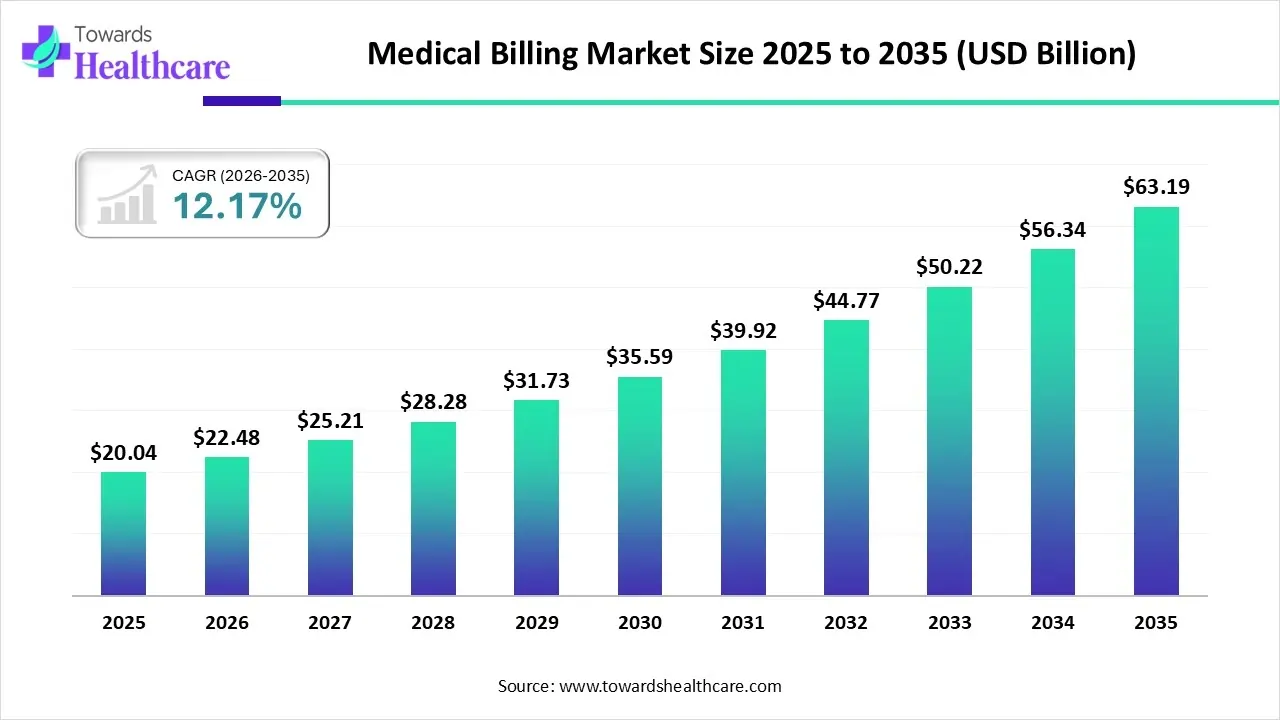
Driven by escalating administrative overhead, the global medical billing market is projected to expand significantly, reaching an estimated value of USD 22.48 billion by 2026 based on market data by Towards Healthcare. This market growth highlights a major industry shift away from rigid, pre-built utilities toward tailored software setups that optimize long-term operational scale.
1. Broken Billing Tools Create Manual Touchpoints
When your software stack consists of disconnected systems, your staff spends more time moving data manually than managing exceptions.
This fragmentation leads to clerical data entry mistakes, delayed submissions, and lost revenue.
- Eligibility checks in one system: Front-desk teams must log into separate insurance websites to verify patient coverage before visits.
- Claims in another: Billing specialists copy data out of the EHR to paste it into an external software application for clearinghouse formatting.
- Denials in spreadsheets: Operations managers track rejected claims and appeal deadlines in static Excel sheets that lack real-time visibility.
- Payment posting in the PMS: Finance teams manually type-check numbers and deposit amounts into the practice management system.
- Patient collections in separate tools: Invoices are generated by third-party print vendors, creating a data gap with internal ledger files.
- Manual follow-up across teams: Staff must coordinate via email and phone to resolve simple billing discrepancies across different clinic locations.
2. Multi-Specialty Needs Dedicated Rules
A multi-specialty medical group cannot operate efficiently on a single generic billing configuration.
Different medical disciplines require distinct code sets, clinical documentation workflows, and validation logic to prevent sudden claim rejections.
- Multi-specialty billing logic: The platform uses smart engines to distinguish between cardiology modifier rules and anesthesia time-based formulas automatically.
- Specialty-specific billing rules: System validation rules screen orthopedic surgical notes for global billing periods while verifying behavioral health session limits simultaneously.
- Facility vs professional billing: The software automatically separates technical component costs from professional services for ambulatory surgery centers and hospital-owned medical groups.
- Provider-level variations: The rule library dynamically accounts for individual provider credentialing statuses with specific insurance companies to prevent out-of-network processing errors.
- Location-level billing workflows: System workflows routes claims to specific clearinghouses depending on the regional location of the clinic or physical laboratory.
3. Need for Productized Billing Logic
Healthcare SaaS companies building for multiple enterprise customers cannot afford to hardcode custom billing rules for every new user.
Therefore, product leads need a modern software architecture that scales effortlessly as their client roster grows.
- Multi-tenant billing platform: The software uses a multi-tenant cloud setup that lets thousands of medical providers share core components while keeping their data completely private.
- Tenant-level rule configuration: Administrators can toggle specific validation rules on or off for individual clients without altering the primary system source code.
- Tenant-level audit trails: The platform records an unchangeable history of every code adjustment and claim submission to satisfy compliance requests for each separate client.
- Client-specific payer logic: The engine maintains unique fee schedule tables and custom payer rules tailored directly to the localized contract agreements of each user group.
- Scalable workflow templates: Engineering teams can deploy standard operational templates to onboard new medical networks within hours instead of weeks.
4. RCM Companies Need Automation
Revenue cycle management firms handle immense claim volumes across diverse specialties, making human review for every single transaction completely unsustainable.
Instead, they require high-speed automation balanced with smart safety controls for complex exceptions.
- High-volume claim processing: The platform uses automated claims scrubbing to validate thousands of files in seconds, checking for standard NCCI edits before delivery.
- Smart Exception Routing: The platform automates payment posting automation and remittance advice reconciliation while isolating complex exceptions for human review.
- Human-in-the-loop safeguards: High-risk claims automatically trigger a human-in-the-loop billing review to protect revenue integrity before clearinghouse submission.
Moving to a custom productized billing infrastructure allows growing medical networks to convert their complex operational rules into automated software features. This structural control protects your revenue stream from the unexpected processing limits common to standard commercial point solutions.
Core Features of a Healthcare Billing Automation Platform
A healthcare billing automation platform includes patient access automation, charge capture, coding validation, claims scrubbing, claim submission, denial management, remittance processing, payment posting, patient billing, AR workflows, and billing analytics.
At the same time, each core feature reduces manual back-office effort while optimizing overall claim accuracy, payment speed, and revenue cycle visibility across your entire healthcare enterprise.
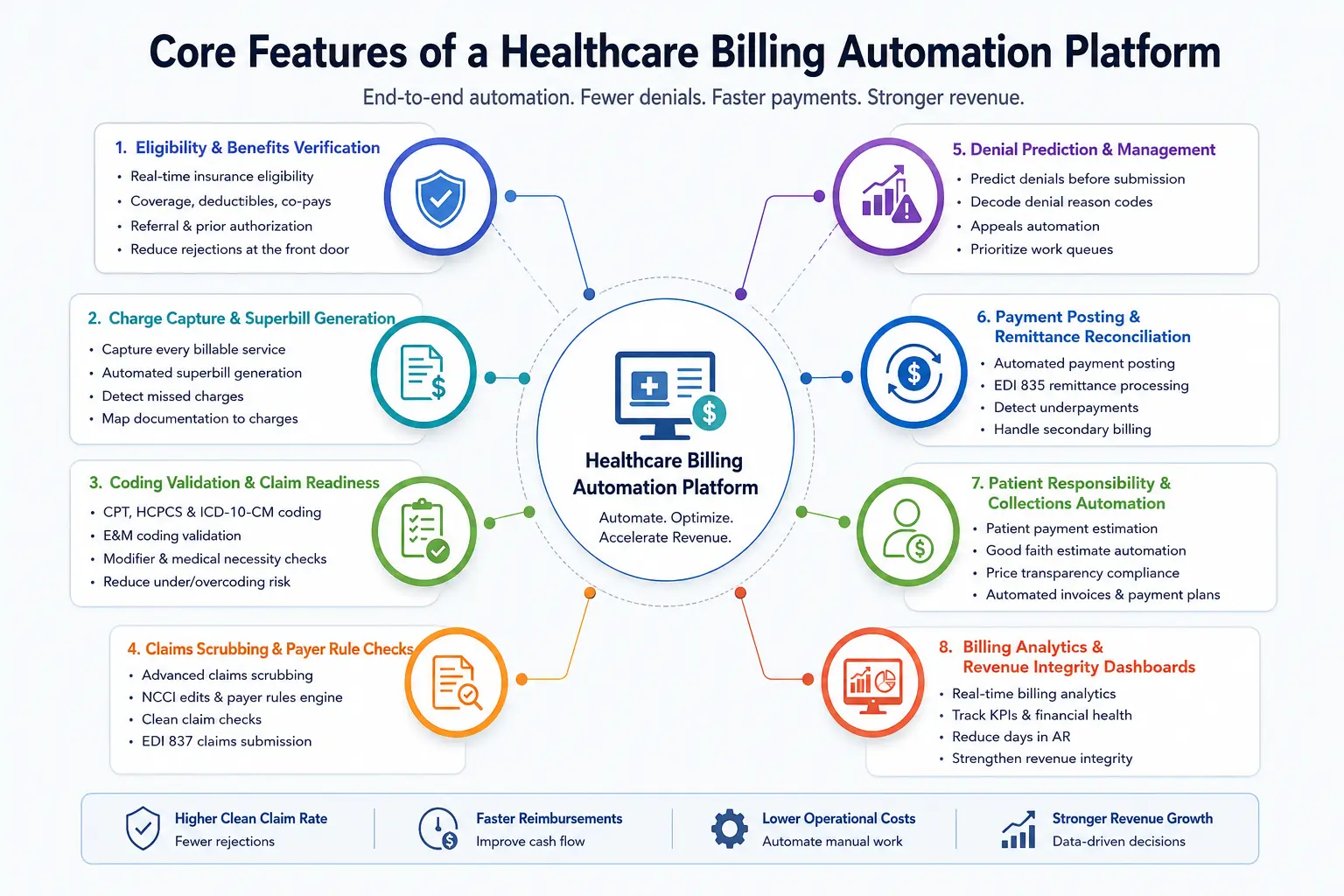
1. Eligibility and Benefits Verification
This feature stops insurance problems before the patient even sees the doctor. It checks coverage automatically, so your front-desk staff does not have to make manual phone calls.
- Insurance eligibility verification & benefits verification: Confirms a patient’s plan is active in real time.
- Coverage status: Identifies active enrollment status and plan types instantly.
- Deductibles, co-pays, & co-insurance: Shows exactly what the patient owes out-of-pocket before their appointment.
- Referral requirements & prior authorization triggers: Flags high-risk procedures that need insurance approval ahead of time.
2. Charge Capture and Superbill Generation
This tool tracks every doctor visit, procedure, and medical supply used during a patient’s visit. It makes sure no billable services get dropped or forgotten.
- Charge capture automation: Scans doctor notes to log billable hours, supplies, and visits.
- Superbill generation: Creates an instant digital superbill as soon as a doctor closes a chart.
- Missed charges: Matches appointment calendars against submitted bills to catch unbilled work.
- Provider documentation & procedure mapping: Turns routine clinic notes into standardized financial charges automatically.
3. Coding Validation and Claim Readiness
This engine double-checks medical codes for accuracy before they go to insurance companies. It catches mistakes that usually lead to rejections.
- CPT code assignment & HCPCS codes: Confirms procedural codes match the actual care provided.
- ICD-10-CM coding automation: Uses smart text tools to pull diagnosis codes from written doctor notes.
- E&M coding validation: Reviews visit levels to stop undercoding detection or overcoding detection errors.
- Modifier validation & medical necessity validation: Ensures codes have the right secondary tags to prove the treatment was required.
4. Claims Scrubbing and Payer Rule Checks
This is your final quality check because the software reviews every invoice against specific insurance rules. They do this to guarantee a high clean claim rate and first-pass acceptance rate.
- Claims scrubbing: Runs deep logical checks on bills before they leave your system.
- NCCI edits: Flags bundled procedures and coding conflicts based on national standards.
- Payer rules engine: Customizes the check based on the specific rules of individual insurance companies.
- Claims submission automation: Formats and sends clean bills instantly using standard EDI 837 transaction protocols.
5. Denial Prediction and Denial Management Workflow
If an insurance company rejects a bill, this feature helps your team fix it immediately. This is because it prioritizes the most important rejections to get your cash flowing faster.
- Denial prediction: Flags claims at high risk for rejection before you hit send.
- Denial reason codes & root-cause tracking: Translates confusing insurance rejection codes into plain English instructions.
- Appeals automation: Generates custom appeal letters filled with the exact clinical documentation required.
- Work queue prioritization & reviewer assignment: Puts high-value rejections at the top of your staff’s to-do list.
Payment Posting and Remittance Reconciliation
This tool automatically matches insurance payments with your outstanding invoices. At the same time, it removes the need for manual math and spreadsheet tracking.
- Payment posting automation: Matches bank deposits to your open invoices without manual data entry.
- EDI 835 remittance processing & remittance advice reconciliation: Directly reads digital insurance payment sheets.
- Contractual adjustments & underpayment detection: Alerts you if an insurance company pays less than your agreed contract rate.
- Secondary billing & patient balance transfer: Automatically bills secondary insurance or shifts the remaining balance to the patient.
Patient Responsibility and Collections Automation
This handles the patient’s side of the bill clearly and honestly. At the same time, it keeps you in line with federal healthcare laws while making it easy for patients to pay online.
- Patient responsibility calculation & patient payment estimation: Tells patients what they owe up front.
- Good faith estimate automation: Generates automated price quotes to meet No Surprises Act compliance.
- Price transparency compliance: Keeps your pricing clear, public, and legally compliant.
- Patient collections automation: Emails digital invoices and sets up automated monthly payment plans.
Billing Analytics and Revenue Integrity Dashboards
This dashboard gives executives a bird’s-eye view of your financial health. At the same time, it tracks key metrics so you can see where your billing process is succeeding or slowing down.
- Billing analytics dashboard: Visualizes your entire financial performance in one clean screen.
- Revenue cycle KPIs: Monitors your exact denial rate, net collection rate, and cost to collect.
- Days in AR reduction: Spotlights processing roadblocks to help you collect cash faster.
Deploying these integrated operational features helps your organization replace siloed software tools with a single automated engine. This unified structure ensures consistent revenue growth while lowering administrative overhead across all locations.
What FHIR R4 Covers and Where You Still Need Custom Adapters
The FHIR R4 standard simplifies how medical systems share basic patient data. For example, it tracks patient demographics, doctor notes, and medication lists via an API. However, it does not handle financial data like charge captures, fee schedules, or insurance contract terms.
Therefore, a healthcare billing automation platform must use FHIR R4 for clinical notes alongside custom adapters for billing data.
1. Clinical Data Ingestion via FHIR R4
FHIR R4 is highly useful for pulling basic clinical text from modern medical databases. Because it organizes data into clean categories, your software can read doctor charts instantly. Consequently, this clear setup serves as the primary starting point for your automated billing pipeline.
- Patient demographics: The platform uses the Patient resource to double-check names, birthdays, and contact details automatically.
- Encounter data: Your software monitors the Encounter resource to find exactly when and where a patient received medical treatment.
- Diagnoses and procedures: The engine pulls data from the Condition resource and Procedure resource to gather the clinical evidence needed for automatic code selection.
2. Gaps in the Standard Billing Models
While FHIR R4 manages clinical notes very well, it completely misses the financial side of the medical industry. As a result, you cannot use basic FHIR APIs to submit real insurance claims. For that reason, your software team must build custom code bridges to talk to insurance networks.
- Fee schedule management: Standard APIs cannot store your custom price lists or specific insurance payout rates.
- Claim-level transactions: The system must use separate pipelines to package and send outbound EDI 837 transaction files to clearinghouses.
- Prior authorization tracking: Insurance approval codes and approval statuses are not tracked inside standard FHIR resource models.
- Remittance processing: Inbound payment details arrive through specialized EDI 835 remittance processing files instead of standard web APIs.
3. Navigating Epic Integration Ecosystems
Connecting your platform to an Epic system requires entering a highly restricted and strictly managed vendor network. Although they offer a helpful sandbox for early testing, moving to live medical data takes a lot of time. Consequently, you must plan for strict certification delays very early in your software project.
- Sandbox development: Your engineering team can test basic data connections using Epic’s public testing tools for early project proofing.
- App Orchard certification: Third-party software companies must complete a formal review process to access live production financial data.
- Timeline impact: Completing this strict vendor approval process usually adds an extra 8 to 16 weeks to your development schedule.
4. Interfacing with Cerner and Legacy Feeds
Cerner provides a more open setup for new web applications, but it still requires separate contracts for financial data access. Furthermore, if you are connecting to older medical databases, modern web APIs will not work at all. Therefore, your engineering team must build hybrid adapters to translate both new and old systems.
- SMART on FHIR apps: Cerner allows faster API access for web tools but requires custom data contracts for revenue cycle data.
- HL7 integration engines: Older hospital software requires setting up traditional, high-speed text streams to capture clinical chart notes.
- Decoupled architecture: Building isolated code adapters lets you switch EHR vendors without breaking your primary automated billing engine.
For a deeper breakdown of EHR integration architecture, see our guide on Building Smart EHR Systems with AI Capabilities.
Ultimately, EHR integration is the most unpredictable component of a billing automation platform build. The specific EHR setup, whether you use Epic, Cerner, athenahealth, or a mix of tools, completely changes your development approach, approval needs, and final cost.
For that reason, this integration landscape should always be fully mapped out before development work begins, not during.
AI Models for an AI-Powered Billing Automation Platform
An AI-powered billing automation platform healthcare teams can trust uses artificial intelligence for documentation review, claim-risk scoring, denial prediction, coding support, payment variance detection, appeal support, and work queue prioritization. However, the platform should never let AI silently approve risky claims without evidence, confidence scoring, and human review.
Instead, the technology acts as a smart assistant that flags errors and speeds up processing while leaving final decisions to human experts.
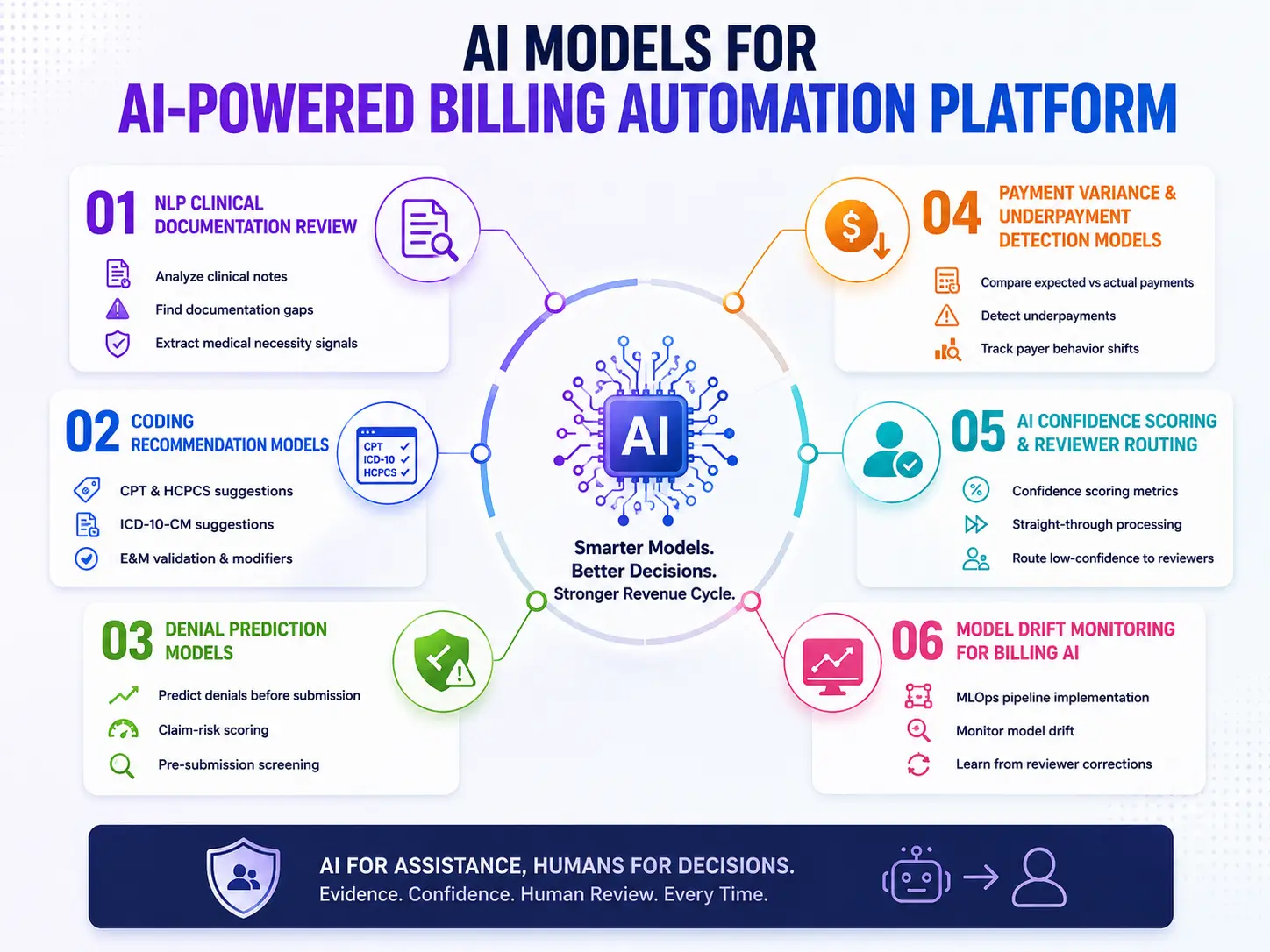
1. NLP Clinical Documentation Review
Doctors often write complex notes that contain hidden billing details. Therefore, the system uses natural language tools to scan text charts and extract critical financial data automatically.
- NLP clinical documentation analysis: The software reads unstructured encounter notes and procedure descriptions to find billable events.
- Documentation gaps identification: It flags missing details in a medical record before the file moves to your coding queue.
- Medical necessity signals extraction: The engine pulls specific evidence from clinical text to prove to insurance companies that a treatment was required.
2. Coding Recommendation Models
Medical coding requires matching complex clinical narratives to specific alphanumeric tags. Because rules change frequently, the platform uses machine learning to suggest the most accurate options.
- CPT code suggestions & HCPCS support: The system analyzes doctor notes to recommend accurate procedure and medical supply codes.
- ICD-10-CM suggestions: It matches recorded patient symptoms and final diagnoses to the correct national code profiles automatically.
- E&M coding validation: The model reviews visit complexity levels and provides modifier prompts to prevent undercoding or overcoding errors.
3. Denial Prediction Models
Waiting weeks for an insurance company to reject a claim hurts your cash flow. For that reason, the platform uses predictive models to spot rejection risks before submission.
- Denial prediction engine: The tool cross-references outbound claims against historical payer history trends to spot potential conflicts.
- Claim-risk scoring: Every invoice receives a safety score based on specialty patterns, prior authorization gaps, and eligibility failures.
- Pre-submission screening: Claims with low safety scores are stopped automatically so your team can fix documentation gaps early.
4. Payment Variance and Underpayment Detection Models
Insurance companies do not always pay the exact amount stated in your provider contracts. Consequently, the platform uses data models to double-check every incoming dollar.
- Expected vs actual payment calculation: The software compares incoming digital checks against your internal fee schedule management tables.
- Underpayment detection: It flags whenever an insurance payout falls below your contractual allowances during remittance advice reconciliation.
- Payer behavior shifts tracking: The system monitors adjustment patterns to alert executive teams when a specific payer alters its processing rules.
5. AI Confidence Scoring and Reviewer Routing
Using AI safely in healthcare requires strict operational boundaries. Therefore, the platform scores its own accuracy and routes complex cases to human specialists.
- Confidence scoring metrics: The machine learning engine calculates an automated precision score for every single code suggestion.
- Straight-through billing processing: Claims that exceed your custom accuracy and risk thresholds clear the system without manual touches.
- Human review routing: Any claim that falls below your target threshold triggers automated escalation rules to alert a human specialist.
6. Model Drift Monitoring for Billing AI
Payer rules, medical guidelines, and clinical documentation patterns change constantly over time. As a result, a static AI model will lose accuracy and cause performance issues if left unmanaged.
- MLOps pipeline implementation: The infrastructure team deploys continuous engineering pipelines to update and retrain models smoothly.
- Model drift monitoring systems: Specialized tools watch for drops in real-world accuracy to catch model performance shifts early.
- Reviewer corrections feedback loops: The platform captures manual reviewer corrections to retrain the AI engine and improve future suggestions.
By treating machine learning as a powerful decision-support tool rather than an autonomous decision-maker, your organization can safely accelerate its administrative workflows. This balanced design ensures your automation stays highly accurate while protecting your baseline revenue cycle metrics.
HIPAA Compliance Architecture: What the Security Rule Requires
HIPAA compliance for a healthcare billing automation platform is not a checklist added at deployment. Instead, it is an architecture requirement that shapes data flow design, access control, storage, and audit trail structure from day one.
The three controls with the highest build-time impact are PHI tokenization, role-based access control, and immutable audit trail design.
Therefore, these must be fundamental design choices rather than superficial product features.
| Compliance Control | Core Technical Implementation | Build-Time Impact | Why It Matters |
| PHI Tokenization | Separates patient identity from clinical text using a secure data-layer token service. | High | Stops data leaks in AI logs. |
| Data-Layer RBAC | Restricts database access based on user role via secure API gateway enforcement. | Medium | Enforces strict least-privilege rules. |
| Immutable Audit Trail | Deploys append-only database logs secured with cryptographic verification. | High | Prevents tampering during compliance audits. |
1. PHI Tokenization at the Data Layer
Every protected health information field in the billing pipeline must be tokenized directly at the storage layer. For example, patient identifiers, insurance member IDs, and diagnosis codes must be stripped of direct real-world identities.
- Isolated data streams: De-identified clinical data flows safely to machine learning training pipelines while tokenized data goes to live billing queues.
- Log security: This dual-path design prevents sensitive patient data from leaking into model training logs or system inference outputs.
- Risk reduction: Because the core database uses secure reference tokens, an unauthorized system breach will not expose readable patient records.
2. Role-Based Access Control and Policy Enforcement
Platform access must enforce strict least-privilege rules at the data layer rather than relying on basic user interface restrictions. Consequently, different staff members only interact with the precise data rows needed for their specific daily tasks.
- Granular permissions: Billing coders can access claim queues but cannot view payer contract terms or high-level financial dashboards.
- Financial separation: Finance managers can review automated remittance data easily, but they cannot open deep clinical patient charts.
- API gatekeeping: A strict policy enforcement point at the API gateway ensures that unauthorized role access attempts are blocked before any data leaves the server.
3. Managing BAA Requirements in Multi-Vendor Stacks
Every single third-party service in your platform stack that touches sensitive patient data requires a signed Business Associate Agreement. This strict requirement applies to your machine learning infrastructure, your chosen clearinghouse, and your cloud hosting provider.
- Hosting compliance: Your cloud infrastructure must deploy on verified platforms like AWS HIPAA Eligible Services or the Google Cloud Healthcare API.
- Vendor tracking: Every external pipeline, including your automated audit log service, must maintain active compliance paperwork.
- Audit readiness: Eliminating BAA gaps in a multi-vendor architecture removes the most common compliance vulnerability found during formal healthcare AI audits.
4. Audit Trail Immutability for Regulatory Compliance
Every billing action must be logged inside a tamper-evident audit trail to satisfy federal rules and protect your organization during legal reviews. For that reason, system administrators cannot modify historical tracking records.
- Append-only log design: The system uses secure tracking tools like AWS CloudTrail to ensure that historical logs can never be overwritten or erased.
- Cryptographic integrity: The platform runs continuous automated verification checks to prove that your historical logs have not been altered.
- Complete operational tracking: The system records every code assignment, claim modification, denial override, and automated payment posting step automatically.
For a broader view of compliance architecture in healthcare AI systems, see our guide on How to Build a Healthcare AI Governance Platform.
Ultimately, building a proper compliance architecture adds approximately 15% to 25% to your base software development cost when executed correctly from day one. However, that figure easily doubles when compliance features are retrofitted after the product is already built.
Top 6 Rated Medical Billing Software Automation Solutions
Choosing the right pre-built software can streamline your operations if a custom build is not your immediate priority. The following list of medical software platforms is curated based on highly rated selections from G2 and Capterra. Both platforms score medical billing software based on user feedback, available features, and overall satisfaction.
G2 uses a five-star system focused on usability and market presence. Meanwhile, Capterra incorporates user ratings across categories like ease of use and value for money. Each of these tools is a strong contender to help your team work smarter.
1. Health Cloud
Salesforce Health Cloud is a scalable, CRM-based platform built for deep interoperability. It integrates care coordination, patient engagement, and billing workflows into a single connected system.
- Automation and claim management: Uses intelligent workflows and third-party tools to streamline the claims process. At the same time, teams can automate tasks like patient outreach, benefit coordination, and pre-authorizations.
- Integration and scalability: Built on a flexible architecture to integrate easily with EHRs and clearinghouses. It supports multi-site configurations and scales smoothly as organizations grow.
- Security and compliance: Meets stringent healthcare standards, including HIPAA and HITRUST certifications. Here, role-based access controls and audit logs support strong privacy governance.
- Analytics and reporting: Built-in dashboards make it easy to track key performance indicators. Additionally, teams can monitor collections, denial patterns, and case resolution times via Tableau.
2. AdvancedMD
AdvancedMD is a cloud-based platform that provides midsize healthcare organizations with integrated billing, EHR, and practice management tools. Therefore, reviewers say its modular architecture makes it a great option for growing practices.
- Automation and claim management: Includes a built-in tool that thoroughly checks claims for coding errors before submission. It also supports automated claim generation and real-time batch processing.
- Integration and scalability: Integrates seamlessly with its own EHR and scheduling modules. It is well-suited to multi-location practices and specialty providers.
- Security and compliance: It is fully HIPAA-compliant and hosted in secure, SSAE-compliant data centers. Customizable user permissions and audit trails protect sensitive records.
- Analytics and reporting: Customizable financial reports and real-time dashboards help clinics monitor key revenue cycle metrics. Built-in alerts flag anomalies before they affect cash flow.
3. CareCloud
CareCloud offers a fully integrated revenue cycle suite with cloud-based billing, scheduling, and telehealth tools. At the same time, reviewers note that its user-friendly interface makes it particularly useful for independent practices.
- Automation and claim management: Automated workflows reduce manual data entry and speed up reimbursements. The system flags errors early and streamlines the appeals process.
- Integration and scalability: Connects seamlessly with CareCloud’s native EHR and practice management systems. It offers specialty-specific templates and multi-location coordination.
- Security and compliance: The software offers end-to-end encryption and strict audit controls. These features ensure HIPAA compliance across all clinical and billing functions.
- Analytics and reporting: Its built-in analytics platform provides real-time financial dashboards. Users can easily create customized reports to monitor billing performance and payer mix.
4. CureMD
CureMD is a comprehensive EHR and practice management suite with robust billing capabilities. For this platform, reviewers find its AI-powered automation and intuitive interface to be a good fit for medical groups.
- Automation and claim management: Automates claims processing and supports electronic claim and remittance processing. It tracks denials and appeals with AI-driven workflow tools.
- Integration and scalability: Includes native EHR and practice management software modules. It offers optional integration for lab, pharmacy, and radiology systems.
- Security and compliance: Meets HIPAA and ONC certification standards securely. The platform includes two-factor authentication, audit trails, and secure data backups.
- Analytics and reporting: Advanced reporting features include customizable dashboards for revenue cycle KPIs. Teams can track patient financial trends and operational performance.
5. eClinicalWorks
eClinicalWorks is an established brand in EHR and revenue cycle management. Therefore,it offers a unified platform with advanced billing, clinical, and telehealth features.
- Automation and claim management: Built-in tools help automate coding and clinical documentation. Billing workflows include automated claim validation and real-time payer status updates.
- Integration and scalability: Includes EHR, billing, and patient engagement features natively. The platform scales easily across large, multi-specialty provider networks.
- Security and compliance: Supports HIPAA and MACRA compliance frameworks through regular updates. It provides audit logs and controlled access to maintain strong data security.
- Analytics and reporting: Includes customizable revenue dashboards and benchmarking tools. Practices can monitor claim status and rejection trends to identify process gaps.
6. PracticeSuite
PracticeSuite is a cloud-based platform that offers modular tools for billing, scheduling, and analytics. This is designed for maximum flexibility, and it gets praise from reviewers who want to tailor their setups.
- Automation and claim management: Includes tools for auto-claim submission, denial tracking, and remittance processing. Built-in claim scrubbers help reduce upfront rejections.
- Integration and scalability: A modular design lets organizations implement the tools they need today and add more later. It also integrates with leading external EHR systems.
- Security and compliance: Role-based permissions, data encryption, and compliance alerts support total HIPAA compliance. These tools ensure highly secure access to sensitive records.
- Analytics and reporting: Dashboards provide real-time views into accounts receivable, collections, and denial rates. Reports can be customized to monitor provider productivity and payment timelines.
While these six platforms offer strong pre-built features, commercial software often lacks the deep flexibility needed for complex, multi-specialty logic. For true operational freedom, an enterprise must weigh these options against a custom build.
How to Build a Healthcare Billing Automation Platform
To build a healthcare billing automation platform, start with workflow discovery, define billing logic ownership, design architecture, build integrations, create the rules engine, add AI models, secure PHI workflows, pilot one billing process, and monitor revenue outcomes. The process should move from billing control to automation, not the other way around.
When we design these systems at Intellivon, we focus on isolating your core code from changing insurance regulations. Therefore, your engineering team can update specific clinical rules without breaking the primary database pipelines. This structured approach keeps your software stable and protects your revenue cycle from unexpected processing blockages.
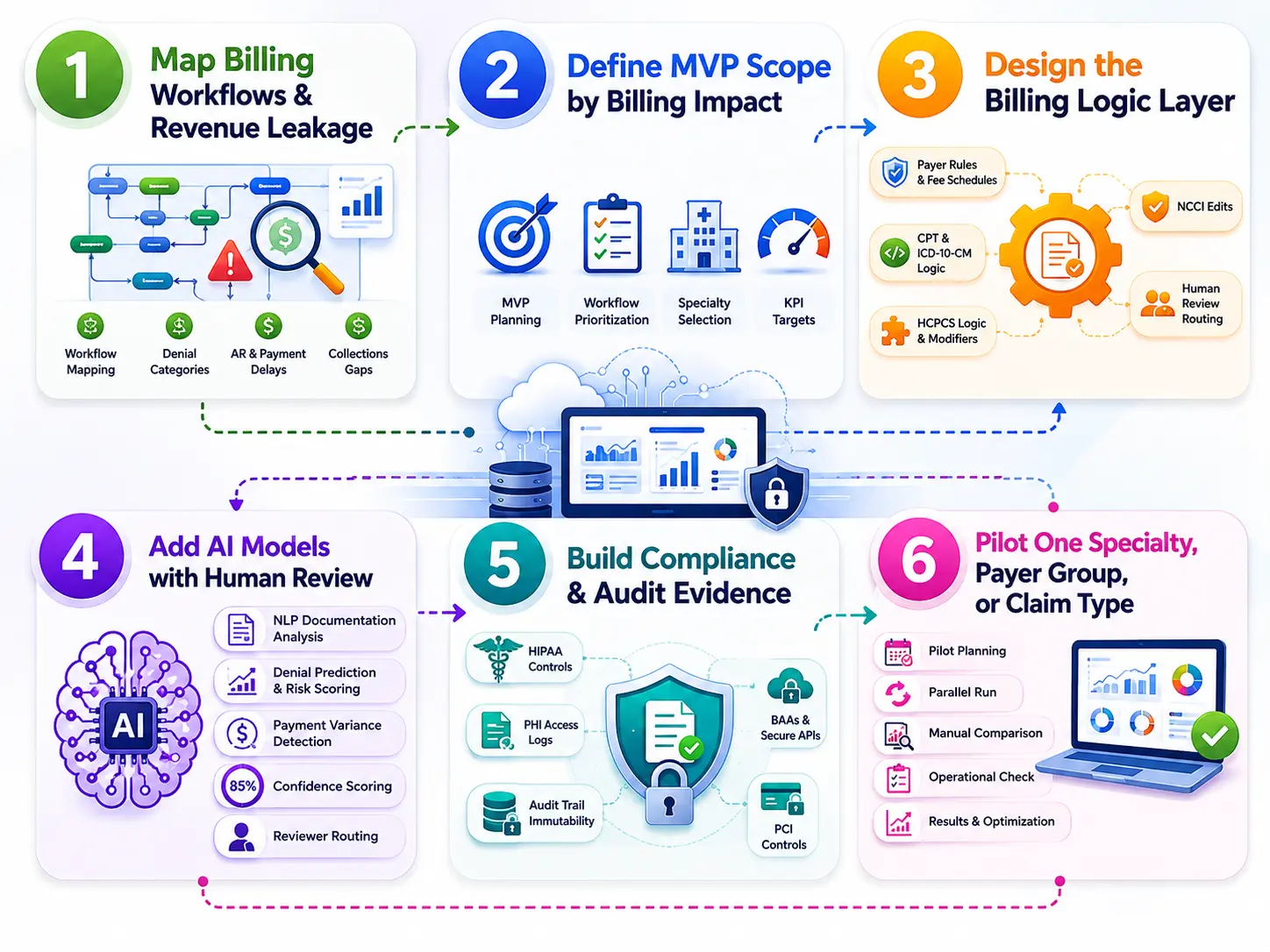
1. Map Billing Workflows and Revenue Leakage
Before writing any code, we map your current claim lifecycle to locate hidden revenue bottlenecks. This helps your engineering team identify precisely where administrative errors lead to lost collections.
- Workflow mapping: We track how data moves from initial patient check-in to final payment clearance.
- Denial categories: Our teams classify your historical insurance rejections to uncover recurring clerical patterns.
- AR delays & payment posting delays: We spot the exact administration tasks that cause invoices to stall in your pipeline.
- Collections gaps: We isolate manual data entry steps that lead to systemic revenue leakage across your clinics.
2. Define MVP Scope by Billing Impact
We do not build every feature at once. Instead, we help you plan a lean minimum viable product that delivers immediate financial returns for your business.
- MVP planning: We focus on the core billing bottlenecks that cause the highest administrative strain.
- Workflow prioritization: Your engineering team targets high-volume claims and dominant insurance companies first.
- Specialty selection: We launch the initial platform version using a single medical discipline to keep rules manageable.
- KPI targets: We establish clear baseline metrics for your initial clean claim rate and first-pass acceptance rate.
3. Design the Billing Logic Layer
Next, we construct a highly flexible rule library that holds your complex business logic outside the primary code base. These design choices let your business analysts update parameters without needing developer support.
- Payer rules & fee schedules: The system evaluates insurance contracts and custom price lists dynamically.
- CPT logic & ICD-10-CM logic: The engine screens code combinations to verify they match national medical guidelines.
- HCPCS logic & modifiers: The software automatically attaches required secondary tags to prove treatment necessity.
- NCCI edits: The platform automatically runs standard compliance checks to catch unbundled procedures early.
- Human review routing: Claims that trigger logical conflicts are instantly isolated for expert manual inspection.
3. Build the Integration Layer
A successful platform must communicate fluidly with your existing health networks and external financial systems. Therefore, we construct a secure, unified data highway using modern web protocols.
- EHR & PMS sync: We build robust API connectors to pull clinical notes directly from tools like Epic or Cerner.
- Clearinghouse integration: The system packages and transmits outbound files using standard EDI 837 transaction formats.
- Payer APIs & payment systems: We establish direct communication channels to process inbound EDI 835 files and patient credit cards.
- Finance tools & data warehouse: The platform pushes clean transaction records straight into your core accounting ledgers.
4. Add AI Models with Human Review
Once the core data pipelines are stable, we deploy specialized machine learning models to automate clinical text analysis. We always couple these tools with human safeguards to protect data quality.
- NLP documentation analysis: Smart text models read written doctor charts to find billable medical concepts.
- Denial prediction: Predictive engines analyze historical data to calculate an automated claim-risk scoring profile before submission.
- Payment variance detection: Machine learning tools spot whenever an insurance payout falls below your agreed contract rates.
- Confidence scoring: The platform calculates an accuracy score for every automated recommendation.
- Reviewer routing: Claims with low confidence scores trigger automated escalation rules to alert your compliance staff.
5. Build Compliance and Audit Evidence
We integrate strict security controls into your database architecture from the very first day of development. This proactive design completely eliminates compliance vulnerabilities.
- HIPAA controls: We deploy advanced PHI tokenization tools to obscure sensitive patient data at the storage layer.
- PHI access logs: The platform maintains unchangeable tracking logs that record every single view or modification attempt.
- BAAs & secure APIs: We verify that every hosting component operates inside verified, fully compliant cloud networks.
- Audit trail immutability: The architecture uses append-only log designs to create tamper-evident evidence for external inspectors.
- PCI controls: Financial workflows route through tokenized payment gateways to keep credit card numbers out of internal servers.
6. Pilot One Specialty, Payer Group, or Claim Type
We launch the new software platform using a controlled test group to verify performance before a full network rollout. This step helps us fine-tune system workflows using real production data.
- Pilot planning: We select a single predictable claim type or specific insurance group for the live test.
- Parallel run: Your staff processes claims through both the old system and the new platform simultaneously.
- Manual comparison: We cross-reference outputs to verify total claim accuracy and track denial changes.
- Operational check: Our engineers analyze payment speed and collect detailed reviewer feedback to optimize system screens.
7. Scale Through Rule Libraries and KPI Monitoring
In the final phase, we expand the platform across your entire organization by activating new specialty modules. We also deploy continuous monitoring tools to maintain long-term system health.
- Specialty rule libraries: We add dedicated transaction parameters for new clinical departments smoothly.
- Payer rule updates: The system ingests annual coding modifications without requiring core infrastructure changes.
- Model drift monitoring: Our MLOps pipelines watch AI precision scores to catch real-world accuracy shifts early.
- Revenue cycle KPIs: Executives use a central billing analytics dashboard to monitor net collection rates and day reduction trends.
- Workflow optimization: The software continually adjusts routing queues to improve overall back-office productivity.
Following this structured development path allows your organization to transition safely from manual workflows to a high-speed automated engine. This careful execution keeps your cash flow entirely stable while your software footprint scales up.
Healthcare Billing Platform Development Cost
Healthcare billing platform development costs usually range from $60,000 to $220,000 for a custom build. A focused MVP sits near the lower end, while an AI-enabled platform with EHR integration, EDI 837/835 workflows, billing rules, HIPAA controls, analytics, and pilot rollout moves toward the upper end.
Cost Breakdown by Development Phase
| Development Phase | Estimated Cost | What It Covers |
| Workflow discovery and MVP planning | $3,000–$8,000 | Billing workflow mapping, leakage points, user roles, KPI baseline, MVP roadmap |
| UX/UI for billing teams | $4,000–$10,000 | Work queues, dashboards, reviewer screens, exception handling, and admin views |
| Billing logic and rules engine | $7,000–$22,000 | Payer rules, fee schedules, CPT checks, ICD-10-CM logic, and modifier validation |
| Data ingestion and normalization | $6,000–$20,000 | Patient, provider, payer, claim, charge, remittance, and code mapping |
| EHR and PMS integration | $10,000–$40,000 | FHIR R4, HL7, Epic or Cerner workflows, practice management system connectivity |
| Clearinghouse and EDI development | $7,000–$25,000 | EDI 837 claims, EDI 835 remittance, claim acknowledgements, rejection workflows |
| AI model development | $10,000–$40,000 | NLP documentation review, denial prediction, claim-risk scoring, confidence scoring |
| Compliance and audit controls | $5,000–$17,000 | HIPAA controls, PHI handling, RBAC, encryption, secure APIs, audit logs |
| Analytics and MLOps | $4,000–$16,000 | Revenue dashboards, clean claim tracking, model monitoring, and feedback loops |
| Pilot, QA, and rollout | $4,000–$22,000 | Testing, parallel runs, training, deployment, specialty, or payer pilot |
| Total Estimated Development Cost | $60,000–$220,000 | Focused MVP to an AI-enabled healthcare billing automation platform |
What Pushes Cost Higher?
The build moves toward $180,000–$220,000 when it includes multiple billing workflows, AI-assisted claim review, custom payer rules, EHR and PMS integration, clearinghouse connectivity, and revenue-cycle dashboards.
Key cost drivers include:
- Multi-specialty billing logic and specialty-specific rule libraries.
- Epic, Cerner, FHIR R4, or HL7 integration requirements.
- EDI 837 claims and EDI 835 remittance processing.
- Multiple clearinghouses or payer API connections.
- Custom NLP, denial prediction, or payment variance models.
- Multi-tenant SaaS architecture for healthcare software companies.
- Advanced billing analytics and revenue integrity dashboards.
- Higher claim volumes require stronger testing and monitoring.
- HIPAA documentation, audit controls, and security validation.
A platform requiring several EHRs, multiple clearinghouses, extensive payer-specific automation, and full multi-tenant commercialization should be built through phased releases rather than forced into the first $220,000 scope.
Ongoing Maintenance Cost
Ongoing maintenance usually costs 18%–30% of the initial build investment each year. For a platform built within the $60,000–$220,000 range, annual maintenance typically falls between $10,800 and $66,000.
This maintenance budget covers:
- Payer-rule and fee schedule updates.
- CPT, ICD-10-CM, HCPCS, and modifier rule updates.
- Cloud hosting, storage, and monitoring.
- Security reviews and HIPAA control maintenance.
- AI model retraining and model drift monitoring.
- EHR, PMS, clearinghouse, and payer interface maintenance.
- Compliance documentation and audit support.
Need a build estimate before development?
Intellivon can map your billing workflows, integration scope, AI model depth, compliance controls, MVP roadmap, and phased development cost before engineering begins.
Conclusion
A healthcare billing automation platform helps teams control the full billing journey from eligibility verification to payment posting. The best platforms do more than automate claims. Additionally, they govern charge capture, coding validation, payer rules, claim readiness, denial prediction, remittance reconciliation, patient responsibility, compliance evidence, and revenue cycle KPIs.
At the same time, the right build combines clear workflow design, deterministic billing rules, AI-assisted intelligence, secure integrations, HIPAA controls, and human review. It also needs post-launch monitoring because payer rules, coding requirements, and revenue risks change constantly.
Build a Healthcare Billing Automation Platform With Intellivon
Intellivon helps multi-specialty medical groups, RCM companies, healthcare SaaS teams, and enterprise providers build healthcare billing automation platforms around real billing decisions.
We help you define what to automate first, where billing rules must stay controlled, how AI should support review, and which integrations, security controls, and revenue KPIs belong in the roadmap.
A. Define the Right Billing Automation Scope
A billing platform should begin with the workflows that create the clearest operational and financial impact.
Intellivon helps you map eligibility, charge capture, coding validation, claims scrubbing, denial workflows, payment posting, remittance reconciliation, patient billing, and collections before deciding the MVP.
- Identify manual billing touchpoints and revenue leakage areas.
- Prioritize workflows by claim volume, denial exposure, and ROI.
- Define the right MVP for specialty, payer, or facility needs.
- Set measurable KPIs before development begins.
B. Design Billing Logic That Your Team Can Control
Healthcare billing automation needs more than task routing. Intellivon helps you plan the payer rules, code checks, fee schedules, modifier validation, medical necessity logic, confidence thresholds, and reviewer overrides that keep billing decisions traceable after launch.
- Configure payer rules and specialty-specific billing logic.
- Govern CPT, ICD-10-CM, HCPCS, and modifier checks.
- Build human review paths for complex or high-risk claims.
- Maintain audit trails for rule changes and billing actions.
C. Connect the Platform With Revenue Systems
Billing automation only creates value when data moves accurately across clinical, payer, and financial systems. Intellivon plans integrations across EHRs, practice management systems, clearinghouses, payer APIs, payment workflows, and finance tools so each automated action uses trusted data.
- Plan Epic, Oracle Health/Cerner, FHIR R4, and HL7 connectivity.
- Support EDI 837 claims and EDI 835 remittance workflows.
- Connect clearinghouses, payer systems, and payment services.
- Design validation, exception handling, and reconciliation flows.
D. Build AI Assistance With Compliance Controls
AI should help billing teams review documentation, identify risky claims, predict denials, and flag payment variance without removing accountability. Intellivon designs AI-assisted billing platforms with evidence-backed outputs, confidence scoring, role-based access, PHI controls, audit logs, and human approval workflows.
- Apply NLP to clinical documentation and coding support.
- Use denial prediction and claim-risk scoring before submission.
- Monitor model outputs, drift, and reviewer feedback.
- Include HIPAA-ready controls from the architecture stage.
E. Plan the Platform Around Revenue Outcomes
A successful healthcare billing automation platform should improve how quickly and accurately revenue moves through the organization. Intellivon helps you define the technical roadmap against measurable billing outcomes, from clean claim improvement to payment posting speed and days in AR reduction.
- Track clean claim rate and first-pass acceptance rate.
- Measure denial trends, payment variance, and AR movement.
- Monitor the cost to collect and the net collection rate.
- Expand automation through phased specialty and payer rollouts.
Planning a custom healthcare billing automation platform requires clarity before development begins. Intellivon can help you define the right billing workflows, rule-governance layer, AI model scope, EHR and EDI integrations, compliance controls, phased cost, and MVP roadmap around measurable revenue outcomes.
Things To Know About Healthcare Billing Automation Platform Development
Q1. What should a healthcare billing automation platform handle beyond basic claim submission?
A1. A healthcare billing automation platform should manage eligibility checks, claim scrubbing, coding validation, denial workflows, payment posting, reporting, analytics, EHR integration, and multi-provider operations. It should connect front-end, mid-cycle, and back-end billing tasks so revenue teams can track each claim from patient intake through final reimbursement.
Q2. Can AI safely automate CPT coding and medical billing decisions?
A2. AI can support CPT coding by reviewing documentation, identifying possible codes, scoring claim risk, and flagging missing evidence. However, complex or high-value claims still need certified human review. The safest platform uses AI recommendations and confidence scores while keeping final billing decisions under accountable clinical and coding oversight.
Q3. Can AI help reduce claim denials and automate appeals?
A3. AI can reduce claim denials by identifying missing documentation, authorization gaps, payer-rule conflicts, coding issues, and incomplete claim fields before submission. It can also support appeals by collecting evidence and preparing draft responses. However, billing teams should approve appeals before submission and retain a clear audit trail.
Q4. Should healthcare teams trust fully autonomous AI agents for billing?
A4. Most healthcare teams should not begin with fully autonomous billing agents. Billing decisions affect reimbursement, compliance, and audit exposure. A safer approach uses AI to recommend actions, prioritize claims, prepare documentation, and flag risks, while trained staff approve coding, claim changes, appeals, refunds, and payment-related decisions.
Q5. Why do EHRs and existing billing tools still leave gaps in RCM automation?
A5. EHRs and standard billing tools often manage transactions, but they may not connect payer rules, denial follow-up, claim edits, AR recovery, and financial analytics in one workflow. A custom billing automation platform can sit around the existing stack and coordinate decisions, exceptions, and revenue actions across systems.