Key Takeaways:
-
Multi-hospital coordination requires transfer center automation, real-time bed management, and centralized scheduling.
-
Unified patient record access, physician handoff workflows, and transport coordination drive network-wide efficiency.
-
FHIR R4, HL7 feeds, EMPI logic, audit trails, and role-based access ensure secure interoperability.
-
Custom platforms cost $70,000 to $300,000 depending on hospital count, integrations, and compliance depth.
-
How Intellivon builds care coordination platforms with AI-assisted patient placement, replacing phone calls and spreadsheets.
Care coordination platform features fall into five categories: transfer center automation, real-time bed visibility, EHR interoperability across sites, centralized scheduling, and network-wide analytics. Getting these right matters, since most hospitals still coordinate transfers through phone calls and spreadsheets, and that manual process costs more than time.
Most platforms treat bed search and physician acceptance as two separate steps. A bed gets found first, then someone starts calling for a physician to accept the patient. That sequencing is where time gets lost. When Johns Hopkins combined real-time bed data with active transfer matching in one of the first hospital command centers, results followed. ED patients waiting for an inpatient bed dropped by 30%, and transfer identification time fell by a full hour. Running these features together, not sequentially, is what moves the needle.
Intellivon designs transfer workflows so bed matching and physician outreach happen in parallel. This post breaks down every feature category that supports that, from transfer automation and bed visibility to EHR interoperability, scheduling, and analytics. By the end, you will have a clear framework to scope your build.
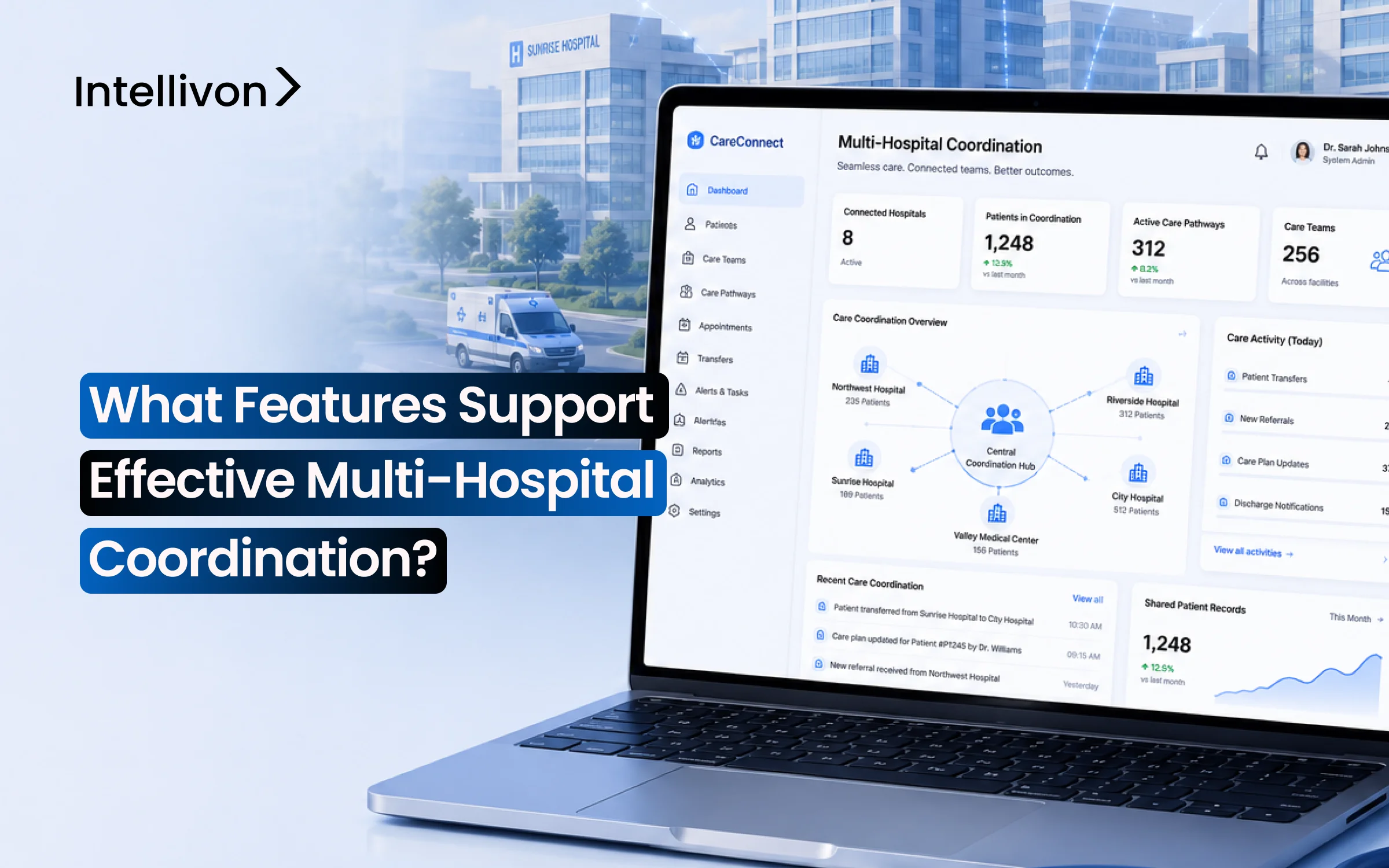
What Is A Multi-Hospital Care Coordination Platform?
A multi-hospital care coordination platform is a secure software infrastructure that unifies clinical operations across independent medical facilities. Consequently, it integrates separate electronic health records, bed management tracking, and transfer logistics into a single dashboard.
Therefore, this platform allows health systems to manage patient transfers, track bed capacity, and route specialists across the network in real time without replacing existing hospital software.
1. It Sits Between The EHR, Transfer Center, And Network Command Center
This platform does not replace Epic, Oracle Health, Meditech, PACS, scheduling, or billing systems. Instead, it pulls the right data from those systems and organizes it around coordination decisions.
Therefore, users view comprehensive logistics data on a single screen rather than digging through disconnected software setups.
- Unified Interoperability: It connects existing infrastructure using FHIR R4 APIs and HL7 ADT data feeds. Furthermore, this ingestion synchronizes updates across all digital endpoints.
- Single-Screen Operations: A transfer coordinator can see a patient’s clinical summary, bed need, and destination options simultaneously. Consequently, this interface cuts down communication delays between departments.
For a deeper breakdown of building enterprise compliance infrastructure, see our deep dive on How to Build AI-Powered Dental Revenue Cycle Software. As a result, connecting these systems creates the technical foundation needed to monitor entire hospital networks from one screen.
2. It Turns Fragmented Coordination Into A Trackable Workflow
Most multi-hospital coordination still happens across phone calls, secure messages, EHR tabs, spreadsheets, and manual bed checks.
However, the platform turns those disconnected actions into one visible case timeline to reduce administrative friction. Because of this tracking, teams identify delays before they impact clinical outcomes.
- Automated Audit Trails: The system logs every requester, reviewer, accepting physician, assigned bed, and transport milestone automatically. Therefore, compliance teams retain a permanent records history.
- Urgency Triaging: Live alerts flag delayed transfers, helping clinical operations teams manage urgency without losing accountability. Consequently, high-risk cases receive immediate visibility.
Moving from manual tracking to an automated workflow naturally unifies the separate teams managing daily hospital logistics. Consequently, this digital audit trail eliminates guesswork during multi-facility patient transfers.
3. It Supports Clinical, Operational, And Executive Users
A care coordination platform serves multiple roles at the same time. Specifically, transfer coordinators need live case status, bed managers need capacity views, physicians need clinical context, and executives need network-wide performance metrics.
Therefore, tailored system access is required to keep all stakeholders aligned.
- Role-Based Interfaces: The platform delivers customized interfaces specifically tailored for transfer centers, bed teams, and specialists. Consequently, users avoid messy dashboards packed with irrelevant data fields.
- Executive Metrics: System leaders access real-time aggregations regarding leakage, network utilization, and transfer bottlenecks. Thus, administrators make data-driven infrastructure investments.
Managing a high-volume hospital network requires more than basic data visibility across these user groups. Moving thousands of patients safely between facilities requires dedicated automation features built specifically for transfer centers.
Why Multi-Hospital Networks Need A Coordination Platform
Multi-hospital networks require a centralized coordination platform to overcome fragmented data silos and disparate EHR systems. Consequently, manual workflows and communication gaps generate between $30 billion and $90 billion in annual care coordination costs across the industry.
The global care coordination and patient journey management connected healthcare platform market size reached a valuation of $4,087.2 million in 2025. Furthermore, current industry projections indicate that this sector will expand at a compound annual growth rate of 6.7% through 2033. Consequently, this sustained growth underscores the accelerating corporate investments in multi-facility clinical software infrastructure.
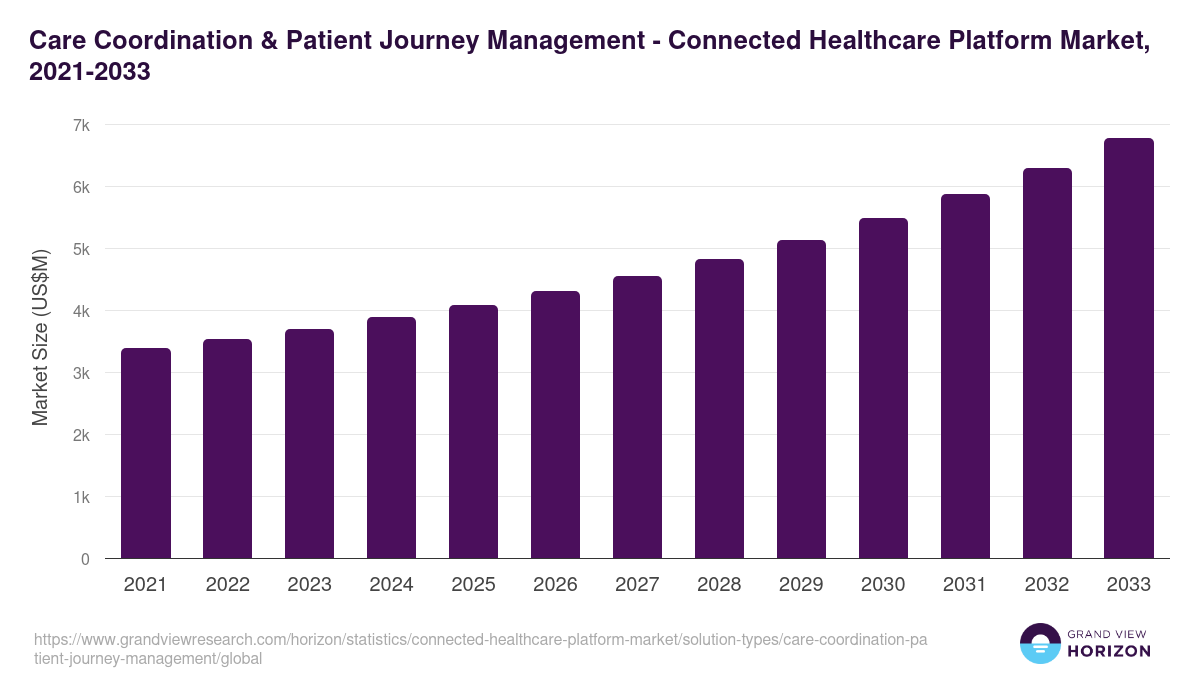
Therefore, deploying unified software infrastructure is essential to prevent operational inefficiencies and protect patient outcomes across multi-facility systems.
1. Disconnected Systems Drive Extreme Financial Waste
Hospital networks routinely struggle with isolated data repositories that prevent a clear view of systemic operational costs. Specifically, without unified software infrastructure, health systems suffer from massive administrative redundancies across their individual branches.
Therefore, organizations lose critical capital on manual tracking that could otherwise fund clinical expansion.
- Severe Financial Leakage: The healthcare industry loses between $27.2 billion and $78.2 billion annually due to coordination failures across the care continuum.
- Redundant Administrative Labor: Care teams spend hours gathering basic patient information instead of delivering direct clinical treatment.
For a deeper breakdown of constructing scalable health system data pipelines, see our technical guide on the Healthcare AI Agent.
As a result, consolidating these metrics provides executives with immediate network-wide financial visibility.
2. Real-Time Visibility Stops Dangerous Clinical Inefficiencies
Delayed data access between medical facilities severely limits the speed and accuracy of urgent clinical decisions. Because paper-based transfer logs and old digital systems update slowly, physicians lack live visibility into active patient histories.
Consequently, this information gap forces clinicians to make complex triaging decisions with incomplete medical records.
- Accelerated Data Delivery: Implementing a centralized architecture allows clinical teams to access essential medical data 89% faster.
- Minimized Treatment Delays: Eliminating data latency drops typical patient wait times from 32 minutes down to just 8 minutes.
Transitioning to instantaneous data access allows clinical staff to focus entirely on patient care rather than tracking missing data. Consequently, this operational transparency ensures high-risk transfers receive immediate, well-informed clinical attention.
3. Missing Discharge Data Negatively Impacts Readmission Success
The period immediately following a patient discharge represents one of the most volatile gaps in hospital network operations. Currently, only 12% to 34% of discharge summaries reach aftercare providers by the time of the first follow-up appointment.
Because of this massive communication breakdown, home health teams frequently miss critical medication adjustments and pending lab results.
- Elevated Mortality Risk: Patients experiencing fragmented readmissions at non-originating hospitals face a 20% higher in-hospital mortality rate.
- Blinded Care Teams: Roughly 20% to 25% of all patient readmissions occur at a completely different hospital within the network.
Providing downstream clinics with immediate discharge visibility dramatically reduces preventable readmissions across the health system. Therefore, matching data continuity with patient movement secures the entire recovery lifecycle.
4. Uncoordinated Diagnostic Testing Inflates Operational Expenditures
Multi-facility networks without synchronized clinical records frequently duplicate expensive diagnostic procedures. Specifically, when a patient transfers between sites, the receiving facility often cannot access recently completed imaging or lab work. Consequently, physicians must re-order identical tests to ensure they have actionable data for immediate treatment.
- Massive Information Gaps: Approximately 40% of uncoordinated care plans completely miss critical diagnostic and historical information.
- Substantial Capital Losses: Individual hospital systems lose an average of $4.3 million annually on entirely unnecessary duplicate testing.
Eliminating testing redundancies directly optimizes resource utilization while saving millions of dollars in annual operating budgets. Thus, cross-facility data accessibility transforms a chaotic medical network into a highly efficient clinical system.
5. Centralized Logistics Yield Proven Reductions in Patient Mortality
Standardizing care coordination workflows across a multi-hospital infrastructure delivers measurable improvements to patient safety metrics. When networks centralize their command centers, clinical teams execute standardized protocols with significantly higher compliance rates.
Consequently, patients receive identical, high-quality care regardless of which physical branch they enter.
- Decreased Surgical Mortality: Centralized network coordination achieves a relative reduction in perioperative mortality of 15% to 40%.
- Shorter Hospitalization Windows: Standardized transfer and placement protocols shorten the average hospital length of stay by 0.5 to 2.0 days.
Optimizing these clinical outcomes proves that centralized coordination platforms are necessary for long-term health system survival. Consequently, stabilizing network logistics prepares organizations to scale efficiently without multiplying their existing administrative burdens.
What Problems Should The Platform Solve First?
A multi-hospital coordination platform should first solve the workflows that create the most operational pressure: patient transfers, bed visibility, physician acceptance, specialist access, clinical handoffs, transport coordination, and network leakage.
Consequently, these problems create measurable delays, staffing burden, capacity strain, and revenue loss when they remain manual. Therefore, stabilizing these foundational modules directly reduces network friction.
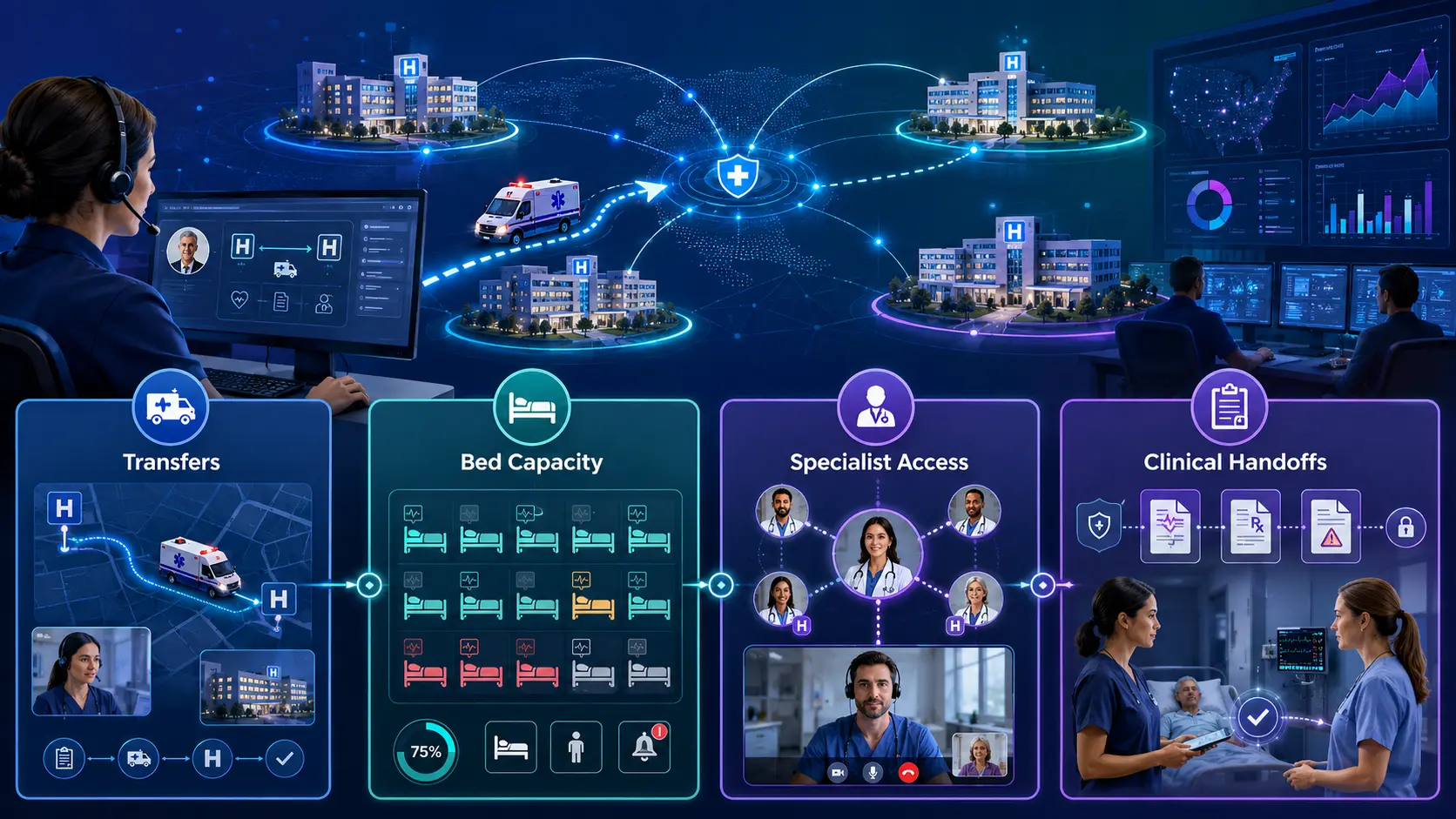
1. Patient Transfer Coordination
Patient transfer coordination features should manage the full journey from request intake to patient arrival. Specifically, the system must track inter-facility transfer workflow features alongside live transport logistics coordination features to eliminate phone trees.
Therefore, teams can automate routing while maintaining absolute clarity over active patient transitions.
- Unified Intake Architecture: The platform captures the core reason for transfer, clinical acuity, required service line, and necessary bed type automatically.
- Automated Transfer Tracking: Integrated transfer center automation features digitize the physician-to-physician handoff and track real-time acceptance milestones.
- Intellivon’s Builder Approach: We construct event-driven transfer timelines that link emergency medical services with the receiving facility’s dashboard.
Consequently, establishing this automated pipeline helps the network reduce manual calls and creates a reliable transfer timeline.
2. Bed Capacity And Patient Placement
Bed availability tracking features should show real-time capacity across all hospitals within the regional system. Consequently, this centralized view includes enterprise bed board features that display active ICU capacity coordination features and cleaning updates.
Therefore, clinical teams can match arriving patients to the ideal care site without manual verification delays.
- Real-Time Bed Management Features: The software displays live dashboards covering step-down, med-surg, behavioral health, isolation, and blocked beds.
- Patient Placement Optimization Features: Automated matching systems suggest optimal destinations based on live capacity management features and multi-facility data.
- Intellivon’s Builder Approach: We deploy predictive load balancing patient placement features that flag upcoming discharge windows using historical trend telemetry.
Because these models update constantly, networks maximize their existing floor space while avoiding dangerous emergency department overcrowding. Thus, human operations leaders retain final decision authority while utilizing data to streamline placement.
3. Specialist Availability And Consult Routing
Specialist availability tracking features should show which physicians are available by site, shift, specialty, and consult type. This visibility is critical for organizing stroke, trauma, cardiology, oncology, psychiatry, surgery, and intensive care transfers.
Therefore, the network can route urgent cross-facility consult request features without relying on outdated paper call sheets.
- On-Call Coverage Coordination Features: Centralized tracking logs physician availability across all physical campus locations in real time.
- Telemedicine Consult Coordination Features: Built-in routing layers connect rural emergency departments with virtual specialist access panels instantly.
- Intellivon’s Builder Approach: We build automated escalation matrices that log specialist acceptance, rejection, response time, and secondary notifications.
Streamlining this directory ensures that time-sensitive cases receive immediate attention from the appropriate credentialed provider. Consequently, tracking these communication touchpoints gives operations leads clear data to optimize regional staffing structures.
4. Clinical Handoffs And Care Continuity
Clinical handoff documentation features should make sure the receiving team has the right information before the patient moves. Specifically, this module ensures cross-facility care plan access features remain open to authorized personnel during transport.
Therefore, receiving nurses can review medical histories prior to the patient arriving on the floor.
- SBAR Transfer Communication Features: The system enforces structured communication formatting to standardize reporting across separate facilities.
- Cross-Facility Medication Reconciliation Features: Shared medication list features and allergy lists sync across EHR barriers during the transfer.
- Intellivon’s Builder Approach: We utilize FHIR R4 multi-facility API features to extract and bundle active care plans into compliance-ready handoff records.
Enforcing these data standards prevents critical information gaps from compromising care quality during inter-facility transit. Consequently, compiling these operational records prepares health systems to transition into high-density clinical checklists.
Core Care Coordination Platform Features For Multi-Hospital Networks
The most important care coordination platform features for multi-hospital networks are transfer intake, bed visibility, patient matching, physician handoff, transport scheduling, shared care plans, centralized scheduling, EHR interoperability, secure messaging, analytics, and compliance controls.
Consequently, these features must work together because patient movement crosses clinical, operational, and administrative boundaries at the same time. Therefore, deploying these unified modules stabilizes regional operations across all active healthcare campuses.
Capability Comparison Across Coordination Frameworks
Multi-hospital systems frequently choose between traditional standalone software tools and comprehensive, unified platforms. Specifically, selecting the correct architecture dictates how well data streams synchronize across separate facilities during high-volume transfers.
Therefore, comparing infrastructure capabilities helps technology leaders choose the best development path for their enterprise network.
| Operational Capability | Fragmented Standalone Tools | Centralized Coordination Platforms |
| Data Ingestion Speed | Manual entry or batch updates create 30-minute delays. | Real-time FHIR R4 pipelines update within seconds. |
| Transfer Center Tracking | Disconnected phone logs and spreadsheets create visibility gaps. | Event-driven timelines log every transition milestone. |
| Bed Capacity Management | Manual phone queries and delayed EHR bed boards. | Automated enterprise bed boards pull direct ADT feeds. |
| Cross-Facility Handoffs | Faxed paperwork and disconnected message loops. | Standardized SBAR forms sync instantly across sites. |
1. Transfer Center Automation Features
Transfer center automation features should capture the transfer request, patient acuity, diagnosis, required service line, referring facility, requested destination, bed type, and acceptance status.
Specifically, the system should replace manual call logs with structured workflows to accelerate clinical routing. Therefore, coordinators can manage volume without dropping critical details.
- Digitized Handoff Infrastructure: The platform implements standardized physician-to-physician handoff features and SBAR transfer communication features to preserve clinical accuracy.
- Automated Escalation Logic: Built-in escalation rules for delayed acceptance send instant alerts if a request remains unreviewed past established SLA windows.
- Intellivon’s Builder Approach: We code automated transfer acceptance features that automatically route admission data directly into the accepting physician workflow.
Consequently, establishing this digital protocol ensures that high-acuity cases move through the intake network with zero administrative latency.
2. Real-Time Bed And Capacity Management Features
Real-time bed management features should show available, occupied, pending discharge, blocked, cleaning, ICU, step-down, med-surg, behavioral health, and specialty beds across the network.
Consequently, the system should support an enterprise bed board that updates directly from ADT data feeds. Therefore, facilities avoid bottlenecking their emergency departments during peak admission surges.
- Network Capacity Visibility: The dashboard aggregates capacity management features, multi-facility views alongside localized bed availability tracking features into one interface.
- Intelligent Placement Allocation: Load balancing patient placement features and specialty bed matching features pair incoming patients with appropriate vacant units.
- Intellivon’s Builder Approach: We build live enterprise bed board features that integrate directly with existing ED diversion management features and ambulance diversion tracking features.
Because these data points update constantly, clinical managers can coordinate complex ICU capacity coordination features across the entire region. Thus, hospital networks maximize their physical footprints while reducing patient boarding times.
3. Inter-Facility Transport Coordination Features
Transport logistics coordination features should connect transfer acceptance to ground ambulance, air medical transport, pickup ETA, destination ETA, acuity level, equipment needs, and crew readiness.
Specifically, tracking these external variables prevents patients from waiting on tarmac spaces or ambulance bays. Therefore, the care team retains precise visibility over the entire mobile timeline.
- Logistics Dashboard Integration: The platform unites inter-hospital transport scheduling features and air medical transport coordination features into a single logistical map.
- Automated Field Diagnostics: Real-time delay reason tracking logs road blockages, weather issues, or crew readiness changes to recalculate destination ETAs.
- Intellivon’s Builder Approach: We design custom EMS coordination integration features that transmit live telemetry data directly back to the receiving facility.
Streamlining these transit data points ensures that trauma units stand fully prepared the exact moment an emergency vehicle arrives. Consequently, this continuous tracking optimizes crew utilization while significantly improving patient safety during critical road transfers.
4. Cross-Facility Care Continuity Features
Care continuity features should allow authorized teams to see the patient’s shared care plan, medication list, allergy list, recent labs, imaging, and care goals across sites.
Consequently, this shared visibility eliminates dangerous medication gaps when a patient moves from a community hospital to a tertiary center. Therefore, clinicians can prescribe treatments immediately without repeating baseline diagnostic steps.
- Unified Clinical Records: The software provisions secure cross-facility care plan access features and unified patient record access features across all branches.
- Synchronized Diagnostics Architecture: Centralized imaging access features, shared PACS access features, and cross-facility lab result access features eliminate missing file errors.
- Intellivon’s Builder Approach: We deploy shared care plan features alongside cross-facility medication reconciliation features and shared allergy list features using secure data structures.
Enforcing these data standards prevents critical information gaps from compromising care quality during inter-facility transit. Consequently, compiling these operational records prepares health systems to transition into high-density interoperability configurations.
Multi-Hospital Coordination Architecture Requirements
Multi-hospital coordination architecture should connect EHRs, ADT feeds, FHIR APIs, identity systems, transfer workflows, bed boards, secure messaging, analytics, and audit controls through a centralized orchestration layer.
Consequently, the architecture must support high availability, federated identity, real-time events, and site-specific rules without forcing every hospital into one identical workflow. Therefore, this framework guarantees system resilience across complex health networks.
1. Architectural Differences Across Coordination Frameworks
Legacy hospital software relies on slow, batch-processed data transfers that limit network visibility. Therefore, choosing a modern event-driven framework prevents system latency and ensures data accuracy across all connected sites.
| Technical Component | Legacy Architecture | Modern Event-Driven Architecture |
| Data Synchronization | Batch processing causes 4-to-12-hour delays. | Real-time event streaming updates records instantly. |
| Identity Management | Disconnected MRNs cause duplicate files. | Centralized EMPI logic matches patients accurately. |
| Workflow Flexibility | Hardcoded rules force rigid campus processes. | Configurable rules engines support local workflows. |
| User Experience | Monolithic dashboards overwhelm operators. | Role-specific views isolate actionable decisions. |
Layer 1 — Data Ingestion And Event Streaming
The ingestion layer should pull ADT events, bed status, transfer requests, lab results, imaging metadata, medication data, and scheduling data from each facility.
Specifically, it must run HL7 integration multi-hospital features and FHIR R4 multi-facility API features concurrently to manage diverse hospital data feeds.
Therefore, the network achieves an instantaneous flow of core operational telemetry without creating severe lag.
- Technical Components: This layer incorporates HL7 v2 ADT feeds, FHIR R4 APIs, an enterprise interface engine, an event bus, an API gateway, strict data validation rules, and automated retry and failover queues.
- Intellivon’s Builder Approach: We map each facility’s source systems first, and then we separate real-time event feeds from slower batch data to avoid overloading the database in production.
- Architecture Continuity: For a deeper breakdown of constructing scalable health system data pipelines, see our technical guide on the Healthcare AI Agent.
Transitioning from batch uploads to automated event streaming ensures your regional dashboard updates within milliseconds of an electronic chart update. Consequently, this live data flow prevents coordinators from routing patients based on outdated information.
Layer 2 — Patient Identity And Matching
The identity layer should connect records across facilities without creating unsafe duplicates that could threaten clinical care safety.
Specifically, enterprise master patient index features and cross-facility patient matching features must parse demographics, MRNs, encounter IDs, phone numbers, insurance fields, and matching confidence scores.
Therefore, clinicians can open a file knowing it contains the complete regional history.
- Technical Components: The core stack utilizes advanced EMPI logic, probabilistic matching algorithms, deterministic matching rules, a duplicate resolution workflow, a manual merge queue, and a complete audit trail for identity decisions.
- Intellivon’s Builder Approach: We keep identity matching completely explainable by ensuring the platform explicitly displays why two records matched instead of silently merging patient records behind the scenes.
- System Integration: This secure identity layer functions natively alongside single sign-on multi-facility features and federated identity management features to protect data integrity at every point of entry.
Establishing a bulletproof identity engine eliminates the risk of overlaying two separate medical histories during an urgent transfer. Consequently, this clear distinction protects patient safety while building a trustworthy data foundation for clinical automation.
Layer 3 — Workflow Orchestration
The workflow layer should route transfer requests, consults, handoffs, bed assignments, transport tasks, and escalation alerts across the medical network. Because different campuses maintain distinct clinical teams, it must support hospital-specific policies without hardcoding every individual workflow separately.
Therefore, the system remains flexible enough to adapt to local rules while enforcing overall network performance standards.
- Technical Components: This operational layer relies on an enterprise rules engine, a task orchestration service, an SLA timer, an automated escalation queue, role-based routing algorithms, a notification service, and an exception handling dashboard.
- Intellivon’s Builder Approach: We separate deterministic routing rules from AI recommendations because this structural split keeps high-risk clinical decisions completely under human control.
- Workflow Automation: This architecture leverages automated transfer acceptance features and multi-site hospital coordination platform requirements to move patients through optimized clinical pathways.
Using an elastic orchestration engine prevents administrative bottlenecks during peak hours when multiple transfer requests arrive simultaneously. Consequently, automating these administrative tasks allows the software to escalate delayed approvals before they impact patient care timelines.
Layer 4 — User Experience And Command Center Dashboards
The user layer should support transfer coordinators, bed managers, physicians, nurses, operations leaders, and executives through tailored interfaces. Specifically, centralized command center features and hospital network operations center features must be designed entirely around role-specific decisions.
Therefore, individual operators see the exact tools they need to complete tasks during their active shifts.
- Technical Components: The user portal includes a network-wide bed board, a transfer status dashboard, a facility capacity dashboard, a specialist availability view, an ED diversion board, a quality and compliance dashboard, and an executive KPI view.
- Intellivon’s Builder Approach: We do not give every user the same dashboard, but instead we configure the platform to show each specific role the actionable choices they need to make within their next shift.
- Interface Optimization: These clean views integrate secure messaging, multi-hospital features, and care team messaging across facilities to replace messy external chat groups.
Designing separate, role-specific views keeps users focused on critical operational metrics without overwhelming them with unnecessary system data. Consequently, anchoring these custom front-end modules to a modular architecture ensures the software scales easily from three hospitals to fifty.
Transfer Center And Patient Placement Features That Reduce Delays
Transfer center and patient placement features reduce delays by turning intake, triage, acceptance, bed assignment, physician review, and transport into one trackable workflow. Consequently, the platform shows who owns each decision, what information is missing, which bed is appropriate, and when escalation is required across the hospital network.
Therefore, deploying these automated features stabilizes patient transfer coordination across all active campuses.
1. Operational Performance Metrics Across Transfer Frameworks
Manual transfer logging creates severe visibility gaps that stall critical patient movement. Conversely, automated platforms track every milestone to eliminate administrative bottlenecks across regional health networks. Therefore, upgrading to digital tracking tools optimizes throughput and protects clinical safety margins.
| Throughput Metric | Manual Transfer Workflows | Automated Tracking Platforms |
| Intake Logging | Paper call logs create data gaps. | Structured forms capture full clinical context. |
| Bed Matching | Manual phone calls to check open units. | Automated rule engines filter specialty beds. |
| SLA Tracking | Retrospective reviews delay active fixes. | Real-time dashboards flag lagging reviews. |
2. Digital Transfer Intake
Digital transfer intake should capture clinical urgency, diagnosis, service line, vitals, required bed level, source facility, payer details, and attachments. Specifically, the system must support phone-based intake because transfer centers still receive urgent calls. Therefore, coordinators capture complete clinical summaries without switching between disconnected applications.
- Technical Execution: The platform digitizes multi-hospital patient transfer coordination features using responsive intake forms, automated acuity scoring, and time-stamped call logs.
- Streamlined Context Gathering: Field validation rules check that essential clinical indicators are input correctly before routing the request to destination facilities.
- Data Continuity: Instant integration loops sync these submitted intake forms directly into active electronic chart records to build a single historical timeline.
3. Specialty Bed Matching
Specialty bed matching should compare the patient’s clinical need with facility capability. Consequently, the platform must verify which site can handle stroke, STEMI, trauma, ICU, neonatal, oncology, psychiatry, surgery, or isolation needs.
Therefore, operators avoid placing complex patients at facilities lacking adequate specialized equipment.
- Technical Execution: The module uses multi-facility care coordination platform features to cross-reference infection control flags and equipment needs with active floor inventories.
- Deterministic Filtering Logic: The rule engine matches real-time facility constraints against patient requirements to eliminate inappropriate destination choices immediately.
4. Accepting Physician Workflow
Accepting physician workflow features should route cases to the right specialist, show the transfer summary, capture acceptance or rejection reasons, and document the final decision.
Consequently, this system replaces fragmented text chains with direct, auditable clinical communications. Therefore, the network minimizes communication latency during time-sensitive medical emergencies.
- Technical Execution: The portal integrates cross-facility consult request features, telemedicine consult coordination features, and virtual specialist access features into one alert system.
- Automated Escalation Paths: Built-in timers reroute pending transfer requests to on-call backup physicians automatically if the primary specialist does not respond within ten minutes.
5. Transfer SLA And Delay Analytics
The platform should measure request-to-review, review-to-acceptance, acceptance-to-bed, bed-to-transport, and transport-to-arrival. Consequently, these metrics help operations leaders identify whether delays come from bed scarcity, physician response, documentation, or transportation. Therefore, administrators gain clear, data-driven insights to eliminate systemic workflow friction.
- Technical Execution: The engine computes request-to-bed assignment times and tracks destination rejection reasons to build network-wide quality check boards.
- Telemetry Performance Monitoring: Visual dashboards isolate specific transfer bottlenecks across departments to give operations leads clear data for resource planning.
Analyzing these live throughput metrics allows network operations teams to optimize regional patient distributions. Expansion plans can then safely proceed because the platform provides full operational visibility.
Centralized Scheduling And Specialist Availability Features
Centralized scheduling features help multi-hospital networks coordinate specialists, consults, procedures, imaging, follow-up appointments, and on-call coverage across facilities.
The platform should expose real availability, not just static calendars, so transfer centers and operations teams can route patients toward sites that can actually complete the next step of care.
As a result, networks maximize specialist utilization while significantly reducing treatment delays.
1. Access Management Capabilities Across Scheduling Architectures
Static spreadsheets and disconnected local calendars create constant scheduling conflicts that stall care transitions. On the other hand, a centralized platform unifies regional resources to ensure incoming patients receive immediate placement.
Consequently, upgrading to an enterprise scheduling layer eliminates operational friction and improves service-line performance.
| Scheduling Capability | Legacy Departmental Calendars | Centralized Scheduling Platforms |
| Availability Auditing | Manual phone confirmation is required. | Real-time digital slot visibility across sites. |
| Consult Dispatching | Faxes and manual pages slow down routing. | Automated digital consult queues with SLA clocks. |
| Discharge Integration | Patients leave without a confirmed follow-up. | Point-of-care appointment booking during discharge. |
2. Enterprise Scheduling Platform Features
Enterprise scheduling platform features should connect facility calendars, department schedules, specialist availability, procedure room capacity, and appointment rules. Specifically, this integration helps care teams schedule follow-up appointments before a patient ever leaves the discharge lounge.
Thus, health systems protect post-acute revenue while actively driving down preventable readmission rates.
- Technical Execution: The module deploys cross-facility appointment booking tools, procedure slot visibility dashboards, and referral-to-appointment tracking engines.
- Proactive Resource Security: Automated schedulers match incoming discharge follow-up scheduling needs against open provider templates across all regional branches.
3. Specialist And On-Call Coverage Visibility
Specialist availability tracking features should show who is available by site, service line, shift, and consult type. In this manner, the software reduces manual phone calls to confirm roster coverage during acute trauma emergencies.
Therefore, transfer centers can instantly identify which campus can accept high-acuity stroke or cardiac patients.
- Technical Execution: The platform implements on-call coverage coordination features alongside automated backup physician rules to secure continuous coverage.
- Shift Integrity Tools: Dedicated service-line calendars and secure shift handoff notes track active clinician handoffs at every shift change.
- Performance Accountability: The infrastructure integrates real-time response time tracking that logs the exact minutes between a page and specialist acceptance.
4. Cross-Facility Consult Requests
Cross-facility consult request features should allow one facility to request specialist input from another facility without moving the patient immediately. For example, this virtual workflow supports rapid telemedicine consult coordination features and immediate virtual specialist access features in rural clinics.
Accordingly, local teams stabilize complex patients on-site while avoiding unnecessary, expensive emergency transport costs.
- Technical Execution: The module uses structured digital consult request portals that bundle clinical packet attachments and secure video visit links automatically.
- Triage Prioritization: Operators flag the consult urgency level to push critical cases to the top of the specialist’s active queue.
- Data Write-Back Synchronization: The system captures the specialist response record and writes clinical notes back to the local EHR immediately.
Enforcing these unified access features helps medical networks route clinical expertise exactly where it is needed most. Furthermore, stabilizing these schedules creates the necessary pipeline to manage complex cross-facility clinical records.
EHR Interoperability And Unified Patient Record Features
Multi-facility EHR integration features should give authorized teams fast access to the patient’s clinical context across Epic, Oracle Health, Meditech, labs, imaging, pharmacy, and scheduling systems.
The goal is not to replace the EHR. Instead, the goal is to create a coordination layer that makes cross-site decisions safer and faster. For this reason, building an effective interoperability layer prevents clinical teams from working in structural isolation.
1. Technical Performance Across Integration Frameworks
Legacy health networks rely on fragmented point-to-point connections that increase database stress and delay record delivery. Conversely, modern interoperability platforms apply unified data schemas to stream patient summaries instantly across separate hospital campuses.
Accordingly, adopting a normalized data layer lowers technical debt and ensures immediate availability at the point of care.
| Interoperability Metric | Point-to-Point Custom Interfaces | Unified Interoperability Platforms |
| Interface Complexity | High maintenance with exponential connection sprawl. | Low overhead utilizing a centralized hub-and-spoke setup. |
| Data Format Support | Rigid translation layers lag during high-volume loads. | Native concurrent handling of HL7 v2 and FHIR JSON. |
| Query Latency | Direct database queries cause visible EHR slowdowns. | Stateless API orchestration delivers sub-second lookups. |
2. Epic And Oracle Health Multi-Facility Integration
Epic multi-hospital integration features and Cerner multi-facility integration features should support ADT data, orders, notes, labs, allergies, medication lists, encounters, and scheduling events.
However, the exact technical scope always depends on each hospital’s specific local deployment environment. Thus, the system must adapt to local configurations without breaking global communication rules.
- Technical Execution: The integration framework routes structured clinical data directly from specialized institutional modules using vendor-approved API access points.
- Bi-Directional Schema Mapping: Transformation engines convert proprietary source data fields into standardized operational packets for immediate cross-site review.
- Encounter Timeline Generation: Disparate clinical events combine into a single, cohesive timeline that lists past admissions and upcoming outpatient appointments.
3. FHIR R4 And HL7 Integration
FHIR R4 multi-facility API features should support modern resource-based exchange across web and mobile infrastructure. At the same time, HL7 v2 software components must still support legacy ADT, orders, results, and bed status because many hospital systems still depend on them.
For this reason, the platform runs a hybrid integration architecture to bridge the gap between old and new systems.
- Technical Execution: The platform exposes secure RESTful endpoints for Patient, Encounter, Observation, MedicationRequest, AllergyIntolerance, and DiagnosticReport resources.
- Event-Driven Messaging Hooks: System gateways ingest HL7 ADT A01, A03, and A08 events alongside active ORU result feeds to update bed status boards.
- Validation and Queue Management: Incoming messages pass through structural validation filters before entering automated retry queues to prevent packet loss during spikes.
4. Unified Patient Record Access
Unified patient record access should show the minimum necessary data for transfer, consult, capacity, and handoff decisions.
Specifically, this administrative interface should not create a full duplicate EHR inside the coordination platform. Instead, it serves as an operational summary that highlights critical patient care boundaries during active transits.
- Technical Execution: The frontend compiles data elements including active problems, allergies, active medications, recent labs, and imaging reports into a single screen.
- Handoff Summary Distribution: Care timelines append complete transfer summaries and advance directives to guide the receiving medical facility team.
- Contextual Data Purging: Cached clinical summaries clear from local session memory automatically after a transfer closes to maximize security.
5. Single Sign-On And Federated Identity
Single sign-on multi-facility features and federated identity management features should let users access the platform across sites without unsafe credential sharing. Crucially, user access must strictly reflect user role, facility, department, and active patient relationships.
Ultimately, enforcing these precise parameters stops unauthorized internal data lookups.
- Technical Execution: The security core uses OAuth 2.0 and OpenID Connect protocols to authenticate user identities against existing hospital enterprise directories.
- Granular Permission Hierarchies: Role-based access controls separate clinical dashboards from high-level management tools based on pre-defined security clearances.
- Emergency Break-Glass Controls: Authorized clinicians can override standard view restrictions during extreme emergencies, which triggers an instant compliance audit entry.
Establishing this secure identity matrix ensures that patient data remain protected while flowing between disparate healthcare systems. Furthermore, standardizing this technical access prepares the care network to run automated clinical validation algorithms.
AI Features For Hospital Network Coordination
AI features for hospital network coordination should support prediction, prioritization, summarization, routing, and exception detection. They should not silently decide where a patient goes.
Instead, the safest model combines deterministic rules, machine learning recommendations, explainability, human review, audit logs, and continuous monitoring. Because of this structured constraint, clinical leaders adopt intelligent automation layers without sacrificing direct medical oversight.
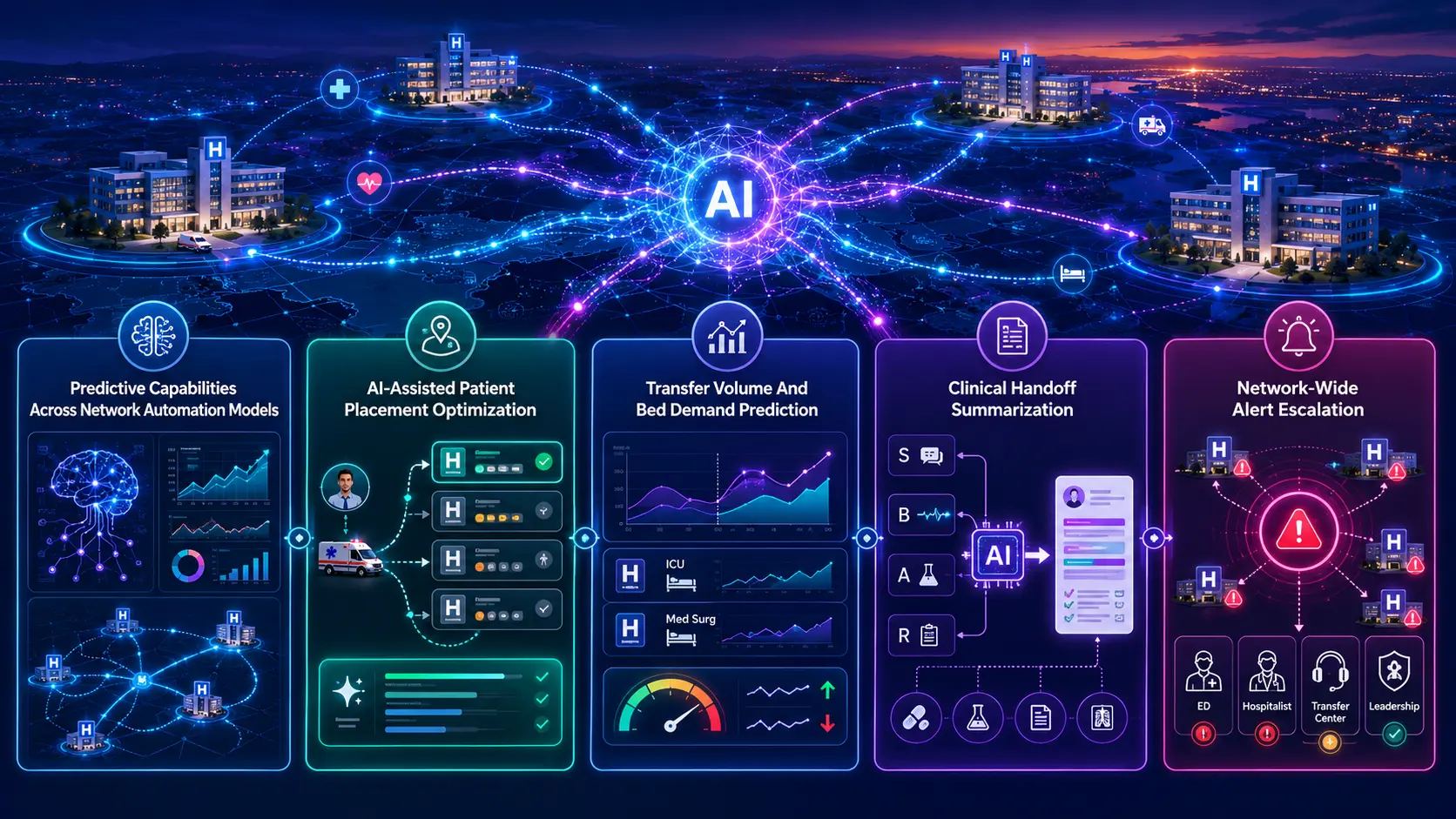
1. Predictive Capabilities Across Network Automation Models
Static spreadsheet workflows force transfer coordinators to respond reactively to sudden bed shortages. Conversely, deploying embedded machine learning algorithms gives command centers the predictive visibility to balance regional patient volumes before bottlenecks occur.
As a result, upgrading to predictive clinical infrastructure directly prevents emergency department overcrowding.
| Intelligence Capability | Rule-Based Software Systems | AI-Enabled Coordination Platforms |
| Placement Matching | Relies on manual filters that ignore active distance logs. | Computes optimal destination rankings using live capacity trends. |
| Demand Forecasting | Restricts insight to retrospective shift reviews. | Generates multi-facility time-series demand forecasts. |
| Handoff Compilation | Mandates full manual narrative typing from scratch. | Summarizes long multi-EHR timelines into clean SBAR blocks. |
2. AI-Assisted Patient Placement Optimization
AI-assisted patient placement should recommend the best destination based on acuity, bed type, service line, distance, physician coverage, historical transfer patterns, and current capacity.
Crucially, the platform must always display its reasoning to the clinical operator. Thus, users can validate suggestions immediately against real-time floor constraints.
- Technical Execution: The placement recommendation model analyzes multi-site hospital coordination platform requirements to calculate real-time destination rankings.
- Explainability Interface Tools: The dashboard incorporates a feature importance display alongside a clear model confidence score for every suggested placement.
- Clinical Safety Layering: Strict deterministic safety exclusion rules automatically filter out inappropriate facilities before routing requests to the human approval workflow.
3. Transfer Volume And Bed Demand Prediction
Predictive models can forecast transfer volume, ICU demand, med-surg demand, ED pressure, and discharge bottlenecks across the network. Specifically, this proactive forecasting helps network operations teams prepare resources before capacity reaches crisis levels.
For this reason, systems can allocate float pools efficiently to accommodate expected patient surges.
- Technical Execution: The system runs time-series forecasting algorithms that ingest local admission trends to output a facility-level demand model.
- Macro Trend Accounting: Built-in calculation engines run seasonal trend detection across different departments to generate a service-line demand forecast.
- Operational Risk Scoring: The interface displays a dynamic capacity risk score while allowing administrators to perform precise alert threshold tuning.
4. Clinical Handoff Summarization
Large Language Models (LLMs) can summarize transfer notes, discharge summaries, consult notes, medication changes, and pending tasks during cross-facility moves.
However, clinicians must review and approve these automated summaries before they enter official system workflows. In this manner, health systems protect data accuracy while saving hours of manual reading time.
- Technical Execution: Natural Language Processing (NLP) pipelines ingest unstructured charts to generate structured SBAR summary packets.
- Clinical Indicator Extraction: Automated modules run medication change extraction and pending result extraction to fuel rapid red flag detection.
- Accountability Provenance: The user interface embeds direct source-note traceability links so clinicians can click any summarized sentence to view the original record.
5. Network-Wide Alert Escalation
AI can identify cases at risk of transfer delay, missed handoff, duplicate intake, prolonged ED boarding, or unresolved specialist review. Accordingly, the platform must escalate these operational risks to the correct role automatically.
This targeted alerting ensures that bottlenecked cases receive immediate managerial support before care delivery degrades.
- Technical Execution: The underlying network monitor unifies critical event notification, multi-facility features, and network-wide alert escalation features into one daemon.
- Active Exception Catching: Automated delay risk detection scripts flag stagnant transfer logs and assign them directly to a designated escalation owner.
- Model Health Guardrails: The platform includes strict alert fatigue controls while monitoring underlying pipelines using automated model drift monitoring dashboards.
Deploying these layered intelligence guardrails provides clinical operations teams with actionable foresight without removing human clinicians from the loop. Furthermore, securing these automated decisions requires pinning the data pipelines to transparent compliance standards. Let’s analyze the exact core features required to maintain regulatory auditability across a multi-hospital environment.
HIPAA-Compliant Multi-Hospital Coordination Features
HIPAA-compliant multi-hospital coordination features should protect PHI across every transfer, message, consult, record view, API call, and analytics dashboard.
The platform needs access control, audit logging, encryption, identity governance, BAA coverage, data minimization, and incident response workflows before hospitals can trust it across facilities.
For this reason, embedding strict regulatory controls directly into the system design prevents costly data leaks across network campuses.
1. Security Framework Differences Across Hospital Deployments
Old-school health networks rely on basic firewall boundaries that fail to secure data once it leaves a local facility. Conversely, modern compliance architectures apply strict continuous verification protocols to protect sensitive health metrics across all endpoints simultaneously.
For this reason, upgrading to a centralized security layer eliminates compliance vulnerabilities while maintaining operational agility.
| Security Capability | Isolated Legacy Security | Multi-Hospital Zero-Trust Security |
| User Authentication | Weak local logins risk internal data exposure. | Federated single sign-on with multi-factor checks. |
| Data Visibility | Open access models expose unnecessary files. | Attribute-based rules restrict views to active teams. |
| Compliance Tracking | Manual spreadsheet reviews cause log gaps. | Automated audit daemons track every single click. |
2. Role-Based Access Across Facilities
Role-based access multi-hospital features should restrict users to the patients, sites, service lines, and actions they need. Specifically, a transfer coordinator should not have the same data clearance as a cardiologist, nurse manager, or executive analyst.
Therefore, configuring granular view rules limits user visibility strictly to files that match their active assignment.
- Technical Execution: The authorization system utilizes advanced RBAC alongside flexible attribute-based access rules to govern regional workspaces.
- Contextual Access Logic: Permissions are configured around facility-specific permissions, department tags, and active patient relationship logic to isolate records.
- Emergency Override Tools: Software portals integrate secure break-glass access triggers alongside an automated access review workflow to check manual overrides.
3. Audit Trail And Monitoring
Audit trail multi-facility coordination features should record who viewed, changed, exported, routed, accepted, rejected, or escalated each case. Consequently, this persistent historical log protects the hospital network during compliance reviews and external security audits.
Therefore, compliance managers can reconstruct individual data journeys instantly without digging through separate server logs.
- Technical Execution: Centralized logging engines capture user activity logs, API access logs, message logs, record view logs, and transfer decision logs.
- Persistent Data Retention: The audit infrastructure implements a strict multi-year data retention policy that locks log tables to prevent tampering risks.
- Governance Review Portals: Compliance teams access a dedicated compliance reporting dashboard to run rapid, multi-facility utilization investigations.
4. Zero-Trust Architecture
Zero-trust architecture multi-hospital features should verify every user, device, workload, and integration across the system. This continuous validation matters because the platform crosses separate hospitals, departments, third-party vendors, and mobile transport partners.
As a result, the application treats all network traffic as potentially hostile until it satisfies active verification rules.
- Technical Execution: The core infrastructure mandates global MFA and enterprise SSO to confirm user identities before loading dashboards.
- Integration Security Layers: Security gateways run continuous device trust checks, deep network segmentation protocols, and secure API authentication routines.
- Data Protection Safeguards: The database architecture enforces strict least privilege access controls alongside military-grade encryption in transit and at rest.
5. BAA And Vendor Governance
BAA requirements for multi-facility vendors must be completely clear before software development begins on the system. Because the platform touches core EHR data, transfer notes, messages, lab results, imaging metadata, and patient identifiers, vendor liability must be locked down.
Ultimately, validating these vendor agreements ensures that external development squads maintain identical security standards.
- Technical Execution: Security officers map out the explicit BAA scope and mandate a formal subprocessor review for all attached microservices.
- Data Inventory Tracking: Data management tools maintain a live PHI data map that matches cloud storage nodes with regional data retention terms.
- Incident Containment Protocols: Governance templates deploy an automated incident response plan alongside tight vendor access controls to block external vulnerabilities.
Enforcing these strict privacy barriers guarantees that high-volume health systems share patient data without violating federal laws. Furthermore, stabilizing this defensive baseline allows technology leaders to confidently extract network-wide operations analytics.
What Does A Multi-Hospital Care Coordination Platform Cost?
A custom multi-hospital care coordination platform usually costs $70,000–$300,000 for a focused MVP-to-production build.
The final budget depends on the number of facilities, EHR integrations, bed management depth, transfer workflows, analytics complexity, AI model scope, transport integrations, and HIPAA compliance requirements.
Therefore, breaking down expenditures by development milestones helps systems allocate capital efficiently without risking scope creep.
1. Phase-Wise Development Cost Matrix
| Development Phase | Primary Technical Output | Target Duration | Estimated Budget |
| Phase 1: Workflow Discovery | Transfer workflows, bed management map, stakeholder requirements. | 2–3 weeks | $6,000–$14,000 |
| Phase 2: Architecture Planning | Multi-hospital coordination architecture, data model, integration blueprint. | 2–4 weeks | $8,000–$22,000 |
| Phase 3: EHR & Identity Integration | HL7 feeds, FHIR APIs, EMPI logic, SSO, patient matching. | 4–8 weeks | $22,000–$70,000 |
| Phase 4: Transfer Center Workflows | Transfer intake, acceptance, bed matching, handoff, transport routing. | 5–8 weeks | $28,000–$85,000 |
| Phase 5: Dashboards & Analytics | Bed board, command center dashboards, transfer KPIs, compliance reports. | 4–7 weeks | $18,000–$55,000 |
| Phase 6: AI Assistance | Placement recommendations, demand forecasts, summary models, escalation scoring. | 4–8 weeks | $20,000–$65,000 |
| Phase 7: Compliance Validation | HIPAA controls, audit logs, access testing, failover, QA. | 3–5 weeks | $12,000–$35,000 |
2. Cost Allocation By Scope Type
| Build Type | Cost Range | Best Fit Scenario |
| Lean MVP | $70,000–$120,000 | 2–3 hospitals, basic transfer workflow, bed board, one EHR environment. |
| Operational Platform | $120,000–$210,000 | 3–8 hospitals, transfer center automation, FHIR/HL7, dashboards, RBAC. |
| Advanced Network Platform | $210,000–$300,000 | 8+ sites, AI placement, transport integration, command center analytics, high availability. |
3. Ongoing Maintenance Cost
Ongoing maintenance usually costs 15%–25% of the initial build per year. For example, a $180,000 operational platform should plan for $27,000–$45,000 annually for system monitoring, server support, integration updates, model retraining, compliance patches, and workflow changes.
Thus, account teams protect software health long after the initial engineering phase concludes.
Establishing this baseline financial framework allows health systems to map out clear technology paths without risking operational downtime. Furthermore, managing these budgets protects initial capital while laying a clean foundation for rapid software rollouts.
Build Multi-Hospital Coordination Platforms With Intellivon
Intellivon helps healthcare organizations build multi-hospital coordination platforms when off-the-shelf tools cannot handle complex transfer workflows, bed visibility, EHR integration, physician handoffs, AI decision support, and HIPAA-ready governance.
With 500K+ engineering hours and experience across healthcare AI, interoperability, and production-grade systems, Intellivon builds coordination platforms that work under real operational pressure.
1. We Understand That This Is Not Just Another Healthcare Dashboard
Multi-hospital coordination platforms sit close to critical operations. They influence patient transfers, capacity decisions, physician response, transport timing, and care continuity across facilities.
Intellivon treats the platform as network infrastructure, not a reporting layer, so every feature connects to a real operational decision.
2. We Build Around Complex Healthcare Integrations From Day One
A coordination platform only works when it connects with the systems hospitals already use. Intellivon designs around Epic, Oracle Health, HL7 feeds, FHIR R4 APIs, EMPI logic, SSO, labs, imaging, scheduling tools, and internal command center systems. This reduces integration risk during rollout.
3. We Know Where AI Helps And Where Human Review Must Stay
AI can recommend patient placement, forecast bed demand, summarize handoffs, and flag transfer delays.
However, it should not silently make clinical or operational decisions. Intellivon builds AI with explainability, confidence scores, audit logs, and human approval workflows so teams can move faster without losing accountability.
4. We Design For HIPAA, Auditability, And Multi-Site Governance
Multi-hospital coordination platforms handle PHI across facilities, roles, departments, vendors, and transport partners.
Intellivon builds HIPAA-ready controls into the architecture, including role-based access, encryption, SSO, audit trails, break-glass access, monitoring, and BAA-aware vendor governance.
5. We Help Leadership Prove Operational Value After Launch
A platform must show more than adoption. It should prove faster transfer decisions, better bed utilization, reduced referral leakage, shorter physician response times, fewer handoff gaps, and clearer network-wide performance.
Intellivon builds dashboards that help clinical, operational, and executive teams measure the value of coordination in practical terms.
6. Why Healthcare Teams Choose Intellivon
- 500K+ engineering hours across enterprise AI and software systems
- Ex-MAANG engineering experience for complex product architecture
- Healthcare AI development experience across workflows, data, and compliance
- Strong understanding of EHR, FHIR, HL7, MLOps, LLM, and agentic AI systems
- Production-first delivery, so the platform is built for real users, not demos
- HIPAA-ready architecture for PHI-heavy healthcare workflows
- Custom build capability when vendor platforms cannot match network-specific requirements
If your hospital network needs more than a generic care coordination tool, Intellivon can help you build a secure, AI-ready coordination platform around your actual transfer, capacity, handoff, and command center workflows.
Conclusion
Multi-hospital coordination improves when transfers, bed capacity, specialist availability, EHR data, transport, handoffs, and compliance operate through one shared platform.
The strongest care coordination platform features give teams real-time visibility, clear ownership, secure data access, and measurable network-wide performance.
With the right architecture, health systems can reduce manual coordination, move patients faster, protect PHI, and make capacity decisions with greater confidence across every facility and care setting each day.
Things To Know About Multi-Hospital Coordination Platform Features
Q1.How much does a multi-hospital care coordination platform cost?
A1. A custom multi-hospital care coordination platform usually costs $70,000–$300,000. For example, a lean MVP with transfer intake, bed board, one EHR environment, and basic dashboards costs $70,000–$120,000. However, advanced builds with AI placement, transport integration, high availability, and multiple facilities cost $210,000–$300,000.
Q2. How long does multi-hospital coordination platform development take?
A2. A focused MVP usually takes 12–18 weeks. However, a production platform across multiple facilities usually takes 5–8 months because teams must connect EHR data, bed status, transfer workflows, identity, access controls, analytics, and compliance testing. Therefore, timelines increase when several hospitals and EHR environments are involved.
Q3. What features support multi-facility coordination fastest?
A3. The fastest features are transfer center automation, real-time bed management, accepting physician workflow, shared clinical summaries, transport tracking, centralized scheduling, and network-wide dashboards. Together, these features reduce manual calls, spreadsheet dependency, and handoff delays. After that, teams can add predictive analytics, AI placement support, and advanced capacity forecasting.
Q4. What AI features for hospital network coordination are realistic?
A4. Realistic AI features include bed demand forecasting, transfer delay prediction, placement recommendations, handoff summarization, and escalation scoring. However, AI should recommend and prioritize instead of making final placement decisions. Therefore, the safest platform design keeps human review, explainability, confidence scores, and audit logs inside every AI-supported workflow.
Q5. What integrations are required for enterprise multi-hospital coordination software features?
A5. The core integrations include EHR, ADT feeds, FHIR APIs, HL7 feeds, scheduling, identity management, secure messaging, imaging, labs, and transport systems. Additionally, Epic and Oracle Health integrations often need separate planning because each facility may configure workflows differently. As a result, integration mapping should happen before feature development.
To Sum Up:
- Multi-hospital coordination fails when bed visibility, physician acceptance, transport, and handoff documentation live in separate tools.
- AI should recommend patient placement, forecast demand, and summarize handoffs, but humans should approve clinical movement decisions.
- A $70,000 MVP can prove value if it focuses on one high-volume transfer workflow instead of every facility use case.
- The most overlooked requirement is shared operational definitions across hospitals, especially for bed status and transfer acceptance.
- A command center dashboard is only useful when it connects live data to clear ownership of the next action.