Key Takeaways:
-
Healthcare systems may use AI safely but only if agentic AI does not act on its own in all situations.
-
It is more reasonable to start with work that carries risk and only then proceed to clinical decisions.
-
All PHI access, EHR permissions, audit logs, and vendor controls should be established in the stages.
-
It is possible to automate actions, but others will need a person to check and approve them.
-
Intellivon develops these platforms in stages. Includes access restrictions, human review, and monitoring from the very beginning.
Yes, safe deployment of AI by health systems is possible provided that compliance is incorporated into the design from the very beginning. Agentic AI healthcare compliance usually fails because teams regard it as a review carried out at the end of a project, by which time the architecture has already been finalized.
An AI agent is capable of doing more than answering questions; it can read patient records, make decisions, and carry out actions within systems such as your EHR. Since each of these steps involves protected health information, the rules set out by HIPAA, the FDA, and the ONC apply at every stage.
Safe deployment thus depends on four choices: which regulations apply, what controls the agent requires, how rollout is to be phased, and who’s to be responsible for the outcome. The following blog considers each of these in turn, with the costs at each phase.
That’s why agentic AI healthcare compliance feels harder than past software rollouts. At Intellivon, where we build agentic AI for healthcare teams, we see the same pattern in almost every project. Still, the projects that stay safe settle four questions early. Those four questions are which rules apply, which controls the agent needs, how you phase the rollout, and who owns the outcome.
Why Agentic AI Creates a New Risk for Health Systems
Agentic AI creates a new risk because it acts instead of advising. Existing healthcare AI governance was built for models that produce a score or a draft for a human to review. An agent queries records, writes updates, and submits requests across several systems on its own.
Therefore, governance written for a single output cannot cover a chain of actions, so health systems need controls that follow the whole workflow.
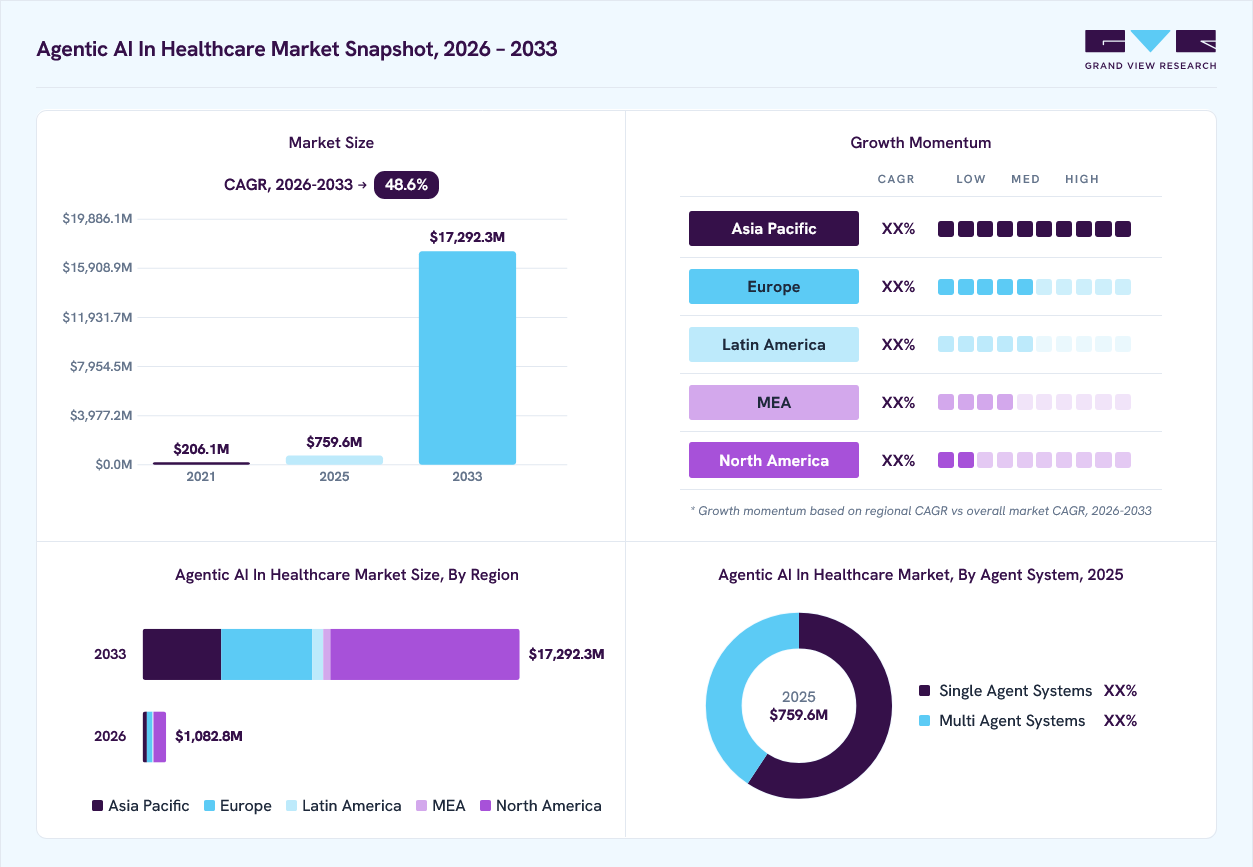
The agentic AI healthcare market is growing rapidly. Grand View Research projects it will rise sharply from roughly $1.08 billion in 2026 to $17.29 billion by 2033, a 48.6% CAGR. As a result, more health systems will deploy agents in the coming years, so compliance planning needs to start now.
1. How Healthcare AI Changes When It Can Take Actions
A chatbot or predictive model hands a person an output. An agent uses that output to decide and act on its own.
a. Traditional Healthcare AI Gives an Output
- A clinician prompts a model, then reviews the answer.
- The risk model returns a score, such as readmission likelihood.
- A human still decides what happens next.
b. Agentic AI Can Continue the Workflow
- The agent plans steps toward a goal, such as resolving a denied claim.
- It calls tools and APIs, including FHIR endpoints, without waiting for approval.
- It repeats steps until the task ends, so one early error can compound.
2. Why One Agent Can Touch Several Compliance Boundaries
A task that looks simple often spans several regulated systems. As a result, one agent can trigger several compliance duties at once.
a. One Task Can Cross Several Data Systems
- A prior authorization check can involve the EHR, a payer portal, and scheduling software.
- Claims processing and patient messaging add more PHI exposure.
- Each system has its own access rules and audit needs.
b. Every Additional Tool Expands the Risk Surface
- Each tool adds credentials, permissions, and logs that need securing.
- Each third-party processor that handles PHI may need a Business Associate Agreement.
- Glean’s compliance guidance recommends separating read privileges from write privileges for agents.
3. Safe Does Not Mean Zero Compliance Risk
No health system can honestly promise risk-free AI. Safe means the risks are known, limited, and visible.
- Model errors and vendor changes leave some residual risk.
- Automation Anywhere reports 772 large breaches in 2025, so exposure is real.
- Controls reduce and detect risk, but they never remove it.
Agents differ from earlier healthcare AI because they act across several systems, and each action carries its own compliance duty. Every added tool widens that exposure. Safe deployment therefore means managing risk openly, not claiming it disappears.
Where Health Systems Are Already Using AI Agents
Health systems mostly use AI agents for administrative work today, though clinical use is now growing across the whole patient journey. Deloitte reported in February 2026 that 85% of surveyed health care leaders plan to increase agentic AI investment over the next two to three years.
Therefore, each workflow needs controls matched to the harm a mistake can cause, from a missed appointment to a wrong treatment suggestion for a patient.
1. Administrative Workflows Are the Natural Starting Point
These tasks carry less direct patient risk, so most teams start here. Similarly, an npj Digital Medicine evidence map found early deployments concentrated in administrative workflows.
a. Scheduling and Patient Access
- Agents book and reschedule visits, so staff handle fewer routine calls.
b. Eligibility and Benefits Checks
- Agents query payer portals to confirm coverage before each visit.
c. Revenue Cycle Administration
- For example, agentic AI for revenue cycle management can rework denied claims and prepare prior authorizations.
d. Documentation Preparation
- Agents draft forms and paperwork, then staff reviews them before filing.
2. Clinical Workflows Require Tighter Controls
Clinical tasks affect diagnosis and treatment, so errors can harm patients directly. Consequently, an ACM FAccT interview study found that healthcare agents currently run under heavy human oversight.
a. Clinical Summarization
- Agents condense charts, but clinicians verify accuracy before anyone acts on them.
b. Care Coordination
- Agents track referrals, while staff confirms any change to a care plan.
c. Decision Support
- Agents suggest options, yet a clinician makes the final call.
d. Patient Communication
- Agents send reminders, but clinical questions escalate to a nurse or physician.
3. Autonomy Should Rise With Evidence, Not Ambition
Autonomy should grow only as safety evidence grows. A scoping review in npj Digital Medicine suggests autonomy tiers that set allowed actions and required human oversight at each level.
- Tier 1: the agent drafts, and a human approves every output.
- Tier 2: the agent acts on low-risk tasks, while humans review samples.
- Tier 3: the agent acts alone only after documented proof of safe performance.
Health systems use agents most in administrative work, where errors cost time, and more carefully in clinical work, where errors affect patients. Autonomy should follow evidence of safety for each workflow.
As a result, oversight should scale with risk instead of applying one rule to every agent.
The Compliance Risks Begin Before the Agent Acts
Compliance problems in agentic AI usually begin in the system design, well before the agent takes a single action in your health system. Data flows, permissions, and vendor contracts decide whether patient information stays protected, so even an accurate model can still cause a violation.
Therefore, hallucination is only one risk, and teams that watch it alone can miss serious exposures in data handling, access control, and vendor contracts.
1. PHI Can Move Outside Its Intended Boundary
Autonomous workflows copy data across many steps. Consequently, PHI can land in places nobody planned for.
a. Prompts and Context Windows
- Full charts pasted into prompts send more PHI to the model than needed.
b. Retrieval and Knowledge Bases
- Indexed records may surface to users who cannot open the source chart.
c. Model and Application Logs
- Debug logs often store raw prompts, so they become unprotected PHI archives.
2. Excessive Permissions Give Agents Too Much Reach
Agents act through service accounts, so their reach can exceed any one user’s. Therefore, permissions need separate design.
- Glean’s guidance recommends separating read and write privileges.
- Limit each agent to the minimum PHI its task needs.
- Similarly, review agent credentials on a fixed schedule.
3. Third Parties Add Another Compliance Layer
Every vendor touching PHI joins your compliance perimeter. As a result, contracts matter as much as code.
a. Model Providers
- Confirm a signed BAA before any PHI reaches the model.
b. Cloud Providers
- Use HIPAA-eligible cloud services with encryption and access logging.
c. Data and Integration Vendors
- Clearinghouses, vector databases, and monitoring tools each need review.
d. Business Associate Responsibilities
- Helpware advises requiring signed BAAs from every PHI-handling vendor.
4. Agent Errors Can Trigger Real Actions
A chatbot’s wrong answer gets read, but an agent’s wrong answer gets executed. Meanwhile, errors can spread downstream before anyone notices.
- A misread eligibility result can trigger a wrong denial or patient message.
- Similarly, a bad record update can corrupt the chart clinicians trust.
- Glean recommends four-eyes approval before sensitive writes.
Compliance risk in agentic AI comes from data movement, broad permissions, vendor chains, and actions that execute on errors. Hallucination is one of these risks, not the whole picture. Consequently, teams must design controls into each layer before deployment.
HIPAA Controls Must Follow the Entire Agent Workflow
Agentic AI healthcare compliance under HIPAA must cover every step an agent takes, not only the model that produces answers. HHS requires administrative, physical, and technical safeguards for electronic PHI, and agents move that data across several systems, through prompts, tools, logs, and outputs.
Therefore, protections must follow the data through the full workflow, from the first request to the final logged action, so no step is left unguarded.
1. Give Every Agent the Minimum PHI It Needs
Minimum necessary means an agent sees only the PHI its current task requires. Therefore, access decisions must happen per task.
a. Attribute-Based Access Control
- A 2026 ACM architecture uses attribute-based access control for dynamic PHI governance.
b. Role and Task Permissions
- Roles set the ceiling, while each task narrows access further.
c. Temporary Credentials
- Issue short-lived credentials, then revoke them when the task ends.
d. Data Minimization
- Send only needed fields, such as a claim ID, not a full chart.
2. Separate PHI Before It Reaches the Model
Sanitizing data before inference limits what the model ever sees. Consequently, this step belongs before every model call.
a. PHI Detection
- The same ACM framework pairs regex rules with a BERT-based model.
b. De-identification
- Remove identifiers the task does not need.
c. Tokenization
- Swap identifiers for placeholder tokens, so the model never sees real values.
d. Authorized Re-identification
- Only approved services restore real values after passing access checks.
3. Protect PHI After the Model Responds
Outputs can repeat PHI or pull it from connected sources. Therefore, outputs need their own checks before anyone uses them.
- Redact outputs again, because the ACM framework redacts at both pre- and post-inference stages.
- Confirm the reader may see each returned field.
- Block PHI from flowing into logs, emails, or tickets unprotected.
4. Keep Agent Actions Traceable
An audit trail lets your team reconstruct exactly what an agent did. At Intellivon, we build this into the orchestration layer, so every step is logged as the workflow runs.
a. Who Started the Workflow
- Log the user or system trigger, with time and purpose.
b. Which Data the Agent Accessed
- Record each record and field opened, not only the final answer.
c. Tools the Agent Used
- Capture every tool call, API request, and downstream change, and store them immutably, as the ACM framework does.
d. What Actions Were Approved or Rejected
- Log each human decision, including who made it and when.
HIPAA safeguards must follow the data through access, sanitization, output handling, and logging, not stop at the model. As a result, a compliant agent is one whose every step is controlled and recorded, which is how we scope healthcare agent builds at Intellivon.
Healthcare Agents Need Boundaries Before Autonomy
Health systems should give an agent only as much authority as the harm its mistakes can cause, and no more than evidence supports. Low-risk tasks can run with light supervision, while patient-affecting decisions need strict clinical governance, documented validation, and human sign-off at every step.
Therefore, teams should set each workflow’s autonomy level before building, because that choice shapes every control that follows and matters more than the model.
1. Level 1 Agents Only Retrieve Information
A Level 1 agent reads governed data and answers questions, but it changes nothing. As a result, it carries the narrowest compliance surface.
- Example: staff asks for the status of an open referral.
- The agent has read-only access and no write permissions.
- Ampcome describes this read-only stage as the narrowest compliance surface, so it suits first pilots.
2. Level 2 Agents Prepare Actions for Human Review
A Level 2 agent drafts the work, and a person approves it before anything happens. Consequently, teams gain speed without giving up control.
- Example: The agent drafts a prior authorization request, and staff submits it.
- Track approval and edit rates to see where the agent makes mistakes.
3. Level 3 Agents Execute Low-Risk Approved Actions
A Level 3 agent acts alone, but only on pre-approved, low-risk task types. Therefore, each action type needs written sign-off first.
- Example: sending appointment reminders or updating a scheduling status.
- Set hard limits on scope, volume, and dollar value.
- Build a rollback path, and review a sample of completed actions regularly.
4. Level 4 Agents Need Strict Clinical Governance
A Level 4 agent influences patient care, so its errors can cause direct harm. Consequently, it needs clinical ownership and validation before launch.
- A named clinician owns each workflow and its outcomes.
- Validate performance on your own patient data before go-live.
- An npj Digital Medicine paper finds that a clinician’s presence alone does not make oversight meaningful, so reviewers need real authority to intervene.
5. Some Decisions Should Stay Human
Some decisions carry too much clinical, ethical, or legal weight for any agent. Therefore, autonomy should stop entirely at these points.
- Final diagnoses and treatment choices stay with clinicians.
- Helpware advises human oversight for decisions affecting care, coverage, or financial responsibility.
- Consent, end-of-life, and emergency triage decisions also remain human.
Autonomy should be assigned by risk, from read-only retrieval at Level 1 to strictly governed clinical action at Level 4. Some decisions should never leave human hands. As a result, each workflow earns its autonomy level through evidence, not vendor promises.
Human Review Must Be Built Into the Workflow
Human in the loop means a trained clinician or staff member holds real authority to approve, change, or stop an agent’s action before harm occurs. A clinician who only watches a screen, without the time or power to intervene, does not meet that standard of oversight.
Therefore, health systems must build approvals, overrides, and escalation rules into the workflow, so human judgment acts as a real safety check.
1. High-Risk Actions Need Approval Before Execution
Some actions are too consequential to run before a person approves them. Glean’s guidance recommends four-eyes checkpoints for sensitive writes, such as patient record updates and eligibility determinations.
a. Clinical Decisions
- Diagnosis, triage, and care plan changes wait for clinician approval.
b. Medication-Related Actions
- Orders, dose changes, and refills need prescriber sign-off.
c. Patient-Facing Medical Advice
- A clinician reviews any message that interprets symptoms or results.
d. High-Impact Coverage Decisions
- Human oversight must be used for decisions affecting care, coverage, or financial responsibility.
2. Staff Need a Simple Way to Override the Agent
An override control must work in seconds, without technical help. Consequently, staff should never need a support ticket to stop an agent.
- Place a visible stop button inside the tools staff already use.
- Let staff edit or reject any drafted action.
- An npj Digital Medicine paper finds oversight works only when reviewers can actually intervene.
3. Escalation Rules Cannot Depend on the LLM Alone
A language model can misjudge its own uncertainty. Therefore, fixed rules outside the model should decide when to hand work to a human.
- Trigger handoffs on fixed keywords, such as chest pain or self-harm.
- Escalate when confidence is low or required data is missing.
- Helpware also suggests asking who reviews exceptions and what happens after hours.
4. Every Override Should Improve Future Monitoring
Each human correction shows where the agent is weak. As a result, overrides should feed your monitoring instead of disappearing.
- Log each override with its reason and reviewer.
- Track override rates by workflow to spot declining accuracy.
- Review patterns monthly with your governance committee.
Human review works only when approvals, overrides, and escalation rules are built into the workflow and enforced outside the model. Overrides then become data that improves monitoring. As a result, human judgment functions as a real safety control, not a formality.
FDA Risk Depends on What the Agent Actually Does
FDA risk depends on what an agent actually does with patient data, not on the fact that it uses AI. Under the 21st Century Cures Act, FDA excludes certain software functions, including administrative support, from the device definition, so not every healthcare agent needs clearance.
Therefore, teams should assess each agent’s intended function early, because scheduling automation and diagnostic recommendations sit in very different regulatory positions.
1. Administrative Agents May Stay Outside Device Rules
Workflow automation is not automatically medical device software. FDA has not historically treated financial records or appointment schedules as device functions.
- Scheduling, billing, and claims agents often fit the administrative category.
- However, software that analyzes or interprets medical data remains under FDA oversight.
- Similarly, an agent mixing administrative and clinical tasks needs each function assessed separately.
2. Clinical Functions Need a Different Assessment
Clinical functions need a review of intended use and decision support design. FDA issued revised final Clinical Decision Support guidance on January 6, 2026.
- Non-device software must let clinicians independently review the basis for its recommendations.
- FDA now applies limited enforcement discretion to some tools giving a single clinically appropriate recommendation.
- Functions that analyze medical images for diagnosis remain regulated.
3. Model Updates Can Become a Regulatory Issue
Agents change through model swaps, prompt edits, and new tools. Consequently, updates to a regulated function can trigger new FDA obligations.
- Manufacturers generally must submit a new application when a change could significantly affect safety and effectiveness.
- Keep a change log for model versions, prompts, and tools.
- Retest performance after every update, before release.
4. PCCPs Can Define Certain Planned AI Changes
A predetermined change control plan describes expected AI modifications in advance. FDA’s final guidance recommends describing planned changes, the methods to validate them, and an impact assessment.
- FDA reviews the plan within the marketing submission, so covered changes need no separate filing each time.
- The guidance applies to 510(k), De Novo, and PMA pathways.
- Changes must stay within the device’s intended use to qualify.
FDA exposure follows an agent’s function, not its technology. Administrative agents often sit outside device rules, while clinical decision support needs careful assessment. As a result, teams should document each agent’s intended use and plan for how model updates will be controlled.
Safe Architecture Keeps Policy Outside the LLM
A safe architecture keeps every compliance rule in code outside the language model, so the model can suggest actions but never grant itself permission. Consequently, six layers enforce that split: identity, protected data, model access, orchestration, policy and guardrails, and monitoring with audit.
Therefore, a prompt cannot override a control, and AWS’s August 2026 reference architecture likewise says agents need PHI protections designed differently.
1. Identity and Access
| Control | What it does | Risk it reduces |
| User identity | Authenticates every requester through single sign-on | Anonymous or shared access |
| Agent identity | Gives each agent its own service account | Untraceable agent actions |
| Role permissions | Ties each agent role to a defined task list | Agents doing more than intended |
| Temporary credentials | Issues short-lived tokens that expire after each task | Stolen or reused credentials |
2. Protected Data Access
| Control | What it does | Risk it reduces |
| PHI classification | Tags fields by sensitivity before agents query them | Agents reading data they should not see |
| Data minimization | Returns only the fields the task needs | Full-record leaks, like the SSN example in AWS’s architecture |
| Retrieval controls | Filters search results by the requester’s permissions | Users seeing records they cannot open |
| Encryption | Encrypts PHI in transit and at rest | Interception and stolen storage |
3. Model and Knowledge Access
| Control | What it does | Risk it reduces |
| Approved model registry | Allows only models covered by a signed BAA | PHI reaching unapproved vendors |
| RAG knowledge sources | Limits retrieval to approved, versioned sources | Outdated or untrusted answers |
| Prompt controls | Keeps system prompts under change control | Unreviewed behavior changes |
| Model routing | Sends PHI-heavy tasks to approved private endpoints | Sensitive data on public routes |
4. Agent Orchestration
| Control | What it does | Risk it reduces |
| Workflow planner | Approves fixed workflow templates in advance | Agents improvising unsafe steps |
| Tool permissions | Grants each agent only the tools its task needs | Excess reach across systems |
| Agent-to-agent communication | Routes messages through the orchestrator and logs each handoff | Unseen data sharing between agents |
| Execution limits | Caps steps, retries, records touched, and runtime | Runaway loops and mass errors |
5. Policy and Guardrails
| Control | What it does | Risk it reduces |
| Deterministic rules | Hard-codes escalation triggers and forbidden actions | Model misjudging its own limits |
| Output validation | Checks outputs for PHI and policy breaches before release | Leaks and unsafe responses |
| Human approval gates | Requires sign-off before high-risk actions run | Unchecked clinical or financial actions |
| Emergency shutdown | Lets staff halt any agent instantly | Errors spreading while people react |
6. Monitoring and Audit
| Control | What it does | Risk it reduces |
| Agent logs | Records every prompt, tool call, and action, with PHI protected | Missing evidence after an incident |
| Clinical safety events | Flags harmful outputs and near misses for clinical review | Patient harm going unnoticed |
| Model drift | Tracks accuracy and override rates over time | Slow, silent performance decline |
| Compliance dashboard | Shows access, exceptions, and approvals to auditors | Audit gaps and delayed findings |
A safe architecture separates thinking from permission: the model proposes, and six layers of code decide what happens. Each layer limits a different risk, from identity to audit. As a result, a single failure becomes far less likely to expose PHI or trigger an unchecked action.
Building a Compliant Platform Costs $70K to $300K
A custom agentic AI platform with compliance controls typically costs $70,000 to $300,000, depending on workflow scope, EHR complexity, clinical risk, and integrations.
Seven phases divide that cost, from discovery to production monitoring, while Intellivon’s AI agent development page cites 8 to 20 weeks for custom agents.
Therefore, budgeting by phase shows where the money goes and where narrowing scope saves the most, before you commit.
| Phase | Key deliverables | Cost range |
| 1. Discovery and compliance mapping | Requirements, workflow map, risk classification, architecture | $8,000 to $30,000 |
| 2. UX and human approval workflows | Reviewer screens, dashboards, escalation, overrides | $8,000 to $30,000 |
| 3. Agent and orchestration development | Agent logic, tools, orchestration, RAG, model integration | $16,000 to $80,000 |
| 4. EHR and system integration | FHIR APIs, Epic or other EHR connections, identity controls | $12,000 to $45,000 |
| 5. Security and compliance controls | PHI protection, logging, audit trail, policy enforcement | $10,000 to $45,000 |
| 6. Testing and clinical validation | QA, adversarial testing, controlled pilot | $8,000 to $40,000 |
| 7. Deployment and monitoring | Infrastructure, MLOps, observability, production controls | $8,000 to $30,000 |
| Total initial build | $70,000 to $300,000 |
Cost depends mainly on agent scope, integrations, and clinical risk. Agent development and security controls take the largest shares of the build. As a result, a narrow administrative pilot sits near the low end, while a multi-EHR clinical platform sits near the top.
How Intellivon Builds Healthcare Agents Around Controls
At Intellivon, we build healthcare agents in eight steps, and each step adds a control before it adds any new capability. We map the compliance boundary first, set the agent’s autonomy second, and write agent code only after your compliance team approves both.
As a result, each recommendation in this guide becomes a deliverable, and our AI agent development engagements typically take 8 to 20 weeks.
Step 1: Map the Workflow and Compliance Boundary
We start by documenting how work actually moves through your systems. Consequently, every later decision rests on a written boundary, and not on assumptions.
- PHI: We list which patient data the workflow touches and where it flows.
- Systems and users: We record every EHR, payer portal, and scheduling tool, plus who uses each one.
- Regulations: We define the HIPAA scope and run an early FDA screen for any clinical function.
- Prohibited actions: We write down what the agent must never do.
- Deliverable: A workflow map, a risk classification, and a compliance boundary document.
Step 2: Define the Agent’s Allowed Autonomy
Next, we assign an autonomy level: retrieve, prepare, execute low-risk actions, or support clinical decisions. Therefore, the agent gets only the authority its evidence supports.
- Most workflows start at Level 1 or Level 2.
- We document what the agent may retrieve, recommend, prepare, or execute.
- Compliance and clinical owners give written sign-off.
- We set the evidence needed to move up a level.
- Deliverable: An autonomy specification for each workflow.
Step 3: Design PHI and Access Controls
Then we build identity and access before the agent exists. As a result, minimum-necessary access is enforced by design, not by policy documents.
- Users and agents receive separate identities.
- Attribute-based policies limit what each task can access.
- Short-lived credentials expire after every task.
- PHI detection and de-identification run before any model call.
- Deliverable: Access policies, an identity design, and a PHI handling standard.
Step 4: Build the Agent and Integration Layer
We then connect models, tools, and systems through an orchestration layer. In our revenue cycle agent work, that layer defines decision boundaries and links agents to the EHR.
- Only approved models under a signed BAA reach production.
- FHIR-based connections link to Epic or other EHRs.
- RAG sources stay limited to approved, versioned content.
- Each agent receives only the tools its task needs.
- Deliverable: A working agent, orchestration layer, and integration set, as in our claims processing software work.
Step 5: Add Human Approval and Guardrails
Sensitive actions sit behind rules that live outside the model. Consequently, a prompt cannot bypass them.
- Deterministic triggers escalate risky cases to a person.
- Approval gates cover clinical, medication, and coverage actions.
- Output validation checks every response before release.
- Staff get a stop control inside their normal tools.
- Deliverable: A guardrail rule set and reviewer workflows.
Step 6: Test Security and Workflow Failures
We test how the system fails, not only how it works. Similarly, we treat adversarial cases as release requirements.
- We test for hallucinations and wrong tool choices.
- We attempt prompt injection and data leakage.
- We check for access failures and permission escalation.
- We rehearse rollback and emergency shutdown.
- Deliverable: A test report with fixes for every critical finding.
Step 7: Launch Through a Controlled Pilot
A pilot limits exposure while evidence builds. Therefore, we restrict users, workflows, and permissions at first.
- A small group of trained reviewers uses the agent.
- The pilot covers one workflow at a low autonomy level.
- Volume and patient impact stay capped.
- Your team reviews overrides and errors weekly.
- Deliverable: A pilot scorecard that compares results against the exit criteria.
Step 8: Monitor and Expand the System
After launch, monitoring decides what happens next. As a result, scope grows only when data supports it.
- Logs, drift tracking, and clinical safety reviews run continuously.
- Override rates signal whether to hold or expand.
- Every model, tool, or workflow change triggers a compliance review.
- An agent moves up one autonomy level only with documented evidence.
- Deliverable: A monitoring dashboard and a governed expansion plan, in line with our orchestration platform approach.
This process turns compliance from a review at the end into a deliverable at every step: boundary, autonomy, controls, testing, pilot, and monitoring. Each step limits one specific risk before the next begins. As a result, autonomy grows only as evidence does.
Why Intellivon Fits Compliance-First AI Projects
Health systems can deploy agentic AI safely, but only when the compliance decisions come before the code. The riskiest step is not choosing a model. It is picking the first workflow, the agent’s autonomy level, and the controls around it.
Therefore, agentic AI healthcare compliance is won or lost in planning, and a clear plan turns a $70,000 to $300,000 build into a controlled, phased investment.
Before you approve a build, confirm these eight points:
- Risk source: Compliance problems start in data flows, permissions, and vendor chains, not only in hallucinations.
- HIPAA scope: Safeguards must follow PHI through prompts, tools, logs, and outputs.
- Autonomy level: Start at read-only or draft-and-approve, and raise autonomy only with evidence.
- Human review: Approvals, overrides, and escalation rules need real authority and must sit outside the model.
- FDA exposure: Administrative agents often stay outside device rules, while clinical decision support needs a separate assessment.
- Architecture: Six layers keep policy in code: identity, data, model access, orchestration, guardrails, and monitoring.
- Budget: Plan by phase, and reserve 15% to 20% of the build for yearly maintenance.
- Rollout: Launch through a controlled pilot with capped users, workflows, and patient impact.
If you are weighing which workflow to automate first, Intellivon’s healthcare AI agent team can map your compliance boundary and autonomy level in a scoped discovery phase. Book a call to get a cost and architecture estimate for your workflow before you commit to a build.
Conclusion
Health systems can deploy agentic AI safely, but agentic AI healthcare compliance must be designed in before the first agent goes live. First, set each agent’s autonomy by risk, and keep approvals and policy rules outside the model. Next, protect PHI at every step, and check FDA exposure for any clinical function.
Finally, launch through a controlled pilot, and expand only when evidence supports it. As a result, your team can capture efficiency gains of agents without avoidable compliance risk.
FAQs
Q1. Can agentic AI be HIPAA compliant?
A1. Yes, but compliance comes from how the system is deployed and governed, not from the technology itself. A compliant agent needs signed BAAs, minimum-necessary access, audit logs, monitoring, and human oversight for care decisions. Therefore, HIPAA-eligible services alone are not enough, because controls must cover every step of the workflow.
Q2. Does a healthcare AI agent need a BAA?
A2. Yes, whenever a vendor creates, receives, maintains, or transmits PHI on your behalf. That can include the model provider, cloud host, vector database, and any integration vendors. Therefore, sign a written BAA with each one before any PHI flows, because a vendor’s HIPAA eligibility does not replace the signed agreement.
Q3. Can an AI agent access patient records in an EHR?
A3. Yes, through standards like FHIR APIs, but only with tightly scoped permissions. Start read-only, give each agent its own identity, limit it to the fields a task needs, and issue short-lived credentials. Similarly, log every record it opens or edits, so your team can prove who accessed what and why.
Q4. Can an AI agent make clinical decisions on its own?
A4. Generally no, not safely today. Clinical decisions affect patients directly, so they need clinician approval, validation on your own data, and possible FDA review. Therefore, agents should recommend while clinicians decide, and independent action should stay limited to low-risk administrative tasks, such as appointment reminders or scheduling updates.
Q5. Does agentic AI need FDA approval?
A5. No, not automatically. FDA looks at what the software does, so administrative agents often fall outside device rules, while functions that diagnose or direct treatment may qualify. Consequently, document each agent’s intended use, then confirm the result with regulatory counsel, especially after FDA’s January 2026 clinical decision support guidance.
Q6. What should healthcare AI audit logs contain?
A6. Audit logs should let your team reconstruct every agent action. Record who started the workflow and when, which data the agent accessed, which tools it called, and which actions humans approved or rejected. Additionally, store logs immutably and protect any PHI inside them, since logs can expose sensitive patient data.
Q7. How should a hospital start deploying agentic AI?
A7. Start with one low-risk administrative workflow, such as scheduling or eligibility checks, at a read-only or draft-and-approve level. Then run a controlled pilot with limited users and permissions. Finally, expand only when logs, override rates, and reviewer feedback show safe, consistent performance, and raise autonomy one level at a time.