Key Takeaways:
-
Pharmaceutical companies manage AI risk by tracking where every clinical model is used.
-
Models that carry risk must go through more thorough testing, have clear ownership, and meet strict approval rules.
-
Once these models are launched, teams must continue to monitor them. That way, they can spot any drift, bias, or signs of performance issues early.
-
This includes oversight for vendor AI tools, large language models, and any updates to existing models.
-
Intellivon builds AI risk systems that cover validation, ongoing monitoring, and change controls.
Pharma companies handle model risk in clinical AI systems by using a five-step loop: they first define the context of use for each model, then categorize it according to the level of influence and consequence, validate it in a way that corresponds to its category, keep an eye on it for drift once it’s in production, and have approval routed through reviewers who are separate from the build team. However, tiering is the key stage since it determines how much of the rest of the process applies.
The order is important since a model can only be regarded as credible for a single purpose. If it is approved for use in triaging safety cases, a different level of risk arises when it determines the submission endpoint. For this reason, the same code can be present in two levels at the same time.
At the same time, the majority of sponsors were already carrying out more clinical AI than their quality system was able to keep track of, and three different rulebooks were changed between January and July 2026, meaning that a governance plan drawn up the previous year is now only partly accurate.
This blog explains how to tier a clinical AI model, what kind of evidence FDA’s credibility framework requires, where GAMP 5 validation falls short, and what the actual cost of the build is. A great deal of this information is derived from the work that Intellivon carries out with regulated life sciences teams.

What Clinical AI Model Risk Means for Pharma
Clinical AI model risk is the exposure a sponsor carries when an AI system produces an unreliable output inside a regulated decision. The output might influence which patients enroll, which safety signals surface, or which numbers reach a submission.
Therefore, the risk sits with the sponsor, not the model.
1. Where Pharma Companies Are Using Clinical AI
AI now runs across the drug lifecycle, not just discovery. Several sponsors adopted it function by function, so the tools are mostly never shared by one owner. As a result, the inventory is usually wider than the quality system records.
Common deployments include:
- Clinical trial recruitment: eligibility screening, site selection, enrolment forecasting
- Patient risk prediction: stratification, dropout risk, adverse event likelihood
- Trial monitoring: protocol deviation detection, risk-based monitoring triggers
- Pharmacovigilance: ICSR intake, case triage, signal detection
- Medical writing: first-draft narratives, CSR sections, literature summaries
- Regulatory submissions: dossier review, synthetic control arms, endpoint modeling
- Drug discovery: target identification, molecule screening, property prediction
- Clinical decision support: dosing guidance, treatment recommendation tools
2. What Model Risk Actually Means
Model risk is the chance an AI system returns a wrong or misleading result and someone acts on it. The failure is rarely dramatic. Instead, it comes from one of five quiet sources.
- Poor data: gaps, mislabels, or a training set unrepresentative of the treated population
- Incorrect assumptions: a model built for one endpoint applied to another
- Weak validation: performance proven on a holdout set, never on an external cohort
- Changing populations: enrolment shifts, new sites, new standards of care
- Model updates: a retrain or a vendor version bump nobody logged
3. Why Clinical AI Carries More Risk Than Basic Software
Traditional software follows fixed rules. Given the same input, it returns the same output every time, so testing it once proves it works. AI behaves differently.
- Behavior is learned, not written: logic sits in weights, not readable code
- Performance is conditional: accuracy holds only for populations resembling the training data
- Degradation is silent: the system keeps returning confident answers as it drifts
- Correctness is statistical: there is no single pass or fail result to test against
4. What Happens When a Clinical Model Fails
Failures surface as business events, not technical ones. Additionally, they tend to appear months after the model actually broke.
- Patient safety risk: missed contraindications or delayed intervention
- Incorrect clinical decisions: flawed dosing or treatment guidance reaching investigators
- Trial integrity problems: biased enrolment undermining the study population
- Regulatory findings: inspection observations on unvalidated systems
- Delayed submissions: evidence withdrawn and analyses rerun
- Poor safety signals: missed or false signals in pharmacovigilance
- Reputational damage: loss of investigator and payer confidence
Clinical AI model risk is ordinary operational risk with an unfamiliar failure mode. Consequently, the controls have to detect degradation rather than defects.
Why Pharma Enterprises Are Managing AI Risk Now
Pharma enterprises are managing AI risk now because their models moved from pilots into regulated decisions. A tool suggesting literature is a convenience. A model shaping enrolment or a submission endpoint is evidence. Consequently, the same system that needed no oversight last year now needs a documented owner, a validation file, and a monitoring record.
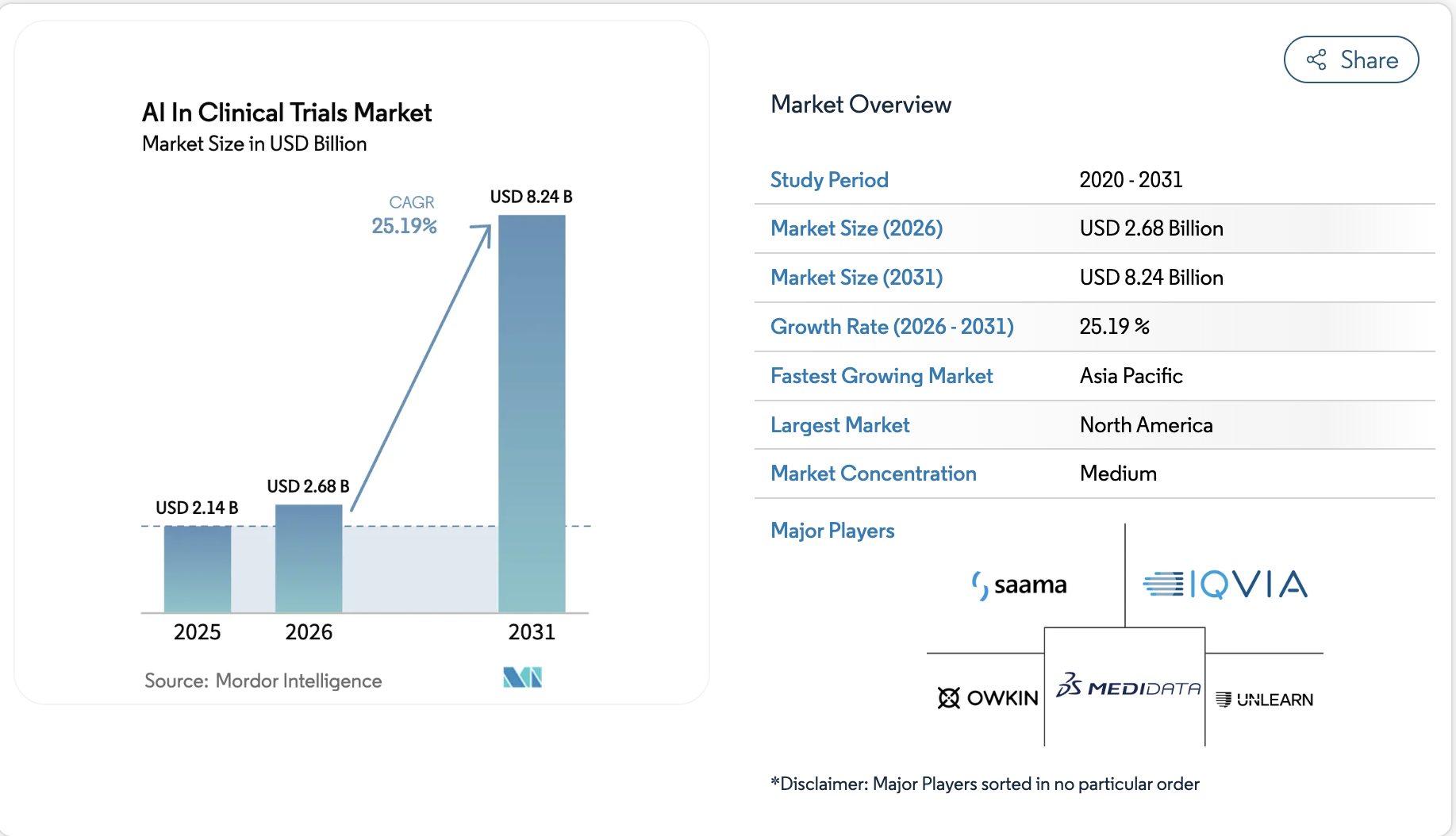
The spend follows the deployment curve. The AI in clinical trials market sits at $2.68 billion in 2026 and is projected to reach $8.24 billion by 2031, a 25.19% CAGR.
Services grow fastest at 26.61%, driven by sponsors buying turnkey implementation and model-maintenance support rather than software alone.
1. AI Is Moving Into More Regulated Workflows
Early pharma AI sat outside GxP. Teams used it to summarise papers or forecast timelines, so nothing it produced reached a regulator. That boundary has largely dissolved.
- Clinical evidence: synthetic control arms, endpoint modeling, patient stratification
- Safety processes: case triage, seriousness classification, signal detection
- Operational decisions: site selection, deviation flagging, enrolment forecasting
- Regulatory work: first-draft narratives and dossier sections entering submissions
2. Regulators Expect Lifecycle Oversight
FDA and EMA both settled on the same posture: risk-based, tied to a specific purpose, and continuous. Neither treats a one-time validation as sufficient. Instead, both ask what the model is for and how you know it still works.
- Context of use: the model’s exact role, written before the build
- Credibility: evidence proportionate to influence and consequence
- Validation: documented performance, including subgroup results
- Lifecycle management: monitoring, change control, and retirement
3. AI Models Keep Changing After Deployment
A validated model is a snapshot. The moment it enters production, the ground under it starts moving, so the validated state has an expiry condition rather than an expiry date.
- Retraining: new weights, new behavior, old validation file
- New populations: sites, geographies, or demographics absent from training
- Data shifts: upstream schema, labeling, or capture changes
- Vendor updates: a version bump nobody told you about
4. Enterprises Need Proof That AI Remains Reliable
Inspectors do not ask whether the model works. They ask you to show it. Therefore, the evidence has to exist before anyone requests it.
- Audit trails: immutable logs of inputs, outputs, and decisions
- Validation evidence: protocols, results, independent sign-off
- Monitoring reports: drift metrics and threshold breaches over time
- Ownership records: a named accountable person per model
- Change histories: every version, with the reason it changed
5. Third-Party AI Creates Another Layer of Risk
Several sponsors buy their own models from CROs and platform vendors, which means the training data, architecture, and update cadence sit behind someone else’s wall.
- Opaque training data: provenance and representativeness unverifiable
- Undisclosed updates: silent retrains changing output mid-study
- Limited validation access: vendor performance claims you cannot reproduce
- Unclear accountability: the output is still yours to defend
AI risk became urgent because pharma AI stopped being experimental. Models now sit inside evidence, safety, and submission workflows, and they change after deployment. Consequently, sponsors need continuous proof rather than a one-time approval.
The Main Risks Pharma Must Control
Six risk categories cover almost every clinical AI failure: data, model performance, bias, operations, vendors, and generative behavior. Each one fails differently, so each needs its own control.
Therefore, sponsors who treat model risk as a single problem usually build one control and leave five gaps open.
1. Data Risk
Data risk is the most common source of failure and the hardest to fix later. A model inherits every flaw in its training set, so problems introduced at the data stage stay invisible until production.
- Incomplete data: partial records, dropped visits, truncated follow-up
- Poor-quality data: mislabels, coding inconsistencies, duplicate entries
- Changing populations: new sites or geographies unlike the training cohort
- Missing values: imputation choices quietly shaping predictions
- Unrepresentative datasets: rare disease and pediatric groups underrepresented
2. Model Performance Risk
Performance risk is the gap between how a model scored in testing and how it behaves in use. Strong holdout numbers prove very little on their own, because the holdout set came from the same distribution as training.
- Inaccurate predictions: error rates higher in production than validation
- Poor calibration: confidence scores not matching real probabilities
- Weak generalization: performance collapsing on an external cohort
- Out-of-environment failure: new EHR, new device, new workflow
3. Bias and Fairness Risk
A model can hold acceptable overall accuracy while failing a specific group badly. Aggregate metrics hide that split, so bias only surfaces when someone measures by subgroup.
- Patient groups: age, sex, ethnicity, comorbidity profile
- Disease populations: rare indications with thin training data
- Geographies: care standards and coding practices differing by region
- Clinical sites: equipment, protocols, and data capture varying site to site
4. Operational Risk
Plenty of models fail without being wrong. The prediction is sound, but the workflow around it breaks, so the output never lands correctly.
- Bad workflows: outputs arriving after the decision point
- User misinterpretation: a probability read as a recommendation
- Integration problems: schema mismatches corrupting inputs
- Poor monitoring: degradation running for months undetected
5. Vendor Model Risk
Bought models carry the same obligations as built ones. However, the controls sit outside your organization, which changes what you can actually verify.
- External models: training data and architecture undisclosed
- APIs: behavior changing without a release note
- Foundation models: deprecation and version sunsets on the vendor’s schedule
- Vendor-controlled updates: retrains landing mid-study
6. Generative AI Risk
Generative AI systems break the assumption underneath every validation protocol. The same input can produce two different outputs, so pass or fail testing stops working.
- Hallucination: fluent, confident, unsupported statements
- Inconsistent responses: variation across identical runs
- Prompt sensitivity: small wording changes shifting output materially
- Weak source attribution: claims not traceable to a document
- Changing foundation models: the base model updating underneath you
These six categories fail in different ways, which is why a single control never covers them all. Data and bias risk are built in early, while performance, operational, vendor, and generative risk surface after deployment. Consequently, the controls have to run across the full lifecycle rather than at one approval gate.
Start With Every Clinical AI Use Case
A model risk framework starts with a use case list, not a policy. For each system, write down what decision it supports, who acts on it, how much weight the output carries, and what breaks if it is wrong.
Those four answers produce a tier, and the tier decides everything downstream.
1. Define What the Model Is Being Used For
Context of use is the model’s exact job, written in one sentence before anything gets built. A model is never credible in general. It is credible for one purpose, with one population, inside one workflow.
- The decision supported: enrolment, dosing, triage, or an endpoint estimate
- The population: indication, age range, geography, care setting
- Workflow position: where in the process the output appears
- The boundary: what the model is explicitly not approved to do
2. Identify Who Relies on the Model Output
The same prediction carries different weight depending on who receives it. A researcher can challenge a number. An automated pipeline cannot. Therefore, the consumer of the output is part of the risk profile.
- Researchers: exploratory work, output treated as a hypothesis
- Clinicians and investigators: output influencing patient care
- Safety teams: output shaping case seriousness or signal detection
- Regulatory teams: output entering a dossier or submission
- Automated workflows: output consumed with no human between
3. Measure How Much Influence the Model Has
Influence is how much the model’s output determines the final decision. A ranked list a human reviews sits far below a system acting on its own. Additionally, influence tends to creep upward as teams start trusting the tool.
- Low influence: one input among several a person weighs
- Moderate influence: the default recommendation a person usually accepts
- High influence: the primary basis for the decision
- Full influence: the model acts with no human review step
4. Measure the Consequence of a Wrong Result
Consequence is what actually happens when the output is wrong, and nobody catches it. Strong influence with low consequence is tolerable. High influence with high consequence is where the evidence burden sits.
- Patient harm: missed risk, wrong dose, delayed intervention
- Study integrity: biased enrolment or a compromised analysis population
- Regulatory evidence: a submission figure that cannot be defended
- Operational impact: rework, timeline slip, or a study rerun
Influence and consequence together set the tier, and the tier sets how much validation, monitoring, and independent review each model needs. Run the four questions across every use case before building any control. Consequently, the framework stays proportionate instead of applying submission-grade rigor to a literature summariser.
Group Clinical AI Models by Risk Level
Pharma companies sort clinical AI into three tiers and attach a different control set to each. Low-risk models get registration and basic oversight. Medium-risk models get formal validation.
High-risk models get independent review, continuous monitoring, and submission-grade evidence. Therefore, the tier is a budget decision as much as a compliance one.
1. Low-Risk Models Need Basic Oversight
Low-risk models sit outside regulated decisions entirely. If the output is wrong, someone notices quickly and nothing downstream breaks. These systems still belong in the inventory, but they do not justify a validation program.
Typical examples:
- Internal literature triage: surfacing papers a researcher then reads
- Meeting and document summarisation: drafts nobody submits anywhere
- Operational forecasting: enrolment projections used for planning only
- Search and retrieval tools: finding existing content, not generating claims
Controls that apply:
- Registry entry with a named owner
- Documented context of use and stated boundaries
- Periodic spot checks rather than scheduled revalidation
2. Medium-Risk Models Need Formal Validation
Medium-risk models shape decisions a person still makes. A human sits between the output and the action, so errors are recoverable. However, the output carries enough weight that the reviewer usually accepts it.
Typical examples:
- Site selection and enrolment forecasting: influencing where a study runs
- Risk-based monitoring triggers: flagging sites for review
- Protocol deviation detection: prioritizing what gets investigated
- Medical writing first drafts: text a writer edits before it goes anywhere
Controls that apply:
- Documented validation protocol and results
- External or held-out cohort testing
- Scheduled performance review with defined thresholds
- Change control on retrains and version updates
3. High-Risk Models Need Stronger Controls
High-risk models touch patients, evidence, or safety directly. A wrong output can reach a regulator, an investigator, or a participant before anyone catches it. Consequently, the evidence burden matches the consequence.
Typical examples:
- Patient stratification and eligibility screening: deciding who enters a study
- Synthetic control arms and endpoint modeling: producing submission evidence
- Pharmacovigilance signal detection: influencing safety conclusions
- Clinical decision support: guiding dosing or treatment
Controls that apply:
- Full credibility assessment with independent adequacy sign-off
- Subgroup performance testing across patient groups and sites
- Continuous drift monitoring with defined action thresholds
- Immutable audit trail linking every output to a model version
- Predetermined change control plan governing retraining
4. Risk Levels Must Change When Use Changes
A tier belongs to a context of use, not to a model. Move the same system into a new population or a new workflow and the old assessment no longer applies. Additionally, influence tends to rise quietly as teams start trusting a tool.
Triggers for reassessment:
- New patient population: different indication, age range, or geography
- New workflow position: output moving closer to the final decision
- Reduced human oversight: a review step removed for speed
- New output consumer: a research tool starting to feed a submission
- Model or vendor change: retrain, version bump, or foundation model swap
Tiering keeps effort proportionate, so submission-grade rigor goes where it earns its cost and nowhere else. The tier follows the use case, which means it has to be rechecked whenever the use case moves. Consequently, reassessment triggers belong in the framework from day one, not as an afterthought.
Document How Every Clinical Model Works
Clinical documentation is a control because it is the only thing that tells a reviewer whether a model was used inside its approved boundaries.
A model card, an assumption log, a failure-condition list, and version-pinned evidence do that work. Without them, an inspector has your word and nothing else.
1. Maintain a Controlled Model Card
A model card is the single record describing what a model is and what it is cleared to do. It sits under change control, so editing it requires the same approval as changing the model. Therefore, it stays accurate rather than drifting into a stale wiki page.
What the card must carry:
- Purpose: the context of use in one sentence
- Model type: architecture, framework, and whether it is vendor-supplied
- Training data: source, date range, population, size, known gaps
- Intended users: who acts on the output and at what point
- Limitations: populations, settings, and questions the model does not cover
- Performance: headline metrics plus subgroup results, not an average alone
- Risks: the failure modes identified during assessment
- Approved use: the tier, the sign-off, and the date
2. Record Model Assumptions
Every model rests on assumptions nobody states out loud. Writing them down converts a silent dependency into something monitorable. Additionally, assumptions are usually what break first when a model degrades.
Assumptions worth logging:
- Data quality: completeness rates, labeling accuracy, imputation approach
- Patient populations: the cohort the model expects to see
- Clinical conditions: standard of care, comorbidity profile, treatment pathways
- Operating environment: source systems, data schema, latency, device types
3. Document Known Failure Conditions
Stating where a model fails is stronger evidence than claiming it works everywhere. Reviewers trust a documented boundary more than an unqualified performance claim. Consequently, the failure list belongs in the card, not in a private engineering ticket.
What to record:
- Performance drop zones: subgroups where accuracy falls and by how much
- Out-of-scope uses: decisions the model must never drive
- Input conditions that break it: missing fields, unusual ranges, new coding systems
- Known degradation signals: what the model looks like shortly before it stops being reliable
4. Keep Documentation Tied to Each Version
Evidence belongs to a version, not to a model name. A retrain produces a new system, so the old validation file no longer describes what is running. Without version pinning, nobody can say which evidence applied on the day a submission figure was generated.
What version control must link:
- Model artifact to card: each version with its own approved record
- Card to validation evidence: protocols and results matched to that build
- Version to outputs: every prediction traceable to the model that produced it
- Change history: what changed, why, who approved it, and when it was deployed
Documentation is what lets a sponsor prove a model was used correctly rather than assert it. The card defines the boundary, assumptions and failure conditions make that boundary testable, and versioning ties it all to what actually ran. Consequently, these records are the first thing an inspection asks for and the fastest thing to lose.
Validate Clinical AI Before It Goes Live
Validation means proving a model performs inside agreed limits on data it has never seen, across the groups it will actually serve. Therefore, the thresholds get set first, the test runs on independent data, and results get broken out by subgroup.
Otherwise, what you have is a demonstration rather than evidence.
1. Define Success Before Testing Begins
Acceptance criteria written after the results arrive are not criteria. Instead, fix the metrics and limits in a protocol, get them approved, then run the test. Consequently, a failing model fails visibly rather than quietly becoming the new benchmark.
Set in advance:
- Primary metrics: what the model must achieve to go live
- Acceptable limits: the floor for each metric, including subgroups
- Test population: who the validation data must represent
- Failure response: what happens when the model misses the threshold
2. Test the Model on Independent Data
A model tested on data resembling its training set will always look better than it is. Independence is the whole point, so the test data must come from a different period, site, or source. Additionally, an external cohort tells you far more than a random holdout split.
What counts as independent:
- Temporal split: a later period than the training window
- Site split: centers absent from the training data
- External cohort: a separate registry, health system, or trial
- Source split: a different EHR, device, or capture method
3. Test Performance Across Patient Groups
Aggregate accuracy hides uneven performance. Therefore, the protocol has to name the subgroups in advance and report each one separately. Otherwise, a model failing one population passes validation on the strength of the others.
Break results out by:
- Demographics: age, sex, ethnicity, comorbidity profile
- Disease groups: severity, subtype, rare indications
- Clinical sites: protocol, equipment, and coding differences
- Operating environments: source system, data completeness, region
4. Test More Than Overall Accuracy
Accuracy alone says almost nothing about clinical usefulness. However, the error profile does, because a false negative and a false positive rarely cost the same thing. Consequently, the protocol should state which error the model is allowed to make more often.
Measure at minimum:
- Calibration: whether confidence scores match real probabilities
- Sensitivity and specificity: at the operating threshold you will deploy
- False positives: the cost of unnecessary review or intervention
- False negatives: the cost of a missed case
- Subgroup performance: every metric above, per group
5. Compare New Models Against Existing Models
A new model has to beat whatever it replaces, including the human process. Champion-challenger testing does that safely, since the challenger runs on live data without acting on it. Meanwhile, the champion stays in production until the evidence supports a switch.
How the comparison runs:
- Shadow deployment: challenger scores real inputs, and outputs go unused
- Parallel period: long enough to cover normal variation
- Defined switch criteria: the margin the challenger must win by
- Documented decision: the promotion recorded under change control
6. Use Backtesting Where Historical Data Supports It
Backtesting replays a model against historical cases with known outcomes. Where clean records exist, it gives real evidence at low cost. However, it only works when the historical data reflects current practice.
Where backtesting holds up:
- Pharmacovigilance: replaying closed cases with confirmed signals
- Enrolment prediction: testing against completed studies
- Risk stratification: scoring cohorts with recorded outcomes
- Where it fails: after a standard-of-care shift or a coding system change
Validation works when the criteria come first, and the data is genuinely independent. Subgroup and error-profile results then show where the model is actually safe to use, while champion-challenger and backtesting give evidence for replacing an existing system. Consequently, the output is a documented boundary rather than a single headline number.
Test Clinical AI for Bias and Explainability
Bias testing measures whether a model performs differently across groups where that difference would change patient outcomes. Explainability testing checks whether the people using the output can understand it well enough to challenge it.
Therefore, both are clinical questions rather than ethics exercises, and both need a defined answer before deployment.
1. Measure Performance Across Meaningful Groups
Fairness testing goes wrong when teams slice the data every possible way and drown in noise. Instead, pick the groups where a performance gap would actually change care or study integrity. Consequently, the subgroup list comes from clinical reasoning, not from available data fields.
Groups worth testing:
- Demographics: age bands, sex, ethnicity where outcomes are known to differ
- Disease severity and subtype: where treatment pathways diverge
- Rare and small populations: pediatric, rare indication, orphan cohorts
- Clinical sites and regions: differing equipment, coding, and care standards
2. Investigate Differences Before Deployment
A performance gap is a finding, not automatically a failure. Some gaps reflect real clinical differences, while others reflect thin training data. Therefore, the team has to explain the cause before deciding whether the gap is acceptable.
Questions to answer for each gap:
- Is it real or sampling noise? Check group size and confidence intervals
- What caused it? Underrepresentation, label quality, or genuine biology
- What is the clinical cost? Who gets harmed and how badly
- What is the response? Restrict the approved population, retrain, or accept and document
3. Match Explanations to the User
One explanation rarely serves everyone. A validator wants feature behavior, a clinician wants a reason to trust or override, and a reviewer wants traceability. Additionally, giving the wrong audience the wrong artifact usually reads as evasion.
Who needs what:
- Technical validators: feature importance, error analysis, failure modes
- Clinicians and investigators: why this patient, in language they can act on
- Safety and regulatory reviewers: the evidence chain from input to output
- Auditors: version, decision log, and approval record
4. Use SHAP Only Where It Adds Value
SHAP attributes a prediction to input features, which helps with structured tabular models. However, it explains what the model weighted, not whether the model is right. Consequently, it is a debugging tool rather than a safety argument.
Where it helps and where it does not:
- Useful: tabular risk models, spotting a feature doing suspicious work
- Useful: investigating why a subgroup performs worse
- Weak: deep image or sequence models, where attributions get unstable
- Not evidence: a clean SHAP plot never substitutes for validation results
Bias testing works when the subgroups are clinically chosen, and every gap gets explained rather than reported. Explainability works when each audience gets the artifact it can actually use. Consequently, both should produce documented decisions, not dashboards nobody reads.
Monitor Clinical AI After Deployment
Monitoring compares live performance against the numbers recorded during validation and raises an alarm when the gap widens. Therefore, four signals need instrumenting: production performance, input drift, performance drift, and subgroup results.
Each one needs a threshold attached. Otherwise, the dashboard records a decline nobody acts on.
1. Track Production Performance Continuously
Validation produces a baseline, and monitoring exists to defend it. Consequently, the same metrics measured during validation have to be measured in production, using the same definitions. Otherwise, the comparison means nothing.
What to track:
- The validation metrics: identical definitions, identical thresholds
- Prediction volume and distribution: sudden shifts often precede failure
- Override rate: how often users reject the output
- Outcome lag: how long until ground truth becomes available
2. Watch for Data Drift
Data drift means the inputs stop resembling the training data. It usually arrives before performance drops, so it works as an early warning. Additionally, it is measurable immediately, which matters when outcomes take months to confirm.
Signals to instrument:
- Feature distribution shift: input ranges moving away from training
- Missingness change: fields going empty more often
- New categories: unseen codes, sites, or device types
- Population shift: enrolment moving toward a different cohort
3. Watch for Performance Drift
Performance drift means the relationship between inputs and outcomes has changed. Here the data looks normal, but the model’s accuracy falls anyway. However, it only becomes visible once real outcomes arrive, so it lags data drift.
What causes it:
- Standard of care change: new treatment altering outcome patterns
- Protocol amendment: different endpoints or assessment schedules
- Upstream system change: new EHR or coding system
- Label definition change: the outcome itself redefined
4. Monitor Important Patient Groups Separately
Aggregate metrics hide small-group failure. A model can hold overall accuracy while collapsing on a rare indication or a single site. Therefore, the subgroups tested during validation must be the subgroups monitored in production.
Break monitoring out by:
- Validated subgroups: the same groups, same definitions
- Small populations: pediatric, rare disease, orphan cohorts
- New sites and regions: anything added after go-live
- Low-volume segments: where a few errors move the metric sharply
5. Set Warning and Stop Thresholds
A metric without a threshold is decoration. Each signal needs a band and a named action, decided in advance. Consequently, the response is a documented step rather than a debate held under pressure.
Three bands, three responses:
- Warning band: investigate, log the finding, raise monitoring frequency
- Action band: restrict the approved population or add human review
- Stop band: roll back to the prior version or suspend the model
- In every case: a named owner, a fixed response window, an audit entry
Monitoring works when production metrics mirror validation metrics and every signal carries a threshold with an owner. Data drift gives early warning, performance drift confirms real degradation, and subgroup tracking catches what averages hide.
Consequently, the model stays in a validated state rather than a validated moment.
Manage Third-Party AI as a Supplier Risk
A vendor model carries the same obligations as one you built, because the sponsor still defends the output. Therefore, the controls shift from engineering to procurement: due diligence before approval, version pinning in production, regression testing on every update, and contract terms that force disclosure. The vendor owns the model, but you own the consequence.
1. Review Vendors Before Approving Their Models
Due diligence has to cover the model, not just the company. A SOC 2 report or an ISO 42001 certificate tells you a process exists. However, it says nothing about whether this model suits your context of use.
What to request before approval:
- Documentation: context of use, model card, intended population
- Model limitations: where performance drops and where the model is out of scope
- Testing practices: validation approach, held-out and external results, subgroup breakdowns
- Data handling: training data provenance, retention, and PHI controls
- Security: access model, hosting, encryption, incident history
- Update policy: how often models change and who decides
2. Ask Vendors How Model Changes Are Handled
Silent retrains are the most common third-party failure. The output shifts mid-study, and nobody connects the change to a vendor release. Consequently, notice terms matter more than performance claims.
Questions worth asking directly:
- Advance notice: how many days before a model or API change ships
- Change detail: what the notice actually contains
- Opt-out window: whether you can stay on the current version
- Deprecation policy: how long old versions remain available
3. Control Which Model Version Enters Production
Pin the version wherever the provider supports it. Otherwise, your validated system updates itself on the vendor’s schedule rather than yours. Additionally, pinning is what makes an audit trail meaningful, since every output maps to a known build.
What version control requires:
- Explicit version pinning: never a floating “latest” endpoint
- Version logged per output: recorded alongside every prediction
- Approved version list: maintained in the model registry
- Fallback path: a tested route back to the prior version
4. Test Vendor Updates Before Accepting Them
Treat a vendor update like a new model, because that is what it is. Run it through regression testing against the workflows it touches before promoting it. Meanwhile, the pinned version stays in production.
What regression testing should cover:
- Golden test set: fixed cases with known expected behavior
- Subgroup results: the same groups validated originally
- Workflow integration: schema, latency, and downstream systems
- Documented decision: accept, reject, or accept with restrictions
5. Put AI Change Requirements Into Contracts
Anything not in the contract is a favor the vendor can withdraw. Therefore, the MSA needs to name the disclosures your validation program depends on.
Clauses to include:
- Notification: minimum advance notice for model and API changes
- Documentation: right to current model cards and validation summaries
- Incident response: defined timelines for model failures and defects
- Evidence access: performance data you can use in a submission
- Continuity: version availability windows and exit terms
Third-party AI fails through change you did not authorize and cannot see. Due diligence, version pinning, and regression testing catch it technically, while contract terms make disclosure enforceable. Consequently, vendor governance belongs in procurement and legal, not only in the data science team.
Add Extra Controls for LLMs and AI Agents
Generative systems break the assumption underneath conventional validation: the same input no longer produces the same output. Therefore, six controls sit on top of the standard framework.
Test for grounding, govern prompts as configuration, version the knowledge base, log everything, restrict what agents can reach, and put a human before anything irreversible.
1. Test LLMs for Unsupported Answers
A hallucination in pharma is an unsupported claim inside regulated content. Consequently, the test is not whether the output sounds right but whether every statement traces back to an approved source.
What to measure:
- Grounding rate: proportion of claims supported by a retrieved source
- Citation accuracy: whether the cited passage actually says it
- Refusal behavior: does the model decline when the source set is silent
- Consistency: variation across repeated runs of the same prompt
2. Control Prompts and System Instructions
A prompt is configuration, because changing it changes system behavior as much as a retrain does. Therefore, meaningful prompt edits belong under change control rather than in an engineer’s local file.
What governance requires:
- Version control: prompts stored, diffed, and reviewed like code
- Approval for material changes: anything altering scope, tone, or safety instructions
- Regression testing: golden set rerun after every edit
- Deployment record: which prompt version ran on which date
3. Version Every Knowledge Source
Retrieval systems are only as reliable as the documents behind them. However, those documents change constantly, and a silently updated label or SOP changes every answer downstream.
What to track:
- Document versions: effective dates and supersession records
- Index builds: when the knowledge base was last rebuilt
- Source approval status: which documents are cleared for retrieval
- Removals: withdrawn content and where it was previously cited
4. Log Model Versions and Responses
Reconstruction is the point. Months later, someone will ask why a specific output appeared, so the log has to answer that without guesswork.
Minimum log fields:
- Model and version: including the foundation model build
- Prompt version: system instruction in force at the time
- Retrieved sources: document IDs and versions returned
- Full input and output: verbatim, with timestamp and user
- Human action: accepted, edited, or rejected
5. Restrict What AI Agents Can Do
An AI agent is a model with permissions, so the risk scales with its reach. Additionally, capability tends to expand quietly as teams connect new tools.
Where to draw boundaries:
- System access: read-only by default, write access explicitly granted
- Data scope: minimum necessary, with PHI segregated
- Tool permissions: an approved list, reviewed on a schedule
- External actions: no outbound communication without a gate
6. Keep Humans Before Irreversible Actions
Some actions cannot be undone once taken. Therefore, an approval gate sits in front of each one, and the gate must be a real decision rather than a rubber stamp.
Actions that require a human:
- Regulatory submissions: anything entering a dossier or filing
- Safety classifications: seriousness, expectedness, causality
- Clinical guidance: dosing or treatment reaching an investigator
- External communication: anything sent to sites, HCPs, or patients
- Data changes: edits to clinical records or trial databases
Generative systems need controls on grounding, configuration, and reach rather than a one-time accuracy test. Logging makes outputs reconstructable, while permission limits and approval gates keep the consequences recoverable. Consequently, the framework governs behavior over time instead of certifying a single result.
Connect AI Risk With Pharma Regulations
Six regimes touch clinical AI, and none of them replaces the others. FDA and EMA set expectations for credibility and lifecycle oversight, GxP and Part 11 govern validation and records, the EU AI Act adds obligations by use case, and NIST and ISO supply the management scaffolding.
Therefore, the operating model comes first, and the mapping follows.
1. FDA Focuses on Context of Use and Credibility
FDA’s January 2025 draft guidance proposes a risk-based credibility framework tied to a specific context of use.
In January 2026, FDA and EMA went further and published ten joint Guiding Principles of Good AI Practice in Drug Development, the first coordinated position across both agencies.
What the framework asks for:
- Question of interest: the regulatory question the model addresses
- Context of use: the model’s exact role and scope
- Model risk: influence on the decision, plus consequence if wrong
- Credibility evidence: depth proportionate to that risk
- Adequacy determination: signed by someone outside the build team
2. EMA Expects Lifecycle Risk Management
EMA’s reflection paper on AI in the medicinal product lifecycle, adopted in September 2024, applies a risk-based and human-centered approach from discovery through post-authorization.
Additionally, it flags data representativeness for small populations specifically.
Where oversight applies:
- Development: discovery, non-clinical, clinical
- Authorization: evidence supporting a marketing application
- Post-authorization: pharmacovigilance and lifecycle changes
- Early engagement: Innovation Task Force and qualification advice routes
3. GxP Remains Part of Regulated AI Control
GxP did not stop applying because the system learns. However, standard computerized system validation qualifies the platform rather than the model inside it. ISPE published the GAMP Guide: Artificial Intelligence in July 2025 to close that gap.
What carries over:
- Validation: fitness for intended use, documented
- Data integrity: ALCOA+ across the training pipeline
- Change control: retrains and version updates treated as changes
- Documented procedures: SOPs covering the AI lifecycle
4. Part 11 Applies to Relevant Electronic Records
Where model outputs become regulated records, 21 CFR Part 11 and EU GMP Annex 11 apply. Consequently, audit trail design is an architecture decision made early, not a feature added later.
What Part 11 expects:
- Audit trails: append-only, time-stamped, attributable
- Access controls: role-based, with authority checks
- Electronic signatures: where records require approval
- Record retention: retrievable for the full retention period
5. The EU AI Act Adds Another Risk Layer
Obligations depend on the system and the use case. Regulation (EU) 2026/1744, the Digital Omnibus, entered into force on 27 July 2026 and moved several deadlines.
Current timeline:
- 2 August 2026: Article 50 transparency obligations apply
- 2 December 2026: transparency rules for legacy systems, new prohibitions
- 2 December 2027: high-risk obligations for standalone Annex III systems
- 2 August 2028: high-risk obligations for embedded Annex I systems
6. NIST and ISO Support the Management Framework
NIST AI RMF and ISO 42001 describe how to run a governance program. However, neither validates a model, so they sit beside pharma validation rather than replacing it.
What each contributes:
- NIST AI RMF: govern, map, measure, manage as a structuring lens
- ISO 42001: certifiable management system, useful in vendor diligence
- Their limit: process assurance, not evidence for a context of use
The regimes overlap rather than compete, and one control set can satisfy several at once when it is designed that way. FDA and EMA set the evidence bar, GxP and Part 11 govern how it is recorded, and NIST or ISO organize the program around it. Consequently, mapping controls to regimes is cheaper than building a separate program for each.
Model Risk Changes Across Pharma Use Cases
The same control set does not fit every clinical AI use case, because each one fails in a different place. Trial AI risks the study population, pharmacovigilance AI risks a missed signal, submission AI risks the evidence itself, discovery AI risks wasted years, and generative AI risks unsupported claims.
Therefore, the tier is set by use case, not by technology.
1. Clinical Trial AI
Trial AI touches who enters a study and what gets measured, so errors compound across the whole program. Additionally, a biased enrolment model cannot be corrected after the fact.
Where the risk concentrates:
- Recruitment and eligibility: systematic exclusion skewing the analysis population
- Site selection: enrolment forecasts driving budget and timeline decisions
- Risk-based monitoring: missed deviations at sites never flagged for review
- Endpoint modeling: predicted outcomes entering the efficacy argument
- Patient-level decisions: stratification or dosing guidance reaching investigators
2. Pharmacovigilance AI
Safety AI fails asymmetrically. A false positive costs review time. However, a false negative can mean a signal nobody sees. Consequently, sensitivity thresholds matter more here than overall accuracy.
Where the risk concentrates:
- Case intake and triage: misrouted or deprioritized ICSRs
- Seriousness and expectedness classification: reportability decisions made wrongly
- Signal detection: disproportionality models missing an emerging pattern
- Surveillance across sources: literature and registry gaps treated as absence of signal
3. Regulatory Submission AI
Submission AI splits cleanly into two tiers, and mixing them is a common mistake. Evidence-generating models carry a full credibility burden, while drafting tools carry almost none.
Evidence-generating AI:
- Synthetic control arms: comparator data replacing real participants
- Endpoint and exposure modeling: numbers a reviewer will interrogate
- Digital twins and simulation: predictions supporting efficacy claims
Productivity AI:
- First-draft narratives and CSR sections: a writer edits before anything is filed
- Dossier review and gap checks: a human confirms every finding
- The rule: once output reaches a filing unedited, it changes tier
4. Drug Discovery AI
Discovery AI sits outside the FDA’s regulatory decision-making scope, but the business risk is real. A flawed model burns budget and years.
Where the risk concentrates:
- Scientific validity: targets or properties predicted on shaky assumptions
- Dataset quality: public data with inconsistent assay conditions
- Reproducibility: results nobody can regenerate from the recorded pipeline
- Vendor-model risk: proprietary platforms with undisclosed training data
5. Generative AI for Medical Teams
Generative tools spread fastest through medical affairs, writing, and MLR review, usually without a governance owner. Meanwhile, every output is regulated content.
Where the risk concentrates:
- Source reliability: answers drawn from unapproved or outdated documents
- Sensitive information: PHI or unpublished data entering external systems
- Hallucinations: confident claims with no supporting reference
- Human review: approval gates that become rubber stamps under deadline
Each use case fails at a different point, which is why a single checklist leaves gaps somewhere. Trial and safety AI need subgroup and sensitivity rigor, submission AI needs a clear evidence boundary, and generative tools need grounding and review gates.
Consequently, controls should be assembled per use case from a shared framework rather than applied uniformly.
Build Model Risk Into the AI Technology Stack
Governance fails when it lives in documents nobody updates. Therefore, the controls have to run inside the systems that already deploy and monitor models.
That means a registry wired into the MLOps pipeline, a link into the quality system, automated evidence capture, and a decision log that records every action taken on a model.
1. Connect the Model Registry With MLOps
A registry maintained by hand goes stale within weeks. Instead, the pipeline should write to it, so the registry reflects what is actually running rather than what someone remembered to log.
What the pipeline should push automatically:
- Model versions: every build, with lineage back to training data and code
- Testing results: validation metrics and subgroup breakdowns at build time
- Deployment status: which version is live, where, and since when
- Monitoring events: drift alerts and threshold breaches, logged against the version
2. Connect Governance With Quality Systems
Model risk records sitting outside the eQMS create two versions of the truth. Consequently, the governance layer needs defined handoffs into the quality system rather than a parallel process.
Where the integration points sit:
- Approvals: model sign-off recorded as a controlled quality record
- Deviations: threshold breaches raised through the existing deviation route
- CAPA: model failures triggering corrective action like any other finding
- Change management: retrains and version updates entering standard change control
- Controlled documents: model cards and validation reports under document control
3. Automate Validation Evidence Collection
Evidence assembled manually at audit time is expensive and usually incomplete. However, most of it already exists inside the pipeline, so the fix is capture rather than creation.
What to capture automatically:
- Test artifacts: protocols, datasets used, results, and pass or fail status
- Approval records: who reviewed, when, and against which criteria
- Environment details: code version, dependencies, data snapshot
- Inspection export: a one-click evidence pack per model version
4. Maintain Complete Decision Logs
Someone will eventually ask why a model was deployed, restricted, or left running after an alert. The log has to answer that without anyone reconstructing it from memory.
Every entry needs:
- Who: the named person, not a service account
- What: approved, changed, deployed, suspended, or retired
- When: timestamped and immutable
- The reason and the evidence reviewed
- Which version: the specific build affected
Governance holds when it is wired into the pipeline rather than layered on top as documentation. The registry, the quality system, and the evidence trail should update themselves as models move through their lifecycle. Consequently, an audit becomes a query rather than a project.
Clinical AI Risk Systems Cost $70K to $300K
A clinical AI model risk system costs $70,000 to $300,000 to build, depending on model count, tier distribution, and how many enterprise systems it touches.
Therefore, the range moves mostly on integration scope and whether generative AI is in scope, not on headcount.
Clinical AI Risk Systems Cost Table
| Phase | What Gets Built | Cost Range |
| 1. Discovery and risk framework | Model inventory, risk tiering rubric, governance requirements, workflow mapping | $8K to $20K |
| 2. Architecture and UX | System design, role definitions, approval flows, audit trail structure, integration planning | $7K to $20K |
| 3. Core platform build | Model registry, dashboards, governance workflows, evidence records, access controls | $20K to $70K |
| 4. Validation modules | Tiering logic, testing evidence capture, model cards, risk assessments, change management | $15K to $60K |
| 5. Enterprise integrations | MLOps pipelines, identity, quality systems, clinical platforms, safety databases | $10K to $55K |
| 6. Security and testing | Platform testing, security verification, permission models, platform validation support | $7K to $40K |
| 7. Deployment and training | Rollout, data migration, administration setup, stakeholder training | $3K to $35K |
| Total build | $70K to $300K | |
| Annual maintenance | Monitoring, infrastructure, updates, support, regulatory change response | 15% to 22% of build |
1. What Moves You From $70K to $300K
Four variables account for most of the spread, so pricing a build without them produces a number nobody can defend.
- Model count and tier mix: ten models with two high-risk sits far below eighty with twenty
- Integration depth: an existing Veeva or eQMS stack pushes phase five toward the top
- Generative AI scope: evaluation harnesses and prompt governance add most of phase four’s upper range
- Validation burden on the platform itself: a GxP-scoped system needs its own qualification
Budget by phase rather than as a lump sum, since phases one and two deliver value even if the build stops there. Integration scope and generative AI coverage drive most of the variance. Consequently, running the tiering exercise first usually lowers the total.
Build Your Clinical AI Model Risk Layer With Intellivon
Most sponsors already know which models worry them. However, what they lack is the tiering rubric, the evidence trail, and the monitoring thresholds that turn concern into something defensible under inspection.
Therefore, Intellivon builds that layer as working software, phased so each stage stands on its own.
What an engagement covers:
- Model inventory and tiering: every clinical AI system scored on influence and consequence, with an approved tier and a named owner
- Credibility evidence workflows: context of use, validation protocols, and adequacy sign-off structured to FDA’s seven-step framework
- Model cards under change control: purpose, training data, limitations, subgroup performance, and approved use, versioned alongside the model
- Drift and performance monitoring: warning, action, and stop thresholds wired to named responses rather than dashboards nobody reads
- Subgroup and bias tracking: the same populations validated before launch, then monitored continuously after it
- Part 11 audit trails: append-only decision logs linking every output to a model version and an approver
- Generative AI controls: grounding tests, prompt governance, knowledge source versioning, and human approval gates
- MLOps and eQMS integration: registry fed by the pipeline, while approvals and deviations route through your existing quality system
Meanwhile, every month a model runs unmonitored is another month of outputs nobody can defend later.
Consequently, the fastest starting point is the tiering exercise, because it tells you which models actually need the full build. Talk to Intellivon’s team about scoping it.
Conclusion
Managing model risk in clinical AI comes down to four habits: define each model’s context of use, tier it by influence and consequence, validate against independent data, and monitor it for drift after launch. However, none of that holds unless the evidence lives inside your systems rather than in documents.
Therefore, start with the inventory and the tiering rubric. Consequently, you learn which models actually carry risk before spending anything on controls they never needed.
FAQs
Q1. How often should pharma revalidate an AI model?
A1. Revalidation follows triggers, not a calendar. Therefore, a retrain, a population shift, a workflow change, or a monitoring threshold breach forces reassessment. High-tier models additionally get a scheduled annual performance review. However, a stable low-risk model running on unchanged data may go years without one.
Q2. Does every clinical AI model need the same testing?
A2. No, and treating them equally wastes budget. Instead, testing depth follows the tier. Low-risk tools need registration and spot checks, medium-risk models need a formal validation protocol, while high-risk models need independent data, subgroup results, and adequacy sign-off from outside the build team.
Q3. Can existing GxP controls manage AI model risk?
A3. Only partly. GAMP 5 validation qualifies the platform, the interface, and the data flows. However, it does not validate the model inside it. Consequently, a trained model can pass IQ, OQ, and PQ cleanly, then degrade silently as production data drifts from its training distribution.
Q4. Who owns a third-party AI model in pharma?
A4. The sponsor owns the output regardless of who trained the model. Therefore, vendor diligence, version pinning, and regression testing on updates are your responsibility, not the vendor’s. Additionally, contract terms should force advance notice of model changes, since silent retrains are the most common third-party failure.
Q5. Does human review make an AI model low risk?
A5. Not automatically. Review only lowers risk when the reviewer can actually challenge the output. However, gates become rubber stamps under deadline, and influence creeps upward as teams start trusting the tool. Consequently, override rate is worth monitoring as evidence that oversight remains real.
Q6. How should pharma manage LLM model updates?
A6. Treat every update as a new model. Pin the current version, then run the challenger against a golden test set and your subgroup checks before promoting it. Additionally, version the prompts and knowledge sources, because a document change alters answers just as much as a foundation model swap.
Q7. When should pharma build a custom risk platform?
A7. Build when model count, integration depth, or generative scope outgrows what a governance vendor covers. Below roughly ten models, buying usually wins. However, once the registry must feed your eQMS, MLOps pipeline, and safety database, custom integration work becomes the higher cost either way.