Key Takeaways:
-
The entire prior authorization system should not be rebuilt from the ground up by hospitals.
-
A combination arrangement maintains connectivity with payers while also incorporating automation that is specific to each hospital.
-
Custom AI is most suitable for use with evidence, workflows, analytics, and exceptions.
-
Custom builds are appropriate for complex systems since they have a clear ownership value.
-
Find out how Intellivon develops custom AI based on your current EHR and payer infrastructure.
No, if your hospital deals with a large number of authorizations that neither your EHR nor your present vendor can handle automatically, then it makes sense to build an AI system for prior authorization. But if the majority of your authorizations currently proceed without any staff involvement, then carrying out such a build would result in extra costs with only limited benefits.
Over the last two years, the gap has become smaller, mainly since Epic and the major provider-side platforms now serve a significant portion of standard volume. But the part that remains is more difficult and takes longer to deal with, including payers lacking modern connectivity, specialties that have complicated evidence requirements, and the denial and appeal processes that come after. For this reason, the first step any hospital should take before setting a price for a build is to assess the size of that remaining volume.
The blog provides a breakdown of the build cost by phase, the annual maintenance cost, the four conditions that make it justified to build the platform, and the situations in which building is the wrong decision. As Intellivon builds these platforms for US health systems, the cost figures mentioned throughout are based on actual delivery work and not on estimates.

What Prior Auth Is Costing Your Hospital Every Week
Prior authorization costs your hospital roughly 13 hours of physician and staff time per physician, every week, spread across about 40 requests. However, that labor figure understates the real number. In addition, denied services, appeal cycles, and dedicated headcount sit on top of it. Therefore, size all three before pricing any technology.
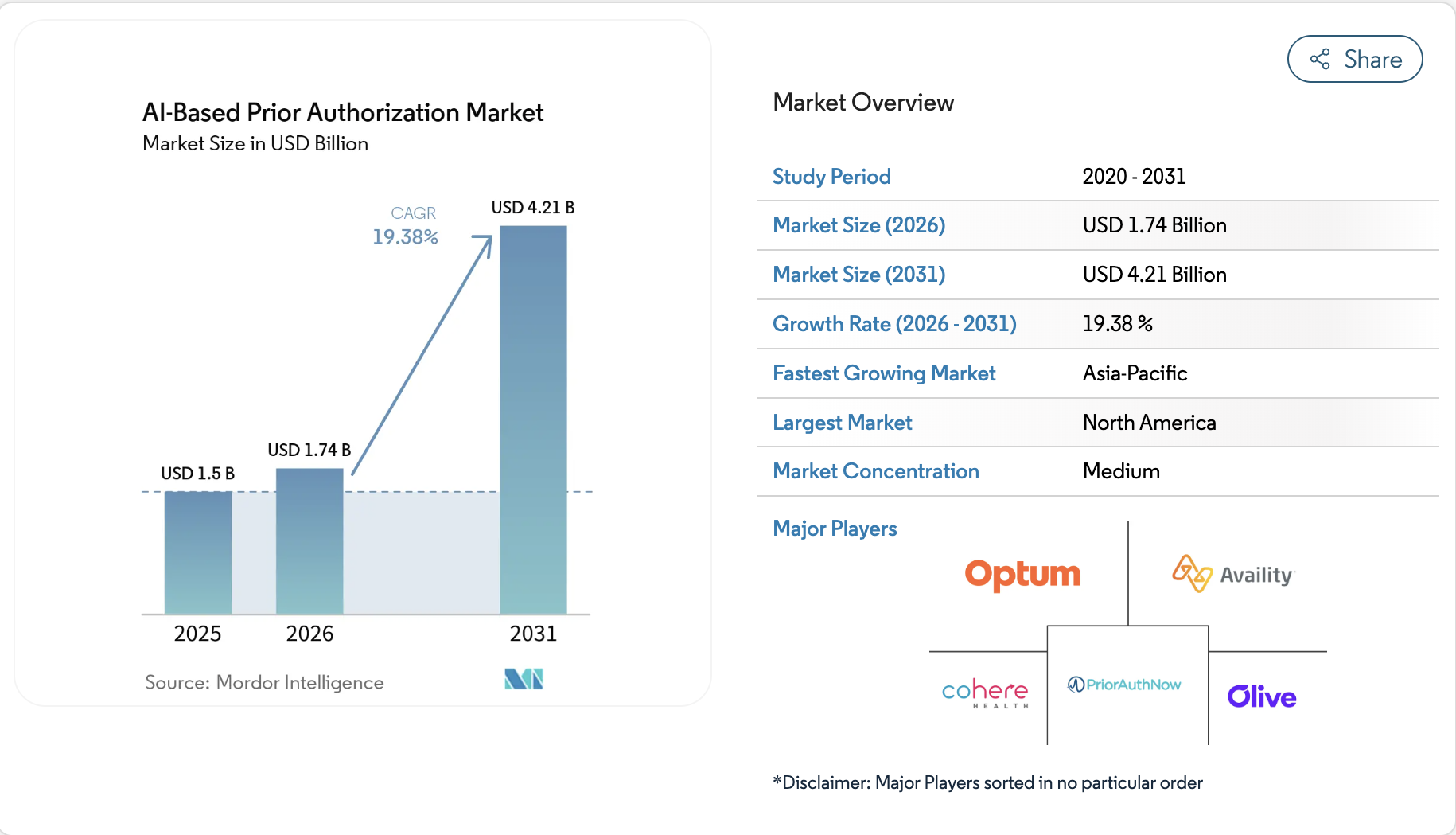
Meanwhile, the spending response is already visible in the market. Specifically, AI-based prior authorization is projected to grow from $1.74 billion in 2026 to $4.21 billion by 2031, a 19.38% CAGR. That growth tracks the problem, because CMS puts the administrative burden at roughly $35 billion a year nationally.
1. The 13 Hours and 40 Requests Per Physician Per Week Baseline
The 2025 AMA survey of 1,000 practicing physicians gives the clearest weekly baseline available. Moreover, it separates physician time from staff time, so you can map the figures to your own roles.
- 40 prior authorizations completed per physician, per week
- 13 hours of combined physician and staff time consumed weekly
- 40% of practices employ staff working exclusively on prior auth
- 94% of physicians link prior auth to burnout
2. Why 60% of Prior Authorizations Still Run Through Fax, Phone and Portals
Electronic adoption has improved steadily. Nevertheless, the majority of medical prior auth volume still moves manually, which is why the labor cost above has barely shifted.
- Electronic adoption rose from 31% to 40% between the 2023 and 2025 CAQH Index
- $21 billion in annual savings still sits in unautomated transactions
- Only 25% of provider organizations currently use AI in administrative workflows
3. The Denial and Write-Off Cost Nobody Puts in the PA Budget
Labor is the visible cost. Denials, however, are the larger one. Furthermore, they are trending the wrong way, so a baseline captured today will look optimistic in two years.
- 32% of physicians report requests are often or always denied
- 74% say denials increased over the past five years
- Services delivered without a confirmed auth cannot be billed to a commercial payer
4. Sizing the Market You Are Buying Into
Market size tells you the category is real. Market composition, on the other hand, tells you what you are actually buying, and the split matters here.
- Services are growing at a 19.67% CAGR, faster than software licensing
- Consequently, spend is shifting toward implementation and workflow redesign, not shrink-wrapped tools
- CMS estimates its prior auth rule alone saves $15 billion over ten years
The weekly labor number justifies attention, but denials and unbillable services justify the budget. Therefore, calculate all three against your own payer mix before evaluating any platform. Once you have that total, the next question is how much of it your EHR already handles.
How AI Prior Authorization Works in a Hospital
AI prior authorization works as a chain of six steps, not one automation. First, the system detects whether an order needs authorization. Next, it pulls the clinical evidence from the chart and checks that evidence against payer criteria. Then it submits, tracks the status, and works any denial.
Consequently, each step fails differently, which is why scoping matters before you build.
1. Finding Out Whether Prior Authorization Is Required
This step runs the moment a physician places an order. However, the answer depends on several variables at once, not just the procedure. Therefore, the system checks all of them together before flagging the order.
- Service or procedure ordered
- Patient coverage and active plan
- Payer and specific plan rules
- CPT or HCPCS code
- Diagnosis code
- Site of service
- Gold-card or exemption status
2. Gathering the Clinical Evidence the Payer Needs
Once an order is flagged, the system pulls the supporting record. Specifically, it reads both structured fields and unstructured notes, since payers rarely accept one without the other. As a result, staff skips the manual chart hunt.
- Physician notes and encounter documentation
- Active and historical diagnoses
- Lab results
- Imaging studies and reports
- Medication history
- Previous treatments attempted
- Prior procedure history
3. Checking the Evidence Against Payer Requirements
Gathering evidence is not the same as proving medical necessity. Accordingly, the system matches what it found against that payer’s published criteria. Moreover, it flags gaps before submission rather than after a denial.
- Medical necessity criteria for the service
- Required diagnostic tests
- Documented failed treatments
- Step therapy requirements
- Supporting documentation checklist
- Missing information routed back to staff
4. Preparing and Submitting the Request
Submission is where payer variation shows up most. Although modern APIs are expanding, most hospitals still need every route available. Therefore, the platform must support all of them in parallel.
- FHIR APIs where the payer supports them
- X12 278 transactions
- Clearinghouse routing
- Payer portal automation
- Fax or manual workflows where nothing else exists
5. Tracking the Authorization After Submission
Submission is not completion. Meanwhile, requests sit in payer queues, expire quietly, or come back asking for more. Consequently, status tracking prevents services from being delivered without a valid auth on file.
- Pending requests and aging
- Requests for additional information
- Approvals and auth numbers
- Denials with reason codes
- Expiration dates
- Renewal triggers
6. Handling Denials and Appeals
Denials are part of the workflow, not an exception to it. Furthermore, appeal success depends on speed and evidence quality. So the system assembles both automatically.
- Denial reason extraction from payer correspondence
- Supporting evidence retrieval from the chart
- Appeal letter preparation
- Peer-to-peer review scheduling
- Resubmission with corrected documentation
Prior authorization is a chain of clinical, administrative, and payer-facing workflows rather than a single task. Because of that, automation rarely covers all six steps evenly.
How Much of This Epic Already Does for You
Epic already handles a meaningful share of your prior auth workflow, but only where the payer participates. Specifically, it checks requirements in real time, exchanges charts directly with connected plans, and drafts medication responses.
However, coverage stops at your payer mix. Therefore, the big question is what happens to everything Epic hands back.
1. What Epic’s August 2026 Auth Check Actually Covers
Epic went live with real-time authorization requirement checks on August 18, 2026. Moreover, it runs on the HL7 Da Vinci CRD standard rather than a proprietary connection. Consequently, adoption depends on payers joining, not on Epic shipping more code.
- Live at Ochsner Health, Froedtert ThedaCare Health, Denver Health and Summit Health
- Connected to UnitedHealthcare, Aetna, and Network Health at launch
- 16 additional payers currently testing the interface
- Tells clinicians whether an auth is needed, not whether it will be approved
2. Where Payer Platform and Penny Stop Working
Beyond requirement checks, Epic clears actual authorizations through direct payer data exchange. In addition, its revenue-cycle AI drafts medication responses. Nevertheless, both depend entirely on payer and PBM participation.
- Ochsner Health and Humana complete 53% of prior authorizations instantly through Payer Platform
- Summit Health cut medication PA submission time by 42% using Penny
- Coverage scales with connected payers, so results vary by market
3. The Auth Volume Epic Still Sends Back to Staff
Whatever falls outside those connections still reaches your staff. Furthermore, this residual volume is slower per case than the volume Epic clears. As a result, it consumes time out of proportion to its share.
- Payers requiring portal logins or fax submission
- Specialty drugs with off-form evidence requirements
- Denials, appeals, and peer-to-peer scheduling
- Status chasing and expiration tracking
4. You Build Around Epic Rather Than Epic
No hospital should replace Epic to fix prior auth. Instead, the practical build sits alongside it, connected through HL7 and FHIR. Accordingly, Epic keeps the clinical record while the layer above works the exceptions.
- Epic remains the system of record and the clinical source of truth
- The build automates coordination work around it
- Integration runs through standard interfaces, not custom EHR modification
Epic clears the connected half of your authorization volume and returns the rest. Because of that, the build decision concerns the layer above Epic, rather than Epic itself. Next, we look at whether the CMS rules shrink that remaining volume for you.
What the New CMS Prior Auth Rules Change, and What They Do Not
The CMS rules change how fast payers must respond and how they must connect, but they build nothing on your side. Specifically, operational deadlines took effect in January 2026, while the API requirements land in January 2027.
However, the rules cover only some of your payers. Therefore, your manual volume shrinks partially, not fully.
1. The Two Dates That Matter: 2026 and 2027
CMS split this rule into two waves. First came the operational requirements, which are already live. Then comes the technical build, which payers must complete by January 1, 2027.
- Live since January 2026: 72 hours for urgent requests, 7 calendar days for standard
- Live since January 2026: a specific reason required on every denial
- Go Live since January 2026: public reporting of approval, denial, and timing metrics
- Due January 2027: four FHIR APIs, including the Prior Authorization API
2. Which of Your Payers the Rule Covers
The rule does not apply to every plan you bill. Consequently, your benefit depends entirely on payer mix. Moreover, the plans left out are often the ones creating the most manual work.
- Covered: Medicare Advantage organizations
- Covered: Medicaid and CHIP, both fee-for-service and managed care
- This Is Covered: qualified health plans on federally facilitated exchanges
- Not covered: commercial plans and self-funded ERISA employer plans
3. The Rule Fixes the Payer’s Side, Not Yours
This is the part most coverage skips. Although payers must expose the APIs, nothing requires them to do your work. Therefore, every hospital-side step in the workflow remains yours to build or buy.
- Payers must accept electronic requests and return electronic decisions
- Hospitals still detect which orders need authorization
- Hospitals still assemble the clinical evidence packet
- Hospitals still track status, work denials, and file appeals
4. The Reporting Measure That Becomes Mandatory
Beyond the payer rules, CMS is tightening provider-side reporting. In addition, what is optional today becomes required later. As a result, electronic adoption stops being a choice.
- A MIPS electronic prior authorization measure already exists for clinicians
- CMS has proposed making the hospital ePA measure mandatory from calendar year 2028
- Manual-heavy workflows become a scoring problem, not just a cost problem
Better payer APIs reduce integration work for part of your payer mix, yet they build none of the hospital-side prior auth workflow. Because of that, the 2027 deadline narrows the problem without solving it.
What Hospitals Can Already Buy Instead of Building
Most of the prior auth stack is already purchasable, and rebuilding it wastes money. Specifically, payer connectivity, provider-side auth software, document AI, and cloud infrastructure all exist as mature products.
However, none of them covers every payer or specialty. Therefore, the honest starting point is subtraction: remove what you can buy, then scope what remains.
1. Payer Connectivity and Authorization Networks
This layer moves transactions between you and the payer. Moreover, it took vendors years and thousands of payer relationships to build. Consequently, recreating it delivers no strategic advantage to a hospital.
- Payer routing and ID crosswalks across hundreds of plans
- Eligibility and benefits verification
- Authorization submission and electronic transactions
- Status tracking and clinical attachment delivery
2. Provider-Side Prior Authorization Software
Several vendors sell directly to hospitals and health systems. In addition, most bundle authorization into broader revenue cycle contracts. Accordingly, you may already own part of this capability without using it fully.
- Waystar, with roughly 5,000 health plan connections
- Humata Health, which reported 70% touchless approval on covered CPT codes at Allegheny Health Network
- Innovaccer Flow Auth, covering detection through appeal drafting
- Optum, R1 and Rhyme, typically inside larger RCM agreements
3. Payer-Side Platforms Hospitals Already Encounter
These platforms sit on the other side of the transaction. Although hospitals interact with them daily, they cannot buy them directly. Therefore, treating them as options wastes an evaluation cycle.
- Cohere Health sells to health plans, processing over 12 million requests annually
- Availity AuthAI is payer-side, reaching providers only through their plans
- Both shape your approvals without being yours to deploy
4. AI Models and Cloud Infrastructure
Hospitals rarely need to build anything at this layer. Furthermore, the commercial options outperform in-house attempts on cost and accuracy. So the sensible move is to rent capability and own configuration.
- Foundation models and commodity LLM access
- OCR and document extraction engines
- Cloud hosting, scaling and disaster recovery
- General-purpose speech and document AI
5. The Parts of PA Technology That Are Now Commodities
Some capabilities have stopped being differentiators entirely. Nevertheless, teams still budget to build them. As a result, scope creep starts before the first sprint.
- Basic payer connectivity
- Standard FHIR transport
- OCR
- Authentication and access control
- Generic document storage
- Commodity LLM access
Payer networks, provider-side auth software, models, and infrastructure are all better bought than built. Because of that, custom development should begin only after you subtract everything on this list.
What Hospitals Should Actually Build
Build the intelligence layer, not the plumbing. Specifically, that means the systems that read your own clinical data, follow your own operating model, and understand your own specialties.
Moreover, that same layer feeds denials, appeals, and analytics later. Therefore, ownership here compounds, while ownership of connectivity does not.
1. The Clinical Evidence Layer
Your charts are unique to your hospital, and payers want proof buried inside them. Consequently, this is where generic tools underperform most. In addition, everything downstream depends on getting this layer right.
- Finding supporting evidence inside unstructured physician notes
- Identifying previously attempted treatments and outcomes
- Matching relevant labs and imaging to the requested service
- Locating the specific documentation a payer requires
- Flagging missing information before submission
2. The Workflow Layer
Authorization work follows your org chart, not a vendor’s template. Furthermore, ownership rules differ by department and payer. So the workflow layer encodes decisions no outside platform knows.
- Who owns each authorization by service line
- Reviews flagged exceptions
- Which department handles which payer
- A case escalates and to whom
- Who prepares and files appeals
- Happens when an authorization expires
3. Specialty-Specific PA Logic
Median-case logic fails on high-value specialties. Meanwhile, those specialties carry your largest denial exposure. Accordingly, specialty rules deserve their own build scope.
- Oncology and infusion therapy
- Cardiology
- Advanced imaging
- Orthopedics
- Behavioral health
- Specialty medications
4. Denial and Appeal Intelligence
Denials reuse the evidence you already extracted. Therefore, building appeals separately duplicates work. Instead, extend the same layer across the full cycle.
- Denial-risk scoring before submission
- Missing-evidence warnings at order entry
- Denial categorization by root cause
- Appeal evidence retrieval from the chart
- Appeal letter drafting with payer policy language
5. Hospital-Owned Analytics
Vendor dashboards report what the vendor measures. However, your board asks different questions. As a result, owning the reporting layer matters more than it first appears.
- Approval rate and turnaround time by payer
- Denials by payer, procedure, and service line
- Staff touches per authorization
- Cost per authorization
- Appeal volume and overturn rate
6. A Shared Evidence Layer Across Revenue Cycle
This is the strongest argument for building. Because the same extracted evidence serves several workflows, one layer replaces several contracts. Consequently, the economics improve with every workflow added.
- Prior authorization
- Claims submission
- Denial management
- Clinical documentation improvement
- Appeals and revenue integrity
Hospitals should own the evidence, workflow, and specialty logic while buying the connectivity beneath it. Because that layer also feeds claims, denials, and CDI, it earns its cost across multiple workflows.
Why a Hybrid Setup Makes Sense for Most Hospitals
A hybrid setup wins because prior auth splits cleanly into infrastructure and intelligence. Specifically, payer connectivity is a solved commodity, while evidence extraction and workflow logic are yours alone.
Therefore, buy the first, build the second, and keep Epic where it is. Consequently, you pay for differentiation instead of duplication.
1. Buy the Connectivity Layer
Payer connectivity took vendors years and thousands of relationships to establish. Moreover, it improves without your involvement. Accordingly, buying it frees budget for work only you can do.
- Payer networks and routing
- Clearinghouse services
- Standard X12 transactions
- API connectivity where payers support it
2. Keep Epic as the Clinical System of Record
Epic already holds the clinical truth. However, teams often rebuild parts of that workflow by accident. As a result, they create a second source of truth that staff stops trusting.
- Epic stays the clinical record, without exception
- The build reads from and writes back to Epic
- No parallel clinical workflow gets created
3. Build the Intelligence Around Your Own Data
This layer reflects your charts, your specialties, and your payer mix. Furthermore, no vendor can pre-train it for you. So this is where custom development earns its cost.
- Clinical evidence extraction from notes
- Missing-document detection before submission
- Specialty-specific authorization rules
- Denial risk scoring
- Workflow routing and exception handling
4. Keep Commercial Components Replaceable
Vendors change pricing, performance, and ownership. Nevertheless, hospitals often hard-wire them into the workflow. Instead, treat every bought component as swappable from day one.
- Clearinghouse
- AI model provider
- Payer network
- OCR vendor
- Cloud service
5. Own the Data the Workflow Creates
Operational data becomes leverage over time. In addition, it improves your models and your payer negotiations. Consequently, contracts should state clearly that this data stays yours.
- Payer performance and response history
- Denial patterns by service line
- Authorization outcomes
- Staff intervention records
- Rule and model performance over time
6. Hybrid Is an Architecture Choice, Not a Compromise
This distinction matters more than it sounds. Hybrid is not what you settle for when custom development feels expensive. Rather, it is the deliberate decision to build what creates hospital-specific value and buy what has already become infrastructure.
- Build where your data, specialties, and workflows differ
- Buy where the market has standardized
- Review the line between them annually, since it keeps moving
Buy the connectivity, keep Epic as the record, and build the intelligence that reflects your own clinical reality. Because that split follows where value actually sits, hybrid is the strongest architecture rather than the cheapest one.
When Buying Prior Authorization Software Is the Better Choice
Buying wins when volume is modest, workflows are standard, and nobody internally can own another production system. Moreover, it wins whenever speed matters more than roadmap control.
Therefore, six conditions should disqualify a build outright. Consequently, testing yourself against them early costs far less than a failed pilot.
1. Your Prior Authorization Volume Is Relatively Low
Custom ownership carries a fixed cost regardless of volume. However, the savings scale with transactions. As a result, low-volume hospitals rarely recover the investment.
- Build cost and annual maintenance stay flat as volume drops
- Payback depends on the hours and denials you actually remove
- Below a certain volume, a subscription is simply cheaper
2. Your Workflows Are Mostly Standard
Commercial platforms are trained on median-case authorization work. Accordingly, they perform well when your operation resembles the median. Furthermore, configuration then replaces development entirely.
- Specialty mix is straightforward
- Documentation requirements are predictable across payers
- Exceptions are limited and handled by a small team
3. Your Main Payers Are Already Well Covered
Connectivity you already have is connectivity you should not rebuild. Meanwhile, rebuilding it returns nothing your staff will notice. Instead, check coverage before assuming a gap exists.
- Most volume already moves through existing integrations
- Epic or your RCM vendor clears your largest payers
- Remaining manual volume is too small to justify a platform
4. Your IT Team Cannot Own Another Production System
Owning software means owning it permanently. Nevertheless, teams often plan the build and not the decade after it. So the honest question is whether anyone will run this in year two.
- APIs and payer rule updates shipped without notice
- Security patching and access control
- AI model monitoring and drift detection
- Infrastructure, uptime and incident response
5. You Need Results Quickly
Urgency changes the correct answer. Although a custom build fits better long term, it does not arrive in eight weeks. Therefore, a configured vendor deployment wins when the deadline is short.
- Buy when results are needed this quarter
- Build when the timeline allows phased delivery
- A pilot on vendor software can still inform a later build
6. Prior Auth Is Not Strategic Enough to Own
This is the simplest test of all. Not every operational problem deserves proprietary software. Consequently, if authorization speed is not part of how you compete, buy it and move on.
- Ask whether faster auth turnaround changes your market position
- If the answer is no, treat it as infrastructure
- Spend the engineering capacity where it does differentiate you
Low volume, standard workflows, strong existing coverage, thin IT capacity, or short timelines all point toward buying. Because a build justified on the wrong condition fails predictably, disqualifying yourself early is the cheaper decision.
When a Custom AI Prior Authorization Platform Makes Sense
Building makes sense when four specific conditions hold at once. Specifically, your denials concentrate in a few specialties, your clinical data needs normalization first, the evidence layer will serve more than prior auth, and roadmap control affects how you compete.
However, one condition alone rarely justifies a build. Therefore, treat these as a combined test rather than a menu.
1. Your Denial Pattern Is Specialty-Specific
Commercial platforms are trained on median-case authorization work. Consequently, they read straightforward orthopedic requests well and complex oncology requests poorly. Moreover, those complex specialties usually carry your largest dollar exposure.
- Denials cluster in oncology, imaging, infusion, or behavioral health
- Payer criteria in those areas depend on treatment history and sequencing
- Vendor configuration cannot reach the underlying model logic
- A platform built for median cases returns median results
2. Your Clinical Data Needs Normalization First
Vendors quote implementation assuming clean inputs. Nevertheless, many hospitals run several EHR instances, legacy document stores, and inconsistent note templates. As a result, cleanup cost belongs inside the comparison, not outside it.
- Multiple EHR instances across acquired facilities
- Unstructured notes with no consistent template
- Scanned and faxed payer correspondence needing extraction
- Normalization work you pay for either way, so ownership becomes cheaper
3. The Evidence Layer Will Serve More Than Prior Auth
This is the strongest financial argument. Because the same extracted clinical evidence supports several revenue cycle workflows, one owned layer replaces several point-solution contracts. Furthermore, each added workflow improves the return.
- Prior authorization and appeals
- Claims submission and denial management
- Clinical documentation improvement
- Revenue integrity and underpayment detection
4. Roadmap Control Is a Strategic Requirement
Buying means the vendor decides what ships next. Meanwhile, your authorization turnaround improves only when your request reaches their priority list. Therefore, control matters when patient access speed is part of how you compete.
- Improvements ship when your engineering finishes, not when a vendor schedules them
- Specialty rules can change as your service lines change
- Payer-specific logic stays adjustable after contract renegotiations
5. Build, Buy, Extend Epic, or Hybrid: A Four-Way Decision Table
| Option | Best fit | What you own | What you outsource | Main advantage | Main risk |
| Extend Epic | Epic-heavy, standardized workflows | Limited workflow logic | EHR and payer connectivity | Lowest disruption | Limited outside participating payer workflows |
| Buy | Standard PA operation | Very little | Most infrastructure | Fast deployment | Vendor dependency |
| Hybrid | Complex hospital workflows | Intelligence and workflow | Commodity connectivity | Control without rebuilding infrastructure | Integration ownership |
| Full custom | Large strategic platform use case | Nearly everything | Selected infrastructure only | Maximum control | Highest cost and maintenance |
A custom platform earns its cost when specialty denials, messy clinical data, multi-workflow reuse, and roadmap control all apply together. Because most hospitals meet two or three of those conditions rather than four, hybrid remains the common landing point.
AI Prior Authorization Automation Build Costs $70,000 to $300,000
A custom AI prior authorization build costs between $70,000 and $300,000, spread across seven phases. Moreover, annual maintenance adds 18% to 28% of that figure every year afterward.
However, the range moves sharply with payer mix and specialty count. Therefore, the phase breakdown matters more than the headline number.
1. Phase-by-Phase Cost Breakdown
| Phase | Range | What it covers |
| 1. Discovery and auth volume mapping | $10,000 to $25,000 | Payer mix analysis, auth-required service inventory, denial audit, compliance scoping |
| 2. Data ingestion and clinical evidence | $15,000 to $45,000 | FHIR and HL7 adapters, EHR read access, document normalization, OCR pipeline |
| 3. Payer rules and requirement detection | $12,000 to $50,000 | Payer rule library, CPT and diagnosis mapping, LCD and NCD checks |
| 4. NLP and medical necessity matching | $15,000 to $60,000 | Note parsing, criteria matching, citation-linked evidence packets, confidence scoring |
| 5. Submission, tracking and appeals | $10,000 to $45,000 | X12 278 and FHIR submission, portal automation, status polling, appeal drafting |
| 6. Compliance and auditability | $5,000 to $35,000 | HIPAA controls, BAAs, immutable audit logs, model versioning, explainability |
| 7. Analytics and pilot rollout | $3,000 to $40,000 | KPI dashboards, phased rollout by payer and service line |
| Total | $70,000 to $300,000 |
2. What Pushes You Toward $300,000 Instead of $70,000
Four variables drive the range. Furthermore, each one multiplies rather than adds. Consequently, scope discipline controls cost better than feature cuts.
- Number of EHR instances to integrate
- Share of payer mix requiring portal automation instead of APIs
- Number of specialties with distinct evidence criteria
- Depth of appeals automation included in phase one
3. Ongoing Maintenance Runs 18% to 28% Per Year
Payers change rules without notice. Therefore, maintenance is operational, rather than optional. In addition, it covers the model work most budgets forget.
- A $90,000 build costs roughly $16,200 to $25,200 annually
- A $280,000 build costs roughly $50,400 to $78,400 annually
- Covers payer rule updates, drift monitoring, and exception support
4. Total Cost of Ownership Over 36 Months
Compare the full picture, not the first invoice. Although subscriptions start lower, they scale with volume. Meanwhile, an owned build plateaus.
- Vendor fees compound as authorization volume grows
- Owned maintenance stays proportional to build size
- Factor in switching cost if the vendor underperforms
Get your AI Prior Authorization Build Roadmap. Intellivon scopes payer mix, MVP scope, integration complexity, and phased cost before any development commitment. Book a scoping call.
The build runs $70,000 to $300,000 across seven phases, with 18% to 28% annually thereafter. Because payer mix and specialty count drive the range, the scoping exercise decides your number.
What Steps Keep an AI Prior Auth Build From Becoming Shelfware
Sequencing keeps it alive. Specifically, Intellivon ships a read-only evidence assembler for one service line and one payer before automating anything. Then each phase adds a single capability only after the previous one clears an accuracy threshold.
Consequently, staff trust the system before it gains authority. Moreover, ownership gets assigned before phase one begins, not after go-live.
1. Scope the Auth Volume Before Writing Code
Intellivon starts by measuring what actually falls outside your existing coverage. Furthermore, this establishes the baseline that later proves ROI. Therefore, no development begins until the numbers exist.
- Map authorization volume by payer, service line, and submission route
- Identify which payers Epic and your RCM vendor already clear
- Audit denial patterns to find where evidence quality fails
- Capture pre-build metrics for turnaround time, touch rate, and denial rate
2. Build the Evidence Layer in Read-Only Mode
The first release assembles evidence and submits nothing. Meanwhile, staff continue working normally and compare the system’s output against their own. As a result, accuracy gets proven before any authority is granted.
- Limit scope to one service line and one payer
- Extract clinical evidence from notes, labs, imaging, and treatment history
- Flag missing documentation back to staff for review
- Measure packet completeness against what staff assemble manually
3. Turn On Submission Where Connectivity Is Real
Automated submission starts only after phase two clears its accuracy threshold. Moreover, it starts with payers offering genuine API or X12 connectivity. Accordingly, portal and fax workflows wait until the core pipeline is stable.
- Enable submission for payers with FHIR or X12 278 support first
- Keep human approval on high-risk and high-dollar requests
- Route low-confidence cases to staff rather than submitting them
- Track first-pass acceptance rate as the gate for expansion
4. Close the Loop With Tracking and Appeals
Submission without tracking creates new risk. Nevertheless, many builds stop here and leave status chasing manual. Instead, Intellivon extends the same evidence layer into the post-submission workflow.
- Poll authorization status and surface aging requests
- Capture denial reason codes from payer correspondence
- Retrieve supporting evidence automatically for appeals
- Draft appeal letters using payer policy language and historical outcomes
- Alert on expiring authorizations before services are delivered
5. Add Portal and Fax Automation for Stubborn Payers
This is the hardest volume and deliberately comes late. Although it consumes disproportionate staff time, it also breaks most often. Therefore, it lands only once the stable pipeline can absorb the exceptions.
- Automate portal logins, form completion, and attachment upload
- Monitor for silent portal changes that break automation
- Maintain fallback routing when a portal path fails
- Keep failed payloads in a replay queue rather than losing them
6. Harden Compliance, Audit Trails and Explainability
Compliance work is designed in from sprint one and hardened here. Furthermore, it determines whether the platform survives an audit in year three. So Intellivon treats it as a release gate rather than a document.
- Record model version, source evidence, and reviewer action on every decision
- Confirm BAA coverage across every cloud and model provider
- Publish feature attribution so managers can see what drove a risk score
- Run bias and accuracy checks on a fixed monitoring cadence
7. Expand by Payer Volume, Not by Feature Wishlist
Expansion follows the money. However, teams often expand toward interesting features instead. Consequently, Intellivon sequences new payers and service lines by auth volume and denial exposure.
- Add the next highest-volume payer before adding new capabilities
- Extend to the specialty with the largest denial exposure
- Reuse the evidence layer for claims, CDI, and denial management
- Review scope quarterly against measured results
Phasing turns a large build into seven small verifiable releases, each gated on measured accuracy rather than a calendar. Because ownership is assigned before the first sprint, the platform keeps working after the engagement ends.
Why Hospitals Partner With Intellivon on Prior Authorization Builds
Hospitals bring Intellivon in when the scope is unclear, and the stakes are clinical. Specifically, we scope which authorizations fall outside Epic and your existing vendors, then build only that layer.
Moreover, we keep deterministic payer rules separate from AI so the system stays auditable. Therefore, you get a defensible platform rather than a pilot that stalls.
- Eleven years building custom software across healthcare, fintech, and AI engineering, with 250+ AI projects delivered since 2017 and 200+ AI professionals on staff.
- Direct Epic and FHIR experience, including a verified SMART on FHIR integration with Epic EHR covering real-time patient data retrieval and write-back for a US healthcare client.
- Revenue cycle depth beyond prior auth, with production work across payer connectivity, claims processing, denial prevention, and revenue integrity.
- Deterministic rules kept separate from AI, so payer-required edits stay rules-driven and auditable while AI handles evidence extraction and exception triage.
- Compliance designed in from sprint one, covering HIPAA, SOC 2, OAuth 2.0, BAA coverage, immutable audit logs, and model version tracking.
- Human approval layers on high-risk submissions, because clinical and compliance teams should sign off where denial exposure is real.
- Phased delivery with cost visibility upfront, so scope, integration complexity, and phased pricing are agreed before engineering begins.
Most hospitals cannot answer build versus buy because nobody has measured how much authorization volume actually falls outside what they already own. That measurement takes one conversation.
Book a strategy call, and we will scope your payer mix, MVP scope, integration complexity, and phased cost before you commit to anything.
Conclusion
AI prior authorization automation is worth building for the volume Epic, and your vendors leave behind, not for the volume they already clear. Therefore, start by measuring that gap. Then buy the connectivity, keep Epic as the clinical record, and build the evidence and workflow logic that reflects your specialties.
Because the build runs $70,000 to $300,000 with 18% to 28% annual maintenance, scoping it properly decides whether the investment returns anything at all.
FAQs
Q1. How Much Does a Custom AI Prior Authorization Platform Cost Hospitals to Build?
A1. Expect $70,000 to $300,000 across seven phases. Moreover, maintenance adds 18% to 28% annually, so a $90,000 build carries roughly $16,200 to $25,200 per year. Three variables drive the range: number of EHR instances, share of payer mix needing portal automation, and count of specialties with distinct evidence criteria.
Q2. If Epic Already Does Prior Authorization, Why Would a Hospital Build Anything?
A2. Because Epic only covers participating payers. Specifically, Ochsner and Humana clear 53% of authorizations instantly through Payer Platform, while the rest return to staff. Therefore, the build targets payers requiring portals or fax, specialties with complex evidence requirements, and the denials and appeals that follow every documentation gap.
Q3. Does CMS-0057-F Mean Hospitals No Longer Need Their Own Prior Auth Automation?
A3. No. Although payers must run FHIR APIs by January 2027, the rule obligates them, not you. Consequently, your team still detects which orders need authorization, assembles evidence, tracks status, and files appeals. Furthermore, commercial and self-funded ERISA plans fall outside the rule entirely.
Q4. Can a Hospital Buy Cohere Health or Availity AuthAI Directly?
A4. No, because both are payer-side utilization management platforms. Cohere sells to health plans, while Availity AuthAI reaches providers only through their plans. Instead, evaluate provider-side options such as Waystar, Humata Health, Innovaccer Flow Auth, Optum, R1, and Rhyme, most of which bundle into broader revenue cycle contracts.
Q5. How Long Does It Take to Build an AI Prior Authorization Platform?
A5. Timelines follow phases rather than a fixed calendar. First comes a read-only evidence assembler for one service line and one payer. Then automated submission, tracking, and appeals follow once accuracy thresholds are met. Consequently, duration depends on EHR instance count and how much of your payer mix needs portal automation.
Q6. Will AI Prior Authorization Automation Increase or Reduce Our Denial Rate?
A6. Provider-side automation reduces avoidable denials by improving evidence completeness before submission. However, payer-side AI raises legitimate concerns, and 60% of surveyed physicians expect denials to rise. Moreover, CMS ties some WISeR vendor pay to savings from unpaid claims. Therefore, treat your build as a countermeasure.