Key Takeaways:
-
It isn’t necessary in all cases to have a large healthcare AI company. At times, a smaller specialist is more appropriate for the kind of thing you’re developing.
-
If you are interested in a made-to-measure product and don’t want to go through many people just to reach a decision, then having a specialist partner is a far simpler option.
-
Freelancers, no-code tools, and ready-made platforms can also be used, but only in cases where the project is simpler and the consequences are less serious.
-
The budget could still end up between $70,000 and $300,000 even when you take custom integrations, compliance, security, and proper product engineering into account.
-
Intellivon is suitable for teams seeking a serious healthcare AI product without having to accept the considerable amount of baggage typically associated with a large consultancy.
The best alternative to AI healthcare developers is to work with a boutique partner. The boutique partner builds the solution in stages, signs a HIPAA business associate agreement, and ultimately gives you ownership of the code. On the other hand, large companies are designed for hospital systems with enterprise budgets.
Founders of companies usually face long procurement processes and multi‑layered pricing when they use large firms. In contrast, a boutique team assigns engineers to the first phase. The boutique team sets workflows, compliance requirements, and integrations at the beginning. Because of this planning, you can achieve a working pilot before the deadline arrives. Other possibilities exist, such as using in‑house teams hiring freelancers or using pre‑built platforms.
This blog examines each option, shows what a smaller partner must demonstrate about patient data protection, and provides a cost breakdown by phase. In the end, you will see how Intellivon fits this model for US founders and when a bigger firm might still be the choice. Our work in healthcare AI, from EHR integrations to platforms, forms the basis for all the examples given.
Why Founders Look Beyond Large Healthcare AI Firms
Founders look beyond large healthcare AI firms because the delivery model often exceeds the size of the product. One AI build needs a small senior team, quick decisions, and direct engineer access.
Large consultancies, however, are structured for sprawling programs, so extra process can slow a startup down.
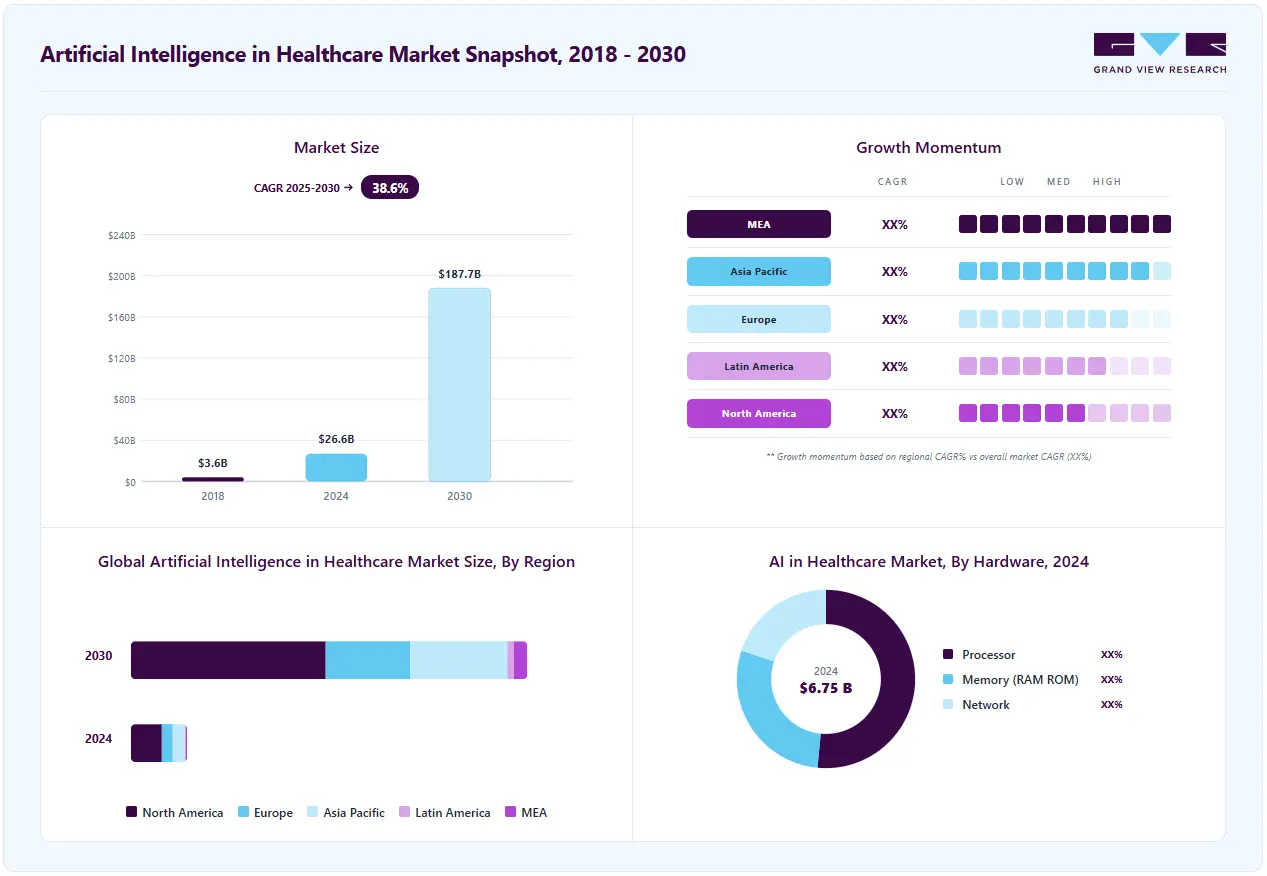
The global AI in healthcare market was valued at $36.7 billion in 2025 and is projected to reach $50.7 billion in 2026, according to Grand View Research. It is forecast to grow at a 38.9% CAGR to $505.6 billion by 2033. Consequently, founders face a crowded field of development partners.
1. Large Delivery Teams Can Bring More Process Than Builds Need
Big consultancies run on structures designed for complex programs. Likewise, that structure can feel heavy for one focused AI product.
- Discovery and account layers: A wide discovery team and several account leads suit many departments, but one use case needs far less.
- Procurement steps: Vendor onboarding and legal reviews can add weeks before kickoff.
- Stakeholder handoffs: Each handoff adds delay and lets requirements drift.
- Enterprise delivery processes: Formal governance protects very large transformations, yet feels disproportionate for one product.
2. A Famous Vendor Does Not Guarantee Closer Collaboration
Brand recognition says little about who builds your product. Therefore, ask who does the work after the contract is signed.
- Sales versus delivery: Confirm the senior people in the pitch also join the build.
- Founder access: Ask whether you can speak with engineers directly.
- Product decisions: Count how many layers a change request passes through.
- Direct communication: Shared technical channels usually beat weekly status reports, and this is how boutique models typically work.
3. Large Firms Make Sense When the Program Is Also Large
Scale has real value in the right situation. Moreover, enterprise firms earn their fees on programs most startups will not run.
- Multi-hospital transformations: Several parallel workstreams need coordinated teams.
- Deep benches: Sectorpunk’s 2026 ranking describes ScienceSoft as having 750+ employees, the capacity a huge rollout requires.
- Global rollouts: Multiple regions demand local compliance and support.
Large firms are built for large programs, and that is a strength. For one focused AI product, however, extra layers add cost and delay without adding value. Consequently, the real test is whether a partner’s size matches the size of your problem.
What an Alternative Healthcare AI Partner Actually Means
An alternative to AI healthcare development firms is any different way of getting your product built, not simply a cheaper agency. It can change team size, contract structure, technology ownership, development model, geography, customization level, or how much engineering your own team carries.
Therefore, founders are often comparing entire building approaches, not just vendors. Consequently, the right choice starts with what you need, not what a shortlist suggests.
1. An Alternative Changes How You Build, Not Just Price
Many founders assume a cheaper agency is the only option. In reality, seven variables can change, and each shifts cost and risk differently.
- Team size: Three senior engineers work differently from a fifty-person program team.
- Engagement structure: Fixed-scope phases, time-and-materials, and dedicated teams carry different risk.
- Technology ownership: Decide who holds the code, models, and data pipelines.
- Development model: Medigy separates firms that build tailored software from platforms you configure.
- Geography: Onshore, nearshore, and offshore teams differ in rate and time-zone overlap.
- Customization: Configuring existing tools costs less than building from scratch.
- Internal responsibility: Some founders manage engineers themselves, while others hand off everything.
2. Alternative Does Not Mean Lower Technical Capability
A smaller provider can handle serious healthcare AI work when its specialty matches your problem. Size alone tells you little, so compare provider types instead.
- Smaller firm: Fewer staff, but not necessarily any healthcare experience.
- General software agency: Strong delivery, though often new to HIPAA and clinical data.
- Healthcare specialist: Knows FHIR, EHR integrations, and PHI handling.
- Freelancer group: Flexible and affordable, but thin on compliance and continuity.
- Product studio: Strong on design and strategy, sometimes lighter on AI engineering.
- Dedicated engineering team: Extends your staff under your direction.
- Boutique test: A boutique pairs small size with a defined specialty. Clients on Intellivon’s Clutch profile report project teams of 6 to 15 people.
3. The Best Alternative Depends on What You Want to Own
Your answer depends on what you want to control after launch. Therefore, three ownership questions narrow the field quickly.
- Who owns product strategy? Founders with clinical vision usually keep this and outsource execution.
- Who owns the engineering team? Hiring gives control, while a partner gives speed.
- Who owns infrastructure and IP after launch? Require written assignment of code, models, and cloud accounts.
- Internal capability: A strong in-house CTO suits a dedicated team, while a non-technical founder needs a full-build partner.
Section takeaway: An alternative changes how the product gets built, not only who charges less. Capability comes from specialty and team fit, not headcount. Consequently, your answers on ownership decide which model suits you.
Six Ways to Build Healthcare AI Without a Big Consultancy
Founders can build healthcare AI without a big consultancy in six ways: an in-house team, freelancers, a dedicated offshore or nearshore team, a prebuilt platform, no-code tools with custom engineering, or a specialized healthcare AI partner.
Each option shifts cost, speed, and ownership differently. Therefore, the right pick depends on how much of the build you want to control.
1. Build an In-House Healthcare AI Team
Building internally gives you maximum ownership and direct control over every hire. However, recruiting a full healthcare AI team takes months.
- Roles needed: ML engineers, backend engineers, security, product, DevOps/MLOps, and clinical advisors.
- Best fit: Companies where AI will stay a permanent core capability.
- Main limitation: The time and cost of recruiting several specialized roles.
2. Hire Individual Freelance AI Developers
Freelancers offer a low initial commitment and fast access to specific talent. Likewise, they handle narrow technical tasks well.
- Best fit: Experiments, isolated integrations, prototypes, or team augmentation.
- Main limitation: One freelancer rarely covers clinical, regulatory, architecture, QA, integration, and MLOps work.
3. Assemble a Dedicated Offshore or Nearshore Team
A dedicated team gives you monthly capacity that scales up or down. Moreover, geographic rate differences can lower cost, though you usually keep product management yourself.
- Best fit: Teams with an internal CTO or engineering leader.
- Main limitation: Healthcare expertise varies significantly between providers.
4. Use a Prebuilt or White-Label Healthcare AI Platform
Prebuilt platforms deploy quickly and cut your engineering burden through subscription or licensing. Medigy notes that platforms offer faster time-to-value, while custom firms offer more tailoring.
- Suitable areas: Appointment assistants, documentation, basic triage, workflow automation, and patient engagement.
- Best fit: Companies whose AI is not the differentiator.
- Main limitation: Limited customization, integration depth, data ownership, model control, and vendor dependence.
5. Combine No-Code Tools With Custom Engineering
No-code tools validate ideas fast and automate simple internal work. Therefore, they suit proofs of concept where risk stays controlled.
- Suitable uses: Workflow prototypes, internal tools, and simple administrative automation.
- Best fit: Early validation before committing to a full build.
- Main limitation: Clinical workflows, PHI, deep EHR integration, complex AI, and regulated functions quickly exceed these platforms.
6. Hire a Specialized Healthcare AI Development Partner
A specialized partner sits between a large consultancy and a small general development shop. Consequently, one team can cover most of the build.
- Typical scope: Product strategy, AI engineering, data engineering, EHR integration, app development, compliance architecture, cloud, MLOps, QA, and post-launch support.
- Best fit: Founders who want an external team to own most of the build without a large-consultancy model.
- Main limitation: The buyer must verify that the healthcare specialization is real.
- Example of specialization: Intellivon’s agentic AI platform guide references SMART on FHIR integrations with Epic.
Six options exist, and each trades control against speed and cost. In-house teams and freelancers sit at opposite ends of commitment, while platforms and no-code tools reduce engineering work but limit depth. Consequently, a specialized partner is the closest direct substitute for a large firm, provided its healthcare expertise checks out.
How the Main Development Options Compare
The seven realistic development options differ on cost, speed, expertise, customization, and internal workload, and none wins on every measure. A large consultancy offers strong healthcare depth at high cost.
A specialized firm balances speed and customization for focused builds. In-house teams give the most control but cost the most over time. Therefore, the right model depends on which trade-off your product can accept.
| Model | Upfront Cost | Delivery Speed | Healthcare Expertise | Customization | Internal Team Needed | Best For |
| Large consultancy | High | Moderate | Usually strong | High | Moderate | Enterprise transformation |
| Specialized AI healthcare firm | Medium to high | Faster | Must verify | High | Low to moderate | Startups and focused enterprise builds |
| Dedicated offshore team | Medium | Moderate | Varies | High | High | Companies with internal technical leadership |
| In-house team | Very high long-term | Slow initially | Controlled internally | Very high | Very high | AI-native healthcare companies |
| Freelancers | Low to medium | Fast for narrow work | Varies | High | High | Prototypes and specialist tasks |
| Prebuilt platform | Low to medium | Fast | Product-specific | Low | Low | Standard workflows |
| No-code/low-code | Low | Very fast | Low to moderate | Low to medium | Moderate | Internal prototypes |
The table shows trade-offs, not a ranking. Each model gives up something in exchange for cost, speed, or control. Consequently, your internal engineering strength and the depth of your product should decide the model.
When a Specialized Partner Becomes the Better Fit
A specialized healthcare AI partner becomes the better fit when your product outgrows off-the-shelf software, your team cannot cover the full stack, you need direct access to builders, or you want to validate before a large commitment.
Any one of these signals can justify the switch, and two or more make the case strong. Therefore, use the four checks below to test your own situation before you shortlist any vendor.
1. Your Product Needs More Customization Than SaaS Can Provide
Buying a platform stops making sense when your workflow is your advantage. Standard tools fit standard processes, not differentiated ones.
- Unique clinical workflows: Prebuilt tools rarely match how your clinicians work.
- Proprietary scoring models: Platforms seldom let you own or tune the model.
- Custom AI agents: Agents need tailored guardrails, as Intellivon’s agentic AI platform guide explains.
- Nonstandard data sources: Unusual inputs need custom pipelines.
2. Your Internal Team Cannot Own the Full Healthcare Stack
AI is only one layer of a healthcare product. Therefore, one ML engineer cannot carry the whole build.
- Product layers: Application architecture, UI, and QA all need owners.
- Data and integrations: Pipelines, APIs, and identity must connect to clinical systems. Intellivon’s integration guide notes that FHIR support alone does not make a platform AI-ready.
- Operations: Cloud, security, and monitoring keep the product running safely.
3. You Need Direct Access to the People Building the Product
Startups move faster when founders talk to engineers directly. Boutique models are usually built around that access.
- Technical conversations: Ask questions without waiting for account managers.
- Faster decisions: Fewer layers mean quicker approvals.
- Founder involvement: You shape the product, not just review it.
- Iterative scope: Clutch reviewers of Intellivon describe progress updates every two weeks.
4. You Want to Validate Before Funding a Huge Program
A smaller partner lets you commit in stages. Consequently, each stage gives you evidence before the next payment.
- Discovery: Confirm the use case, data, and compliance needs.
- Proof of concept: Test whether the AI works on real data.
- MVP and pilot: Put a focused version in front of real users.
- Production rollout: Scale only after the pilot proves value.
A specialized partner fits best when customization, stack coverage, builder access, or staged commitment matters to you. These four signals separate focused builds from programs that need a large consultancy. Consequently, the more of them you recognize, the stronger the case for a partner of this kind.
Smaller Does Not Mean Healthcare AI Can Be Built Cheaply
Choosing a smaller healthcare AI partner can lower your costs, but it does not make the build cheap. Savings come from less overhead rather than skipping the work that keeps patient data safe. Integrations, compliance, testing, and monitoring still cost real money at any firm.
Therefore, cost-effective should mean better value per dollar, not the lowest quote. Consequently, founders who expect a bargain often pay more later to fix what was left out.
1. What Still Costs Money With Any Healthcare AI Partner
Some costs stay fixed whether the team is large or small. Likewise, each one protects your product from failure in a clinical setting.
- Healthcare integrations: Intellivon’s integration guide puts custom healthcare integration work at $70,000 to $300,000, depending on systems and interfaces.
- Model development: Intellivon’s AI healthcare app guide lists model development, RAG pipelines, and output guardrails at $18,000 to $32,000.
- Data engineering: Clean, mapped data feeds every model.
- Security and compliance: The same guide lists discovery and regulatory alignment at $9,000 to $15,000.
- QA and clinical validation: Testing proves the output is safe to use.
- Monitoring and infrastructure: Production hosting and model monitoring continue after launch.
2. Where Cheaper Proposals Usually Remove Scope
Two quotes can differ sharply because one leaves work out. Therefore, compare what each proposal includes, not just the total.
- EHR integration: Often listed as “later” or an add-on.
- BAAs and security architecture: Missing from the price, yet required for PHI. HHS guidance says cloud providers handling ePHI need business associate agreements.
- MLOps and audit logging: Skipped, which makes models hard to track and audit.
- Testing and clinical validation: Reduced to basic checks.
- Ongoing monitoring: Left out, so accuracy drifts unnoticed.
- Production infrastructure: Priced as a demo environment, not a live one.
A smaller partner cuts overhead, not the core work of building safe healthcare AI. Integrations, security, testing, and monitoring remain in every honest quote. Consequently, a much lower proposal usually signals removed scope, not better efficiency.
Compliance Should Eliminate Vendors Before Price Does
Compliance should eliminate vendors before price does, because a low quote means little if the partner cannot protect patient data. HIPAA duties apply equally to small and large firms, so every vendor handling protected health information needs a signed agreement and a clear data-flow design.
Therefore, screen for these four checks first: BAA, data flow, FDA scope, and EHR experience, and only then compare prices across the vendors who pass.
1. Check Whether the Vendor Will Sign the Required BAA
A smaller company still needs full HIPAA safeguards. Therefore, ask for the agreement before any technical work starts.
- Business associate status: A vendor that needs PHI access to do its work can become a business associate, which calls for a BAA.
- Subcontractors: Ask which subcontractors will see PHI, and confirm each one signs a BAA.
- Cloud vendors: HHS guidance says a cloud provider storing ePHI is a business associate, even when the data is encrypted.
- Responsibility chain: Get in writing who answers for a breach at each link.
2. Ask How PHI Moves Through the Proposed Architecture
Vague HIPAA claims fall apart under specific questions. Consequently, ask the vendor to draw the full data path.
- Storage: Where does PHI live, and who holds the encryption keys?
- Model APIs: Does PHI reach a third-party model, and is a BAA in place?
- Logging and backups: Do logs or backups contain PHI, and for how long?
- Analytics and support access: Who can view production data during support?
- Test environments: Does the team use real PHI or de-identified data?
3. Determine Whether FDA Rules May Apply to the Product
Not every healthcare AI product needs FDA clearance. However, intended use decides where you land, so settle it early.
- Administrative versus clinical AI: Scheduling and documentation tools are often treated differently from software that guides diagnosis or treatment.
- Clinical decision support: FDA’s January 2026 guidance describes criteria a function must meet to fall outside the device definition.
- Patient-facing tools: The same guidance says decision support for patients or caregivers can meet the device definition.
- Planning impact: Classification changes testing, documentation, and timeline, so it changes your budget.
4. Verify Interoperability Experience Before EHR Work Begins
Integration projects stall when a vendor learns the standards on your budget. Therefore, ask what the team has already connected.
- Standards: FHIR R4, SMART on FHIR, and HL7 v2 cover most modern and legacy data exchange.
- Major systems: Ask about Epic, Oracle Health, MEDITECH, and athenahealth by name.
- Proof: Intellivon’s agentic AI platform guide references SMART on FHIR integrations with Epic, and a Clutch reviewer describes a similar project.
Four checks decide whether a vendor is even eligible: a signed BAA, a transparent PHI data path, a clear FDA position, and proven EHR integration. A vendor that fails any one of them is a risk, however low the price. Consequently, compliance should narrow your shortlist before cost does.
What a $70K to $300K Healthcare AI Build Covers
A custom healthcare AI product typically requires a $70,000 to $300,000 development budget when the engagement includes production engineering, integrations, security, and deployment. Five phases share that budget, and AI and product development takes the largest share of it, at $30,000 to $120,000 in this breakdown.
Therefore, use the table below to see where each dollar goes, and compare any quote against the full scope of work, not just the total.
Healthcare AI Build Cover Table
| Phase | Estimated Cost | What It Covers |
| 1. Discovery and workflow mapping | $5,000 to $20,000 | Use case, workflow, architecture, regulatory assessment, integration mapping, requirements |
| 2. UX, data, and architecture | $10,000 to $35,000 | UX flows, AI architecture, data pipelines, database design, API contracts, PHI boundaries |
| 3. AI and product development | $30,000 to $120,000 | Application, models, RAG, agents, backend, workflows, dashboards, automation |
| 4. EHR and external integrations | $15,000 to $70,000 | Epic, FHIR, HL7, payer systems, labs, pharmacy, third-party APIs |
| 5. Testing, security, and launch | $10,000 to $40,000 | QA, security, performance, UAT, validation, observability, deployment |
| Phase total | $70,000 to $285,000 | |
| Annual maintenance after launch | 15% to 25% of build cost | Roughly $10,500 to $75,000 per year across this range |
Get a phase-level healthcare AI development estimate based on your workflow, integrations, and compliance requirements.
Phase 1: Discovery and Healthcare Workflow Mapping
Discovery is what founders pay for before any code exists. Therefore, it fixes scope and prevents costly rework later.
- Use case and workflow: Define who uses the product and how.
- Architecture and integration mapping: List the systems to connect and the data needed.
- Regulatory assessment and requirements: Confirm your HIPAA and FDA position, then document requirements.
- Benchmark: Intellivon’s AI healthcare app guide lists discovery and regulatory alignment at $9,000 to $15,000.
Phase 2: UX, Data, and Architecture
Architecture takes a meaningful share because patient data must be separated and protected from the first design decision. This is a main reason healthcare AI costs more than a standard app.
- UX flows and AI architecture: Map screens and model behavior together.
- Data pipelines and database design: Structure clinical data for the AI to use.
- API contracts and PHI boundaries: Define which services may touch patient data.
Phase 3: AI and Product Development
This phase consumes the largest share, because the core product is built here. Consequently, scope choices in this phase move the total most.
- Application and backend: Build the product users actually open.
- Models, RAG, and agents: Intellivon’s radiology guide puts imaging model development at $80,000 to $200,000+, so complex builds can exceed this range.
- Workflows, dashboards, and automation: Turn model output into usable actions.
Phase 4: EHR and External Integrations
Integration cost rises with the number of systems you connect. Therefore, identical AI features can carry very different prices.
- EHR connections: Epic access typically runs through FHIR, with HL7 for older feeds.
- Payer, lab, and pharmacy systems: Each adds interfaces to build and test.
- Third-party APIs: Intellivon’s integration guide notes FHIR support alone does not make a platform AI-ready.
Phase 5: Testing, Security, and Production Launch
A working prototype is not a production product. Consequently, this phase covers everything that makes the system safe to run.
- QA, UAT, and validation: Prove outputs are correct for real users.
- Security and performance testing: Find weaknesses before patients do.
- Observability and deployment: Add monitoring, then release to production.
Ongoing Maintenance After Launch
Healthcare AI keeps costing money after launch. Plan for 15% to 25% of the initial build each year.
- Infrastructure and security updates: Hosting, patches, and bug fixes continue.
- Model monitoring and retraining: Accuracy drifts as data changes.
- Integrations and feature expansion: EHR updates and new features need ongoing work.
A serious healthcare AI build spends its budget across discovery, architecture, development, integration, and production readiness, with development taking the largest part.
Costs continue after launch at 15% to 25% of the build each year. Consequently, a quote that omits any phase is incomplete, not cheaper.
How to Tell a Specialist From a Small Generalist Agency
A specialist proves healthcare expertise with technical evidence, while a small generalist agency usually offers only broad industry familiarity and a few healthcare client names.
Ask for delivered projects involving PHI, EHRs, and clinical workflows, then test the team’s architecture answers, and check exactly which people will build your product.
Therefore, confirm in writing that you own the code, models, and cloud accounts, because ownership decides your freedom after launch.
1. Look for Healthcare Projects With Real Technical Depth
“Healthcare industry experience” proves very little on its own. Therefore, ask for evidence from regulated, technical work.
- PHI and regulated infrastructure: Ask for projects where the team handled protected data under HIPAA.
- EHRs and clinical workflows: Look for live integrations and tools clinicians actually use.
- AI models and patient-facing apps: Request examples that combine both.
- Intellivon example: A verified Clutch review describes a SMART on FHIR integration with Epic for a remote patient monitoring platform, including AI risk analytics.
2. Ask for Architecture Details From Previous Builds
Specific questions expose depth quickly, even for a nontechnical founder. Consequently, a vague answer is itself useful information.
- EHR and standards: Which EHR was involved, and which FHIR resources were used?
- Security: How was authentication handled, and where did PHI enter the system?
- Model quality: How was model drift monitored?
- Safety behavior: What happened when AI confidence was low?
- Intellivon example: Its agentic AI platform guide describes guardrails and clinical escalation logic, the level of detail a real answer should contain.
3. Check Who Actually Joins the Project
The advertised company is not always the team that builds your product. Therefore, name the roles before you sign.
- Roles to verify: Solution architect, AI engineers, healthcare integration engineers, QA, DevOps, security, and product lead.
- Time commitment: Ask what share of each person’s week goes to your project.
- Project management: Clutch reviewers of Intellivon report teams of 6 to 15 people and a dedicated project manager.
4. Confirm Ownership Before Signing
Ownership decides what you can do once the engagement ends. Likewise, unclear terms are the usual source of lock-in.
- Code and infrastructure: Require full assignment of source code and deployment scripts.
- Cloud accounts: Hold them in your company’s name from day one.
- AI assets: Cover prompts, models, fine-tuning assets, and datasets.
- Documentation: Require architecture notes and runbooks.
- Intellivon example: Its radiology guide describes building software the hospital fully owns.
A true specialist shows technical proof, answers architecture questions in detail, names the people on your project, and puts ownership in writing. A small generalist agency often struggles with at least one of these. Consequently, these four checks separate real healthcare AI expertise from general software experience.
Three Intellivon Healthcare Builds That Show the Difference
The three Intellivon healthcare builds below show what a specialized partner looks like in practice: real delivery, real integrations, and real production operations. They cover an Epic-integrated predictive AI product, a maternal and infant digital care platform, and AI work in medical documentation and imaging.
Consequently, they show whether a smaller partner can carry AI models, EHR integration, cloud infrastructure, and production operations inside one engagement, without large-consultancy support.
1. HealthCore Connect and Epic-Integrated Predictive AI
This build joined predictive AI, product engineering, and Epic connectivity in one engagement. Therefore, it shows what integrated delivery looks like.
- Product: AI-powered menstrual and ovulation tracking built on wearable, hormone, and symptom data.
- Explainability: Predictions show the reasons behind them, so users can review the logic.
- Integration and operations: Epic SMART on FHIR, MLOps, security, and production infrastructure.
- Reported results: 95%+ forecast precision and 99.97% uptime.
- Why it matters: One partner handled AI, engineering, EHR integration, and operations together. A verified Clutch review describes the Epic integration work.
2. A Maternal and Infant Digital Care Platform
This platform covers the full care loop instead of a single AI feature. Consequently, it shows work beyond a proof of concept.
- Predictive risk: Models flag high-risk cases early.
- Virtual care and monitoring: Care teams follow patients through monitoring workflows.
- Cloud and security: Infrastructure protects clinical data.
- Reported outcomes: Better risk detection, faster response, lower documentation workload, and stronger high-risk case identification.
- Why it matters: It is an end-to-end platform. Intellivon’s clinical intelligence guide explains how risk models feed care-team workflows.
3. AI Healthcare Documentation and Medical Imaging Work
Documentation and imaging show a range across administrative and clinical AI. Therefore, one partner can support more than a single use case.
- Documentation workflows: Intellivon’s ambient scribe guide covers speech recognition, note generation, and EHR integration.
- Document automation: Its AI solutions page lists automation for clinical notes, lab reports, and intake documents.
- Imaging assistance: Its radiology guide covers connections to PACS, RIS, and EHR systems.
- Why it matters: The work spans administrative and clinical problems, not one specialty.
These builds show a smaller partner working across AI models, EHR integration, cloud infrastructure, and clinical workflows. They also span administrative and clinical use cases. Consequently, they give founders concrete evidence of the specialized-partner model instead of a claim.
Where Intellivon Fits Between Big Firms and Small Agencies
Intellivon fits between big firms and small agencies by owning the whole healthcare AI build, from workflow map to production launch, with one focused team. It covers product planning, architecture, AI, apps, integrations, cloud, QA, and launch, so buyers avoid stitching together separate vendors or adding management layers.
Consequently, founders get specialist healthcare depth and direct access in one engagement, with a phased first commitment and a product they own.
1. Full Product Ownership Without a Global Consultancy Structure
Intellivon takes on the whole build, not one slice. Therefore, you work with one team from first scope to launch.
- Planning and architecture: Scope, design, and compliance mapping come first.
- AI and apps: Models and applications are built together.
- Integrations, cloud, and QA: Connections, hosting, and testing sit inside the same engagement.
- Range of services: Its Clutch profile lists AI development, cloud consulting, and custom software.
2. Healthcare Integrations Are Part of the Build
Integration is scoped from the start, not added later. Consequently, AI products connect to real clinical systems.
- Epic and SMART on FHIR: Intellivon’s agentic AI guide references SMART on FHIR integrations with Epic.
- FHIR and HL7: Its Epic ClinDoc guide describes HL7 v2 pipelines and bidirectional FHIR interfaces.
- Healthcare APIs: Its integration guide covers APIs, connectors, and data mapping around existing systems.
3. Phased Delivery Reduces the Size of the First Commitment
You do not pay the full budget before proving value. Instead, each stage earns the next one.
- Sequence: Discovery, MVP, integration, pilot, production, then scale.
- Pilot first: The agentic guide describes running a pilot and expanding gradually.
- Entry point: Clutch lists a $50,000 minimum project size.
4. The Buyer Keeps a Custom Product Instead of Renting One
Custom development gives you an asset, not a subscription. Likewise, the roadmap follows your strategy, not a vendor’s.
- Code and IP: Put ownership in the contract. Intellivon’s radiology guide describes software the hospital fully owns.
- Workflows and integrations: Both are built around your process, not a template.
- Configurable AI and roadmap: Tune models and add features as the product grows.
Intellivon’s position rests on four things: full-build ownership, integrations built in, staged commitment, and a product the buyer owns. Together they separate it from both a global consultancy and a small agency. Consequently, the fit is strongest when you need custom healthcare AI without enterprise overhead.
Ready to Test the Specialized-Partner Model on Your Own Product?
A short scoping conversation can show whether this model fits your build before you commit any budget. You bring the product idea, and the Intellivon team maps it against the phases, integrations, and compliance steps covered above. Therefore, you leave with a clear view of scope, cost, and risk.
- Use case check: Confirm the healthcare workflow the AI will support.
- Phase-level estimate: See a cost range for each build phase, from discovery to launch.
- Integration map: Identify which systems to connect, such as Epic, FHIR, HL7, and payer or lab systems.
- HIPAA position: Review where PHI enters the system and which agreements you need.
- FDA screening: Flag whether your intended use may raise device-software questions.
- Team and timeline: See who would work on your project and how the first phase would run.
- Ownership terms: Clarify who holds the code, models, and cloud accounts after launch.
- Starting point: Choose between a discovery phase, a proof of concept, or an MVP.
Get a phase-level healthcare AI development estimate from Intellivon based on your workflow, integrations, and compliance requirements. Share your use case, and the team will map the first phase with you.
Conclusion
The best alternative to AI healthcare development firms is the one that matches your stage, budget, and compliance needs, not the cheapest quote. First, decide what you want to own, then realistically compare in-house teams, prebuilt platforms, and specialized partners on cost and healthcare depth.
Moreover, screen every vendor on HIPAA safeguards, FDA scope, and EHR integration experience before you compare any price. Finally, start with a small, well-defined first phase, so that evidence, not promises, earns the larger budget.
FAQs
Q1. Can a small AI healthcare development firm handle HIPAA?
A1. A1. Yes, if it has the right capabilities. HIPAA depends on safeguards, not company size. A capable firm signs a BAA, limits PHI access by role, encrypts data, documents its security architecture, and binds subcontractors to the same terms. Therefore, ask for written evidence of each before sharing any patient data.
Q2. Should a healthcare startup build AI in-house or outsource it?
A2. Outsource if AI is not your permanent core capability. Build in-house if it is, you have technical leadership, and you can wait months to hire. Product stage decides the timing. Consequently, early-stage teams with limited budget usually outsource the first build, then hire once the product proves itself.
Q3. Can offshore teams build HIPAA-compliant health software?
A3. Yes, because geography alone does not decide compliance. What matters is architecture, contracts, access controls, security practices, data handling, and signed BAAs. HHS guidance permits cloud storage of ePHI outside the U.S. with safeguards and agreements in place. Therefore, judge an offshore team on its controls, not its location.
Q4. Is no-code suitable for an AI healthcare MVP?
A4. It can work for validation, but not for regulated production. No-code tools suit workflow prototypes and internal tests with no PHI. However, once you handle PHI, clinical logic, deep EHR integration, or regulated functions, custom engineering becomes necessary. Consequently, use no-code to test demand, then rebuild the proven idea properly.
Q5. How do I know whether a healthcare AI vendor is too small?
A5. A vendor is too small if it cannot cover the full build. Check team coverage, integration experience, production deployments, architecture ownership, security, QA, MLOps, and post-launch support. Therefore, ask for named roles and delivered examples. If two or more areas have no owner, the firm is likely too thin for your project.
Q6. What is the best alternative to a large AI healthcare firm?
A6. There is no universal alternative. Founders needing custom healthcare AI without enterprise-consultancy overhead usually compare specialized healthcare AI development firms. Meanwhile, teams with strong internal engineering may prefer dedicated developers, and standardized workflows may suit prebuilt platforms. Therefore, match the option to your product’s customization needs and your team’s strengths.